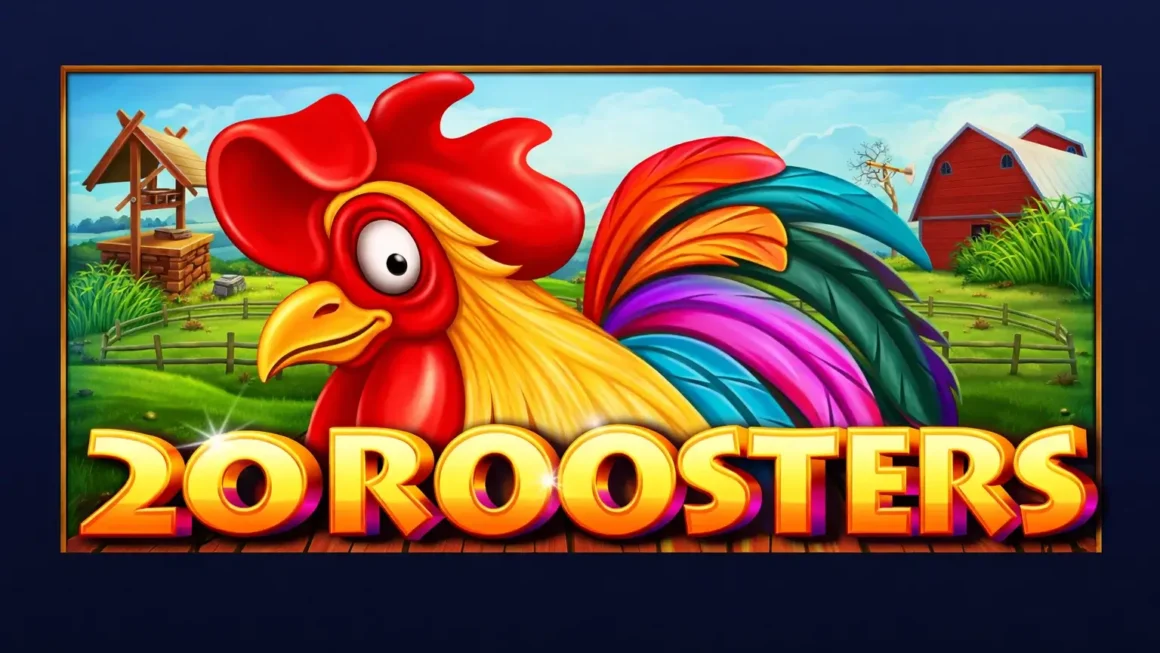
There’s something refreshing about a slot that doesn’t try to overwhelm you. No avalanche mechanics, no cascading reels, no bonus buy button that drains your wallet before the feature even lands. Just five reels, twenty paylines, and a rooster who thinks he owns the place. That’s 20 Roosters in a nutshell — and after running 250 test spins on it, I’ll tell you exactly what kind of player it’s made for and what to watch out for before you deposit a single cent.
Released in May 2020 by CT Interactive (also known as CT Gaming), this farmyard slot sits in an interesting position. It’s not trying to compete with the Pragmatic Play juggernauts or the high-voltage Hacksaw titles. It carved out its own lane for a specific type of player — someone who wants predictable entertainment, a controlled betting experience, and the occasional shot at a decent win without blowing through their bankroll in twenty minutes. Whether that sounds appealing or boring depends entirely on who you are as a player.
First Impressions: What You Notice Before the First Spin
Loading 20 Roosters for the first time, you’re immediately asked whether you want sound on or off. That’s a small touch, but it tells you something about the development philosophy here — CT Gaming built this for real environments. Maybe you’re at work pretending to review spreadsheets, or you’re on the couch at midnight with family sleeping nearby. The sound toggle on the loading screen is a practical decision, not a throwaway feature.
Once you’re in, the visual style makes itself known quickly. The reels sit on what looks like a wooden barn frame, with straw-coloured backgrounds and a cheerful meadow scene behind them. Daisies, green fields, soft light. This isn’t a dark gothic slot or a neon-lit Vegas fantasy — it’s genuinely calming to look at. The cartoonish art style is deliberate. CT Gaming went fully down the route of exaggerated colours and rounded shapes rather than trying to imitate photorealism, and it works well for what the game is trying to do.
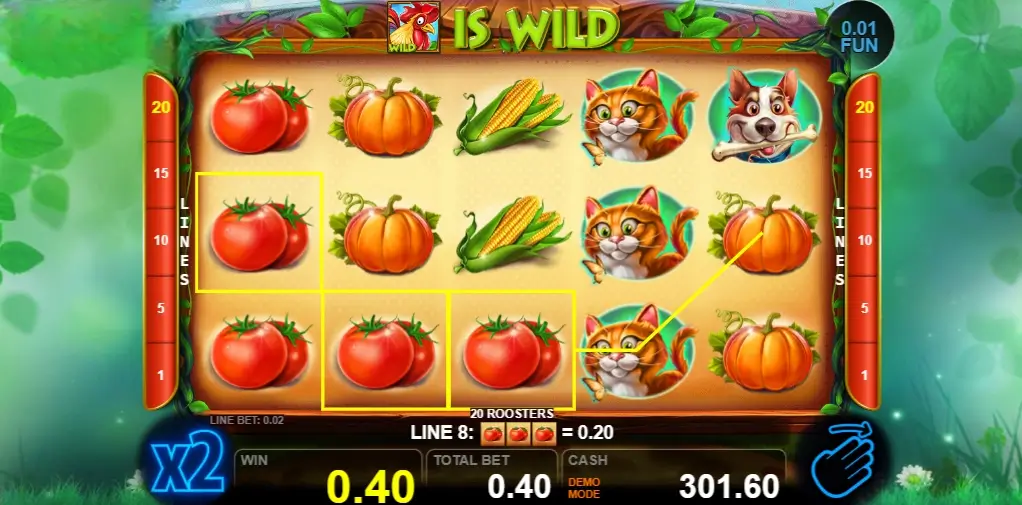
The symbols are a mix of farmyard animals and produce. You’ve got the Rooster himself — wild symbol, proud and colourful, taking up real estate on any reel he appears on. Then there’s a fat pink pig, a dog chasing its own tail energy, a cat eyeing a butterfly, and underneath those four main characters, the vegetable crew: pumpkins, corn cobs, and tomatoes. At the top of the paytable sits the Golden Egg scatter — a shiny gold egg with a pink ribbon tied around it, which is either adorable or slightly unsettling depending on your mood.
The background music is absent during base play. You get short win jingles that pop up when combinations land, and they have a slightly triumphant barnyard feel without being irritating. After 250 spins, I didn’t find myself reaching for the mute button, which is more than I can say for plenty of other slots.
The Grid, Paylines & How the Math Works
The layout is a straightforward 5×3 grid with 20 fixed paylines. All lines are always active — there’s no option to reduce paylines, which is actually a reasonable design choice for this type of low-medium volatility game. It means every spin has the same structure, and you’re always in with a shot on every combination.
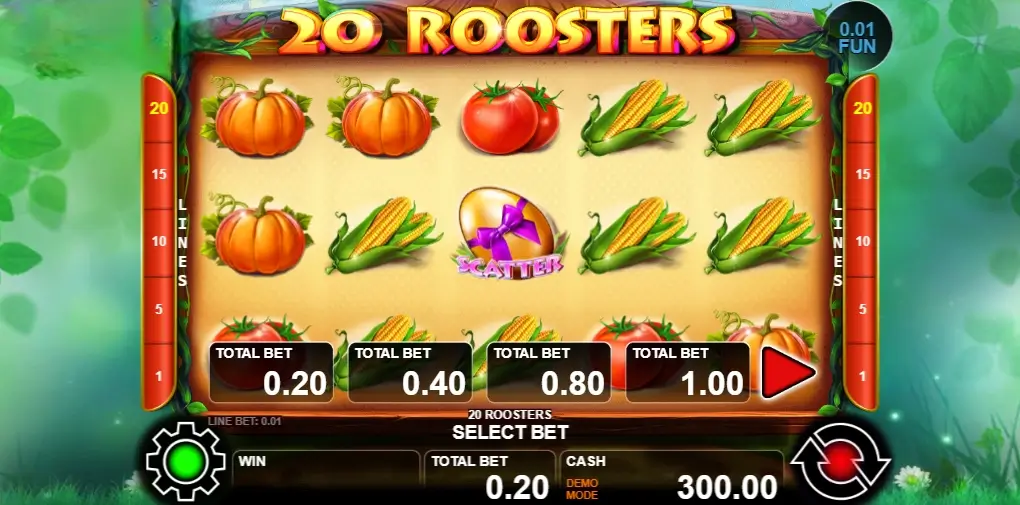
Betting starts at £0.20 per spin and goes up to £10.00. The line bet range runs from £0.01 to £0.50. If you’re on a tight session budget, this is one of those games where you can genuinely stretch a £20 deposit into a meaningful play session. At minimum bet, 100 spins will cost you £20 total — so you’re not burning through it in five minutes.
The RTP sits at 96.12%, which CT Interactive lists as the certified figure. That puts it slightly above average for the industry. To put it in plain terms: over a long enough sample of bets, the game returns approximately £96.12 for every £100 wagered. That’s a theoretical figure, not a session guarantee — short sessions can and will deviate significantly from that number in either direction. But compared to games sitting at 94% or 95%, it’s a more player-friendly setting.
Volatility is classified as low-medium. In practice, this means you’re going to see payouts relatively frequently. You won’t often go 100 spins completely dry. But the top end of wins isn’t going to land jackpot-style — the game delivers consistent medium-sized hits rather than rare huge ones.
Symbol Values & the Stacked Reels Mechanic
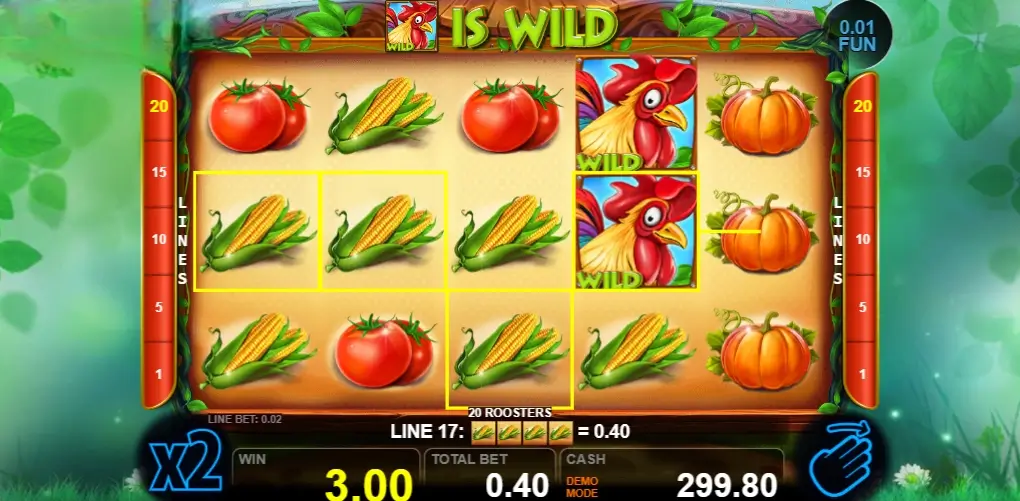
Here’s something that most basic reviews either gloss over or miss entirely: the stacked symbol mechanic in 20 Roosters is the actual heart of the game. Symbols don’t just appear one per position — they frequently appear stacked, meaning an entire reel can fill with the same symbol. When three or more reels fill completely with matching symbols, the game triggers what it calls a “Full House” animation.
During my test session, these Full House triggers happened more than I expected. A Full House of three cat reels plus partial fourth reel paid out notably better than the standard five-of-a-kind would suggest. The combination math when stacked symbols cascade across multiple reels gets interesting quickly.
The single biggest win in my 250-spin test came from four full reels of cats combined with one full reel of roosters — a 200x bet payout. That was the kind of spin you remember. It didn’t happen from a bonus round or a free spins trigger, just from the base game doing its thing with the stacked symbol system.
Symbol payouts per line (at standard bet levels) follow a predictable hierarchy:
The Golden Egg scatter is the premium symbol. Landing three or more scattered anywhere on the reels triggers a scatter payout. The golden egg doesn’t need to follow payline rules — it pays wherever it lands.
The Rooster wild substitutes for all symbols except the golden egg. When wilds appear stacked — which they do — the effect on win potential is significant. A reel full of wild roosters acting as substitutes for other high-value symbols can produce the kind of multi-payline win that makes you sit up straighter.
The pig, dog, and cat form the mid-tier symbols. Their stacking behavior is what makes the base game genuinely unpredictable. The vegetables — pumpkins, corn, tomatoes — fill out the lower end of the paytable and appear most frequently.
The Gamble Feature: CT Gaming’s Real Differentiator
Let me spend proper time on this because it’s what makes 20 Roosters different from most other low-medium volatility slots, and most reviews treat it as a footnote.
There’s no traditional bonus round in this game. No free spins feature where three scatters launch you into ten spins with a multiplier. For players coming from Pragmatic Play or Big Time Gaming titles, that absence is jarring at first. But CT Gaming replaced it with a gamble feature that’s genuinely more interesting than it sounds on paper.
Here’s how it works: after any win where the payout is less than 10x your total bet, a gamble prompt appears. You have two choices before even getting to the gamble itself — you can gamble your full winnings, or just half of them. That second option is more significant than most players realise.
If you choose to gamble, you’re presented with a card guessing game. You guess the color (red/black) to double your amount, or the suit (hearts, diamonds, clubs, spades) to quadruple it. Color is roughly a 50/50 shot; suit is roughly 25% — standard gamble mechanic odds.
The feature has a hard cap: it will end automatically once your accumulated winnings from gambling hit 50x your total bet. That ceiling prevents the feature from spiraling into the kind of exponential disaster where a player turns a £5 win into a £200 win only to lose everything on the next guess.
The half-gamble option is worth serious consideration. If you’ve landed a £3 win on a £0.50 spin, gambling the full amount is high-risk relative to your session bankroll. Choosing to gamble half (£1.50) means you keep £1.50 regardless of outcome. A successful gamble doubles that half to £3, giving you the original £3 back. A failed gamble still leaves you with £1.50.
The expected value math on the gamble feature is essentially neutral for the color guess (50/50 at 2x), meaning over time you’ll roughly break even on the feature itself. But it’s not about expected value — it’s about variance management. Used wisely on small wins, the half-gamble option adds a layer of agency that pure spin slots don’t give you.
Where players go wrong: they gamble on wins that they shouldn’t. If you’re 50 spins into a session and you’ve had a cold run and finally land a 6x win, your instinct to “get back in profit” through the gamble is exactly the psychological trap the feature is designed to exploit. That 6x win on a £0.50 spin is £3. Gamble it and lose, and you’ve wiped out the session’s best moment. The disciplined move is to skip the gamble when the win is meaningful relative to your current session balance.
One practical annoyance: the gamble prompt disappears after about ten seconds if you don’t interact with it. First-time players sometimes miss it entirely and wonder what the button flash was about. Pay attention to the prompt timing.
Autoplay: The Feature That Needs a Warning Label
20 Roosters has an autoplay function that lets you set up to 1,000 automatic spins. That’s a large number. The problem is what’s missing: there are no loss limit settings built into the autoplay configuration.
Most modern slots let you set a stop condition — “stop if my balance drops by £X” or “stop after a single win over £Y.” 20 Roosters doesn’t have this. You can set the number of spins, and that’s it. If you start a 200-spin autoplay at £0.50 per spin and walk away from the screen, you’re trusting the game to either run out of spins or run out of your balance, with no safety net in between.
This is a real design gap. It’s not unusual for CT Gaming’s older titles to skip this feature — the game was built in 2020 when responsible gambling integrations weren’t as standardized as they are now. But it’s worth knowing before you enable autoplay and go make a cup of tea.
Recommendation: if you use autoplay, keep the spin count low — 20 to 50 spins at most — and stay nearby. Watch your balance. Don’t set 500 spins and come back expecting to find your session exactly where you left it.
Mobile Experience
CT Interactive built 20 Roosters on HTML5, which means it scales properly across devices without dedicated app downloads. On an Android mid-range device using 4G, the game loaded cleanly and played without lag. The interface adapts well to portrait mode — the reels take up most of the screen, buttons are large enough to tap accurately, and the gamble feature is easy to interact with on a smaller screen.
The absence of background music actually helps the mobile experience. You can play during a commute or in a waiting room without needing to use earphones, and the win jingles are short enough to not be disruptive even if your sound is on.
The bet adjustment controls work sensibly on mobile — tap the total bet amount at the bottom to cycle through available bet sizes. Not as fluid as some modern mobile-first designs, but functional without frustration.
One thing I noticed: the Full House animation runs slightly slower on mobile compared to desktop, with a brief pause before the win total calculates. It’s a fraction of a second — nothing that breaks gameplay — but noticeable on older devices.
RTP in Practical Terms: What 96.12% Actually Means for Your Session
Let’s get specific about something that gets misrepresented constantly in slot marketing. The 96.12% RTP is a long-term theoretical figure, calculated across millions of spins. It does not mean you’ll get back 96 cents on every dollar in a single session.
In a 250-spin session at £0.50 per spin (£125 total wagered), applying the theoretical RTP would suggest expected returns of around £120.15. But the actual variance at low-medium volatility means your real session result could be anywhere from significantly above that figure to significantly below it. The RTP tells you the house edge over time (3.88% in this case), not what any individual session will look like.
What 96.12% is useful for is comparison shopping. A slot with 96.12% RTP is giving you better long-term odds than one with 94% RTP. All other things being equal, over thousands of spins, you’ll retain more of your bankroll on the higher RTP game. For regular players who clock significant hours on a particular game, RTP matters. For a casual player doing 50 spins once a fortnight, session variance will dominate the result far more than a 1-2% RTP difference.
The low-medium volatility classification means the game is distributing its payouts more evenly — smaller wins more often rather than large wins rarely. This is appropriate for the game’s design and target player. A £0.20–£0.50 per spin player can have a genuinely enjoyable 45-minute session without their balance crashing in the first ten minutes, which isn’t true of high-volatility games at similar stake levels.
Bankroll Management: Playing 20 Roosters Without Burning Through Your Deposit
Because the game targets budget-conscious players, it’s worth spending time on how to approach your session structure. The math here matters more than people realise.
At minimum bet — £0.20 per spin — a £20 deposit gives you 100 spins. That’s not much. At low-medium volatility, 100 spins is a decent sample but you can still hit a dry stretch and burn through it faster than expected. A more sustainable approach for minimum-stake play is to start with at least £30–£40, which gives you 150–200 spins and enough room for the game’s variance to work in your favor at some point.
At £0.50 per spin, a £50 deposit covers 100 spins — again, manageable but not generous. I’d recommend £75–£100 for a proper session at that stake level. The reason is straightforward: low-medium volatility games can still deliver cold stretches of 30–50 spins without a meaningful win, and a thin bankroll won’t survive that without reloading.
A practical session structure that works for this game: play your first 50 spins in manual mode (no autoplay), get a feel for how the stacked symbols are landing, and decide at the 50-spin mark whether the session feels live or cold. If you’ve hit the gamble feature multiple times and landed a couple of good Full House spins, you’re in a good session — continue at your current stake. If you’ve burned 35% of your starting balance without meaningful returns, reduce to minimum stake for the next 30 spins rather than chasing.
One specific consideration for the gamble feature and bankroll: only use the full-gamble option when the win represents a small percentage of your remaining balance. If you have £40 left in your session and you hit a £2 win, gambling the full £2 is a 5% risk of your session balance. That’s acceptable. If you have £8 left and hit a £2 win, gambling the full amount risks 25% of your remaining balance on a coin flip — that’s a different calculation entirely.
CT Interactive as a Developer: What You Should Know
CT Interactive (formerly Casino Technology) is a Sofia-based software provider with roots going back to the early 2000s in land-based gaming before transitioning to online slots. They’re not a household name in the way Pragmatic Play or NetEnt are, but they have a consistent library of games that share a design philosophy: accessible mechanics, reliable RTP, and a focus on traditional slot structures rather than complex feature stacking.
Their portfolio includes titles like Fruits of Desire, Wet and Juicy, and the related 40 Roosters — all sharing the same general approach. The games tend to be HTML5-based, mobile-compatible, and built around a demographic of players who grew up on land-based and video reel slots rather than the new generation of feature-heavy online titles.
From a trust and licensing perspective, CT Interactive operates under multiple regulatory licenses and their games are tested by certified third-party labs for RNG fairness. The 96.12% RTP on 20 Roosters is a certified figure, not a marketing claim — it’s the audited theoretical return based on the game’s mathematical model.
One thing worth noting about CT Gaming games in general: they tend to appear on a wide range of casino platforms, including some smaller regional operators. The game’s availability varies by jurisdiction, but it’s broadly accessible on both desktop casino sites and mobile-optimized platforms across European and Asian markets.
What 20 Roosters Does Well (And What It Doesn’t)
Let me be direct rather than writing around this.
Where it succeeds:
The stacked symbol mechanic makes the base game genuinely interesting. Watching reels fill up with the same symbol and waiting to see how many positions complete a Full House creates real tension in the base game without needing bonus features to manufacture excitement. The 200x max win I hit during testing wasn’t from a feature — it was pure base game, which is rare enough to be worth noting.
The gamble feature, implemented properly, adds genuine decision-making to the session. Games that give you agency over how to handle your wins — even at a micro level — create more engagement than those where you’re purely passive. The half-gamble option especially is underrated.
The bet range is genuinely accessible. A £0.20 minimum means you can stretch a small deposit into a real session, and the low-medium volatility cooperates with that by paying out regularly enough to keep the balance alive.
The visual design is consistent and charming. CT Interactive didn’t try to do too much with the art, and the result is a game that feels cohesive. The cartoonish style ages better than photorealistic attempts from the same era.
Where it falls short:
No free spins is the honest headline weakness. Players who’ve gotten used to the structure of scatter triggers and bonus rounds will find 20 Roosters feels incomplete. The gamble feature is a worthwhile substitute in theory, but it won’t satisfy players who want the psychological reward of entering a bonus round.
The autoplay has no loss limit functionality. For a game with low-medium volatility and accessible bet sizes that targets budget players, this is an odd oversight. A player who sets 500 autoplay spins at minimum bet will lose £100 if they let it run to completion without checking in.
The scatter payout for the golden egg, while present, isn’t the kind of payoff that creates memorable moments. Three scatters pays out, but not at a level that dramatically changes your session.
Who Should Play 20 Roosters?
This game was built for a specific type of player, and it delivers for that audience. It’s not the right fit for everyone.
Play 20 Roosters if:
- You prefer sessions that last rather than high-variance spikes
- You play on a budget and need a game that respects £0.20–£1 stake levels
- Mobile play is your primary setup and you want a light, responsive experience
- You enjoy having some control over your outcomes (the gamble feature)
- You want consistent, relatively frequent payouts rather than chasing a big bonus
Skip 20 Roosters if:
- Free spins bonus rounds are a non-negotiable for you
- You prefer high volatility — big wins or nothing
- You rely on autoplay loss limits to manage your sessions
- You want a progressive jackpot or a genuinely massive max win ceiling
Final Verdict
After 250 spins, I came out with a clearer picture of what 20 Roosters actually is versus what some reviews make it sound like. It’s not a groundbreaking game. CT Interactive wasn’t trying to reinvent anything. What they built is a competent, player-friendly, low-medium volatility slot with a genuine differentiator in its gamble feature and a stacked symbol mechanic that creates real base game excitement.
The 96.12% RTP is good for its category. The bet range suits budget players. The mobile performance is clean. The visual style holds up.
The weaknesses are real — no free spins, no autoplay loss limits, and a scatter payout that doesn’t really move the needle — but they don’t break what the game fundamentally does well.
If you’re managing a modest bankroll, want reliable entertainment over a proper session length, and don’t need the dopamine hit of a bonus trigger every 15 minutes, 20 Roosters is a genuinely solid choice. Just keep a hand on the spin button yourself and don’t let autoplay run wild.
Rating Breakdown:
- Theme & Design: 7.5/10 — Consistent, charming, ages well
- Gameplay Mechanics: 7/10 — Stacked symbols and gamble feature work well; bonus absence is felt
- RTP & Volatility: 8/10 — 96.12% is above average; low-medium suits the design
- Mobile Experience: 8/10 — Clean, responsive, functional
- Overall: 7.5/10
A dependable slot for the right player. Don’t go in expecting Gates of Olympus — go in expecting a well-designed session game that plays fair and gives you something to do between spins.
All RTP figures referenced in this review are based on CT Interactive’s published specifications. Slot results are determined by certified RNG software. Please gamble responsibly and within your limits.