There’s a moment, somewhere around your twentieth spin of Barnyard Bash Chicken Chase, when you notice the Nest meter in the corner has been quietly filling up the whole time — and you realize this game has been running its own little side story while you were just watching the reels. That’s the kind of thoughtful design S Gaming has packed into this farmyard slot, and it’s one of the main reasons this title stands out in a market drowning in generic animal-themed releases.
Released in February 2025, Barnyard Bash Chicken Chase is built by S Gaming, a UK-born studio that only entered the market in 2023 but has already secured partnerships with major operators including Buzz Bingo. The head of slots at Buzz Bingo called this game “wonderfully chaotic” when the deal was announced — and that’s honestly the best two-word summary you’ll find anywhere. It’s farm chaos with a mechanic underneath it that rewards patience. Whether that combination is worth your time and bankroll is what this review is here to answer.
Game Overview: What You’re Working With
Before anything else, the numbers. Barnyard Bash Chicken Chase runs on a 5×3 grid with 20 paylines. The provider lists an RTP of 93.5%, which is on the lower side — though there’s a range system in play, meaning different operators may configure a slightly different return percentage. The volatility sits at a low-medium level (classified as Level 2 by S Gaming), and the maximum win exposure is 827x your stake. Bets start at $0.10 and go up to $50 per spin.
On paper, 827x isn’t the kind of ceiling that gets high-variance hunters excited. But this game was never designed for them. The low-medium volatility tells you exactly who the target player is: someone who wants a session that breathes, with regular small returns, a handful of engaging features, and the odd moment when something actually interesting happens on screen.
The game is built on HTML5 and runs cleanly on both desktop and mobile, which matters more than people give it credit for — more on that later.
First Impressions: Setting the Scene
The visual design is cartoonish and deliberate about it. Chickens waddle across the screen between spins, a mischievous fox lurks around the edges, and the barnyard backdrop has that hand-painted quality you see in children’s book illustrations. It doesn’t try to look cinematic, and it’s better for that choice. The color palette is warm — lots of yellows, oranges, and greens — and the whole thing feels like a Saturday morning cartoon that’s been turned into a slot.
The sound design is in step with the visuals. There’s a cheerful, slightly chaotic soundtrack playing throughout the base game, and the audio cues for egg collection are satisfying in a low-key way — a little chime when an egg drops into the Nest, a slightly different tone when the meter fills. It’s the kind of sound work that doesn’t announce itself but would be noticeably absent if it were gone.
The interface is clean. The bet controls are straightforward, the paytable is accessible in two taps, and the Nest Egg meter sits visibly at the top of the screen without dominating the layout. S Gaming clearly put thought into not cluttering the experience, which is something smaller studios sometimes struggle with when they’re trying to pack in features.
My first session ran about 45 minutes on mobile, and I didn’t find myself fighting the controls once. That counts for a lot.
Symbol Hierarchy: What Pays and What Doesn’t
Like most video slots, the symbols break into two tiers — low-paying fillers and the premium stuff worth landing.
On the low end, you’ve got the vegetable symbols: carrots, cabbages, and a few other farmyard produce items that pad out the reels. These land frequently and keep the hit rate ticking along, but the returns are modest — a full five-of-a-kind line on these won’t move the needle much.
The premium symbols are where the personality lives: a rooster, a turkey, various hen characters, and the wild symbol, which carries a multiplier. Landing wilds is the base game’s primary moment of excitement outside of the Nest Egg mechanic. A wild with a multiplier attached can noticeably bump a line win, and because the game’s volatility keeps things relatively calm, these wilds feel meaningful rather than rare.
The scatter symbols are the gateway to the bonus feature, and the egg symbols are the core of the Nest mechanic. These two symbol types are the ones you’re always peripherally watching for, even when you’re focused on the reels themselves.
The Nest Egg Mechanic: The Heart of the Game
This is the feature that makes Barnyard Bash Chicken Chase genuinely distinct, and it’s worth understanding properly before you play.
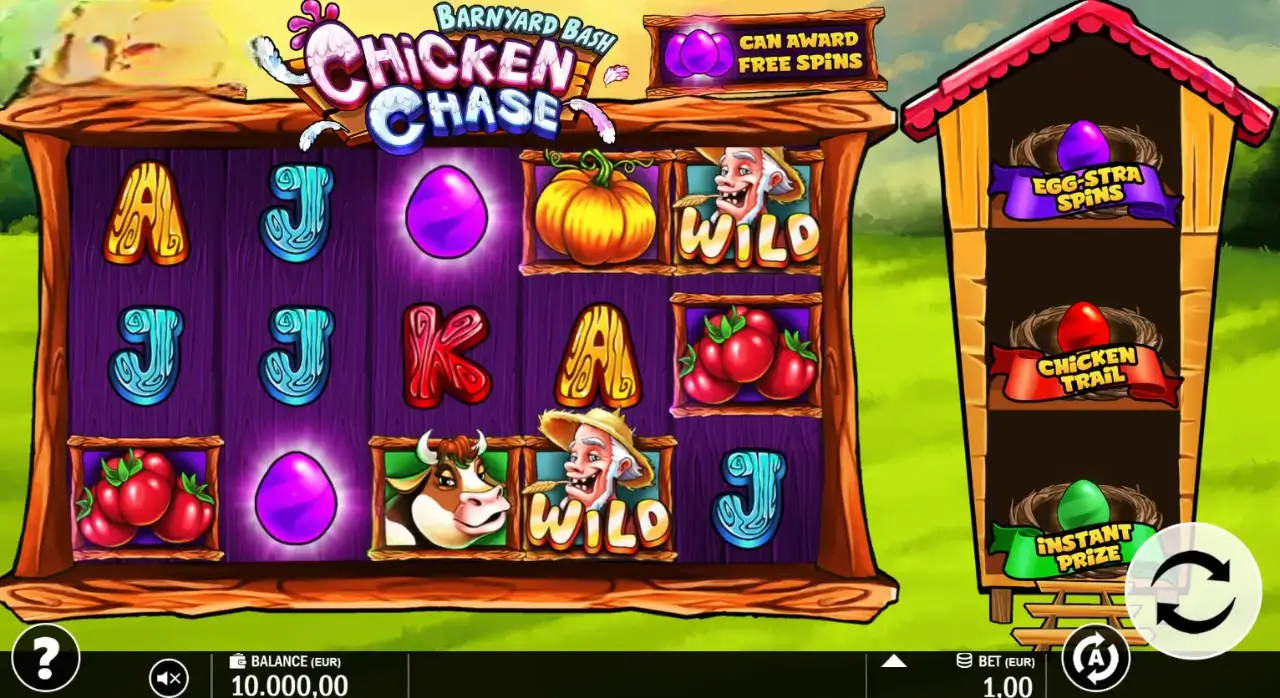
Every time an egg symbol lands on the reels, it gets added to the Nest meter displayed at the top of the screen. The eggs are colour-coded — there are multiple Nest slots, each corresponding to a different egg colour. As eggs of a matching colour accumulate, the corresponding Nest Egg meter fills.
When a Nest Egg activates, it randomly triggers one of three outcomes:
The Chicken Trail — This is the bonus that generates the most anticipation. You’re placed on a trail board featuring the player’s chicken navigating a path. The fox is on that same board, and your job is to keep moving forward without running into it. Each step along the trail wins a prize, and the further you progress before the fox catches up, the bigger the payout. There’s a genuine tension to this one that the other two outcomes don’t quite match. Landing a long Chicken Trail run is one of those moments where the room actually gets quiet.
Egg-stra Free Spins — The Nest Egg can drop you into a free spins round with additional spin multipliers active. The exact number of spins awarded depends on how many Nest Eggs have contributed to the trigger, and multipliers during this phase can push returns meaningfully above what the base game delivers. In testing, I triggered this twice in a 200-spin session — once with three spins at low multipliers, and once with a longer run that ended up being the highlight of the entire session.
Instant Prize — The simplest outcome. The Nest Egg resolves as an immediate cash award, credited without additional interaction. These tend to land when you’d rather be playing than picking, and the amounts vary. They’re not the most exciting outcome, but they’re rarely disappointing either.
The genius of the Nest Egg system is the passive engagement it creates. Even during a stretch of unremarkable base game spins, you’re always watching the meter in the corner. It gives the session a background narrative — you’re not just waiting for scatters, you’re watching something build. That’s a different kind of anticipation, and it keeps sessions feeling active even when the reels aren’t delivering anything spectacular.
One practical note: don’t abandon a session while the Nest meter is partially filled. You’ve effectively put work into that trigger, and walking away when it’s three-quarters full is the slot equivalent of leaving before the last act.
Wild Symbols and Multipliers
The wild symbol in Barnyard Bash Chicken Chase functions as a standard wild — it substitutes for all regular symbols to complete winning combinations — but the multiplier attached to it elevates it above a standard mechanic.
When a wild lands with a multiplier value, any win it contributes to is multiplied by that amount. In a low-medium volatility game, this is often the primary route to landing a win that feels genuinely rewarding. The base game keeps you afloat with frequent small returns, but the multiplier wilds are what create the occasional spike that makes you lean forward.
The multiplier values I observed during testing ranged modestly, which is appropriate for the volatility profile. This isn’t a game where a wild multiplier is going to deliver a hundred times your stake from nowhere — but landing one during an otherwise quiet run genuinely changes the character of that spin.
Pick-and-Click Bonus Game
Separate from the Nest Egg system, the scatter symbols on the reels can trigger a pick-and-click bonus. Landing three or more scatter symbols activates the bonus round, where players are presented with a selection of chickens, each concealing a cash prize.
The prize pool available scales with how many scatters triggered the feature. More scatters mean higher potential prizes across the selection. The mechanic is simple — you pick a chicken, you get the prize it was hiding — and that simplicity is by design. The bonus doesn’t try to be more than it is.
Compared to the Chicken Trail, this feature feels lightweight. It’s a nice moment when it triggers, and the prizes are proportional to the overall max win of 827x, but players who come in expecting a multi-level free spins extravaganza will find it underwhelming. As a casual player looking for variety in the base game loop, it’s a satisfying punctuation mark. As a source of big wins, it’s not really the point.
RTP and Volatility: The Honest Numbers
The 93.5% RTP needs to be addressed directly, because it sits below the industry standard and players deserve to know that upfront.
Most well-regarded online slots operate in the 95–97% RTP range. At 93.5%, Barnyard Bash Chicken Chase is returning fewer credits over time, statistically speaking, than the slot sitting next to it from a competing provider. For players who care about long-term theoretical return — and anyone serious about bankroll management should — this is a meaningful difference.
The RTP range system compounds this. S Gaming, like several modern providers, publishes a range rather than a fixed number. This means the operator running the game selects which RTP configuration they deploy, and players may not always know which version they’re playing. Before sitting down for a real-money session, it’s worth checking the paytable within the game itself, where some versions display which RTP setting is active.
On volatility: the low-medium classification is accurate. During testing, sessions rarely hit extended losing stretches. Small returns from the 20 paylines kept the balance moving, and the Nest Egg system provided consistent background engagement between significant wins. The longest dry patch I experienced before any meaningful return was around 18 spins — brief by the standards of medium or high-volatility titles.
For players who want frequent interaction and steady, manageable swings, the volatility profile is genuinely well-suited. For players whose threshold for entertainment is a big win, the 827x ceiling and low-medium variance mean this isn’t the right game on most days.
Mobile Performance
S Gaming built Barnyard Bash Chicken Chase on HTML5 from the ground up, and the mobile experience reflects that. The game scales correctly across screen sizes — tested on both a mid-range Android handset and an iPhone — and the touch controls are responsive without being oversensitive.
The Nest Egg meter remains clearly visible on mobile, which is an important detail. Some slot developers let secondary UI elements collapse or disappear on smaller screens, which strips out the context that makes those mechanics work. Here it stays prominent and legible.
Load times are reasonable, and the game doesn’t stutter during animations. For players in markets where data connections can be inconsistent, the lightweight build is a practical advantage. The visual style — cartoonish rather than photorealistic — also means the assets aren’t demanding on hardware or bandwidth, which keeps things running smoothly even on older devices.
The auto-spin and turbo spin options are both available on mobile, and for a game with a passive engagement mechanic like the Nest Egg system, the auto-spin function is particularly useful — you can let the meter build while you occasionally check in on progress.
Bankroll Considerations: Managing Your Money on a Low-Medium Variance Slot
Because the volatility profile is predictable, Barnyard Bash Chicken Chase is one of those games where a few simple rules go a long way.
At the minimum bet of $0.10 per spin, a $20 session budget gives you 200 spins before you hit zero — assuming zero wins, which won’t happen at this hit frequency. In practice, the frequent small returns from the 20 paylines mean $20 at minimum stakes can comfortably sustain 300 to 400 spins before it’s exhausted, depending on how the session runs. That’s a lot of game time for a small outlay.
For players with a $50 budget who want meaningful returns from the Nest Egg features without burning through stakes in thirty minutes, a bet of $0.25 to $0.50 sits in the reasonable range. At $0.50 per spin, a $50 bankroll gives you 100 spins at baseline. With the hit frequency this game delivers, you’ll likely extend that naturally.
The main trap in low-medium volatility slots is mistaking session longevity for value. The RTP of 93.5% means the house edge is real and steady — around 6.5 cents per dollar wagered over a long run. The game won’t punish you with a ten-spin losing streak that drains the balance, but it also won’t stop the slow background erosion of extended play. Set a session limit before you start, and stick to it regardless of whether the Nest Egg meter is sitting at 80% full.
One practical tip specific to this game: the Nest Egg accumulates across the session, so early spins aren’t just warmup — they’re laying the foundation for the bonus triggers that come later. This means very short sessions of 30 to 40 spins are somewhat inefficient for experiencing the full feature set. If you only have the time or budget for a quick hit, the pick-and-click scatter bonus is fast to trigger and immediately rewarding. But the Chicken Trail and Egg-stra Spins, which are the highlights, tend to come after the Nest has had time to develop — and that usually means a session of 100 spins or more.
Session Experience: What Playing Actually Feels Like
A 150-spin session in the base game of Barnyard Bash Chicken Chase feels like a sustained low-level hum with occasional crescendos. The 20 paylines deliver regular small returns — nothing exciting, but enough to keep the balance stable. The Nest Egg meter ticks along in the background, building anticipation without demanding attention.
In my primary testing session, the Chicken Trail triggered twice in approximately 200 spins. The first was a short run — three steps before the fox caught up — delivering a modest prize. The second was longer, seven steps, and provided the session’s biggest single return. The Egg-stra Spins triggered once and delivered solid value through multiplier activity during the free rounds. The pick-and-click scatter bonus triggered once and paid out at the lower end of its range.
None of this produced dramatic highs. That’s the trade-off with low-medium volatility — you get stability and engagement, not spectacle. After 200 spins, my test balance had declined by roughly 12%, which is broadly in line with what the 93.5% RTP would predict over that sample size.
The game never felt tedious, which is the best compliment you can give a slot with this volatility profile. The Nest Egg mechanic kept each spin feeling like part of something rather than an isolated event. That sustained sense of building toward something is harder to engineer than it looks, and S Gaming has done it well.
Pros and Cons
What works:
The Nest Egg collection mechanic is genuinely original. It creates background engagement that keeps sessions alive during quiet stretches, and the three different outcomes from the Chicken Trail, Egg-stra Spins, and Instant Prize means each activation feels like a small event rather than a predictable formula.
The volatility profile is honest and consistent. Low-medium actually plays like low-medium — the hit frequency is real, and extended losing streaks are rare. For players managing tight session budgets, this predictability has practical value.
The mobile build is clean and well-considered. Controls work, key UI elements stay visible, and performance holds up on modest hardware. This matters in markets where mobile is the primary access point.
The visual design has charm without being cloying. Cartoonish but cohesive, with animations that are lively without being distracting.
S Gaming as a provider is worth watching. For a studio only two years old, the technical execution here is polished, and the design philosophy — building passive engagement into the base game rather than packing in features and hoping for the best — shows genuine understanding of how players interact with slots.
What doesn’t:
The RTP is the main concern. At 93.5%, with a range system that may push it lower depending on the operator, this game costs more to play over time than most comparable titles. Players who run the math will notice.
The pick-and-click scatter bonus is underwhelming. It works fine, but in the context of a game that has a trail feature with genuine tension and a free spins round with multipliers, the pick-one-chicken instant win feels like the weakest card in the hand. The mechanic could use a second level or an escalating prize structure to make it feel worth triggering.
The 827x maximum win won’t satisfy players who come in expecting life-changing potential. This ceiling is appropriate for the volatility and the game’s overall design, but it needs to be stated plainly for anyone with bigger expectations.
The RTP range transparency issue is a broader industry problem, but it affects this game specifically. Players can’t always know what configuration they’re playing on, and that information asymmetry is a real frustration.
Who Should Play Barnyard Bash Chicken Chase?
The game is built for a specific kind of player, and it delivers well for that person.
If your ideal slot session involves settling in for thirty to sixty minutes of relaxed play, with a balance that moves up and down in manageable increments, occasional moments of genuine engagement when the Nest triggers, and no real risk of catastrophic variance, Barnyard Bash Chicken Chase earns its place in your rotation.
It’s also genuinely well-suited to mobile-first players who want something that runs cleanly on a phone without demanding a premium device or a strong data connection.
The game is not a fit for players chasing significant wins, anyone who wants a free spins bonus they can retrigger for escalating multipliers, or anyone whose primary enjoyment comes from high-variance near-misses and big swings. For those players, there are better options — and this game won’t pretend otherwise.
Players new to slots will find the mechanics accessible without being patronizing. The Nest Egg system is explained clearly in-game, and the pick-and-click bonus requires no strategy or prior knowledge. As an introduction to what feature-based slots can feel like without the exposure of high-volatility play, Barnyard Bash Chicken Chase is a reasonable starting point.
Verdict
Barnyard Bash Chicken Chase is a well-made slot that does exactly what it sets out to do. S Gaming took a farmyard theme — one of the most saturated in the industry — and gave it a mechanical identity through the Nest Egg system that distinguishes it from the pack. The Chicken Trail feature in particular has genuine moments of tension that feel out of place in a game this calm, in the best possible way.
The RTP is a real concern and can’t be talked around. At 93.5%, this game is more expensive to play over time than many comparable titles, and the range system means you may not always be getting even that. For players who play regularly and track their returns, this matters.
Everything else is solid. The volatility is honest, the mobile build is clean, the features are coherent, and the passive engagement loop of the Nest Egg mechanic keeps sessions feeling alive in a way that standard slot mechanics often don’t manage.
Rating: 7.2 / 10
Best for: Casual players, mobile sessions, low-budget recreational play, players who want engagement without extreme variance. Not for: Win-hunters, free spins aficionados, anyone who needs an RTP above 95% to feel good about a session.
Frequently Asked Questions
What is the RTP of Barnyard Bash Chicken Chase? The published RTP is 93.5%, but S Gaming uses a range-based system. This means individual operators can configure the game to run at different RTP settings within that range. Before playing for real money, check the in-game paytable or help section to see if your operator displays which setting is active.
How does the Nest Egg mechanic work? As you spin the base game, egg symbols land on the reels and get added to the Nest meter displayed at the top of the screen. Eggs are colour-coded and fill corresponding Nest slots. When a Nest Egg completes, it randomly activates one of three bonus outcomes: the Chicken Trail, Egg-stra Free Spins, or an Instant Prize.
What happens during the Chicken Trail feature? The Chicken Trail places your character on a progress board. You advance along the trail with each step awarding a prize, but a fox is also moving on the board. The feature continues until the fox catches up with your chicken. Longer runs before the fox arrives produce bigger returns. This is the most rewarding of the three Nest Egg outcomes.
Is Barnyard Bash Chicken Chase available on mobile? Yes. The game is built on HTML5 and designed specifically for mobile play. It runs on iOS and Android without requiring a dedicated app, and the interface scales correctly across screen sizes. The Nest Egg meter remains visible on mobile, and touch controls are responsive.
How does Barnyard Bash Chicken Chase compare to Chicken Chase by Pragmatic Play? Despite the similar name, these are completely different games from different providers. Pragmatic Play’s Chicken Chase features Spin and Hold mechanics and a max win of 210x, with RTP up to 96.48%. Barnyard Bash Chicken Chase from S Gaming uses the Nest Egg collection system with a higher max win of 827x but a lower published RTP of 93.5%. They share a farmyard theme and low-medium volatility, but the gameplay experience is distinct.
What is the maximum win in Barnyard Bash Chicken Chase? The maximum win is 827x your stake. At a $1 bet, that’s a maximum return of $827. This is a reasonable ceiling for the game’s low-medium volatility profile, though it won’t satisfy players looking for the four or five-figure multipliers found in higher-variance titles.