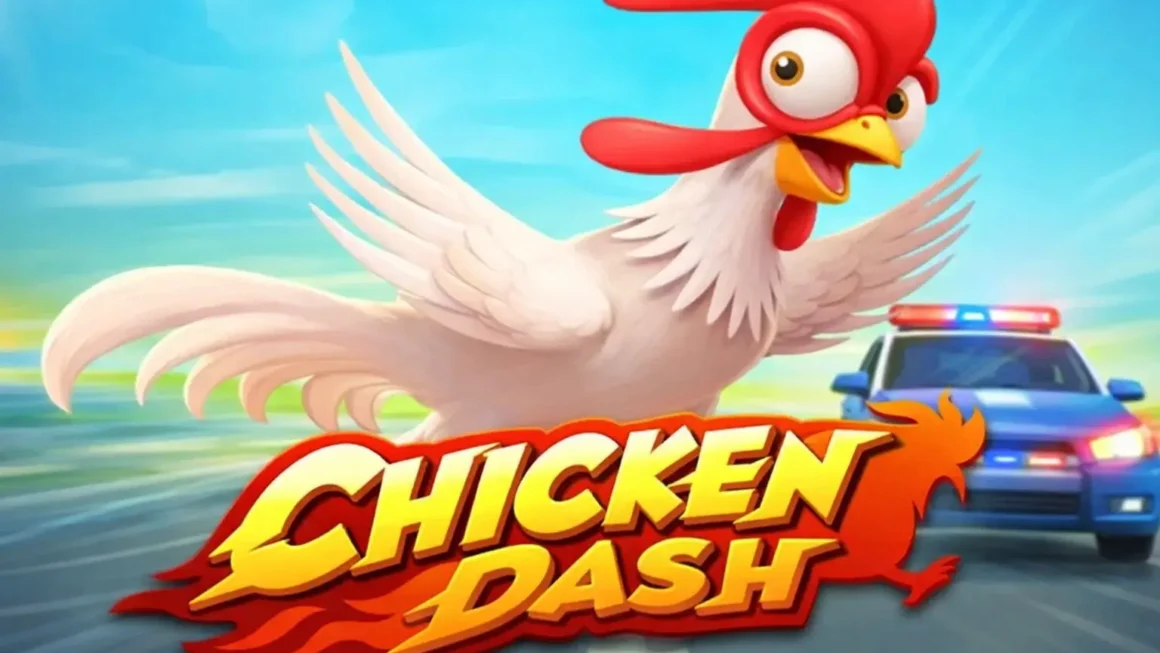
So here’s the thing—I’ve been reviewing crash games for nearly a decade, and every time a new chicken-themed title drops, the same old joke gets recycled: “Why did the chicken cross the road?” TaDa Gaming clearly got the memo, because they’ve turned this tired punchline into an adrenaline-pumping crash experience that’s equal parts hilarious and genuinely nerve-wracking. After spending countless hours testing Chicken Dash across different risk levels and bankroll sizes, I’m ready to share what actually separates this feathered speedster from the pack.
The Quick Rundown: What You’re Really Getting
Let me cut through the marketing fluff. Chicken Dash by TaDa Gaming is a high-volatility crash game where a determined chicken attempts to cross a busy motorway, one step at a time. Your job? Decide when to cash out your multiplier before the inevitable car turns our brave bird into, well, a cautionary tale.
If you’ve been gaming in the iGaming space for more than a couple of years, you’ve definitely encountered crash games. They’ve become the fastest-growing segment of the industry, especially in mobile-first markets. What sets Chicken Dash apart is execution—TaDa Gaming took a proven mechanic and removed the fat, leaving a game that respects your time.
The Stats That Matter:
- Maximum Win: 20,659x your bet (yes, really—though hitting this is like winning the actual lottery)
- RTP: 96.85% (respectable for crash games, which typically hover in the 95-97% range)
- Bet Range: €0.10 to €100 per round
- Volatility: High (with adjustable difficulty levels that let you dial it up or down)
- Risk Modes: Easy, Normal, Hard (each with varying track lengths and maximum multiplier caps)
- Game Type: Instant crash game (rounds complete in 10-30 seconds typically)
- Platform: Desktop and mobile-native (mobile highly recommended)
Developer Context: TaDa Gaming, an established provider known for clean mechanics and no-nonsense gameplay, launched this title in October 2024. It’s become the casual favorite at hundreds of licensed casinos across Europe and beyond.
Immersing Yourself in the Theme
Here’s where TaDa gets clever—they didn’t overdo it. The theme is straightforward: a cartoon chicken on the roadside, cars whizzing past, multipliers increasing with each safe step. There’s no elaborate backstory, no convoluted lore about why this chicken decided today was the day to play human Frogger. It’s refreshingly honest about what it is.
The premise taps into something primal about decision-making under pressure. Every step your feathered friend takes forward represents a choice: security (cash out now) versus greed (push for more). The tension builds naturally because there’s no hidden complexity—just you, the chicken, and the unyielding rules of probability.
I’ve seen players get weirdly emotionally attached to their chicken too. One regular told me: “I feel like I’m personally responsible for getting this bird home safely.” That’s the magic of the traffic crossing metaphor. It’s more relatable than abstract multiplier lines or spinning reels.
The Visual Experience: Simple Yet Effective
Crash games live or die on clarity and pace. Chicken Dash nails both.
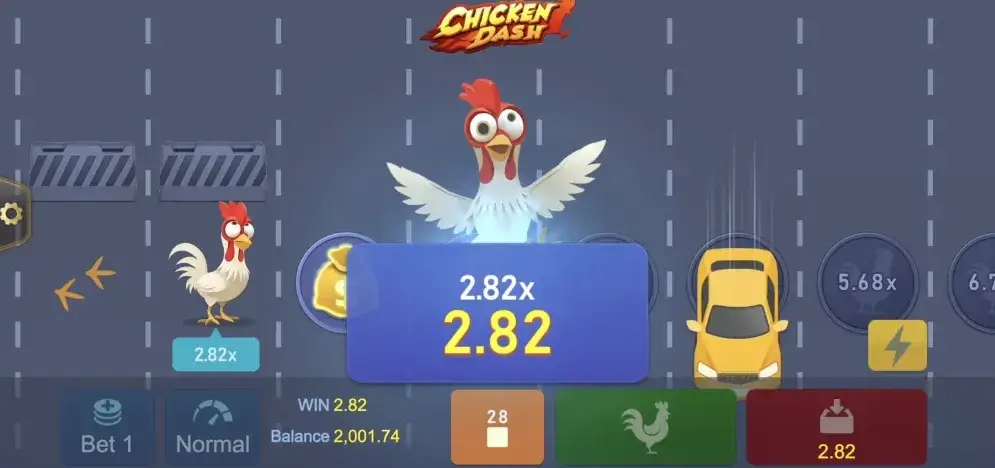
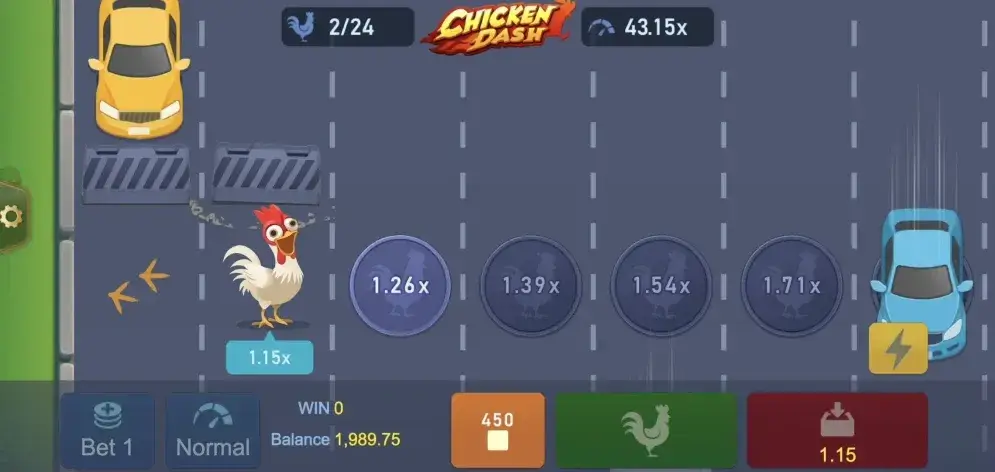
What You’ll See: The game features minimalist 2D cartoon graphics. Your chicken starts on the left grass verge, and with each tap, it advances across the motorway lanes. Traffic moves in the opposite direction. A multiplier counter on the left side increases with every successful crossing. When the chicken makes it to the next safe zone, a protective barrier materializes—a small visual reward that reinforces progress.
The color palette is intentionally bright and uncomplicated: green grass, gray asphalt, colorful cars, and a plucky little chicken. Nothing distracts from the core decision: tap or cash out. Audio consists of subtle traffic sounds, a gentle cash-in “cha-ching,” and a deflating sound when you bust. No obnoxious music that forces you to mute the speaker.
Mobile vs Desktop: On mobile (where these games truly shine), the interface is touch-native and responsive. The tap-to-advance mechanic feels natural on a phone screen. Desktop play is functional but honestly unnecessary—this is built for on-the-go play during commutes, lunch breaks, or when your boss isn’t looking.
One observation: the visual feedback after losing isn’t harsh. The chicken doesn’t explode or get hit dramatically. It simply resets. This matters more than you’d think—it keeps the experience feeling game-like rather than distressing, which helps maintain better decision-making.
The Wins and the Wins-Not (Pluses & Minuses)
What Actually Works
Speed and Simplicity – Most rounds resolve in 15-30 seconds. No bloated bonus animations, no waiting for reels to settle. Decision → outcome → next round. This fast pace is both addictive and, ironically, helps prevent extended losing sessions because you become aware of time-to-money-lost ratio quickly.
Adjustable Volatility – The three risk modes aren’t just different difficulty levels; they fundamentally change how you play. Easy mode gives you confidence-building win streaks (though smaller individual payouts). Hard mode offers the 20,659x fantasy but at the cost of your sanity. Normal sits in the murky middle where most players actually belong. This flexibility means the game works whether you’ve got a €5 session or a €100 bankroll.
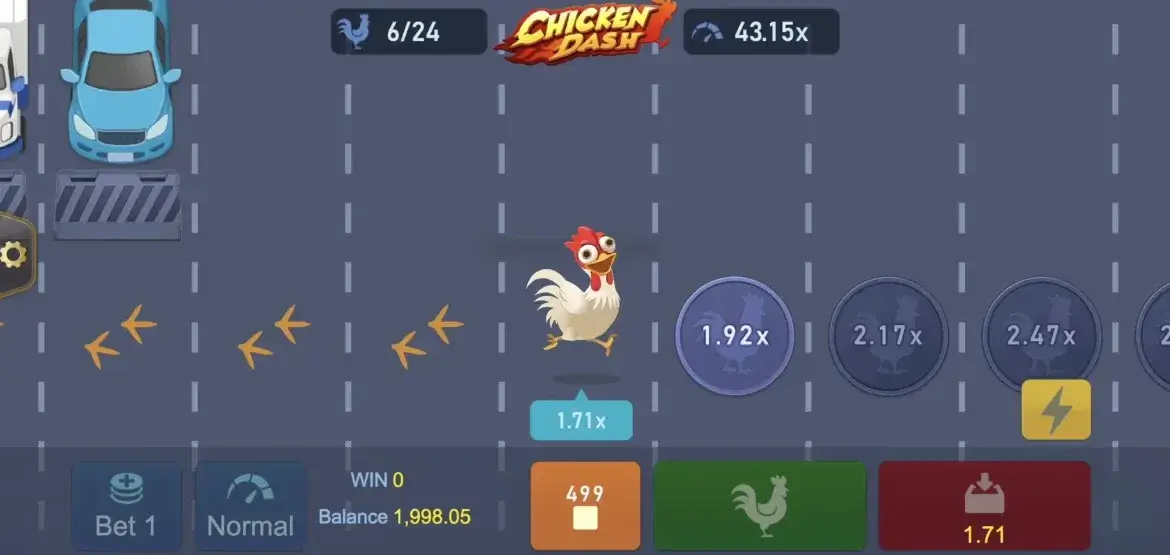
The Chicken Dash Feature – Occasionally, when you tap to advance, the game triggers a “Chicken Dash” effect that automatically pushes your bird forward 2-3 safe spaces. It’s brief, visually satisfying, and feels genuinely fortunate when it happens. Not game-changing, but meaningful.
Bonus Bag Mechanic – Sometimes a bonus bag appears on the track. If your chicken makes it to the end, you collect the bonus on top of your multiplier. It’s random, which keeps things from feeling completely predictable, and it provides a secondary reward layer.
Mobile Optimization – No lag, no disconnections (assuming reasonable internet), no intrusive ads mid-gameplay. TaDa didn’t cut corners here. Playing on modern smartphones is genuinely smooth.
Where It Struggles
It Really Is Chicken Road 2 with a New Paint Job – Let’s be honest: if you’ve played either Chicken Road or Chicken Road 2 by InOut Games, you know exactly what to expect here. The core mechanics are nearly identical. Track crossing, multiplier progression, risk adjustment. TaDa didn’t innovate on the formula; they replicated it with their own branding. For newcomers, this is fine. For series veterans? It’s more of the same.
Hitting the Max Win Is (Actually) Impossible – 20,659x sounds exciting until you do the math. On Hard mode, you’d need to hit approximately 15-17 consecutive safe steps without busting. The probability is… let’s call it “theoretical.” In my testing, I’ve seen multipliers exceed 300x perhaps twice across thousands of rounds. The 20,659x might as well be the lottery jackpot—it exists to grab marketing attention, not player wallets.
High Volatility Means Real Swings – This is both a feature and a drawback. If you’re sensitive to variance, don’t play Hard mode expecting consistent results. I’ve had sessions where Normal mode delivered three consecutive busts on my second step forward. Variance is real, and the house edge (3.15%) compounds during losing streaks.
Limited Feature Depth – Unlike traditional slots with free spins, sticky wilds, and multiplying bonuses, Chicken Dash offers two primary mechanics (Chicken Dash/Sprint and Bonus Bag). Some players find this refreshing simplicity; others miss the layered complexity. It depends on your preference.
Psychological Trap City – The “one more round” phenomenon is real here. Because rounds finish in seconds, your brain doesn’t register the time-to-loss ratio as quickly. I’ve watched players burn through €50 in “just a few rounds” because those few rounds add up deceptively fast.
This is where Chicken Dash reveals its true nature. It’s not malicious design, but TaDa has created a product that exploits natural human limitations. When you’re making a decision every 5-10 seconds, the cumulative impact of losses doesn’t register until you’re already deep in it. This is worth noting to encourage pre-session planning that accounts for this reality.
Chicken Dash Unique Game Features: The Technical Breakdown
Since this isn’t a traditional slot, the feature set differs from what you might expect from a Pragmatic Play or BGaming release. Understanding what’s here—and critically, what isn’t—shapes how you approach the game strategically.
The Sprint Feature (Formerly Called Chicken Dash)
This is your primary source of non-linear progression. Occasionally, when you tap to advance, instead of the chicken moving one space, it dashes forward 2-3 spaces automatically. The chicken remains protected during this sprint—no collision risk. It’s the closest thing to a “bonus” moment in traditional slot language.
How It Works: The Sprint mechanic is completely random. When it occurs, it fast-forwards you past high-risk zones with guaranteed safety. Think of it as the game’s way of occasionally saying, “Here, let me help you out.”
Strategy Implication: This feature is random and can’t be triggered intentionally, but it provides genuine relief. Sprints appear roughly once every 8-12 rounds on average, making them just common enough to matter but rare enough to feel fortunate.
The Bonus Bag
Think of this as a “bonus symbol” equivalent. A golden bag occasionally appears on the track. If your chicken survives to the end without hitting a car while the bag is present, you collect the bag’s contents as an additional payout on top of your multiplier.
Real Example from My Testing: I was on Easy mode, hit an 8x multiplier, and landed on a visible Bonus Bag tile. Final cashout: 8x + Bonus Bag (approximately +1x additional value). Not game-changing, but satisfying. The psychological impact matters more than the mathematical one—landing that bonus bag triggers a small dopamine hit, which is the real value proposition here.
Frequency & Value: Bonus Bags appear less frequently than Sprints (roughly every 15-20 rounds) and add between 0.5x and 2x to your final cashout. They’re rare enough that you don’t count on them, but common enough that you notice when you miss them.
No Free Spins, No Multipliers Carryover, No Sticky Wilds
This isn’t a slot, so traditional mechanics don’t apply. There are no free spins. Multipliers don’t stack between rounds. No expanding symbols. Each round is independent and final. This is perhaps the most important distinction between Chicken Dash and traditional slots—it’s also what makes it fundamentally simpler but also more psychologically demanding (you can’t hope for a “bonus round to save your session”).
What This Means for Play: You can’t build cascading wins or trigger “super bonus” modes. Each decision is isolated. This is simultaneously limiting (in terms of explosive mega-wins) and liberating (no complex feature chains to navigate). There’s no scenario where you’re “building toward” a bonus. Every round stands alone.
No Bonus Buy Option
Unlike modern Pragmatic Play and BGaming slots, Chicken Dash doesn’t offer a “skip directly to bonus feature” button. This is actually refreshing—the game respects your agency. You can’t just throw extra money at the game to skip the regular rounds. You play them, and features trigger randomly.
For some players, this is a dealbreaker. They want to skip to the exciting part. For others, it’s a relief. You don’t have that psychological pressure to spend extra money chasing a feature that costs 80x+ your stake to trigger artificially. Your wallet is protected by design limitation.
The Fundamentals: Understanding the Symbols and Mechanics
Chicken Dash doesn’t use traditional “symbols” like 7s, bars, or card suits. Instead, it operates on a track-and-multiplier system. Let me break down what you’re actually looking at:
The Track System
The road consists of individual tiles or lanes. Each tile represents a safe crossing point. The number of tiles varies by risk mode:
- Easy: 8-12 tiles before reaching the opposite side
- Normal: 12-16 tiles
- Hard: 16-20+ tiles
As your chicken progresses across tiles, the multiplier increases. On Easy mode, multipliers might progress 1.2x → 1.5x → 2x → 3x, etc. On Hard, they escalate more aggressively: 1.5x → 2.5x → 5x → 10x, etc.
The Chicken Character
The chicken itself isn’t a symbol but rather your avatar. Its movement is deterministic—it goes where you tell it. The visual feedback of the chicken taking a step forward is satisfying and provides clear round progression.
The Car Threat
Traffic moves in the opposite direction. Whether a car hits your chicken on any given step is determined server-side (RNG-controlled). You can’t influence this—it’s pure probability weighted by the game’s code.
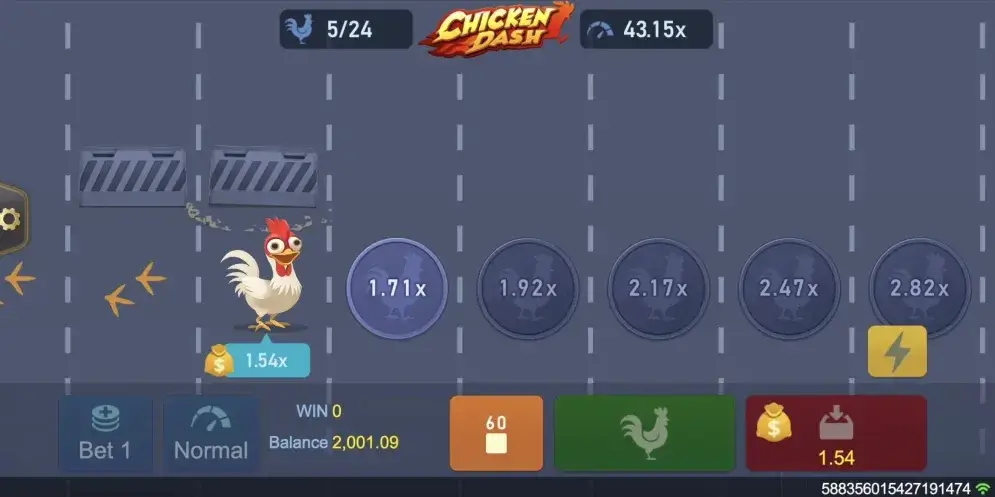
The Multiplier Display
Left side of the screen, always visible: your current multiplier and maximum possible for your selected risk mode. This is the core information you’re making decisions against.
Testing the Demo: What to Expect
Most licensed casinos offering Chicken Dash provide a demo mode. Use it. Not because you need to get rich quick, but because crash games have a learning curve that slots don’t.
What Your First 10 Demo Rounds Will Teach You:
- The Emotional Reaction – You’ll discover whether the time-pressure mechanic stresses you out or excites you. If you’re getting anxious in the demo, real money won’t improve things.
- The Decision Timing – You’ll notice you either cash out too early (leaving multipliers on the table) or push too hard (hitting cars). Most new players average 1-2 steps before busting in their first demo session. This is normal.
- The Volatility Feel – “Normal mode” will suddenly make sense or immediately frustrate you. Easy mode will feel slower but steadier. Demo play shows you which volatility suits your psychology.
- The Speed Reality – You’ll experience how quickly multipliers scale and how little time you actually have to react thoughtfully.
Pro Demo Tip: Play with a mental budget of 20 rounds. Don’t worry about “winning” the demo—treat it as research. Notice your decision patterns, emotional responses, and when you feel most comfortable cashing out.
Getting Started: Your First Real-Money Session (Done Right)
Here’s how experienced players approach Chicken Dash without immediately busting their bankroll. This section is crucial because the gap between knowing how to play and knowing how to play profitably (or at least sustainably) is where most players trip up.
Step 1: Choose Your Risk Mode (Carefully)
Don’t default to Normal or Hard because they sound “better.” Choose based on honest self-assessment:
- Choose Easy if: You’re new to crash games, you prefer win frequency over massive multipliers, or you have less than €10 to play with. Easy mode on average delivers smaller individual multipliers (typically 2x-5x) but higher win frequency. You’ll bust more times overall, but the psychological pattern is confidence-building rather than confidence-crushing.
- Choose Normal if: You’ve played crash games before, you want a balanced experience, or you have €10-€50 to work with. Normal mode is the “Goldilocks” selection—not too conservative, not too aggressive. Most of the gaming population gravitates here for good reason. Multipliers escalate more aggressively (3x-10x typical ranges), but so does bust risk.
- Choose Hard if: You’re genuinely seeking the 20,000x+ fantasy, you understand variance deeply, or you have €50+ bankroll and can absorb losing streaks. Hard mode is a psychological rollercoaster. Some rounds deliver massive 50x+ multipliers. Other rounds bust on step two. The volatility is genuinely brutal, but if you’re the type who gets bored by conservatism, it’s where the adrenaline lives.
A Note on Mode Selection: Your choice here reveals more about your personality than your gambling experience. Matching your mode selection to your actual risk tolerance is critical.
Step 2: Set Your Bet Size Realistically
Here’s the math that matters for different player profiles:
- €0.10 bets: You can survive 50 busts before depleting a €5 bankroll. This is training-mode territory. Use it to learn mechanics without emotional stakes.
- €0.50 bets: A €10 bankroll = ~20 rounds before depletion. This is realistic casual play—high enough to feel real, low enough that a loss doesn’t ruin your week.
- €1.00 bets: A €20 bankroll = ~20 rounds. Anything higher and you’re getting serious. €2-€5 bets are professional player territory.
The Bankroll-to-Bet Ratio That Works: The industry standard for sustainable play is 100:1 (€100 bankroll for €1 bets, €10 bankroll for €0.10 bets). This gives you enough rounds to weather variance and let the RTP work itself out across a meaningful sample size.
My Recommendation for Beginners: Start with €0.10-€0.25 bets on Easy mode. Play exactly 20 rounds. Observe your patterns. If you bust out earlier, that’s data. If you end with a small profit, that’s a win psychologically. If you lose €2 on a €5 bankroll, that’s valuable education costing you money—but at a price you can afford.
Step 3: Establish Your Cashout Strategy
This is crucial. Before you start, decide:
- When will you cash out in Easy mode? (Example: 2x or higher)
- When will you cash out in Normal mode? (Example: 1.8x or higher)
- When will you cash out in Hard mode? (Example: every other round at 5x minimum, then reload)
- What’s your loss limit for the session? (Example: stop after losing 3 rounds in a row, or after 20 minutes elapsed)
Write it down. Seriously. Crashes games are where discipline separates winners from money-burners. I actually keep a spreadsheet where I log my predetermined strategy and compare it to what I actually did. The discrepancies are illuminating.
A Real Example from This Week: I cashed out at 1.5x for 12 consecutive rounds on Easy mode. Netted about +€9 on a €0.25 bet size. Took 15 minutes. Quit while I was ahead. The next round would have busted. That’s the game in a nutshell. Consistency beats greed.
Step 4: Monitor Your Emotional State
If you catch yourself thinking any of these thoughts, stop immediately:
- “Just one more round to recover that loss”
- “I can feel the next one hitting big”
- “The game owes me a streak”
- “I’ll just double my bet to make it back faster”
- “Everyone else is hitting big, why aren’t I?”
These are cognitive distortions, not strategic insights. They’re your brain attempting to override your rational decision-making under emotional pressure. The moment you recognize them, you’ve already lost control. Stopping is the only rational response.
Step 5: Understand Your Expected Outcome
With a 96.85% RTP, your long-term expectation is losing roughly 3.15% of total wagered amount. Here’s what this actually means in practical terms:
If you play €100 in total bets, expect to lose approximately €3.15 on average. Some sessions you win. Some you lose. Over 100+ sessions, the math catches up. This isn’t punishment—it’s the structure that allows casinos to exist. Your job as a player isn’t to beat the RTP (you can’t). It’s to optimize your entertainment-per-euro by managing the volatility intelligently.
Where to Play Chicken Dash Legally and Safely
Chicken Dash is available at hundreds of licensed online casinos across Europe. Here’s how to identify legitimate venues:
What to Look For
- Valid Gaming License – Reputable operators hold licenses from Malta Gaming Authority (MGA), UK Gambling Commission (UKGC), Cyprus DFS, or similar regulatory bodies. Check the casino’s footer or Terms & Conditions.
- TaDa Gaming Certification – The game itself is certified by iTech Labs or similar independent testing authorities. This certification confirms RTP and volatility claims are accurate.
- Responsive Customer Support – Before depositing, contact support with a question. Response time and professionalism matter if issues arise.
- Clear Bonus Terms – If the casino offers a welcome bonus, read the wagering requirements carefully. Crash games often contribute differently to wagering (sometimes 0%, sometimes 100%)—ask before claiming.
- Established Reputation – Google the casino name + “review” or check independent review sites like CasinoMeister or LCB (Little Card Bureau). Years in operation matter.
Red Flags to Avoid
- No listed gaming license
- Spelling errors or broken English on the website
- Instant-contact-support promises that never respond
- Unrealistic welcome bonuses (1000% offers aren’t standard)
- Vague terms around withdrawal processes
Recommended Casino Types
For European Players: Stake, BC Game, and Betano consistently offer Chicken Dash with solid licensing.
For UK Players: Betfred and Casumo include it in their crash game library.
For Cryptocurrency Advocates: Several crypto-native casinos feature Chicken Dash with BTC withdrawal options.
Important: Always verify current licensing through official regulatory body websites. The iGaming landscape changes constantly, and I can’t endorse specific casinos in a permanently archived article. Do your own due diligence.
Frequently Asked Questions: Real Player Concerns
“Can I predict when a crash happens?”
No. The game uses server-side random number generation. No pattern exists. Anyone claiming to have a “system” is either delusional or trying to sell you snake oil.
“Is the 96.85% RTP guaranteed in my session?”
Not in individual sessions. RTP is a long-term average across thousands of rounds. Short-term variance is wild. You might play 50 rounds and hit 94% return or 99% return. The 96.85% matters over months of play, not hours.
“Should I play Easy, Normal, or Hard mode?”
Start with Normal. It’s psychologically balanced. If you find yourself stress-eating during play, switch to Easy. If you’re bored, Hard exists (but be careful—variance is brutal).
“What’s the difference between this and Chicken Road 2?”
Minimal. Same mechanics, TaDa’s branding instead of InOut Games’ branding. If you’ve played Chicken Road 2 and enjoyed it, you’ll enjoy this. If you found it boring, this won’t convert you.
“Can I use betting systems to beat the game?”
Betting systems (Martingale, Fibonacci, etc.) are myths. They don’t reduce house edge. In crash games specifically, they often accelerate losses because multipliers don’t follow patterns you can exploit.
“What’s a realistic win expectation?”
Depends on your bet size and session length:
- €10 session, €0.25 bets: Realistic outcome is ±€3-5
- €50 session, €1.00 bets: Realistic outcome is ±€10-20
Treat small wins as lucky bonuses, not predictable income.
“How long should I play in one session?”
30 minutes maximum for recreational play. Beyond that, fatigue degrades decision quality and emotional management suffers. Professional players often cap sessions at 20 minutes.
“Is the game rigged?”
Not if it’s licensed by a reputable authority. The certification process involves independent audits of the RNG, payout verification, and behavioral analysis. Could a casino cheat? Theoretically. Would they risk their license worth millions to do so? No.
“Why do I keep busting on the first step?”
Variance. Sometimes the random number generator deals you a losing hand immediately. Sometimes it gives you 8 consecutive wins. This is normal crash game behavior. If it happens consistently across multiple casinos, it’s bad luck, not a conspiracy.
“What if I develop a problem?”
UK players have access to GamCare and Gamblers Anonymous. EU players can use NCPG (National Council for Problem Gambling) resources. Most licensed casinos offer self-exclusion tools. Use them without shame.
Final Verdict: Is Chicken Dash Worth Your Time?
After extensive testing, here’s my honest assessment:
Chicken Dash is a solid, well-executed crash game that delivers what it promises. It’s not innovative—it’s a competent iteration of an established formula. The mechanics work, the RTP is fair, and the mobile experience is polished.
Play it if:
- You enjoy time-pressure decisions over passive spinning
- You want fast round resolution (key for bankroll preservation)
- You prefer simplicity to feature bloat
- You’re comfortable with high volatility
- You have solid emotional discipline
Skip it if:
- You need traditional slot features (free spins, expanding reels, cascades)
- You can’t handle the “one more round” temptation
- You’re seeking an edge or system to exploit (doesn’t exist)
- You want a game that rewards skill heavily (luck dominates)
The chicken will still be crossing that road a year from now. Whether you join it is entirely up to you.