
Key Specs
| Spec | Detail |
|---|---|
| Developer | 100HP Gaming |
| Game type | Step-based crash / instant game |
| Release date | 5 March 2026 |
| RTP | 97% |
| Volatility modes | Easy, Medium, High, Extreme |
| Max multiplier — Easy | x62.93 |
| Max multiplier — Medium | x267.56 |
| Max multiplier — High | x10,308.99 |
| Max multiplier — Extreme | x55,833.16 |
| Min bet | $0.01 |
| Max bet | $150 |
| Monetary max win | Operator-dependent (verify at your casino) |
| RNG | Provably Fair |
| Distribution | SOFTSWISS, Hub88 |
Chicken Heart arrived in online casino lobbies on 5 March 2026, timed to coincide with International Women’s Day. The game comes from 100HP Gaming, a relatively small but prolific studio that has built its identity entirely around step-based crash and instant-win titles — Chicken Road, Chicken Train, Chicken Pirate, Meta Crash, Fortune Crash, Astronaut. Chicken Heart fits that same template. It is not a slot. There are no reels, no paylines, no scatter symbols, no free spin round, and no wild substitutions. Anyone who has read otherwise on a competitor site has been misled — and there are quite a few sites doing exactly that.
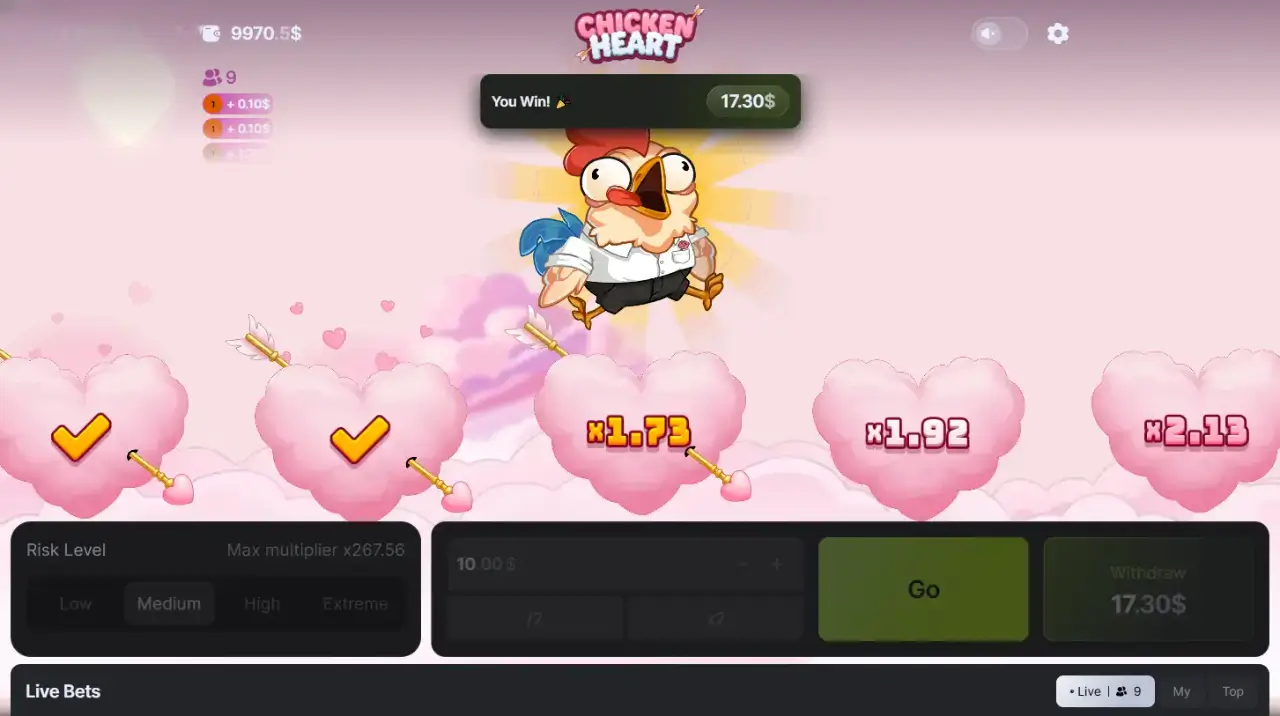
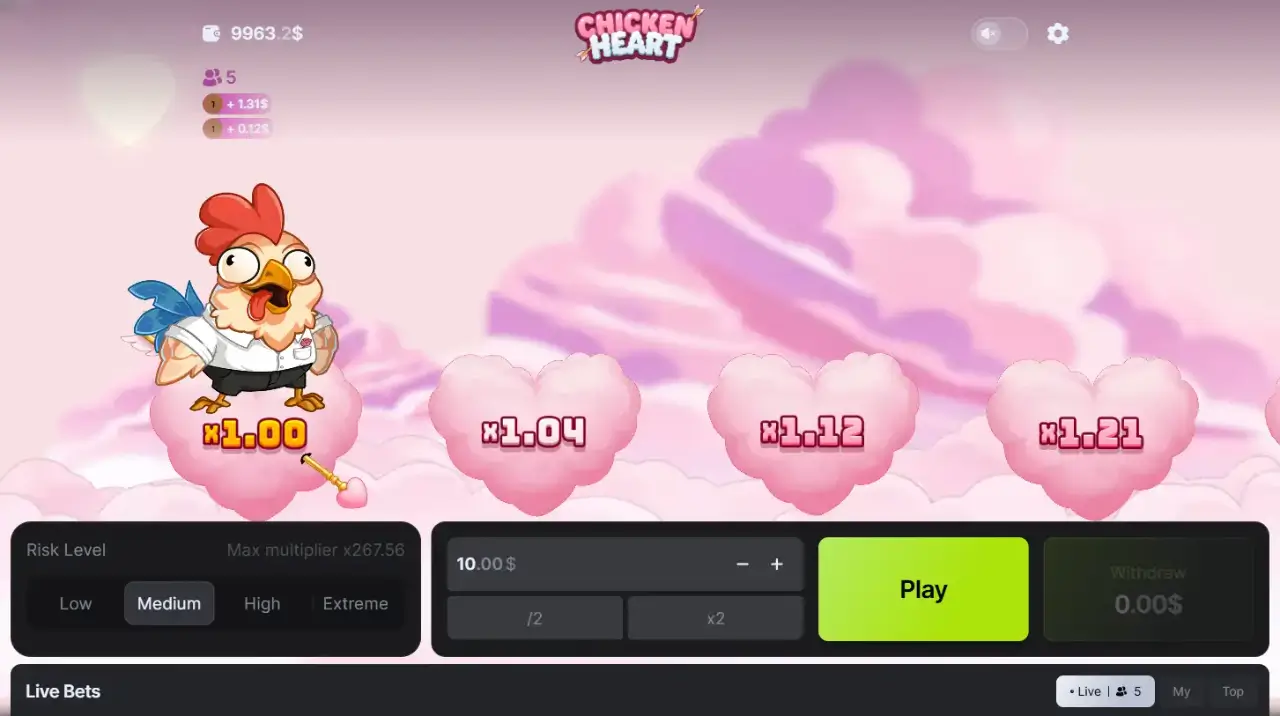
What Chicken Heart is, plainly, is a step-based instant game: the player places a bet, the chicken begins jumping across a sequence of heart-shaped clouds, and at each cloud the player decides whether to cash out at the current multiplier or jump to the next one. Push too far and the run ends, the stake is lost. Stop at the right moment and the multiplier applied to the original bet becomes the payout. That is the entire game. The decision loop is simple. What keeps people playing is that the decision never gets easier.
What Kind of Game Is Chicken Heart?
The broader “chicken game” category has become crowded enough in 2026 that the terminology can mislead. Some chicken-themed titles are straightforward five-reel slots with bonus rounds. Others are grid-based minesweeper variants. Chicken Heart belongs to neither of those categories. It shares its mechanical DNA with crash games — the kind where a multiplier rises and the player must decide when to exit before the crash event ends the round — except here the multiplier advances in discrete steps rather than climbing along a continuous curve.
The practical difference matters. In a conventional crash game, the multiplier rises automatically and the player hits a single cash-out button to exit. In Chicken Heart, nothing happens automatically. Each jump to the next cloud is a deliberate action. The player sees where the multiplier stands after each successful step and actively chooses to continue or stop. This makes the experience feel more like a series of small decisions under pressure than a single reaction-time test. The tension is spread across the entire run rather than concentrated at one moment.
100HP Gaming built Chicken Heart on the same step-based engine that powers Chicken Train and Chicken Pirate. The core loop is identical across those titles: bet, advance step by step, cash out before the run collapses. What differentiates Chicken Heart is its seasonal visual dressing — heart-shaped clouds, a spring colour palette, a chicken protagonist with a valentine’s-day aesthetic — and its multiplier caps per difficulty mode. The underlying math model, the four-tier volatility structure, and the 97% RTP are consistent with the rest of the studio’s output.
Core Mechanics: How a Round Works
Starting a round in Chicken Heart takes three actions. The player selects a bet amount, chooses a volatility mode, and launches the round. The chicken appears on the first cloud and the starting multiplier is displayed. From that point on, each tap of the advance button moves the chicken to the next cloud, raising the multiplier. A tap of the cash-out button ends the round and locks in the payout equal to the current multiplier multiplied by the original stake.
If the advance button is pressed and the jump fails — the cloud gives way, the run ends, whatever the visual representation — the entire stake is lost and the round concludes with zero payout. There is no partial return, no consolation prize, no second chance within the same round. The stake either comes back multiplied or it does not come back at all.
Bet sizes run from $0.01 to $150 per round. The minimum is low enough that a player can run a substantial number of rounds on a modest session budget, which makes the game accessible for casual play at lower volatility settings. The maximum of $150 per round means that a run reaching the Extreme mode ceiling of x55,833.16 would, in theory, produce a payout approaching $8.4 million — but in practice, the monetary maximum win is capped at the operator level and will vary by platform. Players chasing large absolute payouts should check their casino’s house rules rather than assume the multiplier ceiling translates directly to an uncapped cash amount.
Volatility Modes: What Each Setting Actually Means
Chicken Heart offers four volatility settings: Easy, Medium, High, and Extreme. Selecting a mode before the round begins locks in the multiplier ceiling for that session. The modes are not just difficulty labels — they determine how the multiplier scales per step and how likely the run is to survive to deeper cloud positions.
Easy mode caps the maximum multiplier at x62.93. At this setting, the run survives longer on average, multipliers grow more gradually, and the probability of losing the stake on any given step is lower than in higher modes. This is the appropriate setting for players who want to understand the step mechanic without rapid bankroll depletion. The trade-off is a relatively modest ceiling — x62.93 on a $10 stake produces a $629.30 maximum payout, which is meaningful but far from spectacular.
Medium mode raises the ceiling to x267.56. The probability of surviving each step decreases relative to Easy, which means runs tend to be shorter but individual steps carry more multiplier value. A $10 stake taken to the Medium ceiling would return $2,675.60. Realistically, most sessions in Medium mode will not approach the ceiling, but the mode provides a reasonable balance between run frequency and upside potential.
High mode takes the ceiling to x10,308.99. This is where the game’s character shifts noticeably. The step survival probability is materially lower, meaning many rounds will end at low multipliers even when the player exits early. The rare runs that climb deep into High mode produce substantial multipliers, but a player should go into High mode understanding that most rounds will not last long enough for that to matter.
Extreme mode carries the maximum multiplier of x55,833.16. This number gets cited widely because it is the headline figure. What does not get discussed as frequently is what it costs to reach it. In Extreme mode, the probability of failure on any given step is high. Most rounds end quickly. The sessions that produce memorable multipliers in Extreme mode are genuinely rare, and chasing them by default is a reliable way to end a session early. Extreme mode suits players who are specifically comfortable with a high-variance, short-session format and who are not expecting consistent results.
The choice of volatility mode should match the session goal. Players who want extended play with a reasonable chance of finishing ahead should use Easy or Medium. Players who want lower session volume in exchange for a shot at larger multipliers should use High. Extreme is for players who understand and accept the trade-off clearly. None of these modes is wrong — they serve different purposes and are honest about the trade-offs.
RTP: What 97% Means in Practice
Chicken Heart carries a theoretical return to player of 97%, which places it above the industry average for online casino games. Most traditional video slots run at 95–96% RTP; a figure of 97% means that over a sufficiently long run of rounds, a player should expect to retain 97 cents of every dollar wagered.
The word “theoretical” matters. RTP is a long-run statistical property of the game’s math model. It says nothing meaningful about any individual session, and it says nothing about how that 97% distributes across different volatility modes. A player running Easy mode at low stakes for an extended session will experience something closer to the theoretical average than a player running ten Extreme-mode rounds. Variance compounds the further a game sits from its mathematical average in any given session, and Chicken Heart’s higher volatility modes involve a lot of variance.
It is also worth noting that RTP in live casino environments is frequently operator-configured rather than fixed. 100HP Gaming distributes Chicken Heart through SOFTSWISS and Hub88 aggregator platforms, and casinos operating through those networks may adjust the RTP within permitted ranges. The 97% figure is the developer’s published default. The actual RTP at a specific casino may be lower. This is not unique to Chicken Heart — it applies across virtually all content distributed through aggregator platforms — but players should be aware that the headline figure is not always the figure in effect at their platform of choice.
This gap between developer-published RTP and operator-configured RTP is one of the most consistently underreported aspects of crash and instant-game coverage. Aggregator agreements typically allow casinos to reduce RTP within a defined band, sometimes to 94% or below, in exchange for operators taking a smaller revenue share from the provider. The effect on long-run expected value is material. A player running 500 rounds at 94% RTP will retain noticeably less than a player at the same stakes running the same number of rounds at 97%. There is no reliable external source that lists each casino’s configured RTP for Chicken Heart specifically — the only way to verify it is to check the in-game settings menu at the platform you are using, if the operator makes that information available, or to contact support directly. Some regulated markets require operators to disclose the active RTP of each game in the game interface; others do not.
The Provably Fair verification system built into Chicken Heart’s RNG means players can verify individual round outcomes. This is a meaningful transparency measure: the result of each round is cryptographically determined before the round begins and cannot be altered mid-play. Provably Fair does not guarantee wins or protect against variance, but it confirms that the house cannot manipulate outcomes after the fact, which is a genuine credential in a genre where trust is a legitimate concern.
Theme and Presentation
Chicken Heart’s visual concept is straightforward. The protagonist is a cartoon chicken navigating a series of heart-shaped clouds set against a warm spring sky. The colour palette runs to soft pinks, warm yellows, and the kind of pastel blues that appear on seasonal packaging in late February. The game was designed around International Women’s Day, which places its release on 8 March, though the official game page lists 5 March 2026 as the release date. The visual language is consistent across the presentation: hearts, spring colours, a cheerful chicken, clouds that carry both the literal path of the game and the symbolic weight of the theme.
This is a seasonal release, and that fact carries genuine consequences for evergreen content strategy. A slot with a generic fantasy or adventure theme can sit in a casino lobby year-round without the visuals creating any dissonance. Chicken Heart’s aesthetic is firmly tied to a specific time of year. That is not a fatal flaw, but it is worth acknowledging. Casinos that promote the game outside its natural window will get less engagement from the theme than they would from a neutrally themed title, and players who prefer their game library to feel current will notice.
The audio design, based on what can be inferred from the game’s visual style and 100HP Gaming’s broader catalogue, will be light and festival-appropriate. The studio’s other titles use clear, responsive sound feedback tied to successful steps and cash-outs. There is no soundtrack information confirmed in available sources, and inventing specific audio details would not serve anyone, so the honest position is that the presentation matches the genre norm — functional, responsive, themed to the holiday occasion — without additional detail confirmed as of this writing.
On mobile, the lightweight engine that 100HP Gaming uses across its catalogue performs well on mid-range hardware. The step-based format means there is no continuous animation to sustain — the game renders one step at a time, which reduces demands on the device compared to full crash games with constantly rising curves and animated backgrounds. Players on lower-specification handsets or on 4G connections with variable signal should experience fewer performance issues than they would with more graphically demanding titles.
How Chicken Heart Compares to Other 100HP Gaming Titles
The most useful comparison is between Chicken Heart and its two closest siblings: Chicken Train and Chicken Pirate. All three games run on the same step-based engine. All three carry 97% RTP. All three share the four volatility modes with the same multiplier ceilings — Easy at x62.93, Medium at x267.56, High at x10,308.99, Extreme at x55,833.16. The $0.01–$150 bet range is consistent across the portfolio.
What differs between them is primarily theming and, in the case of Chicken Train and Chicken Pirate, the presence of confirmed bonus mechanics. Chicken Train has a Bonus Run feature, which activates under specific step conditions and causes the chicken to traverse multiple steps automatically in a single sequence. Chicken Pirate has an analogous Bonus Strike. Whether Chicken Heart has its own equivalent mechanic is a question that deserves a clear answer.
The studio’s broader catalogue extends beyond the chicken-themed titles. Meta Crash, Fortune Crash, and Astronaut are all crash-format games from 100HP Gaming, distributed through the same SOFTSWISS and Hub88 pipelines, and share the studio’s design philosophy of lightweight engines, simple interfaces, and above-average RTP. The chicken series occupies a specific niche within that catalogue — step-based decision games with strong thematic identities tied to seasons or narratives. Chicken Road, the original, established the formula. Chicken Heart applies it to a spring holiday release window, which positions it as part of a growing seasonal content strategy rather than a standalone entry.
That strategic context matters for casino operators more than for players directly, but it is relevant background for understanding what Chicken Heart is and what 100HP Gaming is trying to do with it. The studio is iterating on a proven formula and applying it to different themes and release windows. The quality of the underlying mechanics does not vary significantly between these titles — the math model, the step structure, and the cash-out decision loop are the same. What changes is the packaging and, in some cases, the bonus mechanic layered on top.
Several affiliate sites describe a feature called “Bonus Dash” in Chicken Heart, presented as a mechanic that propels the chicken across multiple clouds automatically when a specific condition is met. This would be consistent with the Bonus Run and Bonus Strike features in the sibling titles. However, the name “Bonus Dash” cannot be confirmed against 100HP Gaming’s own materials or any primary source that clearly attributes it to the developer. The official game page description for Chicken Heart on chicken-heart.app uses the phrase in a context that reads more like aggregator-extrapolated content than a developer specification. Until a primary source confirms the feature name and trigger conditions, the honest position is to flag it as unverified rather than repeat it as established fact.
If a bonus step-skipping mechanic does exist in Chicken Heart under that name, the review will note it as confirmed when better sourcing becomes available. What can be said without qualification is that the game’s core mechanic — step by step, cash out or continue — functions identically to the rest of the 100HP Gaming step-based catalogue.
Honest Pros and Cons
No review that omits weaknesses is worth reading, so here is a direct accounting of both.
Strengths:
The 97% RTP is a genuine advantage. Most of what occupies a casino lobby falls below this figure, and for players who care about long-run expected value, Chicken Heart’s math model is more favourable than average. The four calibrated volatility modes give the game meaningful range — Easy and Medium are genuinely different experiences from High and Extreme, and the multiplier ceilings per mode are published openly rather than buried in terms and conditions. The Provably Fair RNG gives players a way to verify round outcomes independently, which is more transparency than most casino titles offer. The step-based mechanic is easy to learn, requires no prior knowledge of slot pay tables or bonus round logic, and generates clear decision moments that players can understand within one or two rounds.
The bet minimum of $0.01 means the game is accessible at the lowest stakes a player would reasonably wager. On a slow session in Easy mode, a player can run a substantial number of rounds on a few dollars, which supports extended play without requiring large deposits.
Weaknesses:
The seasonal theme is the most practical limitation. Chicken Heart is a Valentine’s Day and International Women’s Day release. The heart-clouds and spring aesthetic make sense in late February and early March; they become slightly incongruous in July. Casinos that keep a seasonal rotation of games around their lobby will handle this naturally. For players browsing a general lobby in mid-year, the visual may read as a mismatch with the time of year. This is not a gameplay flaw, but it is a context that affects how the game presents itself over a twelve-month cycle.
The monetary maximum win is operator-dependent. The x55,833.16 multiplier gets cited frequently as the headline number, but the actual cash ceiling at most casinos will be capped well below what that multiplier could theoretically produce on a maximum bet. Players should verify the terms at their specific platform.
Chicken Heart offers limited feature variety compared to traditional slots. There are no respins, no expanding wilds, no progressive jackpot, no gamble feature, no pick-me bonus. The game is a single mechanic repeated across every round. For players who enjoy mechanical variety and the kind of layered bonus structure that video slots provide, Chicken Heart will feel thin. That is not a criticism of the design philosophy — the simplicity is intentional and serves the format well — but it should be stated plainly for players who have specific expectations about what an online casino game delivers.
The high and Extreme volatility modes will deplete a bankroll faster than most players anticipate if they are not set appropriately. The probability of failing on a given step in those modes is high enough that runs are frequently short, and a sequence of short runs at high volatility can end a session before the player has had much time to engage with the game. This is mathematically predictable behaviour, not a design flaw, but new players switching from Easy to Extreme without adjusting stake sizes will notice the difference immediately.
Who Should Play Chicken Heart
Chicken Heart works well for players who are specifically interested in the step-based decision format and who understand that the appeal is in the judgment call — how far to push on a given run — rather than in passive entertainment. It suits players who are comfortable with the idea that each round is binary: a multiplied return or a complete loss, with no middle ground. If that trade-off is not one a player wants, the game will feel unrewarding regardless of volatility setting or stake size.
The 97% RTP and Easy/Medium volatility modes make Chicken Heart a reasonable choice for players who want an above-average return rate and are not chasing large multipliers. Long sessions at low stakes in Easy mode produce frequent small wins and occasional exits at meaningful multipliers, which is a functional way to use the game’s math model.
High and Extreme modes are for players who are specifically comfortable with variance-heavy formats and who are not measuring success by session frequency. The game suits this profile well — the multiplier ceilings are high enough to make deep runs worthwhile — but it does not suit players who want steady engagement across many rounds.
Newcomers to crash and instant games will find the learning curve genuinely low. There are no pay table structures to memorise, no bonus round rules to internalise, and no symbol combinations to track. The game asks one question per round: stop here or go one step further? That simplicity is an asset for players who find traditional slot interfaces unnecessarily complicated. The step format also makes it easy to observe and understand the risk progression in real time, which is useful when deciding how to allocate stakes across a session.
Players who primarily enjoy video slots, progressive jackpots, or games with multiple bonus layers will find Chicken Heart’s format reductive. There is genuinely nothing wrong with that preference. The game is designed for a specific kind of player, and it delivers what it promises to that player. It does not pretend to be something it is not.
Final Assessment
Chicken Heart is a well-executed entry in a format that 100HP Gaming has built and refined across several titles. The step-based mechanic is clear, the four volatility modes are calibrated with honest multiplier ceilings published openly, and the 97% RTP with Provably Fair verification represents a transparent math model by casino game standards. The release date of 5 March 2026 and the holiday-linked aesthetic make it a seasonal title, and that characteristic will limit its evergreen appeal in casino lobbies compared to theme-neutral games.
The most important correction to make for anyone arriving from competitor content: Chicken Heart is not a slot. There are no reels, no wilds, no scatters, no free spin rounds. It is a step-based instant game where the player advances one cloud at a time and decides when to stop. Understanding that distinction is the foundation for understanding what the game actually offers — and what it does not.
For players who want that format with strong RTP, flexible volatility, and a lightweight engine that works on modest hardware, Chicken Heart delivers. For everyone else, there are other titles in the lobby.