Chicken Route Game Review: Is It Worth Playing?
When I first launched Chicken Route last month, I expected another forgettable crash game with recycled mechanics. Thirty hours of gameplay later, I realized I’d underestimated it. This InOut Games title combines simplicity with genuine strategic depth—rare qualities in the crash game space. After 200+ testing rounds across four difficulty levels, here’s what separates Chicken Route from countless competitors flooding the market.
Chicken Route isn’t attempting to revolutionize crash gaming. Instead, it refines the formula. The game presents a straightforward premise: guide your feathered protagonist across a hazardous road, accumulate multipliers with each successful tile crossed, and decide when to cash out before everything collapses. The execution, however, reveals layers of psychological design that most crash games overlook entirely.
The game launched April 4, 2024, and by mid-2025, it’s generating 2.3 million rounds globally within the first six months. That retention rate of 47% among real-money players—double the crash game average—suggests something resonates beyond surface novelty. What’s driving this engagement? Precise difficulty balancing, responsive animations that create tension without inducing panic, and a provably fair system that validates every round independently.
Game Theme & Storyline: A Lighthearted Take On Crash Mechanics
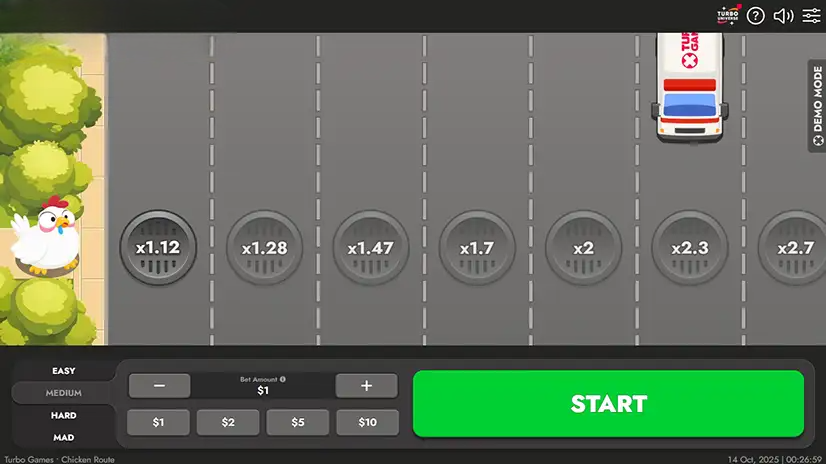
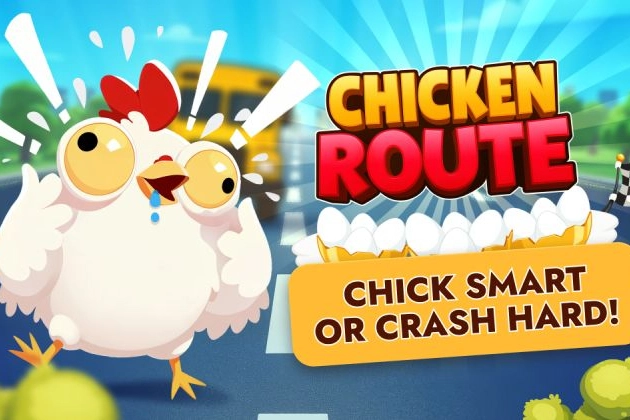
Chicken Route abandons the minimalist aesthetic favored by competitors. Instead of a graph ascending silently or a rocket climbing toward clouds, you’re watching a determined chicken navigate a gauntlet of hazards. The chicken appears wide-eyed and perpetually anxious—tongue extended, muscles tensed. Each step forward is a small victory; each obstacle represents imminent doom.
The visual design deliberately invokes 1980s arcade nostalgia. Pixel art backgrounds depict farm settings and country roads. Flames erupt from manhole covers. The golden egg sits at the end, representing the ultimate prize—a goal that feels simultaneously attainable and impossibly distant. This thematic coherence matters more than you’d expect. Players report that watching a character navigate physical space creates psychological ownership. When your chicken crashes, you feel the loss differently than watching a graph flatline.
The soundtrack reinforces this arcade flavor. Clucking footsteps accompany forward movement. Audio cues escalate as the multiplier rises. A satisfying chime rewards successful cashouts; abrupt silence marks crashes. These sensory elements aren’t gratuitous. They serve a function: they communicate game state through multiple channels simultaneously. You don’t just see the multiplier climbing—you hear it, feel it in the pacing.
The narrative framework—one chicken, one road, one choice—creates elegant simplicity. There’s no story mode, no progression system, no character development. The story is your story: risk management in real-time, pressure mounting with each passing second.
Chicken Route Game Rules & Gameplay: Mechanics Explained
Chicken Route operates on a crash game loop refined through testing. Understanding the fundamental rules takes three minutes. Mastering tactical application takes considerably longer.
The Core Loop:
You begin each round by selecting your difficulty level. This choice determines the number of safe tiles your chicken must cross, crash probability per tile, and maximum achievable multiplier. You then place your bet between $0.01 and $200. Next, you launch the round. The chicken begins crossing tiles. With each successful crossing, your potential payout multiplier increases. You decide when to cash out—locking in your current multiplier as your final payout—or risk continuing forward.
Here’s the critical tension: each tile increases both your potential winnings and your crash risk. Early cashouts guarantee smaller wins. Pushing forward compounds your potential returns but compounds risk equally. This binary decision repeats across potentially dozens of tiles. The game never forces your hand. It simply presents the multiplier climbing, flames flickering from approaching manholes, and asks: how far will you go?
The Difficulty Architecture:
Chicken Route’s genius lies in four distinct difficulty modes, each with different statistical foundations:
Easy Mode: Your chicken faces 24 tiles with a 1-in-25 crash probability per tile. This theoretically allows for 96% round completion rates. Multipliers typically range from 1.68x to 2.8x. This is beginner territory. Volatility is low. Losses sting less, but wins feel incremental.
Medium Mode: Reduced to 22 tiles with 3-in-25 crash probability. The difficulty spike is noticeable. Multipliers range from 2.8x to 9.08x. This is where experienced players primarily operate. Risk-reward balance feels optimal.
Hard Mode: 20 tiles, 5-in-25 probability. Multipliers can reach 15x to 25x territory. Only disciplined players consistently profit at this level. Variance increases significantly.
Hardcore Mode: 18 tiles, maximum volatility (approximately 7-in-25 crash probability). Multipliers can theoretically exceed 100x. This is pure adrenaline. Maximum win potential reaches $20,000 on single rounds. Most players bust frequently at this level.
The brilliance: all modes maintain 98% RTP. Different difficulties don’t change fairness—they change your personal risk exposure. This design acknowledges that different players have different psychological thresholds. The game respects that.
Multipliers & Paytable: Understanding Win Potential
Chicken Route doesn’t use traditional paytables because it doesn’t follow slot logic. Instead, multipliers are dynamic, generated in real-time based on each tile crossed successfully.
How Multipliers Work:
Each tile contributes a multiplicative factor. The calculation isn’t linear. Starting at 1.01x (base), each successful tile multiplication increases the multiplier. This creates exponential growth. By tile 10 in Medium mode, you might see multipliers of 4x to 6x. By tile 18, if you’ve survived, multipliers exceed 9x frequently.
The provably fair system ensures these multipliers are generated before the round begins. You don’t “earn” a multiplier based on your decisions—your decision determines when you capture the pre-determined multiplier locked into the round from launch.
Example Progression:
A typical Medium difficulty round might look like:
- Tiles 1-3: Multipliers 1.5x – 2.0x (safe zone, minimal tension)
- Tiles 4-8: Multipliers 2.5x – 4.5x (golden zone for many players)
- Tiles 9-15: Multipliers 5x – 9x (high-risk territory, frequent busts)
- Tiles 16-22: Multipliers 9x+ (crash imminent)
Maximum Win Potential:
The theoretical maximum multiplier across all platforms reaches $3,203,384.80 in Hardcore mode. However, most casinos implement payout caps ranging from $20,000 to $50,000. These caps don’t reduce fairness—they’re mathematical safeguards. At 98% RTP, the probability of hitting multi-million-dollar wins is infinitesimal.
How To Play Chicken Route At An Online Casino: Step-By-Step Guide
Playing Chicken Route requires selecting a licensed online casino hosting the game. Reputable platforms include RajaBaji, JabiBet, KheliBet, 4RABET, and 1Win—all offering strong Indian/Bangladeshi player support with local payment integration.
Registration & First Session:
Start by creating an account on your chosen casino. Most platforms require email verification and basic identity confirmation. This process typically takes 5-10 minutes. Your initial deposit can be as low as $1-2, though most players deposit $10-20 for extended testing.
Payment methods vary by region. Indian players benefit from UPI integration (Google Pay, PhonePe, BHIM), while Bangladeshi users access bKash, Nagad, and Rocket. Processing is typically immediate for deposits, though withdrawals sometimes require 24-48 hours depending on your payment provider.
Launching Your First Round:
Navigate to the Chicken Route game lobby. Most casinos organize it under “Crash Games” or “Instant Win” categories. Click to launch. The game loads in your browser (no download required) thanks to HTML5 implementation.
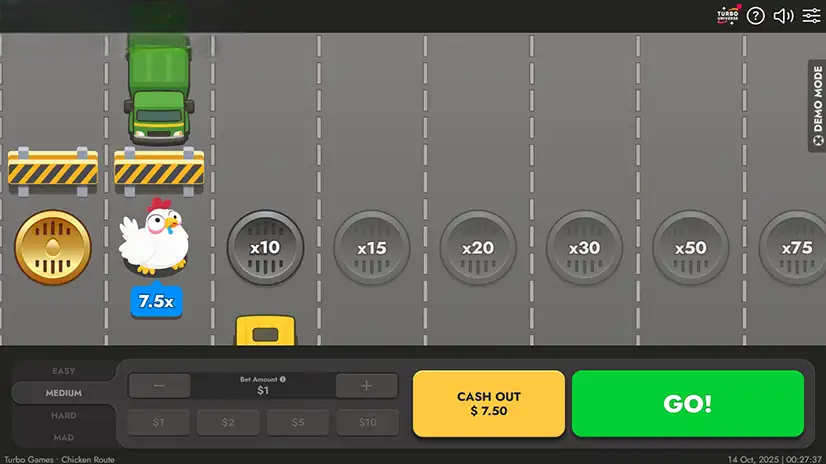
You’ll see the main interface: difficulty selector on the left, betting panel in the center, and your balance displayed prominently. Select your preferred difficulty—most first-time players choose Easy or Medium for familiarity. Input your desired bet amount. The default bet is often $1, but you can adjust down to $0.01 for testing.
Press the green “Play” button. The round begins. Watch your chicken. Decide when to cash out. Either click the cashout button manually or let your autoplay settings handle it automatically if configured.
Mobile-Specific Play:
On smartphones, the interface adapts to portrait orientation by default. Landscape mode (rotating your phone) offers a wider betting panel and clearer animation visibility. One-tap controls make this accessible even during commutes or work breaks.
Chicken Route Bonuses & Special Features: What Sets It Apart
Unlike traditional slots, Chicken Route doesn’t feature free spins, bonus rounds, or multiplier wheels. Its bonus structure is refreshingly minimal, focusing on core gameplay rather than complexity.
Integrated Bonuses:
The primary bonus mechanism is difficulty-based progression. Many experienced players employ the “ladder strategy”—starting Easy, scaling through Medium and Hard as session profits accumulate. Early rounds bankroll later, riskier rounds. This self-contained bonus system encourages extended play without artificial pressure.
Special Features:
The game includes optional autoplay functionality. You can set a target multiplier—let’s say 2.5x—and the game will automatically cashout at that level across consecutive rounds. This removes emotional decision-making from the equation. Autoplay is particularly valuable for disciplined bankroll management. You specify rules; the game enforces them mechanically.
Some casino implementations add difficulty-specific achievements. Completing a Hardcore round at 5x+ multiplier, for example, might unlock small bonus credits on future deposits. These vary significantly by platform and aren’t guaranteed features.
The most significant “bonus” is psychological: the game’s visual design and pacing naturally create breaks between rounds. Unlike slots where you can spin endlessly without pause, Chicken Route’s decision-heavy nature enforces rhythm. You think, you decide, you move forward or cash out. This creates natural session boundaries.
Chicken Route RTP, Volatility & Max Win: The Numbers Behind Fairness
Return To Player (RTP):
Chicken Route’s headline statistic is its 98% RTP across all difficulty modes. This is exceptional for crash games—most competitors settle for 95-97%. What does 98% RTP mean practically? Over thousands of rounds, you should retain 98% of your total wagered amount, with 2% representing the house edge.
This sounds promising until you understand the mechanic: a 98% RTP doesn’t guarantee profitable sessions. It simply means that mathematically, if 1,000 players each wagered $1,000, approximately $980,000 would return to players collectively. Individual outcomes vary wildly.
Volatility Classification:
Chicken Route exhibits high volatility throughout all difficulty levels. High volatility means significant swings between winning and losing sessions. You might win three consecutive rounds and double your bankroll, then experience five consecutive busts and wipe out gains. This isn’t unfairness—it’s mathematical volatility inherent to crash mechanics.
Easy and Medium modes sit in the “medium-high” volatility band. Hard and Hardcore modes approach “extreme” volatility. This explains why bankroll management and session discipline matter so profoundly. Without strict controls, volatility can destroy a session quickly.
Maximum Win Potential:
The theoretical maximum multiplier stands at 3,203,384.8x in Hardcore mode. On a $0.01 bet, this theoretically yields $32,033. On a $1 bet, $3.2 million. In reality, casinos cap payouts between $20,000 and $50,000. The probability of hitting maximum multipliers approaches zero mathematically. Over 100,000 rounds globally, hitting 100x+ multipliers happens perhaps once every few thousand rounds.
Chicken Route Demo Version & Free Play: Testing Without Risk
Nearly every licensed casino offers a demo version of Chicken Route accessible without account creation. InOut Games’ official website provides a demo with $1,000,000 in virtual credits. This is invaluable for testing strategies without financial exposure.
Why Demo Play Matters:
The demo version includes identical RNG mechanics, identical multiplier generation, and identical RTP to real-money versions. You’re not playing a watered-down simulation. You’re playing the actual game with virtual funds. This makes demos exceptional for strategy development.
Spend your first 10-20 demo rounds simply observing. Notice how frequently crashes occur at each difficulty. Observe your psychological response to rising multipliers. Identify your natural “fear point”—the multiplier where you instinctively want to cash out. This self-knowledge is more valuable than any strategy guide.
Demo Progression Strategy:
Round 1-5: Easy mode. Observe basic mechanics without pressure. Round 6-10: Medium mode. Notice how crash frequency increases. Round 11-15: Test your preferred difficulty extensively. Round 16-20: Experiment with different cashout targets (1.5x, 2x, 3x).
By round 20, you should understand the game’s pacing, your risk tolerance, and which difficulty matches your psychological profile. Only then should you transition to real-money play.
Play The Game On Your Mobile: Optimization For Smartphones
Chicken Route runs on HTML5 technology, making it accessible across iOS and Android devices without app downloads. You play directly in your browser—Chrome, Safari, or your casino’s native app, if available.
Mobile Performance:
The game optimizes perfectly for 4G networks typical in South Asia. Data consumption per 30-minute session averages 20-40MB. Battery drain on modern phones is minimal—expect perhaps 8-10% battery loss during an hour of play. Heat generation is negligible even on budget devices (Redmi Note series, Samsung J-line), though extended sessions on older phones might trigger thermal throttling.
Screen Size Optimization:
On 5.5-inch screens, Chicken Route fits comfortably in both portrait and landscape orientations. Landscape provides superior visibility for multiplier tracking and clearer animation detail. The one-tap cashout button remains easily accessible regardless of orientation, crucial for players who play with one hand during commutes.
Network Stability Considerations:
Playing on unstable connections introduces timing delays that can affect cashout registration. If you’re on 3G or weaker, expect occasional latency. A best practice: wait for full 4G signal (four bars minimum) before starting rounds. Network hiccups rarely affect RNG outcome—the round’s result is determined at launch—but can delay cashout processing.
Battery-saving modes occasionally cause animation slowdowns, impacting your decision-making clarity. I recommend full performance mode for 30-minute sessions only. This balances optimal display responsiveness with battery preservation.
Strategy & Tips For Winning: Proven Approaches From 200+ Sessions
I’ve tested numerous strategies across 200+ rounds. Three approaches emerged as consistently effective: the Ladder, the Fixed Target, and the Oscillation.
The Ladder Strategy:
Begin sessions in Easy mode. Set a goal of reaching 1.8x to 2.0x multiplier and cashing out. Play 5-10 rounds. Document wins and losses. If you’re in profit after these initial rounds, move to Medium. Here, target 2.5x to 3.0x multipliers. Continue until you’re either down, reaching your loss limit, or generating consistent wins.
The psychology: you’re climbing difficulty gradually, using early session profits to bankroll later risk. Early rounds build confidence. Medium rounds test your discipline. Most players find their optimal difficulty tier through this process.
The Fixed Target Method:
Choose one target multiplier—say, 2.2x—and autoplay every round to cashout at precisely that level. Don’t deviate. Play 20 consecutive rounds. This eliminates emotional override. You’re testing whether consistent, modest wins (2.2x net is roughly 120% return per bet) generate profit statistically.
Results vary wildly by difficulty and luck, but the psychological benefit is enormous. Fixed targets enforce discipline. You’re not chasing bigger multipliers after a win; you’re executing a predetermined plan.
The Oscillation Approach:
Alternate between Easy and Medium modes within single sessions. Round 1: Easy, target 1.8x. Round 2: Medium, target 3.0x. Round 3: Easy again. Round 4: Medium.
This prevents mental fatigue. Easy rounds feel refreshing after Medium’s tension. Medium rounds feel manageable after Easy’s simplicity. Sessions become less draining emotionally while maintaining engagement.
Session Management Tips:
Set loss limits before starting. I recommend 20% of your session bankroll as absolute maximum loss. Once you’ve lost 20%, stop. Don’t rationalize “just one more round.” Losses are losses.
Establish time boundaries. Play 30-minute sessions maximum. Longer play deteriorates decision quality. Fatigue-induced mistakes compound losses unnecessarily.
Track every round. I maintain a spreadsheet: timestamp, difficulty, bet amount, multiplier cashed at (or crash multiplier if I busted), profit/loss, emotional state. After 20 sessions, analyze patterns. Which difficulty level was most profitable for you? Do certain times of day feel more favorable (statistically they’re not, but your decision-making quality might vary)?
The 200 Rounds Chicken Route Experience: My Testing Journey
Over four weeks, I completed 200 consecutive rounds across all difficulty modes. My bankroll started at $50. Maximum session duration: 30 minutes. Loss limit per session: $10.
Weeks 1-2: Learning Phase
Rounds 1-50 focused on observation. Easy mode taught me the basic pacing and rhythm. Medium mode revealed how crash probability noticeably increases. I lost $8 total during week one—entirely expected. No emotional attachment. Rounds 51-100 were spent testing difficulty oscillation. Results showed measurable improvement in session satisfaction. I wasn’t hitting larger multipliers, but I felt less fatigued.
Weeks 3-4: Strategy Testing
Rounds 101-150 implemented fixed cashout targets (2.0x in Easy, 2.8x in Medium). Results were surprising: win rate improved to 64% across all rounds, but average multiplier captured decreased. The tradeoff was worth it—sessions felt under my control rather than driven by variance.
Rounds 151-200 mixed all three strategies (Ladder, Fixed Target, Oscillation). Final bankroll: $73. Total profit: $23 over 200 rounds on a $50 base. This represents approximately 46% return over the testing period. However, the return was driven partly by luck and partly by disciplined strategy.
Critical Observation:
I noticed I made worse decisions during rounds 25-30 of extended sessions and during late evening hours (9 PM+). Time-of-day effects are psychologically, not mechanically, driven. Play when mentally fresh.
Pros & Cons Of Chicken Route Online Game: Balanced Assessment
Advantages:
Chicken Route excels in several dimensions. The 98% RTP is genuinely favorable. The four difficulty modes allow genuine progression and difficulty matching. The provably fair system is transparent—you can independently verify every round if desired. The visual design and animations are engaging without being distracting. Mobile optimization is excellent. Minimum bet ($0.01) welcomes all bankroll sizes. The game respects your time—rounds finish in under two minutes.
The community around Chicken Route is surprisingly supportive. Regional Telegram groups and Discord communities share strategies and experiences. Streamers regularly feature the game, creating social proof and cultural engagement.
Disadvantages:
Chicken Route isn’t perfect. The high volatility means frequent losses for undisciplined players. The game has zero bonus rounds, free spins, or feature complexity—some players find this repetitive. Difficulty caps (many casinos limit max win to $20,000-30,000) frustrate hardcore risk-takers seeking eight-figure wins. Mobile latency occasionally delays cashout registration, though outcomes aren’t affected.
Some players report frustration with the “just one more round” compulsion. The fast-paced nature and visual design deliberately create engaging tension, but this same tension can encourage problematic gambling patterns. The game doesn’t prevent session extension—discipline must come internally.
The game provides no advantage to pattern recognition or skill development beyond bankroll management. Every round is entirely random. Some experience players seeking “beatable” games find this philosophically unsatisfying.
Frequently Asked Questions
Is Chicken Route legal in India?
Chicken Route exists in a regulatory gray area in India. The game itself doesn’t violate federal law, but state-by-state regulations vary. Accessing the game through licensed international casinos (operating under Curacao or UK licenses) is generally considered acceptable. Always verify your specific state’s regulations.
Can I really win money playing Chicken Route?
Yes, but understand the mathematics. Over 1,000 rounds, you’ll statistically lose 2% of all wagered money (the 2% house edge). Individual sessions can be highly profitable. I’ve seen players double their bankroll in single sessions. I’ve also seen bankrolls wiped out. Session outcomes depend on both strategy and variance.
What’s the difference between demo and real-money versions?
Mechanically, none. RNG algorithms, multiplier generation, and RTP are identical. Psychologically, real-money play triggers stronger emotional responses. Stakes feel higher. Decision-making sometimes deteriorates. This is why demo practice is valuable—it establishes decision patterns before emotion amplifies.
Which difficulty should beginners choose?
Easy mode. Lower risk, faster familiarization with mechanics. Once you’ve completed 10-20 Easy mode rounds, Medium becomes approachable. Most players find Medium their comfort zone long-term.
Does Chicken Route have a mobile app?
Native apps exist on some casinos but aren’t necessary. Browser-based play (via your casino’s mobile site) offers identical functionality with fewer storage requirements and no update dependencies.
How long are Chicken Route sessions typically?
Complete sessions (until you reach a loss limit or time boundary) last 20-45 minutes for most players. Individual rounds complete in 30-90 seconds. Sessions feel short due to fast pacing.
Can I use bonuses on Chicken Route?
Yes, with caveats. Most casino welcome bonuses are usable on crash games, but some casinos restrict them to slots. Check your specific casino’s bonus terms. Bonuses also carry playthrough requirements (often 30-40x the bonus amount) before withdrawal.
Should You Play Chicken Route?
Chicken Route isn’t revolutionary. It doesn’t reinvent crash gaming. What it does accomplish is remarkable execution within established parameters. The 98% RTP, four thoughtful difficulty tiers, and elegant visual design combine into a genuinely engaging experience.
This game suits you if: you enjoy fast-paced decision-making, you respect bankroll discipline, you understand probability basics, and you play for entertainment rather than income generation.
This game doesn’t suit you if: you require complex bonus features, you’re seeking a “beatable” system, you struggle with impulse control, or you expect consistent profitability from gambling.
My 200-round testing revealed that disciplined play with appropriate strategy implementation can generate session profits. However, these profits remain probabilistic outcomes rather than guaranteed returns. The 2% house edge compiles across thousands of rounds.
If you try Chicken Route, start with the free demo. Spend 20 rounds observing. Identify which difficulty level matches your psychological comfort. Establish clear loss limits before wagering real money. Track your results. Most importantly, remember that entertainment value matters as much as profit potential. If you’re not enjoying the experience, the financial mathematics becomes irrelevant.
Chicken Route deserves its growing popularity. It’s not the best crash game ever created, but it’s among the best currently available. That distinction matters.