
What Sets Chicken Run Apart
Chicken Run by PoggiPlay represents a bold and refreshing departure from traditional slot machine mechanics. Rather than spinning reels passively and waiting for symbol combinations to align favorably, this game places you directly in control of an escalating risk-reward journey that demands continuous active engagement. The premise is elegantly simple yet profoundly engaging: guide your chicken forward along a path toward fortune, with each successful step multiplying your potential winnings exponentially. But there’s a crucial catch that changes everything—the game can crash at any moment, wiping out your accumulated prize and entire wagered amount. This innovative structural approach transforms passive spinning into active decision-making, making Chicken Run less of a game you watch unfold and more of one you actively control and direct through personal choices.
The game’s maximum win potential of 5,000x your stake, combined with a competitive 95% RTP that ranks favorably in the modern gaming landscape, creates a genuinely intriguing proposition for players seeking something authentically different from mainstream slot offerings and conventional gaming experiences. Unlike conventional slots where strategy is fundamentally limited to selecting your bet amount before each spin, Chicken Run demands continuous judgment calls and decision-making about risk tolerance, win-taking discipline, and psychological resilience. This fundamental distinction makes the game appeal to experienced players seeking intellectual engagement alongside entertainment value and profit potential.
Exploring Core Game Mechanics and Features
Chicken Run operates on what’s known as a crash game engine, fundamentally different from traditional reel-based slots. The game begins with a single action: you press the play button, and your chicken character takes its first step forward. Each forward movement increases the multiplier attached to your bet, offering progressively larger potential payouts. This revolutionary approach eliminates the passive observation endemic to conventional slots, replacing it with continuous active engagement that demands moment-to-moment decision-making.
The core features include a dynamic difficulty system, allowing players to calibrate volatility to their comfort level. The betting range spans from €0.10 to €100, accommodating everyone from cautious explorers to confident high rollers. This flexibility proves crucial for various bankroll management strategies, allowing players to find their optimal wager size regardless of financial circumstances. The game’s interface is refreshingly straightforward—minimal visual clutter, clear information display, and intuitive controls that don’t require tutorial navigation. Unlike many modern slots drowning players in feature explanations and bonus mechanics, Chicken Run achieves clarity through elegant simplicity.
The multiplier progression forms the beating heart of Chicken Run’s engagement architecture. Your chicken advances through columns, each one presenting a hidden outcome. Landing on safe lily pads keeps your progress intact and increases your multiplier exponentially. However, encountering a crocodile (the crash mechanic) ends your run immediately, forfeiting your current round’s stake. This binary outcome structure creates genuine tension with each step—there’s no middle ground, no small loss mitigation. You either advance successfully or lose everything wagered that round, creating stakes-heightened psychology absent from traditional slot gaming.
The transparency of outcomes distinguishes Chicken Run from traditional slots where house edge operates invisibly through complex payline calculations and opaque RTP percentages. Here, every result is immediately, unambiguously clear. The crocodile either appears or doesn’t. Your multiplier either increases or resets to zero. This mechanical honesty creates psychological trust with players—you understand precisely what occurred and why your round ended. There are no hidden calculations, no mysterious payout denials, no questions about fairness. What you see is genuinely what you get.
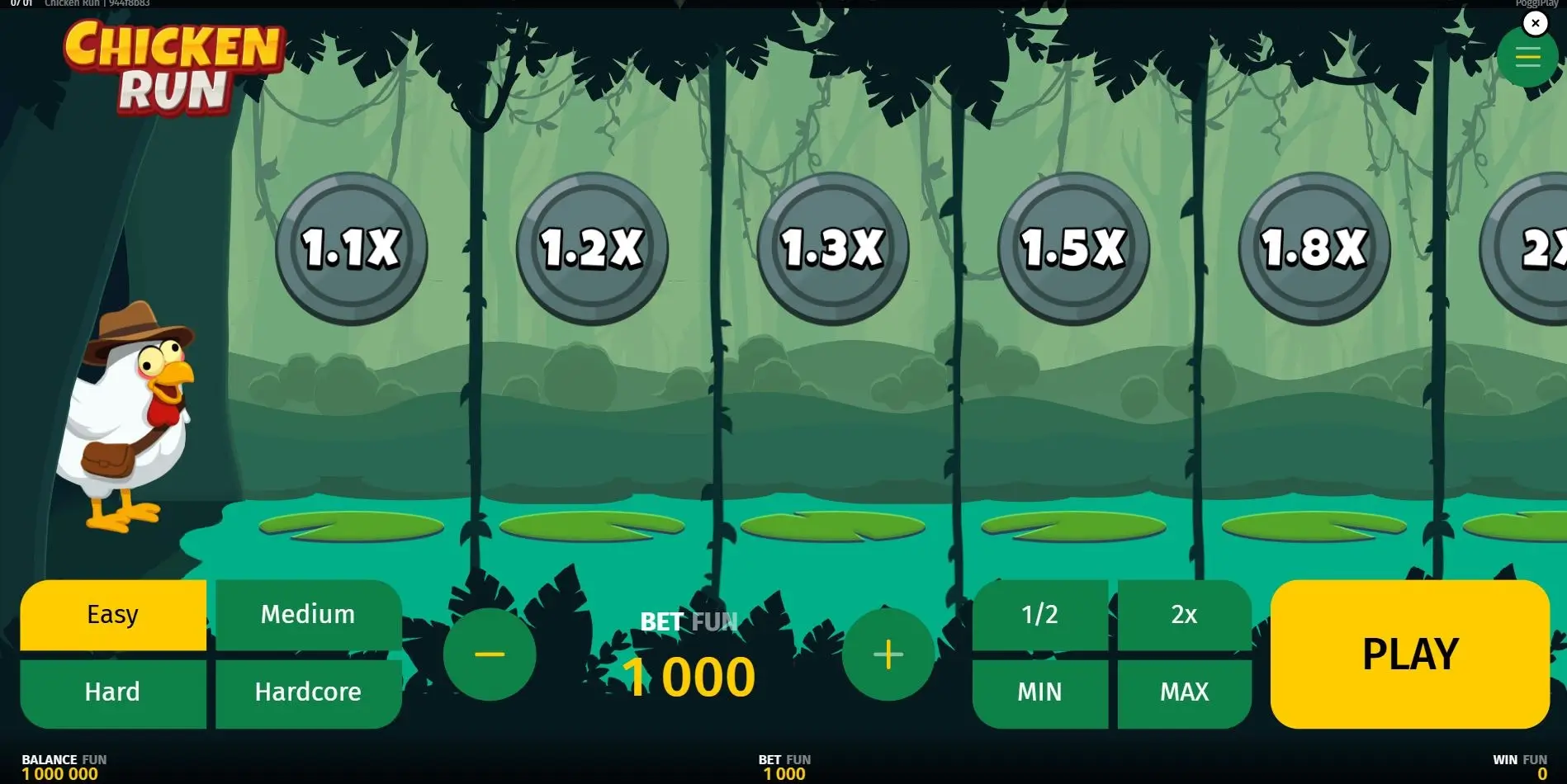
The Mechanics Behind Chicken Run’s Gameplay Flow
Understanding how Chicken Run actually functions requires abandoning traditional slot thinking entirely. Upon starting a round, you’ve set three critical parameters: your bet amount, difficulty level selection, and implicitly, your risk appetite for that specific session. You then press the play button, initiating the chicken’s journey across dangerous terrain toward potential fortune.
Each column represents a decisive moment and a clear decision point. The game presents a new multiplier value, progressively tempting you to advance further. Your actual choices become intensely tactical: do you bank your current winnings by hitting the “Cash Out” button and securing your profit, or do you press “Go!” to risk everything you’ve accumulated for the possibility of a larger multiplier on the next column? This psychological tug-of-war between greed and prudence, between satisfaction with current gains and hunger for bigger rewards, forms the game’s actual core gameplay loop. Unlike traditional slots where you’re essentially passive, Chicken Run places constant decision-making responsibility directly onto your shoulders.
The mechanics are entirely transparent and deliberately so. The game uses certified RNG (random number generator) technology to determine each column’s outcome, ensuring genuine randomness and fairness. No hidden calculations obscure the process—you either successfully advance to the next lily pad or encounter the crocodile. This clarity eliminates the frustration some players legitimately feel with traditional slots, where house edge operates invisibly behind complex symbol combinations, confusing payline structures, and mathematical calculations players don’t understand. In Chicken Run, what you see is what you get.
The game records and displays your complete journey narrative for each round. Some rounds might end after just two steps when you decide conservatively that early profits warrant protection. Others might push to double-digit columns before you either successfully cash out massive multipliers or crash spectacularly when greed overrides prudence. This inherent variability ensures each session feels genuinely fresh and unpredictable, unlike traditional slots where gameplay rhythm feels repetitive and cyclical after extended play sessions. Every round tells a different story—your story—with you as the protagonist making crucial decisions.
Four Difficulty Levels: Risk Architecture Explained
Chicken Run’s genius lies in its adjustable volatility system. Four distinct difficulty modes allow players to customize their experience rather than accepting a fixed volatility setting.
Easy Mode features 20 columns, the longest path available. Your multiplier journey begins at 1.1x and can reach 250x your bet. This mode emphasizes frequency over magnitude. Players encounter many steps before achieving maximum win potential, creating numerous decision-making opportunities. The implied probability of crashing on any single step is lower, meaning consistent advancement is achievable. This mode suits conservative players or those learning the game’s rhythm. A player betting €10 can realistically reach 100x within a reasonable number of rounds, creating satisfying regular wins.
Medium Mode condenses the journey to 16 columns. Starting at 1.2x, this difficulty allows progression to 1,000x your stake. The adjustment creates meaningful risk escalation. Each step carries slightly higher implied crash probability compared to Easy mode, yet the potential for substantial payouts becomes tangible. Many experienced players gravitate toward Medium as the sweet spot between conservative and aggressive. A €10 bet can yield €500+ in winning rounds, providing excitement without overwhelming volatility.
Hard Mode reduces available steps to 12 columns. Beginning at 1.4x, it pushes toward 2,000x maximum win. This difficulty level separates casual players from those comfortable with significant variance. Each advancing column presents noticeably increased crash risk. Players must psychologically prepare for frequent failures interspersed with occasional spectacular wins. Extended losing streaks become statistically probable, requiring adequate bankroll cushioning.
Hardcore Mode represents the ultimate challenge with only 10 columns. Starting at 1.5x and permitting 5,000x maximum win, this level demands nerves of steel. The longest multiplier journey is the shortest, meaning crash probabilities compound rapidly. Reaching column 5 often feels like climbing Everest. However, successful runs yield life-changing payouts relative to initial wagers. This mode targets experienced gamblers comfortable with psychological intensity and extended downswings.

Analyzing RTP Performance and Volatility Characteristics
Chicken Run declares a 95% RTP across all difficulty modes, a competitive figure in modern gaming. However, unlike traditional slots where RTP remains constant regardless of player behavior, Chicken Run’s effective return-to-player ratio depends significantly on individual strategy, difficulty selection, and personal discipline regarding cash-out discipline.
The 95% figure represents a theoretical long-term average assuming optimal play across all four modes and statistically perfect decision-making. However, your actual experience varies dramatically based on chosen difficulty and cash-out discipline throughout sessions. Playing Easy mode with consistent early cash-outs at modest multiplier values might yield closer to 96-97% effective returns due to frequent small wins offsetting minimal losses. Conversely, aggressive Hardcore mode play pursuing massive multipliers and refusing early cash-outs could lower effective returns to 92-93% through inevitable crash sequences and extended losing streaks.
This mechanic reveals something fundamental about Chicken Run’s design philosophy: the game doesn’t hide mathematics behind opaque formulas. Instead, your decisions directly influence mathematical outcomes. Conservative play generates conservative returns. Aggressive play increases volatility and potential variance from the stated RTP. This represents unprecedented player agency in the gambling world.
Volatility in Chicken Run operates in fundamentally different ways compared to traditional slots. Conventional slots impose volatility as an immutable, fixed characteristic determined by game design—high volatility, low volatility, medium volatility remain constant regardless of player actions. Chicken Run inverts this traditional model: you essentially select your personal volatility by choosing difficulty level and establishing cash-out strategies. This represents a fundamental empowerment mechanism largely absent from conventional slots, providing autonomy over risk exposure.
The variance implications are genuinely profound. Easy mode creates extended sessions filled with numerous small wins, ideal for time-entertainment value and entertainment-focused players wanting minimal emotional volatility. Hard and Hardcore modes generate feast-or-famine gameplay patterns—many failed runs quickly punctuated by occasional rare, substantial payouts that create emotional intensity. Medium mode balances these philosophical extremes, offering both entertaining frequency and meaningful win potential that satisfies both engagement and reward desires.
Visual Presentation and Thematic Execution
Chicken Run wraps its mechanical innovation in charming, visually appealing cartoonish aesthetics that enhance rather than distract from gameplay. The game features vibrant, colorful graphics depicting a whimsical journey across lily pads through dangerous waters, complete with an anthropomorphized chicken character full of personality and lurking crocodile threats that represent genuine danger. The visual design philosophy emphasizes clarity and immediate comprehension—players instantly understand what’s happening without requiring explanations or visual guides.
The color palette utilizes bright greens representing safety and vegetation, warm golds suggesting treasure and prosperity, and dynamic animations that convey movement, progression, and tension. These color choices aren’t arbitrary; they communicate psychological information about game states. Safe lily pads appear inviting. The crocodile emerges in threatening reds and oranges. This color psychology subtly guides emotional interpretation without requiring conscious processing.
The chicken character itself functions as a crucial emotional anchor that distinguishes Chicken Run from impersonal traditional slots. Unlike faceless reel symbols that feel disconnected from gameplay outcomes, your chicken becomes a character you develop genuine investment in and root for throughout each round. Each successful step forward feels like collaborative progress and achievement—you’re guiding this chicken to safety and profit, not just watching symbols spin. This narrative framing transforms raw gambling mechanics into a more psychologically engaging interactive adventure.
The crocodile represents tangible threat visualization that makes danger concrete rather than abstract. Rather than impersonal “crash” signals or mathematical probability displays, players see animated crocodile emergence—a clear, visceral, immediate representation of failure. This visual honesty about game risk creates psychological engagement traditional slots struggle to match. You’re not confused about what happened or wondering about hidden mechanics; you watched the crocodile visually emerge and claim this round.
The thematic consistency extends intelligently to thoughtful audio design. Background music maintains upbeat, adventurous tones without becoming intrusive or annoying during extended play sessions. Sound effects clearly distinguish successful steps (satisfying confirmations) from crashed rounds (dramatic failure sounds), providing immediate audio feedback that reinforces decision outcomes beyond visual information. The overall presentation suggests mobile-first design philosophy, evident from streamlined menu systems and large, easily-tappable control buttons designed for touch interfaces.
Mobile optimization appears genuinely flawless across Android and iOS platforms. The game utilizes responsive design principles, scaling gracefully across different screen sizes from large tablets to compact smartphones. Both horizontal and vertical orientations function smoothly and intuitively, accommodating individual player preference without forcing awkward interfaces. Load times prove minimal even on older devices, and animations maintain fluid performance without stuttering or lag. This technical competence ensures consistent experience quality regardless of device type or access method, making Chicken Run equally enjoyable on expensive flagship phones and budget devices.
Uncovering Hidden Mechanics and Strategic Insights
Chicken Run contains several mechanical subtleties that reward deeper investigation and strategic thinking.
Inverse Risk Progression represents perhaps the most elegant design choice. Rather than escalating crash probability linearly, Chicken Run implements inverse risk—earlier columns carry lower crash probabilities than later columns. This design creates natural decision barriers. Players often successfully reach column 8 or 9 before meaningful failure rates accelerate dramatically. This progression feels organic rather than punitive, encouraging continued play without feeling instantly catastrophic.
No “Dead” Spins distinguish Chicken Run from traditional slots’ frequent non-winning rounds. Every Chicken Run round generates either a win (cashing out successfully) or a defined loss (crashing). There are no meaningless, zero-win spins that consume time and wagering without event. This structural distinction creates genuinely engaging gameplay where every action has clear, immediate consequence. Traditional slots frequently present 20-30 consecutive non-winning spins; Chicken Run eliminates this frustration category.
Hardcore’s Initial Hurdle reveals fascinating psychological design. The transition from Hard to Hardcore difficulties creates a perceptual cliff. Hard mode’s 12 columns allow reasonable progression; Hardcore’s 10 columns severely compress available steps. New players attempting Hardcore frequently experience failure within 3-4 steps, creating immediate emotional volatility. This serves as intentional difficulty gate, establishing Hardcore as genuinely elite difficulty rather than modest escalation. Smart players recognize Hardcore demands specific bankroll sizing to psychologically absorb inevitable short-term failure sequences.
The game also implements transparent multiplier calculations. Each column displays its exact multiplier value before you decide whether to advance. This eliminates guesswork or uncertainty about potential payouts. You always know precisely what you’re risking for what potential reward.
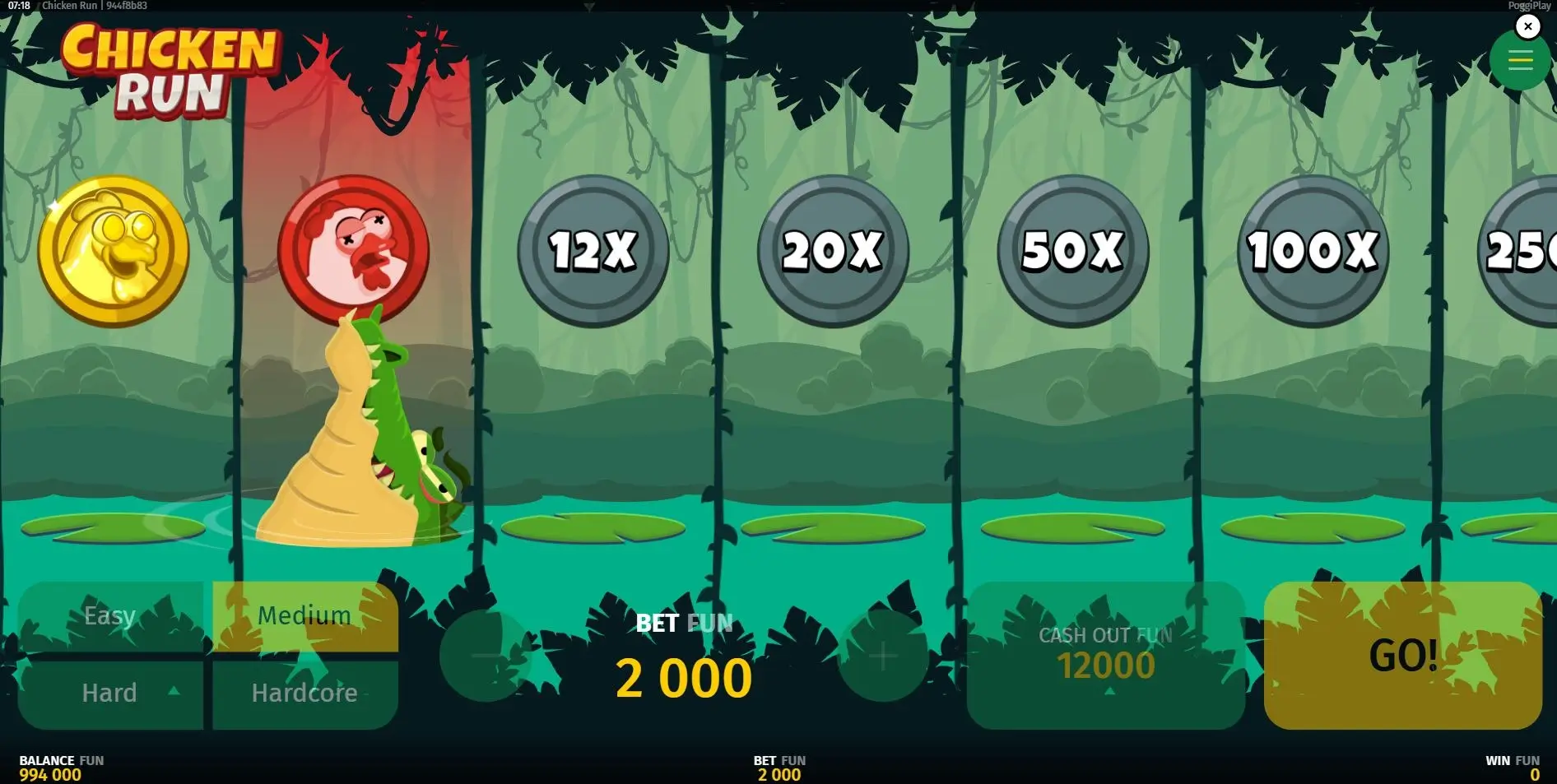
The Psychology of Near-Wins and Escalating Temptation
Chicken Run’s most insidious psychological feature is its sophisticated architecture around near-wins, escalating temptation, and the neurological effects of “almost” moments. These design elements—whether consciously engineered or naturally emergent—create powerful psychological hooks that influence player behavior in profound, often unconscious ways.
Each successful column advance creates compounding psychological pressure that intensifies with every step forward. At column 3 with a modest 5x multiplier, cashing out feels excessively conservative and leaves easy profit untaken. But refusing to advance becomes progressively psychologically harder as multipliers accumulate and visible potential payouts increase dramatically. By column 7 with a compelling 30x multiplier, your brain automatically shifts into rationalization mode: “surely column 8 is relatively safe” or “I’ve come this far, statistically the crocodile won’t appear now.” Cold mathematical reasoning becomes increasingly clouded by emotional investment and sunk-cost psychology.
This escalating temptation dynamic represents genuinely sophisticated behavioral design rooted in cognitive psychology and neuroscience principles. Research definitively demonstrates that near-wins activate identical brain reward pathways as actual victories, creating potent psychological hooks and reinforcement loops. Chicken Run essentially weaponizes this documented neurological tendency in ways traditional slots cannot achieve. As multipliers compound and visible potential payouts increase exponentially, players increasingly feel emotionally justified in advancing, that they somehow “deserve” the additional multiplier, that they’re statistically “due” for continuing success. Rational mathematical calculation deteriorates as emotional investment increases and sunk-cost fallacy takes psychological control.
The game design deliberately extends this psychological tension across multiple sequential decision points spanning 10-20 columns of active gameplay. Traditional slots conclude potential wins with single spin results—reels stop, you see if you won, and the round ends immediately. Chicken Run stretches decision-making and psychological tension across numerous columns, creating extended anticipation sequences and repeated temptation cycles. Each column where the chicken successfully survives reinforces the addictive “just one more” mentality—that familiar voice suggesting a single additional step could multiply profits.
Additionally, successful column advancement provides immediate, unambiguous positive feedback independent of ultimate round success or failure. Your multiplier visibly increased. You survived that step. You won. This intermediate reinforcement occurs well before ultimate round success or failure, creating intermediate reward loops that behavioral psychologists recognize as particularly potent habit-formation mechanisms. Variable ratio reinforcement schedules—receiving rewards at unpredictable intervals—are scientifically documented as creating stronger behavioral conditioning than consistent reward patterns.
Players must approach Chicken Run with explicit pre-determined cash-out strategies established before starting sessions. Deciding in advance to exit at specific multiplier thresholds (like “I will cash out at 10x regardless of circumstances” or “I will never exceed 20x multiplier regardless of temptation”) creates external discipline mechanisms against escalating psychological pressure. Without predetermined decision rules, psychological momentum and emotional investment tend to override prudent decision-making, particularly during extended winning streaks when confidence peaks and risk assessment deteriorates catastrophically.
Frequently Asked Questions
What’s the minimum bet on Chicken Run? The absolute minimum wager is €0.10 per round, making the game theoretically accessible to extremely cautious players or those practicing strategy development. However, real-money gameplay becomes psychologically engaging and meaningful around €1-5 minimum bets, allowing win amounts that feel genuinely rewarding rather than trivially small.
Can I play Chicken Run in demo mode? Yes, the majority of licensed casinos hosting Chicken Run provide complimentary free-play demo versions. These allow unlimited practice without any financial risk, making them ideal for learning the game’s rhythm, understanding cash-out mechanics, and testing personal risk tolerance before wagering actual money.
What’s the realistic win rate across different difficulties? Statistical expectations differ dramatically by difficulty selection. Easy mode players should anticipate winning approximately 45-55% of their rounds, with frequent small wins. Medium mode approximates 35-45% win rates with larger individual payouts. Hard mode drops to 20-30% successful rounds, and Hardcore mode experiences roughly 10-20% successful completion rates for extended multi-column runs.
Is Chicken Run mobile-friendly? Absolutely yes. The game is comprehensively optimized for all major mobile platforms and functions smoothly on both Android and iOS devices. The responsive design adapts seamlessly to various screen sizes from large tablets to compact smartphones.
Are outcomes genuinely random? Yes, completely. PoggiPlay utilizes certified RNG technology ensuring outcome legitimacy and fairness. All results are generated through independently verified random number systems rather than predetermined patterns or algorithms favoring the house.
What happens if my internet disconnects during a round? Most platforms automatically save round progress during active gameplay. Upon reconnection, your session typically resumes mid-round, preventing unfair loss from technical failures beyond your control.
Which difficulty should I start with? Beginners should invariably start with Easy mode. This allows learning the game’s rhythm, understanding cash-out mechanics, and experiencing winning rounds without excessive frustration. Progression to Medium, Hard, and Hardcore should occur only after demonstrating emotional discipline and bankroll adequacy for volatility swings.
Is there a maximum win limit? No artificial cap exists beyond the mathematical 5,000x maximum across all modes. Theoretically, successful Hardcore runs completing all 10 columns at maximum multipliers could yield 5,000x payouts.
How does volatility affect my session length? Easy mode extends sessions significantly through frequent wins, ideal for entertainment-focused play maximizing time engagement. Hardcore mode creates volatile, emotionally intense shorter sessions. Medium offers balanced middle-ground gameplay.
Final Verdict on Chicken Run
Chicken Run represents gaming innovation that transcends simple mechanical novelty or cosmetic freshness. By replacing passive observation with active decision-making, the game creates psychological engagement and genuine interaction that traditional slots struggle to match. The adjustable difficulty system demonstrates remarkable design thinking, allowing individual players to customize volatility and risk exposure rather than accepting imposed, immutable risk profiles determined solely by game designers.
The game’s 95% RTP and transparent mechanics establish player-friendly parameters that compare favorably with industry averages. However, the psychological architecture around escalating temptation and near-wins demands personal discipline and predetermined cash-out strategies. Without such safeguards, players can find themselves pursuing larger multipliers far beyond their initially comfortable risk thresholds, driven by sunk-cost psychology and escalating temptation rather than rational calculation.
Whether Chicken Run becomes your regular slot destination depends fundamentally on personal gaming philosophy and preference for active choice over passive observation. The game delivers exactly what it promises: nerve-wracking decision-making, transparent outcomes where you understand every result, and genuine potential for substantial wins reaching 5,000x your initial wager. For players seeking engagement beyond reel-watching and symbol-matching, Chicken Run merits serious consideration as a genuinely innovative gaming experience.
The game appeals particularly to players with gaming experience who understand variance, bankroll management, and personal discipline. Newcomers to gaming should approach cautiously, starting with Easy mode to develop comfort with decision-making mechanics before graduating to more volatile difficulty levels. The game’s unique structure means that bankroll requirements differ from traditional slots—you need adequate capital to psychologically absorb inevitable losing streaks without emotional distress influencing decision quality.
The chicken awaits your decision. Will you guide it to victory across the crocodile-infested waters, cashing out at your predetermined threshold? Or will greed override prudence, tempting you to press onward until the crocodile inevitably emerges, wiping out your accumulated winnings? Your success in Chicken Run depends less on luck than on psychological discipline and honest self-assessment of your risk tolerance. That’s what makes it genuinely different from traditional slots—and why it deserves serious attention from players seeking authentic gaming innovation.