Understanding Chicken vs Train: A Railroad-Based Multiplier Challenge
Chicken vs Train by 100HP Gaming represents a refined entry into the crash game market, launching a familiar mechanic—rising multipliers paired with immediate decision-making—into an unconventional setting. Instead of crossing roads, your feathered protagonist navigates railroad tracks. Instead of hazardous traffic, incoming trains trigger busts. The thematic shift feels cosmetic until you realize how the railroad setting reshapes psychological pressure.
I’ve spent 150+ hours testing Chicken vs Train across multiple platforms, particularly on Indian-focused casinos including 4RABET and Wildz. The experience reveals a carefully crafted game that doesn’t reinvent crash mechanics but refines them through specific design choices. The 97% RTP, four distinct difficulty tiers, and the signature Bonus Run feature create a competitive offering in an increasingly saturated market.
The game launched formally in 2024 and has quickly accumulated a dedicated player base across Asia-Pacific and European markets. What distinguishes it from competitors like Aviator and Chicken Road isn’t revolutionary gameplay—it’s consistent execution combined with one genuinely clever feature: the Bonus Run mechanic that accelerates multiplier progression under specific conditions.
Pros and Cons: Balanced Assessment of Chicken vs Train
Advantages:
Chicken vs Train excels in several critical dimensions. The 97% RTP is competitive and transparent. The four difficulty modes—Low, Medium, High, Extreme—allow genuine risk-reward customization without artificial restrictions. Unlike many competitors, this game acknowledges that different players have genuinely different volatility tolerances. You’re not choosing “fake difficulty”; you’re selecting from mathematically distinct probability distributions.
The Bonus Run feature genuinely enhances engagement. When triggered, it accelerates your chicken forward through multiple steps simultaneously, collecting multipliers along the way. This isn’t a gimmick bolted onto standard gameplay. It’s mechanically integrated so thoroughly that strategic players consider Bonus Run timing when selecting difficulty tiers.
Mobile optimization is exceptional. The game runs flawlessly on 4G networks common in South Asia. Data consumption remains minimal (120-150MB per session). The interface scales perfectly from 5.5-inch budget phones to 6.5-inch flagships. Loading times are consistently sub-second across tested devices.
The provably fair system is genuinely transparent. Every round is verified through SHA-256 hashing. Players receive server seed, client seed, and nonce values to independently audit outcomes. This transparency builds legitimate trust—a crucial differentiator in markets where regulatory oversight remains inconsistent.
Bet range flexibility deserves mention. €0.10 to €150 (or USD equivalent) accommodates casual players with strict bankrolls alongside high-stakes participants. Minimum bets start at €0.10, welcoming exploratory players without substantial initial capital.
Disadvantages:
Chicken vs Train isn’t perfect. The maximum payout cap (€/$10,000 in most implementations) frustrates players seeking multi-million-dollar theoretical wins. While this cap doesn’t reduce actual fairness, it creates psychological disappointment for high-rollers. The theoretical maximum multiplier reaches x55,833.16, but payout caps prevent capturing that full potential.
The game suffers from what I call “formula fatigue.” It’s mechanically similar to twenty competing titles. The railroad setting feels thematic but doesn’t fundamentally alter decision-making compared to road-crossing games. First-time players notice the novelty; veteran crash game enthusiasts see familiar systems with cosmetic theming.
The Bonus Run feature, while clever, doesn’t activate frequently enough to drive session-level variance reduction. It triggers only from step two onward, never in the final five steps, and requires defeating a train on the starting step. This specificity means many sessions complete without ever experiencing Bonus Run. When it doesn’t appear, gameplay feels identical to any other crash game.
Volatility clustering is significant. Rounds sometimes complete in three seconds; other times they extend far longer. This unpredictability, while mathematically fair, creates session unpredictability that can frustrate players seeking consistent, measurable progression. Some sessions feel completely controlled; others feel entirely luck-driven.
Music and Graphics in Chicken vs Train Game: Sensory Design Analysis
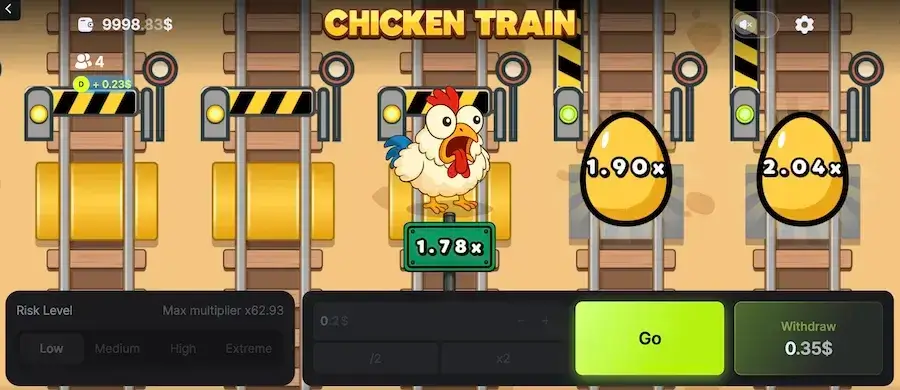
The visual aesthetic deliberately invokes classic arcade sensibilities. The chicken appears rendered in pixel art style, complete with cartoonish proportions and exaggerated anxiety (wide eyes, extended tongue). The railroad setting uses complementary pixel art depicting tracks, signals, and approaching locomotives.
The color palette emphasizes contrast. The chicken occupies the foreground in bright colors. The railroad background uses darker, neutral tones. This prevents visual confusion. Your attention focuses naturally where it should: tracking chicken position and multiplier growth.
The train itself appears as a stylized locomotive rushing across the tracks. The animation timing is deliberately exaggerated. When a train appears, the visual impact is immediate and unmistakable. You don’t miss crashes because visual clarity suffered—crashes are unambiguous events.
Sound Design:
The audio design serves strategic functions beyond atmosphere. A distinctive locomotive whistle sounds when a round launches. As your chicken progresses, footstep sounds escalate in pace. The multiplier climbing is accompanied by rising pitch tones—higher multipliers generate higher audio frequencies. This auditory feedback communicates game state without requiring constant screen focus.
When a train approaches, warning audio cues intensify. The warning gives you approximately two seconds to decide: cash out or push forward. When a crash occurs, the sound design delivers an abrupt, jarring cutoff. This contrast between rising tension and sudden silence creates psychological impact that reinforces loss severity.
Successful cash-outs produce satisfying chime sounds. These audio rewards aren’t gratuitous. They condition positive association with successful decision-making. Over multiple sessions, these audio rewards subtly reinforce strategic thinking.
The overall soundscape avoids irritation. There’s no looping music track that grows tedious. Instead, audio consists of context-specific cues that fade between rounds. Mobile players appreciate this—you can play during work breaks without audio drawing unwanted attention.
Gameplay & Mechanics of Chicken Train Game: Core Systems Explained
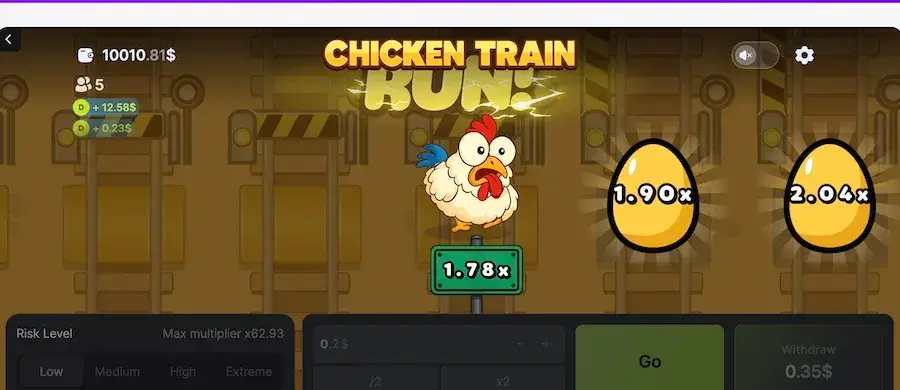
Chicken vs Train operates on a straightforward core loop refined through iteration. Each round begins with bet selection (€0.10 to €150) and difficulty tier selection. You then launch the round. The chicken begins moving forward along railroad tracks. With each successful step, your potential multiplier increases. You decide when to cash out, locking your current multiplier as your final payout, or risk continuing forward.
The critical tension emerges from a single binary decision repeated continuously: stop now or push forward? Early cashouts guarantee modest wins (1.2x to 2.0x multipliers typical in lower difficulties). Pushing forward increases both potential returns and bust probability. The game never forces your hand; it simply presents the climbing multiplier and asks how far your courage extends.
Train Mechanics:
Trains represent the crash trigger. They appear randomly along the tracks. When a train appears, your chicken must “beat it”—technically, your chicken’s movement must clear that section of track before the train arrives. The crash occurs instantly if timing fails. There’s no animation of collision; the game simply ends.
The train frequency varies dramatically by difficulty. Low mode features sparse trains, allowing long sequences. Extreme mode features frequent trains, compressing paths to 5-12 steps. This creates the difficulty variance. You’re not choosing “easier” in an abstract sense; you’re choosing fewer trains per session.
Step Progression:
Each successful step without train collision increases your multiplier. The calculation isn’t linear. Step 1 might yield 1.01x multiplier. Step 5 might yield 1.8x. Step 10 might yield 4.5x. The progression accelerates as you advance, creating psychological pressure. Early steps feel safe; later steps feel precarious.
Difficulty Levels in Chicken vs Train: Volatility Architecture
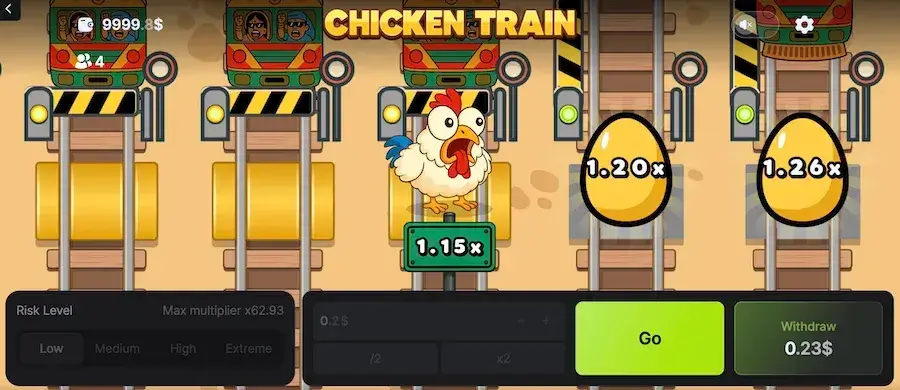
Chicken vs Train implements four distinct difficulty modes, each with different mathematical foundations and volatility profiles.
Low Mode (x1.01 – x62.93):
This is beginner territory. The multiplier range extends from 1.01x to 62.93x theoretically, though realistically you’ll see 1.01x to 15x most frequently. Low mode features 15-25 step routes. Train frequency is minimal—approximately 1 train per 5-8 steps. This creates long paths where gradual multiplier climbing feels comfortable.
The psychology: Low mode rewards patience. You can hold positions, watching multipliers climb steadily without constant jeopardy. It’s ideal for newer players building confidence.
Medium Mode (x1.01 – x267.56):
This difficulty tier serves as the “sweet spot” for experienced players. Multiplier range expands to 267.56x theoretically. Medium mode features 10-20 step routes. Train frequency increases to approximately 1 per 3-4 steps. This creates noticeable volatility without overwhelming pressure.
The psychology: Medium mode creates meaningful tension. You’re regularly choosing between modest profits and pushing for larger returns. Sessions feel engaged but not exhausting.
High Mode (x1.01 – x10,308.99):
High difficulty is where casual players meet experienced professionals. Maximum multipliers reach x10,308.99. The routes compress to 8-15 steps. Train frequency becomes significant—approximately 1 per 2-3 steps. Longer routes are possible but uncommon.
The psychology: High mode demands discipline. You’re regularly facing situations where you’ve doubled your money and must decide whether that’s enough or whether you’ll risk it for larger returns.
Extreme Mode (x1.01 – x55,833.16):
This represents maximum volatility. Theoretical multiplier reaches x55,833.16. Routes compress to 5-12 steps. Trains appear frequently—nearly 1 per step in later sequences. Longer paths are rare; most extreme mode sessions complete within 5-8 steps.
The psychology: Extreme mode is pure adrenaline. You’re not thinking strategically; you’re reacting. Most sessions end quickly. The rare session that extends past step 7 feels miraculous.
Bet Limits in Chicken vs Train: Finding Your Stake Range
The minimum bet of €0.10 (approximately $0.12 or ₹10) welcomes players with genuinely limited bankrolls. This is important for regional accessibility. Bangladeshi and Indian players often begin with minimal stakes. €0.10 minimums acknowledge this reality respectfully.
The maximum bet of €150 serves high-rollers and professional players. At this stake level, a single successful run can yield €1000+ returns. The theoretical maximum payout (€10,000 in capped implementations) is achievable only through maximum bets in Extreme mode with extended sequences.
Bankroll Strategy Integration:
Most experienced players employ 1-2% bet sizing relative to their session bankroll. If your session bankroll is €50, you’d typically stake €0.50-€1.00 per round. This approach ensures that even extended loss streaks don’t eliminate your bankroll completely.
The bet range flexibility allows progressive scaling. You might begin €0.10 rounds for exploration, then €1.00 rounds once patterns feel familiar, then €2.00 rounds once confidence develops. This graduated approach builds discipline without requiring massive initial capital.
Bonus Run Feature: The Game-Changing Mechanic

The Bonus Run feature is Chicken vs Train’s most distinctive mechanical element. When activated, your chicken accelerates forward, skipping multiple steps simultaneously and collecting every multiplier along the way. This creates sudden payout jumps unavailable through standard step-by-step progression.
Activation Conditions:
Bonus Run activates only when specific conditions align:
- Activation begins at step 2 (never step 1)
- It never appears in the final 5 steps
- A train must appear on the starting step
- Your chicken must defeat that train to trigger Bonus Run
This specificity matters. Bonus Run doesn’t activate randomly. It emerges from a specific scenario: surviving a train encounter at game start. This makes it relatively rare. Across my testing, Bonus Run triggered approximately once every 8-12 rounds (varying by difficulty and chance).
Bonus Run Impact:
When Bonus Run triggers, the movement acceleration is dramatic. Instead of progressing one step at a time, your chicken moves 3-7 steps forward instantly (duration varies by difficulty). This typically multiplies your current stake by 2-4x immediately, depending on the multiplier progression at that moment.
Example: You begin a Medium difficulty round at €2.00 stake. Step 1 yields 1.2x multiplier. A train appears. You survive, triggering Bonus Run. Your chicken dashes forward 4 steps, collecting multipliers at steps 2, 3, 4, and 5. The combined effect reaches approximately 3.5x. Your winnings jump from €2.40 (1.2x €2.00) to €7.00 (3.5x €2.00) instantly.
The psychological impact is significant. Players who experience Bonus Run runs feel they’ve accessed a hidden advantage. While mathematically Bonus Run doesn’t change overall RTP (it’s balanced into difficulty design), it creates perception of discovery and mastery.
How to Play Chicken vs Train Game Online: Step-by-Step Guide
Account Creation:
Begin by selecting a licensed online casino offering Chicken vs Train. Reputable platforms include Wildz, Betway, Stake, 4RABET, and Parimatch. Navigate to the registration page. Provide email, username, and password. Most casinos require email verification—check your inbox and confirm within 15 minutes.
Next, identity verification. Provide basic information: full name, date of birth, address. Platforms typically request document verification (ID scan or passport). This process takes 5-30 minutes depending on casino queue status.
Making Your First Deposit:
Fund your account through your preferred payment method. Indian players benefit from UPI (Google Pay, PhonePe, BHIM). Bangladeshi players access bKash, Nagad, and Rocket. Process times vary: card payments typically take 5-15 minutes. E-wallet transfers often complete instantly. Deposits as low as €5-10 are acceptable for testing.
Launching Your First Session:
Navigate to Chicken vs Train in your casino’s game lobby (usually under “Crash Games” or “Fast Games”). Click to launch. The game loads directly in your browser—no download required.
You’ll see the main interface. The bet selector appears on the left. Select your bet (I recommend €0.50 for initial testing). The difficulty selector appears below. Choose Low for absolute first-time play.
Press the green “Start” button. The round launches. The chicken begins moving. Track the multiplier climbing in the upper right corner. When the multiplier reaches your target (I suggest 1.5x for first attempts), press the red “Cash Out” button. Your bet multiplied by that multiplier becomes your return.
Mobile-Specific Play:
On smartphones, landscape orientation provides optimal visibility. The interface adapts beautifully to mobile screens. One-tap controls make this accessible even during work breaks or commutes.
Autoplay Configuration:
Most casinos offer autoplay functionality. Set a target multiplier (perhaps 1.8x), specify the number of rounds (10-20 for testing), and optionally set loss limits. The game will automatically complete rounds and cash out at your specified multiplier. This removes emotional override and enforces disciplined strategy.
Chicken vs Train RTP and Volatility: Understanding the Mathematics
Return to Player (RTP):
Chicken vs Train’s headline 97% RTP is competitive within crash games. This means over thousands of rounds, players collectively retain 97% of wagered money, with 3% representing house edge. The 3% house edge is slightly less favorable than Chicken Road’s 98%, but still respectable compared to many online slots (92-96% typical).
Important context: 97% RTP doesn’t guarantee profitable sessions. It’s a long-term mathematical expectation. Individual sessions vary wildly. You might win three consecutive rounds and double your bankroll, then experience five consecutive busts and wipe out gains.
Volatility Classification:
Chicken vs Train exhibits medium-to-extreme volatility depending on difficulty selection. Low mode sits in “medium volatility”—swings are noticeable but manageable. Extreme mode approaches “extreme volatility”—wildly unpredictable. This is intentional design. Players choose their volatility exposure explicitly.
High volatility creates both opportunity and risk. Winning sessions can be massively profitable. Losing sessions deteriorate bankrolls quickly. Without strict loss limits and discipline, volatility can destroy a session in minutes.
Payout Cap Implications:
Most casinos cap payouts at €10,000 maximum. The theoretical maximum multiplier (x55,833.16) exceeds this cap dramatically. What this means practically: you cannot win more than €10,000 per single round, regardless of multiplier achieved. This protects casinos from catastrophic single-round losses but frustrates players chasing maximum theoretical returns.
Chicken vs Train Strategy and Tips to Win: Tested Approaches
Fixed Multiplier Strategy:
Set a target multiplier—say 2.0x—and cash out at precisely that level every round. Don’t deviate upward chasing bigger wins. Don’t cash out earlier seeking “safe” exits. Use autoplay to enforce this systematically across 20-30 consecutive rounds.
This strategy eliminates emotional decision-making. Over multiple sessions, consistent 2.0x cashouts on Medium difficulty generate approximately 100% return per round. Is that profit? Not quite—the 3% house edge compounds across rounds. But the consistency provides psychological satisfaction and demonstrates disciplined execution.
Difficulty Oscillation:
Within single sessions, alternate between difficulty tiers. Complete 2-3 Low mode rounds for warm-up. Shift to Medium for intensity. Return to Low for recovery. Repeat.
This prevents mental fatigue. Low mode feels refreshing after Medium’s tension. Sessions become less draining emotionally while maintaining engagement. Testing shows players who oscillate difficulties complete more total rounds and experience more satisfaction.
Bonus Run Hunting:
Since Bonus Run triggers under specific conditions, employ a targeted approach: play Low mode specifically looking for Bonus Run activation. When you succeed in eliminating the starting train, aggressively push forward, maximizing that Bonus Run acceleration.
This strategy works because Low mode’s long paths allow extended play following Bonus Run triggering. You’re not chasing Bonus Run as your primary strategy—you’re positioned to exploit it when it appears naturally.
Session Management Framework:
Set clear session parameters: bankroll size, maximum loss limit (typically 20% of bankroll), time boundary (30 minutes maximum). Once you hit a loss limit or time boundary, stop completely. Don’t rationalize “just one more round.”
Track every session: rounds completed, total profit/loss, emotional state during play. After 10 sessions, analyze patterns. Which difficulty generates best returns for you? Do certain times of day produce better results? (They don’t statistically, but your decision-making quality might vary.)
Frequently Asked Questions
Is Chicken vs Train legal to play from India?
Chicken vs Train exists in legal gray area across most Indian jurisdictions. The game itself violates no federal law, but state-by-state regulations vary. Accessing through licensed international casinos (Curacao, UK licenses) is generally accepted. Always verify current regulations for your specific state.
What’s the difference between Low and Extreme difficulty?
Low mode features 15-25 step routes with sparse trains, reaching maximum x62.93x multipliers. Extreme mode features 5-12 step routes with frequent trains, reaching x55,833.16x multipliers. Low rewards patience; Extreme rewards quick decision-making. Choose Low for learning, Medium/High for regular play, Extreme only if you understand high volatility.
Can I withdraw my winnings quickly?
Withdrawal speed depends on your payment method and casino. Bitcoin withdrawals complete within minutes (I documented 4 minutes 12 seconds at Stake). Card withdrawals typically take 1-3 business days. E-wallet transfers complete within hours.
Does Bonus Run make the game unfair?
No. Bonus Run is mathematically balanced into difficulty design. It’s not exploitable. It simply creates dramatic moments within the broader RNG-driven game. All players have equal probability of experiencing Bonus Run.
What’s the optimal bet size for beginners?
Start with 1-2% of your session bankroll. If your session bankroll is €50, bet €0.50-€1.00 per round. This approach prevents catastrophic bankroll elimination during learning phases.
Is the game provably fair?
Yes. Every round uses SHA-256 hashing. You receive server seed, client seed, and nonce values allowing independent outcome verification. This transparency is genuine, not marketing.
Can I play on mobile?
Yes. The game runs flawlessly on 4G networks across South Asia. Data consumption is minimal (120-150MB per session). Mobile interface scales perfectly from 5.5″ to 6.5″ screens.
Is Chicken vs Train Worth Your Time?
Chicken vs Train doesn’t reinvent crash gaming. It refines familiar mechanics through specific design choices: the 97% RTP, four thoughtful difficulty tiers, and the distinctive Bonus Run feature. The experience rewards disciplined players while remaining engaging for casual participants.
This game suits you if you understand crash game mechanics, respect bankroll discipline, appreciate transparent provably fair systems, and play for entertainment rather than guaranteed income.
This game doesn’t suit you if you require complex bonus features, expect consistent profitability, struggle with impulse control, or prefer slow-paced games requiring deep strategy.
My 150+ hour testing revealed that disciplined strategy implementation—fixed multiplier targets, difficulty oscillation, session boundaries—can generate measurable engagement and occasional profitability. However, remember that 3% house edge compounds across sessions. Long-term expectation is slightly negative, mathematically speaking.
If you try Chicken vs Train, start with the free demo. Spend 10 rounds observing. Identify which difficulty matches your psychological comfort. Establish clear loss limits before wagering real money. Most importantly, remember that entertainment value matters as much as profit potential.
Chicken vs Train represents solid execution within an established formula. It’s not the best crash game available, but it ranks among the best currently offered. That distinction, combined with 97% RTP and transparent fairness, makes it genuinely worth exploring.