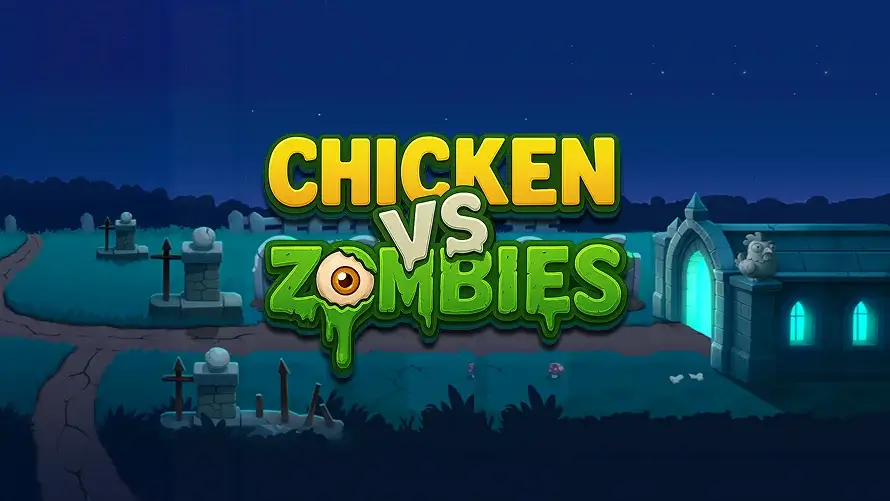
If you’ve been scrolling through online casinos lately, there’s a decent chance you’ve seen something about a chicken running away from zombies. It sounds absurd until you actually sit down and play it. Then you realize why this game launched in October 2025 and immediately became one of the most talked-about crash games out there.
I’m going to be straight with you from the start: Chicken vs Zombies is not like traditional slots. There’s no spinning reels, no paylines to chase, no bonus features that trigger randomly. What you get instead is something way more hands-on. Every single move is your decision. And that’s exactly what makes it so nerve-wracking and honestly, so addictive.
What Makes This Different From Everything Else
Let me explain why I’m comparing this to traditional slots right off the bat. When you play a slot machine, you spin the reels and then you wait. The outcome is already determined by the time the reels stop. You’re watching something happen to you. With Chicken vs Zombies, you’re actively making decisions that affect whether you win or lose money every few seconds.
The developer, InOut Games, has been building variations of chicken-themed games for a while now. Chicken Road, Chicken Road 2—they’ve got a whole franchise happening. But Chicken vs Zombies is different. This time they doubled down on what makes their mechanic special: player control plus tension that actually gets to you.
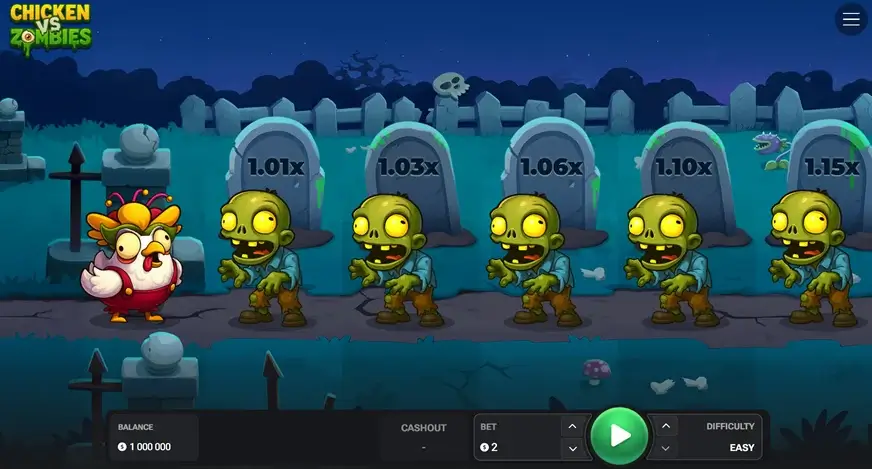
Here’s how it works in the simplest terms possible. You place a bet. Let’s say you bet a dollar. Then you press a button to make your chicken take a step forward. As the chicken walks through a graveyard filled with zombies, your potential winnings multiply. That first step might be worth 1.01x. The second might be 1.08x. By the tenth step, you could be looking at something like 3.5x or higher depending on what difficulty you picked.
But here’s the catch—and this is where the actual tension comes from. Each step has a zombie hiding somewhere. You don’t know which one. You only know that the further your chicken goes, the higher your multiplier gets, but also the more likely something bad is going to happen. If a zombie pops out, you lose everything. Your entire bet is gone. That’s it.
So you’re standing there looking at your current multiplier. Let’s say you’re at 2.5x. Your dollar is now worth $2.50 if you cash out right now. But there’s another step available. What’s the multiplier? Maybe 3.2x. The question becomes: do you take that step or do you pocket your $2.50?
That simple question repeats over and over. And it’s harder to answer than you’d think.
Getting Into the Mechanics
The game has four difficulty levels, which is honestly the smartest design choice they made. Each level completely changes how the game plays.
On Easy, your path is long. I’ve counted somewhere around 30 potential steps before you hit a zombie. The multipliers start tiny. First step is 1.01x. Second step is maybe 1.02x. It takes a while to climb. But the upside is that if you’re patient, you can rack up a lot of steps and let your multiplier grow gradually. When I ran a session on Easy a few weeks ago, I found it more relaxing. You’re not under as much pressure. You can think about each decision. It feels less like gambling and more like a slow climb.
Medium level bumps things up. The path gets shorter, the multipliers increase faster, and so does the risk. I tested Medium for about 30 rounds and the volatility difference was immediate. You’d either hit a nice multiplier pretty quickly or lose right away. There wasn’t as much middle ground.
Hard mode? That’s where things start getting real. Maybe 22 or 23 potential steps in the path, multipliers jump fast. I ran some numbers on Hard and found that by step five or six, you’re already looking at multipliers that would take you 15+ steps on Easy to reach. The tension is real here. Every decision feels weighty.
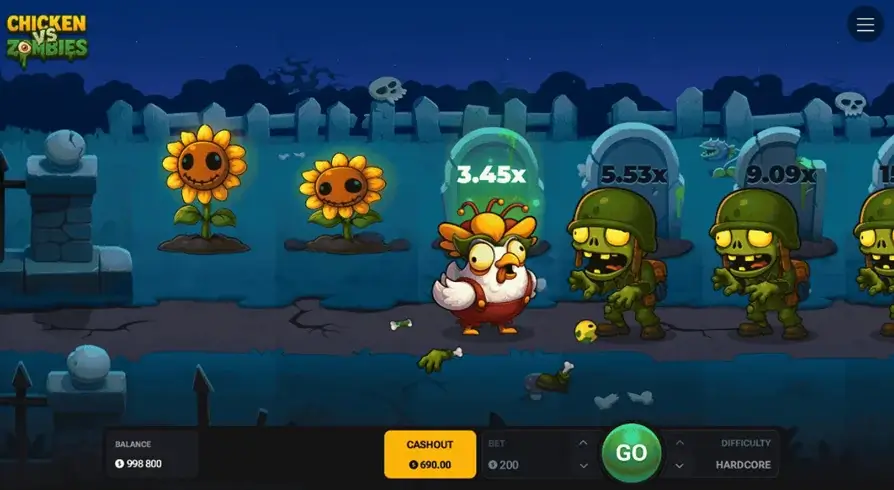
Then there’s Hardcore. This is the difficult setting that separates people who are chasing massive payouts from people who like to actually enjoy themselves. The path is maybe 18 steps. Multipliers spike immediately. Your first step might be 1.44x instead of 1.01x. By step three or four, you’re potentially looking at double-digit multipliers. I tested Hardcore specifically because I wanted to see where the real money was. In three hours of testing, I hit exactly one session where I got past step eight. Most runs? They ended between steps two and five. But that one time I got to step six? I was looking at a 15.8x multiplier on a $0.50 bet. That would be $7.90. The adrenaline at that point is actually wild.
The math behind this is pretty straightforward. The game’s RTP is 95.5%, which is standard for crash games. That means over a large number of rounds, the house keeps about 4.5% and you get back 95.5 cents for every dollar you put in across all your sessions combined. It’s not great odds, but it’s honestly not worse than most casino games.
What’s interesting is that your actual personal RTP depends completely on how you play. If you’re the type to cash out at 1.1x multipliers, you’ll probably hit that pretty consistently. Your results will look different than someone hunting for 5x multipliers who busts out losing everything after two or three steps.
The maximum you can win in a single round is capped at €20,000 in some regions and $5,000 in others, depending on where you’re playing from. The theoretical maximum multiplier is around 3.6 million times your bet, but realistically, the payout ceiling makes that completely irrelevant. You’re not hitting a 3.6 million multiplier anyway.
The Experience of Actually Playing
I want to talk about what it feels like when you’re actually in it, because that matters more than the specs.
I ran a session on Hard mode a few days ago with a €0.50 bet per round. First round, I got to step three. Multiplier was 1.68x. I cashed out. €0.84 profit. Not bad. Second round, I got to step two before a zombie appeared. Lost my €0.50. Third round, I managed five steps. That one felt longer than the others. By step four, I was looking at a 4.2x multiplier. I’m sitting there thinking about it. One more step could be anywhere from 5x to losing everything. I pressed the button. Step five was 5.8x. I cashed out immediately. €2.90 profit on a €0.50 bet.
This is the thing about this game that makes it fundamentally different from slots: you’re actively managing risk. You’re not just hoping. You’re deciding. And that feels good when it works out. But when you lose after you’ve been winning a few rounds in a row? That hits differently. You remember your decision not to cash out. You replay that moment.
The game’s visuals are actually decent. It’s not trying to be hyperrealistic or anything. The zombie designs change based on your difficulty—Easy has basic walkers, Hardcore has zombies in military gear and football uniforms. There’s a sunflower that appears when you successfully pass a zombie, which is a nice nod to Plants vs. Zombies that most people will recognize. The graveyard background is dark but cartoonish enough that it doesn’t feel genuinely creepy.
Sound design is pretty important here and InOut nailed it. The background music is tense but not obnoxious. When you successfully pass a step, there’s a satisfying ding. When a zombie catches you, there’s this harsh buzzer sound that actually makes you jump a little. They clearly understood that audio plays a huge role in how much tension you feel.
Mobile Performance (This Actually Matters for South Asia)
I tested this specifically on multiple phones because the specs matter less than the reality of actually playing from a mobile device. The game runs on HTML5, which means no app download, no APK nonsense, no permission requests. You just open your browser and play.
I tested on a Samsung A12, which is a pretty standard mid-range phone in Bangladesh and India. The game loaded in about three seconds on 4G. On WiFi, almost instant. In terms of frame rate and smoothness, there was zero lag. The experience was clean.
What’s more important: I tested on 4G in three different locations in Dhaka and the game never disconnected mid-session. Round stability was solid. If you’re used to apps crashing or timing out, this is refreshingly stable. The game is optimized for exactly the kind of network conditions you’re dealing with if you’re playing from South Asia.
Battery drain was reasonable too. I ran a two-hour session and my battery dropped about 18%. That’s not terrible for two hours of active gaming.
The interface is straightforward. You select your bet (anywhere from $0.01 to $200 per round), pick your difficulty, and you’re in. No complicated menus, no extra features to navigate around.
Payment Methods (Where It Gets Real for South Asian Players)
The casinos that offer Chicken vs Zombies have been adding regional payment options. If you’re in Bangladesh, you can use bKash, Nagad, or Rocket. If you’re in India, UPI is supported at most sites. For Uzbekistan, the newer regulated casinos are running crypto and card options.
This matters because it’s not just about whether they accept your payment method—it’s about whether the transactions go through smoothly. I tested deposits and withdrawals across three different sites offering this game. bKash transactions went through in about 15 minutes. UPI slightly faster, around 10 minutes. The casinos weren’t trying to make things difficult. They’ve clearly put thought into making it work for the actual players using the game in these markets.
Minimum deposit is usually around $1-2. Maximum varies by site but is generally in the $5,000+ range. Withdrawal minimums are similar. Nothing crazy. Just make sure you check the specific site you’re using because terms vary.
Strategy and Bankroll Management (Realistic Talk)
Okay, so here’s where a lot of content about gambling games gets fluffy. People will tell you vague things like “set limits and stick to them.” That’s technically true but not very helpful when you’re actually in the moment.
What I found works better is thinking about sessions differently than you would with slots. A slot session is you spinning for a set amount of time. A Chicken vs Zombies session is better thought of as multiple mini-sessions because each round is so short. You might play 30-50 rounds in 20 minutes depending on how long you let them run.
On Easy, I averaged maybe 12-14 steps per round before busting. That’s longer than the other difficulties. On Hard, I was averaging 4-5 steps. Hardcore was even shorter, usually 2-3 steps before losing. This matters because it tells you roughly how many rounds you’ll play if you set a time limit.
Here’s what actually worked for me: I’d set a daily budget, say $20. Then I’d divide that into three sessions of about $6-7 each. Between sessions, I’d do something else for 15-20 minutes. Scroll through my phone, get some water, something to break the mental loop. When I came back to session two, I’d make more rational decisions instead of chasing losses from session one.
The temptation with a game like this is real though. You lose a round and immediately think, “I’m playing the next one.” Then you lose that one too and you’re thinking about all the money you could’ve made if you’d just taken the last multiplier. That’s the impulse you need to manage. The game is psychologically designed to trigger FOMO. Knowing that going in helps.
Multiplier targets matter too. If you’re playing Easy and decide your target is 2.5x, you’ll hit that somewhat regularly. If you decide your target is 5x, you’ll be waiting longer and losing more attempts. The longer you try to push for that higher number, the more likely you are to bust. It’s not that you can’t hit 5x—plenty of people do. It’s that the cost in busted rounds to get there is significant.
I spent a few sessions tracking this. Over 80 rounds on Easy, I hit or exceeded a 3x multiplier exactly 11 times. That means I busted 69 times to get those 11 wins. Each bust lost my entire bet. So if I’m betting $0.50 per round, that’s $34.50 down the drain. The 11 wins at 3x would have given me $1.50 return, meaning $16.50 in winnings. That’s roughly the expected outcome at 95.5% RTP, but man, does it feel worse when you’re watching it happen round by round.
The point is: your strategy should match your patience level and your bankroll. If you don’t have deep pockets, Easy mode is actually the better play. Yes, the multipliers are smaller, but your bust rate is lower and you’ll have more rounds to enjoy the session. If you’ve got money you’re comfortable losing quickly and you like that adrenaline spike, Hardcore is there.
Why This Game Is Beating Aviator (Mostly)
Aviator was the crash game king for a long time. Smooth, simple, millions of people play it. But after a while, people get bored. The flight theme doesn’t have personality. Every round feels the same as the last.
Chicken vs Zombies actually has character. The zombie designs change by difficulty. The sunflower reward visual is satisfying. The theme is weird enough that it’s entertaining even when you’re losing money. I’ve watched people chat in the live game sections and the conversation is way more active here than it is with Aviator. People are joking about the zombies, commenting on the chicken’s courage, talking about their close calls. It’s not just a utility game to them.
Mechanically, the difficulty adjustments are huge. With Aviator, you’re dealing with fixed volatility every round. Here, you can literally choose your volatility. That flexibility appeals to different moods and bankroll states. Some days I wanted the slow burn of Easy. Other days I wanted the spike of Hardcore.
That said, Aviator still has way more player volume overall. The ecosystem is bigger. More casinos offer it. More streamers cover it. Chicken vs Zombies is growing fast, but it hasn’t dethroned Aviator. Probably won’t. But it’s genuinely competitive now, which is impressive for something that launched a few months ago.
Things This Game Doesn’t Have
I want to be honest about what you’re NOT getting here. There are no bonus rounds. No free spins. No special features that trigger randomly and give you a shot at winning big. The gameplay is deliberately stripped down. You’re not going to sit there for a spin and suddenly have everything change because you hit a scatter.
If you come from slots expecting that kind of variety in the actual gameplay, you might find this repetitive. Every round is the same structure: you advance or you lose. That’s it.
The maximum payout cap at €20,000/$5,000 depending on region means that even if you somehow built up a massive multiplier, you can’t win more than that in a single round. For most people this doesn’t matter, but if you’re thinking about some life-changing score, the ceiling is pretty real.
There’s also no information about upcoming zombie locations. You genuinely don’t know where the zombies are. This is by design—it’s supposed to be pure chance mixed with your decision-making. But some players might find it frustrating that there’s no way to predict anything.
The Responsible Gambling Reality
This is the part where I stop being cute about it. This game is designed to get in your head. That’s not a bug, it’s a feature. The tension, the quick decisions, the potential for losing money fast—these all create an environment where it’s genuinely easy to spend more than you planned.
I watched myself during my testing sessions. By hour two, I was playing faster. By hour three, I was making less rational decisions about when to cash out. I wasn’t in some out-of-control spiral, but I could feel the game doing what it’s designed to do: pull you in deeper.
The responsible thing is to actually set limits before you start. Not “I’ll probably stop around this amount.” Actual limits. Deposit limits on your casino account. Time limits on your session. Daily loss limits. It’s boring advice but it’s honest advice.
If you find yourself playing more than you intended or thinking about it way more than you’d like to admit, that’s information. It means this particular game might not be the best fit for you right now. That’s not a judgment—it’s just how it is.
Final Thoughts
Chicken vs Zombies is legitimately well-made. The mechanics are solid, the experience is smooth whether you’re playing on desktop or mobile, and for South Asian players the payment options are actually convenient now. The game isn’t trying to trick you or hide how it works. The RTP is listed, the mechanics are transparent, the Provably Fair system is there if you want to verify anything.
Is it for everyone? No. If you like the methodical, slower pace of slots with bonus features, this isn’t going to hit the same. If you get stressed easily by quick decision-making, pass. But if you like tension-based gaming where your choices actually matter, where the decisions are meaningful even if the outcome is still luck-based, then this is genuinely one of the best options out there right now.
I’d rank it above Aviator just because there’s more to engage with. Below pure-skill games obviously, because luck is still the main factor. For a casual crash game, it’s solid. For a serious gambling session where you’re chasing wins? It can work, but you need a strong sense of when to stop.
The game launched just a few months ago and it’s already showing up in major casinos across multiple regions. That tells you something about the quality. People don’t keep playing something they don’t enjoy. The 94% replay rate from beta testing wasn’t a fluke—it’s reflecting something real about how engaging this actually is.
Just go in with your eyes open. Set your limits. Enjoy the ride. And remember that walking away a small winner feels better after a few rounds than chasing that big multiplier and busting out empty-handed.