There’s something almost charming about a slot that doesn’t take itself too seriously. Chickenville Power Combo shows up with its cartoon hens, a windmill swaying in the background, and a soundtrack that sounds ripped straight from a county fair — and it dares you to dismiss it. I almost did. Then I ran a 300-spin test session and came away with a more complicated opinion than I expected.
Let me be upfront: this game has flaws. It leans heavily on a mechanic framework that All41 Studios has recycled across multiple titles. If you’ve played Luck of the Devil Power Combo or Queens of Ra Power Combo, you’ve already met this slot’s skeleton. But Chickenville dresses that skeleton with enough personality — and enough raw win potential — that calling it generic would be a little unfair. It’s not a revolution. It’s a solid, sometimes infuriating, occasionally thrilling high-variance grind with a genuinely interesting bonus structure.
Here’s everything you need to know before spinning.
Game Specs at a Glance
| Spec | Detail |
|---|---|
| Developer | All41 Studios |
| Release Date | May 20, 2024 |
| RTP | 96.20% (standard) |
| RTP Variants | 94.20% / 92.20% / 86.90% |
| Volatility | High |
| Reels / Rows | 5 × 3 |
| Paylines | 40 (fixed) |
| Bet Range | $0.20 – $20 per spin |
| Max Win | 15,000x the stake |
| Hit Rate | ~33.96% |
| Jackpot | Fixed (no progressive) |
| Free Spins | None |
| Key Feature | Link & Win (3 variants) + Feature Buy |
One thing worth flagging immediately: the RTP you see advertised — 96.20% — is the best version of this game. Many online casinos run the 94.20% or even the 92.20% variant. Before you play anywhere, it’s worth checking which RTP setting your casino uses. That difference isn’t cosmetic. Over a long session, it matters.
First Impressions: The Farm That Tries Hard
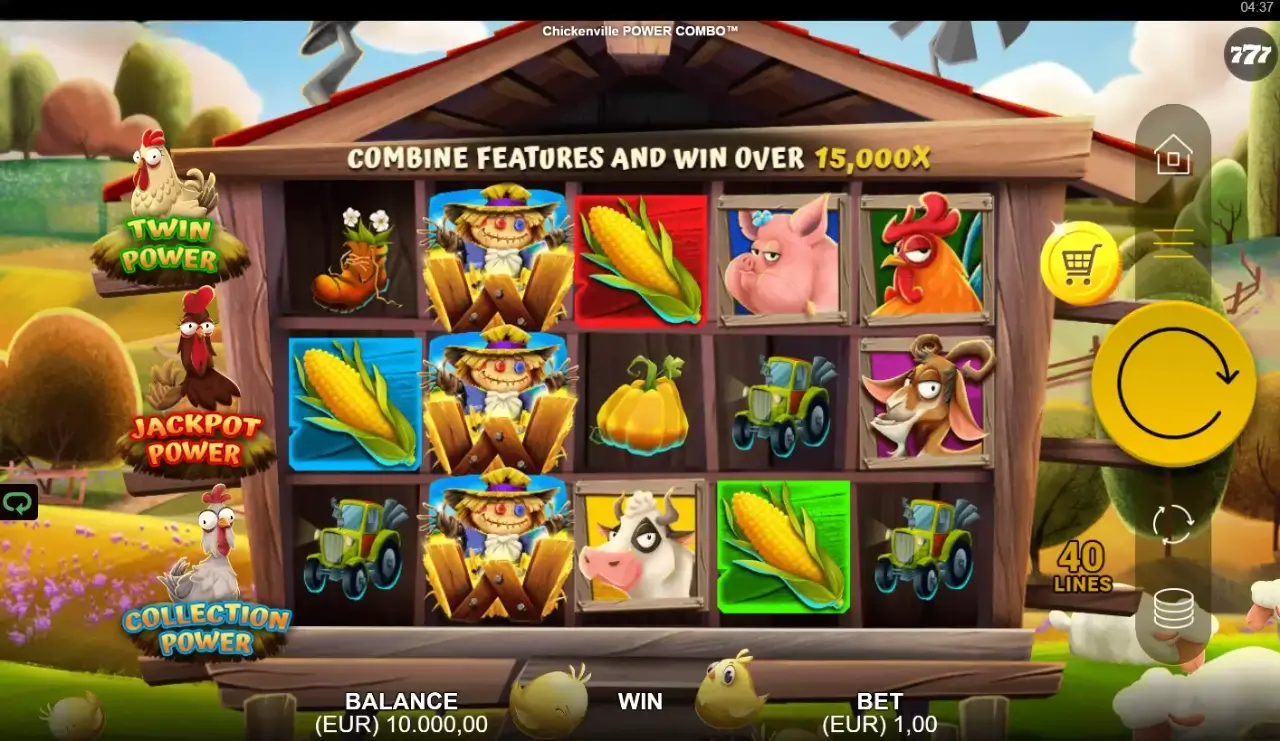
Boot this game up and your first reaction will probably be positive. The art direction is genuinely good — not in a jaw-dropping, premium-studio way, but in a confident, self-aware way. The reels sit against the side of a wooden barn with a red roof. Fields stretch behind it. A fox occasionally wanders past on the left side of the screen. Three brightly coloured chickens — labelled Twin Power, Jackpot Power, and Collection Power — stand beside the grid like mascots waiting for their moment.
The animations are smooth. The sound design is one of the better aspects of this game: a bouncy, upbeat folk track that manages to stay listenable across long sessions without drilling a hole in your patience. The overall vibe is cheerful without being saccharine.
Where the visuals fall short is in differentiation. The low-value symbols — carrots, sunflowers, pumpkins, boots, and a tractor — are fine, but they blend together more than they should. When you’re watching five reels spin at pace, the carrot and the sunflower can feel interchangeable at first glance. The higher-paying animal symbols (pig, sheep, goat, chicken, cow) are more distinct, which helps. But a little more contrast between the lower symbols would have improved the experience.
Symbol Breakdown: What’s Actually on the Reels
Understanding the paytable matters in a high-volatility game because it tells you what you’re actually chasing. Here’s what’s working for and against you on each spin.
Low-value symbols pay between 0.4x and 0.5x the total stake for five of a kind. These are: carrot, sunflower, pumpkin/turnip, boot, and tractor. You’ll land these constantly, and they won’t do much for your balance. Think of them as the machine’s way of keeping you warm without actually feeding you.
High-value symbols pay between 1x and 2.5x the total stake for five of a kind. These are: pig, sheep, goat, chicken, and cow. The cow is the top-paying regular symbol at 2.5x. Landing five cows on a $5 bet gets you $12.50 — not remarkable, but it contributes to a base-game rhythm that at least feels alive.
The Wild is a scarecrow, and it can only appear on reels 2, 3, and 4. It substitutes for all regular symbols but not scatters. That reel restriction matters: you’ll never see a wild on reels 1 or 5, which limits its ability to complete certain line combinations. In practice, it functions as a solid support symbol without being a game-changer on its own.
The three Scatter symbols are the whole point of this game. Each one is a corncob — green, red, or blue — on a matching coloured background. Each colour triggers a different variant of the Link & Win feature. This is where Chickenville separates itself from a generic farmyard slot, and it’s what we need to spend the most time on.
The Link & Win System: Three Roads to the Same Destination
Most slots with a “bonus feature” have one bonus. Chickenville has three distinct Link & Win modes, and the ability to run them simultaneously. This is genuinely interesting game design, even if the individual features themselves have appeared in other Power Combo titles before.
Here’s how each one works:
Green Scatter → Twin Power
Landing a green corncob triggers Link & Win with the Twin Power modifier. This activates two separate reel grids simultaneously, each with its own spin counter. Both grids operate independently — a reset on one doesn’t reset the other — but wins accumulate from both. The visual of two sets of reels running side by side is striking the first time you see it. In terms of win potential, Twin Power provides more opportunities for golden egg symbols to appear, which is the primary value engine of the feature.
Red Scatter → Collection Power
The red corncob triggers Collection Power. In this mode, every golden egg that lands during the respin sequence contributes its value to a collector total, which is paid out at the end of the feature. The key mechanic here is that each new golden egg landing resets the respin counter back to three. You’re chasing a screen-fill while knowing that each egg both extends your runway and adds value to your payout.
Blue Scatter → Jackpot Power
The blue scatter is the one most players are hoping for. Jackpot Power shifts the focus from raw coin values to the fixed jackpot prizes positioned around the edge of the grid. There are four tiers — Mini, Minor, Major, and Grand — and landing symbols in the right positions during the respin sequence can award these directly. The Grand jackpot represents the highest fixed prize in the game and is the closest thing Chickenville has to a life-changing single payout (within a realistic range, not 15,000x territory).
Combining Features: The Real Magic
Where Chickenville genuinely earns its name is in the combination mechanic. Landing two different scatter types in the same base-game spin activates both their features simultaneously. Land all three scatters, and you trigger a full Power Combo — all three Link & Win modes running at once.
This combination state is transformative. The win potential multiplies dramatically when you have Twin Power expanding your golden egg opportunities, Collection Power accumulating their values, and Jackpot Power targeting the fixed prizes simultaneously. On my test sessions, the two times I hit multi-scatter triggers were the only times I posted genuinely significant wins. Single-scatter triggers produced respectable but unremarkable results.
The gap between hitting one scatter and hitting two or three is enormous. This is the variance engine that makes Chickenville both exciting and punishing.
Golden Egg Values
During any Link & Win mode, golden egg symbols carry individual prize values ranging from 0.5x to 20x the stake. The distribution isn’t flat — lower-value eggs appear far more frequently than higher-value ones. A screen full of 0.5x eggs at a $2 bet is a modest win. A screen where several 20x eggs land alongside jackpot symbols at the same bet is a different conversation entirely.
Feature Buy: Is Spending Extra Worth It?
One of Chickenville’s more player-friendly decisions is offering Feature Buy at reasonable costs compared to some of the more predatory buy options seen elsewhere in the market. You can purchase individual features — Collection Power only, Twin Power only, or Jackpot Power only — or buy combinations of two or all three.
The logic of buying makes sense for players who want to get into the bonus quickly rather than grinding through base-game spins. High-volatility slots with infrequent triggers can test patience in ways that a Feature Buy directly addresses.
However, there are genuine risks here. Buying the full three-feature combination is expensive relative to stake, and the outcome is still random. You can buy the Power Combo state and land a modest collection of low-value eggs. I’ve seen it happen. The theoretical return percentage of each buy option is built to be slightly less favourable than organic trigger play — that’s how buy features work — so you’re trading cost certainty for time efficiency.
My practical recommendation: Feature Buy makes most sense when you’re playing at a comfortable stake level and have a session budget that can absorb multiple buy attempts. At $1 per spin with a $100 session bankroll, buying a single feature for roughly $15–$20 equivalent feels manageable. At $0.20 per spin with a $20 session bankroll, a buy that costs $8–$12 effectively ends your session if it doesn’t deliver. Scale your stake first. Buy second.
Avoid buying the full three-feature combination unless you have a genuine high-roller budget and understand that you might need five or more buy attempts before one pays significantly. The 15,000x max win exists. It’s just not your likely outcome from any single purchase.
Base Game Experience: The Honest Version
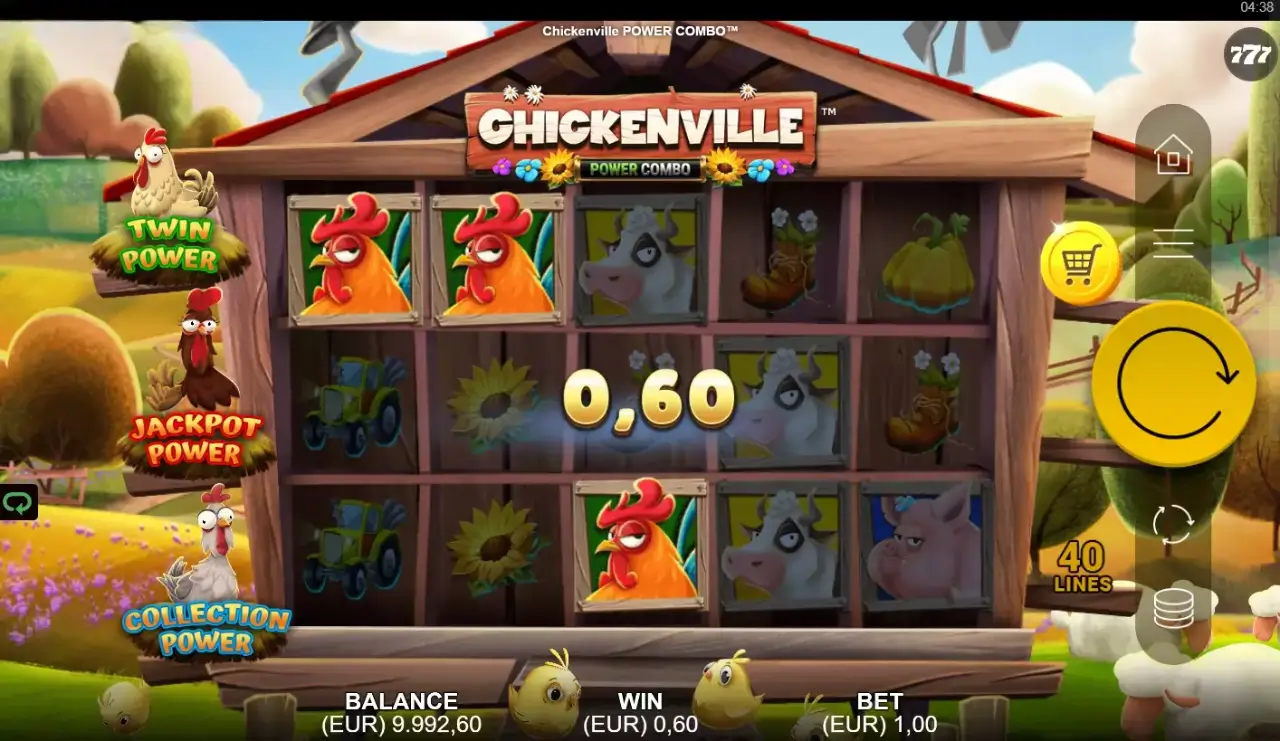
The base game is functional but unremarkable. You’ll spin through sequences where nothing much happens. The hit rate of around 34% means roughly one in three spins produces some form of return, but a large portion of those returns are low-value line wins that barely offset the bet. Dead stretches of 30–50 spins with minimal returns are common in high-volatility play, and Chickenville doesn’t behave differently.
In my 300-spin test session at $1 per spin:
- I triggered single-scatter Link & Win features 9 times
- I triggered two-scatter combinations twice
- I never hit all three scatters organically
- My best single-feature result was approximately 18x the stake from a Collection Power trigger
- My two dual-scatter results produced approximately 34x and 67x the stake respectively
- Net session result: down approximately $40 after Feature Buy costs
That’s high volatility doing its thing. The base game doesn’t hide what it is. If you’re playing this at $0.20 per spin and treating it casually, the base game rhythm is fine. If you’re playing at higher stakes chasing the big combination triggers, the dead periods can be genuinely exhausting.
The scarecrow wild appears rarely enough that it doesn’t substantially change the base game feel. When it lands on a key reel position during a near-winning combination, it’s satisfying. But it’s not a high-frequency contributor to your balance.
How It Compares: Chickenville vs. The Power Combo Family
This is where I have to be honest, because it’s also where existing reviews tend to pull punches.
All41 Studios has built several Power Combo slots, and they share an almost identical mechanical foundation. Luck of the Devil Power Combo, Queens of Ra Power Combo, 3 Powers of Zeus Power Combo — all of them use the same respin-and-collect structure with three scatter variants. The theming changes. The underlying game largely doesn’t.
So the question is: does the Chickenville theme and execution make it worth choosing over its siblings?
Versus Luck of the Devil Power Combo: Both share the 96.20% RTP and 15,000x max win. Luck of the Devil has a darker, more intense aesthetic. Chickenville is lighter and arguably more accessible to casual players. Mechanically identical. Choose based on theme preference.
Versus Queens of Ra Power Combo: Again, same mechanics. Queens of Ra appeals to players who like Egyptian mythology aesthetics. Chickenville wins on soundtrack quality. Neither is mechanically superior.
Versus 3 Powers of Zeus Power Combo: Zeus has a more impressive visual production, but the Power Combo mechanics remain the same. Chickenville’s max win of 15,000x matches or exceeds some earlier Power Combo releases.
The honest conclusion: if you’ve played any Power Combo slot and enjoyed it, you’ll enjoy Chickenville. If you found the mechanic repetitive before, this game won’t convert you. It’s a good entry point for players new to the series — the farmyard theme lowers the intimidation factor and the overall presentation is cheerful and accessible.
Bankroll Strategy: Playing This Game Without Torching Your Account
High-volatility slots require a different approach than medium-variance games. Here’s a realistic framework:
Minimum session bankroll: 50x your bet size. At $1 per spin, bring at least $50 to the session. This gives you enough runway to absorb dead sequences and reasonably expect at least several bonus triggers. Anything less is a coin-flip session.
Recommended session bankroll: 100x your bet size. At $1 per spin, $100 is a comfortable session budget. At this level, you can absorb Feature Buy costs without compromising your ability to continue spinning organically.
Stake tiers:
- Casual ($0.20–$0.50/spin): Low risk, slower progression. Good for exploring the game without significant financial exposure. Feature Buy less practical at this level.
- Standard ($1–$5/spin): The target zone for most players. Feature Buy becomes viable. Session results more meaningful.
- High roller ($5–$20/spin): Serious variance territory. A $20 max-bet session swings hard in both directions. The potential for a large absolute win is real. So is the potential to lose $400–$600 in a single session without a significant bonus.
Win target: Set a point at which you stop. Doubling your session bankroll is a reasonable target. If you’ve turned $100 into $200, walking away locks in a meaningful win.
Stop-loss: Know the number at which you end the session regardless of how you feel. Most experienced high-variance players use 50% of their session bankroll. If you started with $100 and hit $50, you’re done for the day.
Mobile Performance: Playing on Your Phone
Chickenville runs on HTML5, which means it adapts to screen size rather than requiring a dedicated mobile app. In practice, the game handles well on both Android and iOS.
On Android (tested on Chrome, mid-range device), the game loaded in approximately 8–10 seconds on a 4G connection and around 4–5 seconds on WiFi. The touch controls are responsive — tap to spin, swipe to access settings. The dual-grid Twin Power feature, which is the most graphically intensive bonus state, maintained smooth performance without visible frame drops.
On iOS, performance was similar. The game fits cleanly on a 6-inch screen without interface elements feeling cramped. The paytable and settings menus are accessible and readable at mobile resolution.
The one mobile caveat: the bonus states, particularly the full three-feature Power Combo, involve a lot of simultaneous visual activity. On older devices or congested network conditions, there may be minor slowdowns. Nothing that breaks the experience, but worth noting for players in areas with limited connectivity.
Final Verdict: Who Should Play Chickenville Power Combo?
Chickenville Power Combo is a well-executed, thematically cheerful, mechanically recycled high-variance slot with genuine upside potential. The 15,000x max win is real. The three-variant Link & Win system is more interesting to engage with than a simple free spins round. The Feature Buy gives experienced players control over when they enter the bonus. The soundtrack is legitimately good.
Its weaknesses are real too. The base game is thin. The mechanic is copy-pasted from other Power Combo releases. Landing the three-scatter combination organically is a rare event. Single-scatter triggers, which are the common occurrence, produce modest results that rarely justify the frustration of triggering them.
Play this if:
- You enjoy high-volatility slots and understand what that means for session variance
- You’re looking for a farm-themed slot that goes beyond simple free spins mechanics
- You want multiple paths to the bonus, not just one scatter type to chase
- You’re comfortable with Feature Buy as a session tool
Skip this if:
- You want frequent, smaller wins to sustain a session
- You’ve already played other Power Combo titles and found the format repetitive
- You’re a casual player with a limited bankroll who needs more consistent returns
Overall Score: 7.2/10
- Visual Design: 7.5/10 — charming, competent, not groundbreaking
- Feature Innovation: 6.5/10 — interesting combination mechanic, recycled framework
- Win Potential: 8.5/10 — 15,000x is among the better max wins in the Power Combo series
- Base Game Value: 5.5/10 — standard high-variance thinness
- Mobile Experience: 8/10 — clean, responsive, reliable
At the end of a long session, Chickenville left me with mixed feelings and a net negative balance — which is, somewhat perversely, exactly what a well-functioning high-volatility slot is supposed to do. The potential is there. The structure is sound. The fox walking past the reels every few spins is oddly calming. Whether you cash out ahead or not comes down to whether you catch those scatter combinations at the right moment.
Most sessions, you won’t. But when you do, Chickenville reminds you why people play these games in the first place.
The Psychological Design of Chickenville: What Keeps You Spinning
This section isn’t meant to be alarmist — understanding how a slot is designed to maintain engagement is simply useful information for any player who wants to make informed decisions about their time and money.
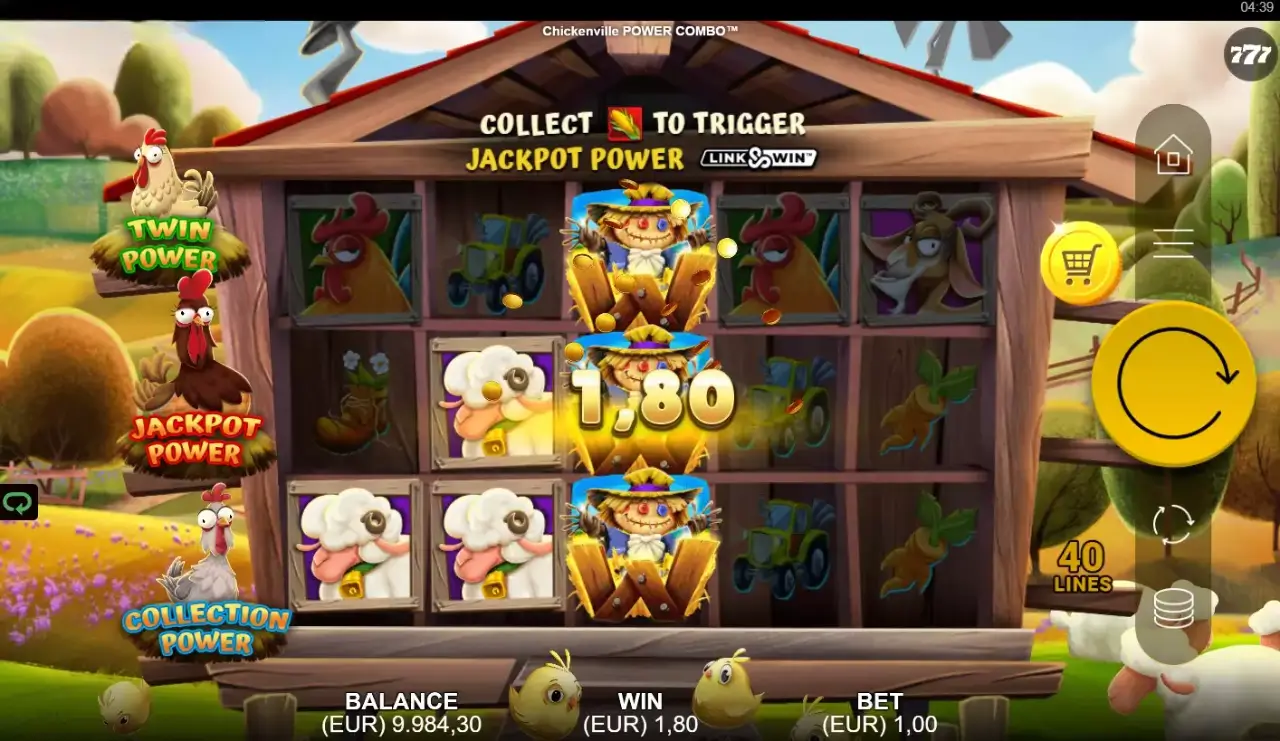
Chickenville uses several standard but effective retention mechanics. The three-scatter combination system is the most significant. By creating three distinct scatter types, each triggering a different bonus mode, the game gives players three simultaneous things to track while the reels spin. You’re not just watching for “any scatter” — you’re watching to see which colour lands, whether a second colour follows, and whether the third might complete the set. This multi-target attention pattern keeps the base game feeling active even during unremarkable spins.
The respin counter within the Link & Win feature is another deliberate design choice. Watching a counter tick down from three to two to one, and then seeing a new egg land and reset it back to three, produces a specific kind of relief that reinforces continued engagement. Each reset is a small victory. The potential screen-fill — and the major payout that implies — stays just close enough to feel achievable.
The Feature Buy system adds another psychological layer. The ability to purchase entry into the bonus shifts some control back to the player, which reduces the frustration of long base-game waits. However, it also creates a decision loop: after a disappointing bought bonus, players often want to “buy back” the lost edge with another purchase. Knowing this tendency exists is valuable. Set a hard limit on how many Feature Buy attempts you’ll make per session before you start, not during.
None of this means Chickenville is designed to exploit its players — these mechanics exist across virtually every modern online slot. But the combination of three scatter targets, variable respin outcomes, and purchasable features creates a particularly layered engagement structure. Playing with awareness of it makes for better decisions than playing purely on instinct.
Responsible Play: Keeping Things Sensible
High-volatility slots like Chickenville deserve a straightforward note on responsible gambling, not buried in small print but said plainly.
This game is built to produce long sequences without significant wins. That’s not a flaw — it’s the nature of high variance. The 15,000x max win and the large bonus payouts that are theoretically available require patience, variance, and a healthy bankroll relative to your stakes. If you find yourself chasing losses — spinning through a session budget hoping the next trigger will recover what you’ve lost — that’s the moment to stop.
Set a session budget before you start. Set a time limit. Treat what you spend as entertainment cost, not as an investment with an expected return. The RTP of 96.20% describes a theoretical long-run average across millions of spins — it doesn’t mean you’ll receive $96.20 back for every $100 you spend in a single session. Real sessions deviate from theoretical averages, sometimes dramatically, in both directions.
If gambling stops being fun, most regulated casinos offer deposit limits, cool-down periods, and self-exclusion tools. Use them if you need them.
Alternatives Worth Considering
If Chickenville doesn’t fully hit the mark for you, here are a few directions worth exploring depending on what specifically appealed or didn’t appeal to you.
For fans of the Power Combo mechanic who want variety: Try Luck of the Devil Power Combo or 3 Powers of Zeus Power Combo. Same framework, different themes. If the farm aesthetic isn’t for you but the three-variant Link & Win system is, these deliver the same experience with different aesthetics.
For farm-themed slots with different mechanics: Chicken Burst by Wizard Games offers medium volatility with four jackpot tiers and a Lock ‘N’ Spin feature. The lower volatility makes sessions less punishing, though the ceiling is lower. Chicken Night Fever by PearFiction takes a more creative approach with an expanding grid (from 243 to 7,776 ways) and progressive multipliers in free spins — a genuinely different feel from the Link & Win format.
For high-volatility players who want free spins instead: The Power Combo format deliberately omits traditional free spins. If free spins with multiplier potential are important to you, look at slots like Dead or Alive 2, Beast Mode, or Reactoonz 2 — all high-volatility options that use free spins as their primary bonus delivery mechanism.
Chickenville is a confident, well-constructed slot that knows its audience. It’s not trying to be the most innovative game on the market. It’s trying to deliver a reliable, high-ceiling, high-volatility experience with enough charm to make the inevitable dead spells tolerable. On that measure, it largely succeeds.
FAQ
What is the RTP of Chickenville Power Combo? The standard RTP is 96.20%. However, casinos may also run the game at lower settings: 94.20%, 92.20%, or 86.90%. Always check which RTP variant your casino offers before playing.
Does Chickenville Power Combo have free spins? No. There are no free spins in this game. The bonus feature is Link & Win, which uses a respin mechanic. Three scatter types (green, red, blue corncobs) each trigger a different version of the feature.
What is the maximum win in Chickenville Power Combo? The maximum win is 15,000x the stake. On a $20 max bet, this represents a potential payout of $300,000. This is achievable primarily through the combined three-feature Power Combo state.
Can I buy the bonus feature? Yes. Chickenville Power Combo includes a Feature Buy option that allows you to purchase individual Link & Win variants or combinations of two or all three features. Costs vary by stake level and feature combination selected.
Is Chickenville Power Combo available on mobile? Yes. The game is built on HTML5 and plays on Android and iOS devices through a mobile browser. No download or app installation is required.
Who developed Chickenville Power Combo? The game was developed by All41 Studios, also referred to as All For One Studios, an Estonian-based game development company founded in 2018. They are responsible for several other Power Combo series slots.