There’s something oddly satisfying about farm-themed slots. Maybe it’s the bright colors. Maybe it’s the low-pressure atmosphere — no ancient temples crumbling, no treasure hunters running for their lives. Just chickens, roosters, and the quiet promise that one of those eggs might hatch something worth your while.
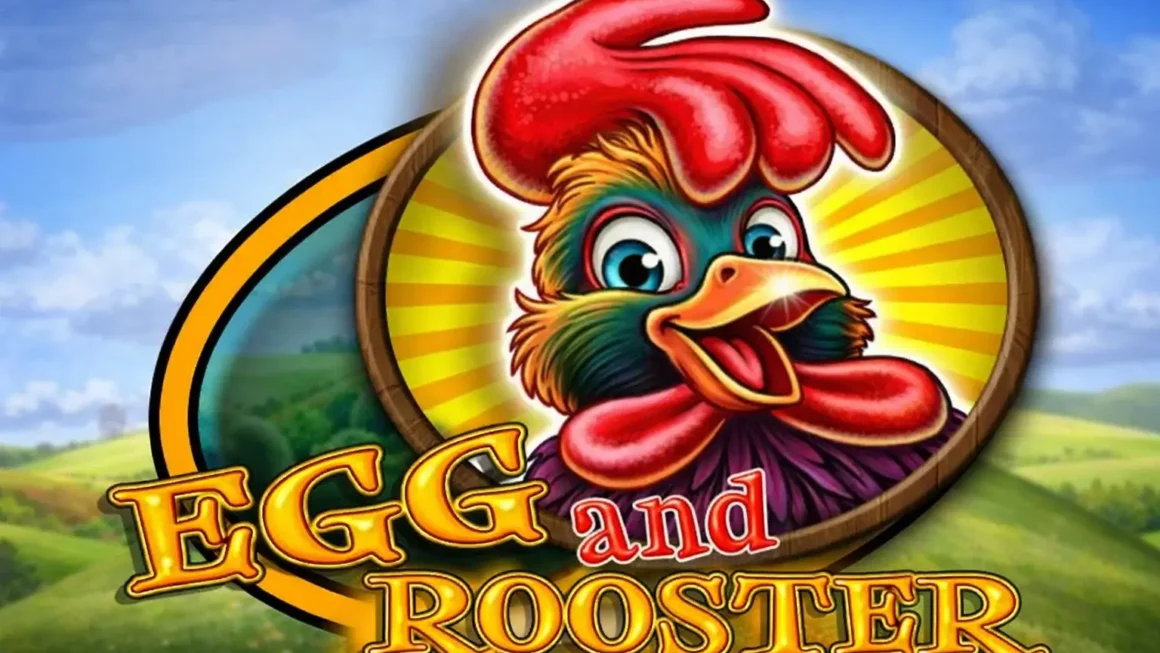
Egg and Rooster, released by CT Interactive in November 2020, fits squarely into that category. It’s not trying to reinvent the wheel. What it does instead is build a comfortable, genuinely playable slot around a simple premise — spin the reels, watch the rooster strut, and hope the right symbols fall into place. After spending considerable time with this game across both desktop and mobile sessions, here’s what you actually need to know.
The Basics: What Kind of Slot Are We Talking About?
Before getting into the fine details, let’s put Egg and Rooster in context. This is a 5-reel, 3-row video slot with 20 fixed paylines. CT Interactive kept the structure traditional, which works in the game’s favor — you’re not spending the first 20 minutes trying to understand some convoluted cluster pay mechanic or cascading reel system. Lines run left to right, combinations form from reel one outward, and that’s that.
The betting range runs from a minimum of $0.20 per spin up to a maximum of $5.00. That top end is modest by today’s standards, which tells you something about who this game is aimed at: casual players, mobile users on tighter budgets, and anyone who’d rather extend a session than blow through their bankroll chasing one colossal hit.
The RTP sits at 95.28%. That’s a touch below the broadly accepted industry average of around 96%, and it’s worth being straight about that upfront. Over thousands of spins, that number matters. It won’t ruin your session, but players who are particularly RTP-sensitive might note that games like NetEnt’s EggOMatic — a direct thematic competitor — run at 96.5%. The difference is real, even if it takes a very long time to feel it.
Volatility is listed as medium, and from actual play, that classification feels accurate. You won’t sit through 80 dead spins wondering if the game is broken. Small wins come often enough to keep your balance ticking along, and the feature triggers arrive at a pace that doesn’t require supernatural patience.
The Theme and Visual Design
CT Interactive went for a classic, slightly cartoonish farm aesthetic here. The reels sit against a backdrop of rolling green fields, wooden fences, and a sky that looks like it belongs in a children’s picture book. Everything is bright. Everything is warm. There’s no ambiguity about the mood they were going for.
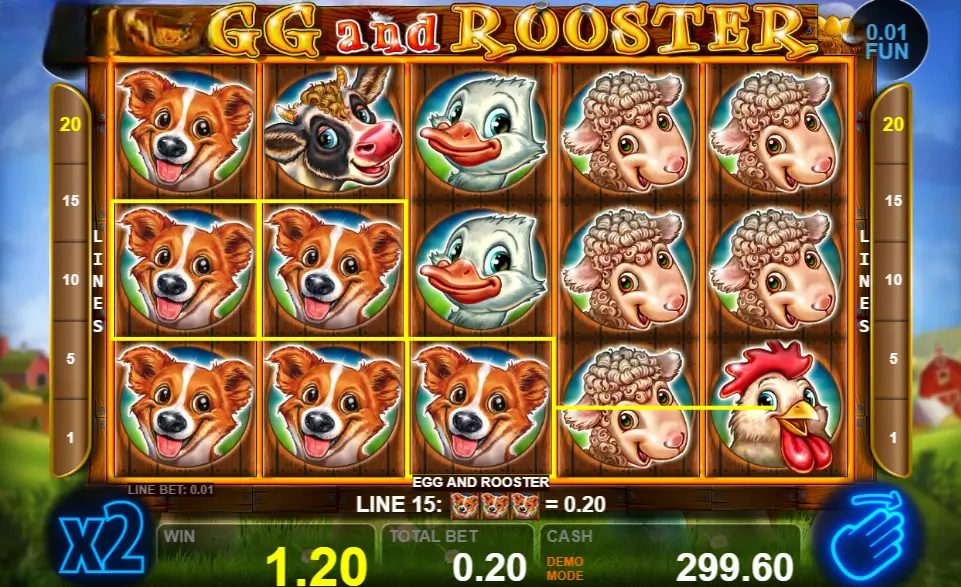
The symbols themselves are exactly what you’d expect. High-value icons include the rooster — which doubles as the game’s Wild — a hen, a chick, and various styled egg designs. Lower-value symbols follow the old-school casino tradition of using playing card suits: hearts, diamonds, clubs, and spades, each stylized to fit the farm theme without looking completely out of place.
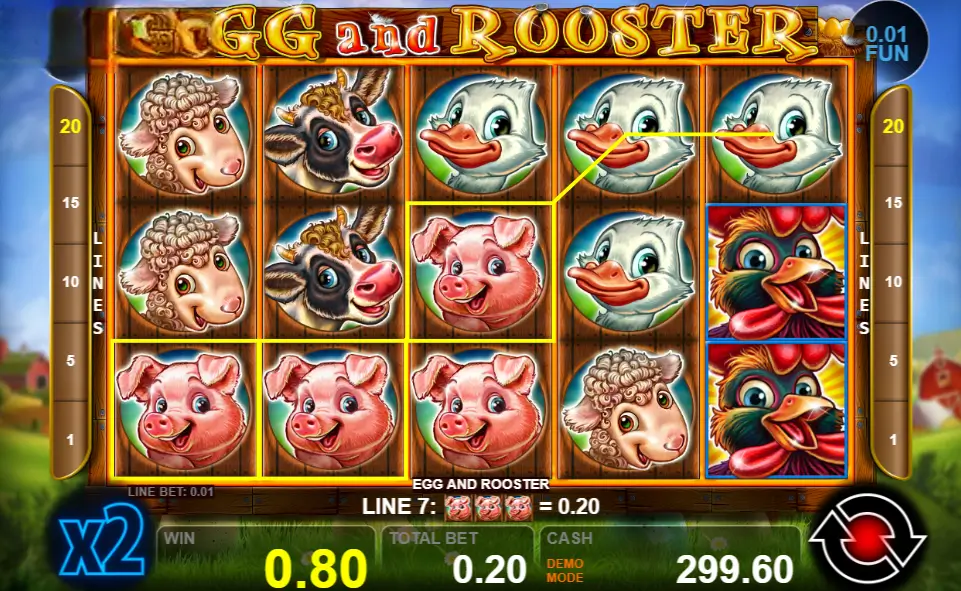
The animations are modest but functional. When a winning combination lands, the relevant symbols light up with a brief flash of color. There’s nothing particularly cinematic happening here — no characters dancing across the screen, no elaborate win sequences that eat up 10 seconds of your time after every small hit. That restraint is actually welcome during longer sessions when flashy animations start to feel like obstacles between you and the next spin.
Sound design follows the same philosophy. The backing music is light, almost pastoral — the kind of thing you’d expect to hear in a countryside setting. The rooster crows occasionally. Eggs crack. It’s all contextually appropriate and, crucially, not the sort of audio that makes you reach for the mute button after 10 minutes.
Symbols and Paytable
Understanding the paytable is worth a few minutes of your time before betting real money, because the spread between the lowest and highest-value symbols is significant.
The rooster, functioning as both a high-value symbol and the Wild, sits at the top of the pay table. Landing five roosters across a payline delivers the biggest single-line payout the base game has to offer. Below that, the hen and the more colorful egg symbols form the mid-tier range — still meaningful wins, but nothing that’s going to make your evening on their own.
The card suit symbols at the bottom of the paytable pay modestly. You’ll hit these combinations frequently given the 20-payline structure, but the returns are small — often less than the cost of the spin itself. This is standard practice in medium-volatility games: the frequent low-value hits keep you engaged and extend your session without actually padding your balance much.
The maximum win in Egg and Rooster is set at 1000x your total stake. At the $5.00 maximum bet, that translates to a $5,000 potential payout. For a slot in this price range and volatility class, that’s a respectable ceiling. You’re not playing for a life-changing jackpot here, but the potential for a genuinely good session win is real.
Wild Symbol: How It Actually Works
The rooster symbol is the Wild, and it does what Wilds do — substitutes for any regular symbol to complete winning combinations. Where Egg and Rooster adds a layer of interest is through the win multiplier attached to the Wild.
When the Wild forms part of a winning combination, it doesn’t just fill in the gap; it amplifies the win. The multiplier attached to the Wild can meaningfully boost otherwise modest payouts, and this is particularly relevant during the Free Spins feature, where the interaction between multipliers becomes more pronounced.
In the base game, landing a Wild on the right reel at the right moment — where it connects two or three matching symbols on either side — can turn what would have been a near-miss into a solid return. It’s one of those mechanics that keeps you leaning into the next spin rather than mindlessly clicking through.
The Wild can appear on any of the five reels, which is more flexible than some games that restrict Wild placement to the middle three reels. That means every single spin has a chance to produce a Wild-assisted win somewhere on the board.
Scatter Symbol and How Free Spins Get Triggered
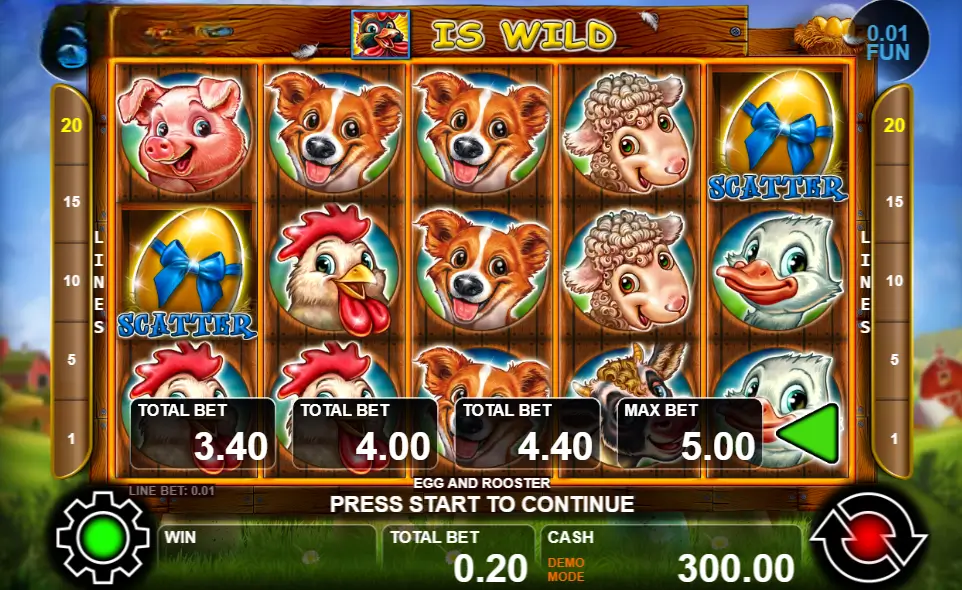
The Scatter in Egg and Rooster is represented by the egg — specifically a golden egg that sits distinctly apart from the regular egg symbols in the paytable. Landing three or more Scatter symbols anywhere on the reels triggers the Free Spins feature.
It’s important to understand that Scatter pays here are based on the number appearing anywhere on the reels simultaneously, not limited to specific paylines. This increases the effective trigger frequency compared to games where you need to land scatters on consecutive reels from left to right. In a 300-spin session played on mobile, the Free Spins feature triggered roughly once every 55 to 65 spins — which is reasonably consistent with what you’d expect from a medium-volatility game.
Three Scatters awards a set number of free spins to get you started. Landing additional Scatters during the feature can extend the round, which is where things get genuinely exciting. There’s something particularly satisfying about watching a Scatter land mid-free-spins and knowing the feature is going to run longer than you initially expected.
Free Spins Feature: The Heart of the Game
The Free Spins round is where Egg and Rooster earns most of its replay value. During free games, the win multiplier attached to the Wild symbol is active and can stack in a way that isn’t available in the base game.
The practical effect of this is that Free Spins feel materially different from base game play. The same combination that paid out modest returns with a base game Wild can deliver a notably larger win during free games when the multiplier is running. Over the course of a free spins round — particularly one that extends through additional Scatter triggers — it’s possible to accumulate wins that significantly outpace anything achievable in a similar number of base game spins.
In one extended session on a mid-range Android device, a re-triggered Free Spins sequence produced the session’s three largest wins back-to-back — each of them multiplied by the Wild mechanic in a way that simply doesn’t happen at the same frequency during regular play. That’s exactly how these features are supposed to function, and CT Interactive executed it cleanly.
The visual presentation during Free Spins is identical to the base game, which keeps things clean and easy to follow. Some developers add visual flourishes during bonus rounds that, while impressive, can make it harder to track what’s actually happening on the reels. Egg and Rooster keeps it straightforward.
The Gamble Feature: Use It Carefully
After any winning spin in the base game, you have the option to activate the Gamble Feature. This takes you to a secondary screen where you’re asked to make a guess — typically involving a card color or suit — to either double or quadruple your most recent win.
The Gamble Feature is a binary risk proposition. Get it right, and your win multiplies. Get it wrong, and you lose the payout you just earned. There’s no middle ground.
The honest assessment: use this feature selectively. For small wins — the sub-$1 hits that land regularly on the low-value symbols — the risk-reward calculation might make sense if you’re comfortable losing that return and want a shot at a larger payout. For any win that represents a meaningful chunk of your session bankroll, the Gamble Feature is a fast way to turn a good outcome into a disappointing one.
There’s no mathematical edge to be found here; both options have equal probability. The decision is entirely a function of your risk tolerance and where your balance sits at any given moment in the session. Experienced players typically ignore the Gamble Feature entirely during their better winning runs and deploy it sparingly on the small incidental wins that don’t move the needle either way.
RTP and Volatility: What They Mean for Your Session
The RTP of 95.28% means that, across an enormous sample of spins, the game is designed to return roughly $95.28 for every $100 wagered. This is a theoretical figure calculated across millions of spins — your individual session will vary, sometimes dramatically, in either direction.
What matters practically is the interaction between that RTP and the medium volatility classification. Medium volatility means:
You won’t hit extended cold streaks the way you would with a high-volatility game like Gates of Olympus or Book of Dead. The hit frequency is high enough that you’re regularly seeing some kind of return, which keeps your balance from evaporating quickly between feature triggers.
At the same time, you’re not going to see the giant single-spin payouts that high-volatility games occasionally produce. The wins are more evenly distributed — more consistent, smaller peaks.
For a $20 starting balance, the $0.20 minimum bet gives you a substantial runway — 100 spins before you’ve exhausted your budget in the worst case. Realistically, at medium volatility with 20 paylines generating regular small wins, $20 at minimum bet will typically last 150 to 200+ spins before depletion, assuming no significant feature trigger. At the $1.00 bet level, $50 provides a comfortable 50-spin cushion, though you’d want a feature trigger or two within that window to maintain it.
For players in South Asian markets where budgets tend to be tighter and mobile data costs are a real consideration, the minimum bet structure is particularly relevant. At $0.20 per spin — roughly ৳22 BDT or ₹17 INR — you can run a meaningful session for the equivalent of a few dollars. That’s not nothing. The game doesn’t require a heavy financial commitment to feel like a real experience, and that accessibility is one of the more underrated aspects of Egg and Rooster’s design.
One additional point on volatility worth understanding: medium volatility doesn’t mean the game is predictable. You will still have losing runs. You’ll still spin through 20 or 30 rounds where the highest return is a 0.40 payout on a 0.20 bet. The difference between medium and high volatility isn’t that the dry spells disappear entirely — it’s that they’re shorter and less frequent, and the wins that interrupt them are more regular even if they’re not enormous. Keeping that expectation calibrated before you sit down will make the experience more enjoyable.
Practical Session Strategy
There’s no system that guarantees wins in any RNG-based slot, and anyone who tells you otherwise is selling something. What you can do is structure your sessions in ways that give you more control over the experience.
The most straightforward approach for Egg and Rooster is to set a budget and a target before you spin. Decide before you load the game what you’re willing to lose (your hard stop) and what you’d be happy to walk away with (your win target). With medium volatility, the wins come frequently enough that hitting a modest win target — say, 30% above your starting balance — is achievable in a reasonable session. High-volatility games can go 200 spins without giving you a realistic chance at that; Egg and Rooster is more cooperative.
Bet sizing matters more than most players realize. At $0.20 per spin, a $20 budget gives you 100 spins in the absolute worst case — in practice, much more because the regular small wins add back to the balance. At $1.00 per spin, that same $20 gives you 20 spins, which may not be enough to even trigger the Free Spins feature once. The relationship between bet size and session length is linear, but the relationship between bet size and feature trigger frequency is not — it doesn’t change. You trigger Free Spins with the same frequency regardless of your bet level. The only thing that changes is the absolute size of the payout when you do.
For most players, the sweet spot in Egg and Rooster is somewhere in the middle of the bet range. If your session budget is $30, a $0.50 bet gives you 60 spins at minimum, extends to well over 100 with typical returns, and sizes the wins and feature payouts at a level that feels meaningful without being reckless. At $0.20, the payouts can feel underwhelming even when the mechanics are working as intended. At $2.00 or above, you’re burning through your budget faster than the feature frequency can compensate.
One more practical note: if you trigger the Free Spins feature early in a session and it produces a solid return — say, 50x your total bet or better — that’s a good moment to consider stopping or dramatically reducing your bet size. The feature doesn’t trigger again immediately just because it’s run once. You’ll spin through another 50 or 60 base game rounds on average before the next activation, and chasing a second feature right after a strong first one at maximum bet is how sessions that started well end on a frustrating note.
This is where CT Interactive genuinely deserves credit. Egg and Rooster runs on HTML5, which means it loads directly in the browser on any device — no downloads, no apps, no compatibility issues. On a mid-range Android phone running on a 4G connection, the game loaded in under five seconds and ran without any perceptible lag throughout multiple extended sessions.
The UI scales cleanly to smaller screens. The spin button, bet adjustment controls, and paytable access are all sized appropriately for touchscreen use. Some older CT Interactive titles feel slightly cramped on smartphone displays, but Egg and Rooster has been optimized well for the format.
For players in markets where most casino access happens via smartphone — South Asian markets particularly, where mobile-first casino use is the norm rather than the exception — this matters more than the graphics quality or the complexity of the bonus round. A slot that loads reliably, runs without stuttering, and has controls you can actually hit accurately on a phone screen is worth more than a visually spectacular game that freezes every three spins.
The game also handles orientation changes gracefully. Switching from portrait to landscape doesn’t cause the session to reset or the interface to break — a small thing, but one that casual mobile players will appreciate.
How Egg and Rooster Compares to Similar Slots
The obvious comparison is NetEnt’s EggOMatic, which shares the egg-and-rooster theme and a broadly similar mechanical structure. EggOMatic has the superior RTP (96.5% vs 95.28%) and the more inventive bonus mechanic — the conveyor belt that drops feature eggs onto a Wild Rooster is genuinely clever and more visually engaging than Egg and Rooster’s straightforward scatter-to-free-spins trigger.
That said, EggOMatic’s maximum payout caps out at 600x stake, while Egg and Rooster reaches 1000x. If you’re a casual player who cares more about win potential than RTP precision, that gap is meaningful.
CT Interactive’s game is also noticeably simpler to understand. EggOMatic’s conveyor belt mechanic, while entertaining once you grasp it, takes a few minutes to fully internalize. Egg and Rooster is the kind of game where you can sit down and play confidently within 30 seconds of loading it up. For new players or anyone who finds complex bonus systems more stressful than fun, that simplicity has genuine value.
Compared to other CT Interactive titles in the same thematic territory — fruity three-reel classics and animal-themed 5-reel games — Egg and Rooster sits in the upper tier of the developer’s portfolio. The multiplier mechanic adds a layer of strategic interest that many of their simpler slots lack, and the Free Spins feature is more substantial than the brief bonus rounds found in some of their catalog.
Who Should Play Egg and Rooster?
This slot has a fairly clear target audience, and it’s not everyone.
If you’re looking for high-volatility excitement — the kind of game where you can sit through 40 dead spins and then hit a 500x win out of nowhere — Egg and Rooster isn’t going to scratch that itch. The medium volatility design prioritizes consistency over drama. That’s a feature, not a flaw, but it depends entirely on what you’re looking for.
If you’re a new player still getting comfortable with how slot mechanics work, this is a genuinely good starting point. The base game is simple, the bonus features are easy to understand, and the Gamble Feature gives you a low-stakes way to experiment with risk decisions without those choices having catastrophic consequences.
If you’re a casual mobile player who wants something reliable — a game that loads fast, runs smoothly, and delivers a reasonably entertaining session without demanding a significant time investment to understand — Egg and Rooster fits well. The minimum bet of $0.20 makes it accessible for players managing modest budgets, and the 20-payline structure keeps enough hits coming to make the experience feel rewarding even during quieter spells.
Players who prioritize maximum RTP should note the 95.28% figure and weigh it against alternatives. There are farm-themed and animal-themed slots available at higher RTPs if that metric is your primary decision factor.
Honest Assessment of the Weak Points
CT Interactive built a solid, playable slot here, but it’s not without its limitations, and being straight about them serves you better than glossy promotional copy.
The RTP of 95.28% is the most significant drawback. It’s not dramatically below average — we’re talking about less than a percentage point off 96% — but across extended play, that gap accumulates. Players who are sensitive to theoretical return rates will find better options in the same thematic space.
The visual design, while clean and functional, doesn’t push any creative boundaries. If you’ve played 20 other farm-themed slots, nothing about Egg and Rooster’s aesthetic is going to surprise or delight you. The graphics are good enough to not be a distraction, but they’re not a reason to play the game.
The maximum bet of $5.00 limits the ceiling for high-roller adjacent players. At 1000x maximum win, the best-case scenario payout caps at $5,000 — respectable for the budget player this game targets, but underwhelming for anyone accustomed to slots with $20+ maximum bets and correspondingly larger jackpot potential.
The Gamble Feature, as discussed, adds a layer of variance that some players will enjoy and others will find frustrating. Its presence doesn’t hurt the game, but its absence wouldn’t hurt it either.
Final Verdict
Egg and Rooster is a well-executed medium-volatility slot that does exactly what it sets out to do. CT Interactive didn’t build this game to win awards for innovation. They built it to provide a comfortable, accessible, reliably functional slot experience for players who want straightforward entertainment without a steep learning curve.
The Wild multiplier adds genuine mechanical interest to what could otherwise be a very plain paytable. The Free Spins feature, while not the most spectacular bonus round in the genre, delivers the kind of sustained win potential that makes a game worth returning to. The mobile performance is excellent by any reasonable standard.
Where the game falls short — the RTP, the conservative visual design, the modest maximum bet — those shortcomings are real but contextual. They don’t define the experience; they define the audience. If you match the profile of the player this game was built for, you’ll get solid value from it. If you’re chasing something with more volatility, higher win potential, or better theoretical return, there are options better suited to those priorities.
Rating: 7/10
A dependable, mobile-friendly farm slot with functional bonus mechanics and honest accessibility for casual players. Not the most innovative title CT Interactive has produced, and the RTP leaves a little on the table, but a genuinely competent game that holds up across extended sessions.