I’ve been testing online slots seriously for over nine years now, and I’ve seen plenty of games come and go. Most of them blend together after a while—the same mechanics, the same promises, the same disappointments. But when Spinomenal released Hut With Chicken Legs back in July 2022, something about it grabbed my attention. Maybe it’s the weird mix of Slavic folklore and serious win potential, or maybe I just can’t resist a game with a literal haunted house standing on chicken legs. Either way, I spent way more time with this one than most reviews would suggest, running 500+ spins across multiple sessions, tracking everything from free spin frequency to just how brutal the downswings can get.
So here’s what I actually found—the good, the frustrating, and everything in between.
What You’re Actually Getting Into
Let me start with the basics, but I’ll keep it real. Hut With Chicken Legs sits on a 5×4 grid with 100 paylines, which sounds pretty standard until you realize that’s a lot of ways to potentially lose money. You’ve got flexibility though—you can dial it down to just 10 paylines if you want to be conservative about your bets. The bet range runs from $0.10 to a thousand bucks per spin, so whether you’re working with a fifty-dollar bankroll or you’ve got serious money to throw around, this game will let you play.
The RTP clocks in at 96.04%, which is decent but not spectacular. For context, that means that over thousands of spins—thousands, mind you, not hundreds—you should expect to get back about $96.04 for every $100 you put in. The volatility is medium-high, which is the part I want to really dig into because it’s where most players get surprised.
Spinomenal released this game back in July 2022, and they’ve done a pretty solid job with the technical implementation. The game is built on HTML5, which means it works seamlessly across desktop and mobile devices without any lag or performance issues. There’s no software to download, which is increasingly the standard for online gaming anyway. You just load it directly in your browser, set your stakes, and you’re ready to go. The interface itself is intuitive—the spin button is prominent and easy to find, bet adjustments are straightforward, and the paytable is accessible from anywhere during gameplay.
One thing worth mentioning is that this game appears regularly across multiple platforms. You’ll find it at RajaBaji, JabiBet, KheliBet, and other major South Asian-focused casinos, as well as European operators. The game runs identically across all platforms because Spinomenal maintains strict standards, which actually means you’re getting a consistent experience whether you play in Bangladesh, India, Uzbekistan, or anywhere else.
The Theme Actually Works
Baba Yaga. If you’re not familiar with the legend, she’s basically the Slavic horror version of a witch. She steals children, practices dark magic, and lives in a hut that literally moves around on chicken legs. It’s creepy folklore stuff that somehow translates into a surprisingly atmospheric slot machine.
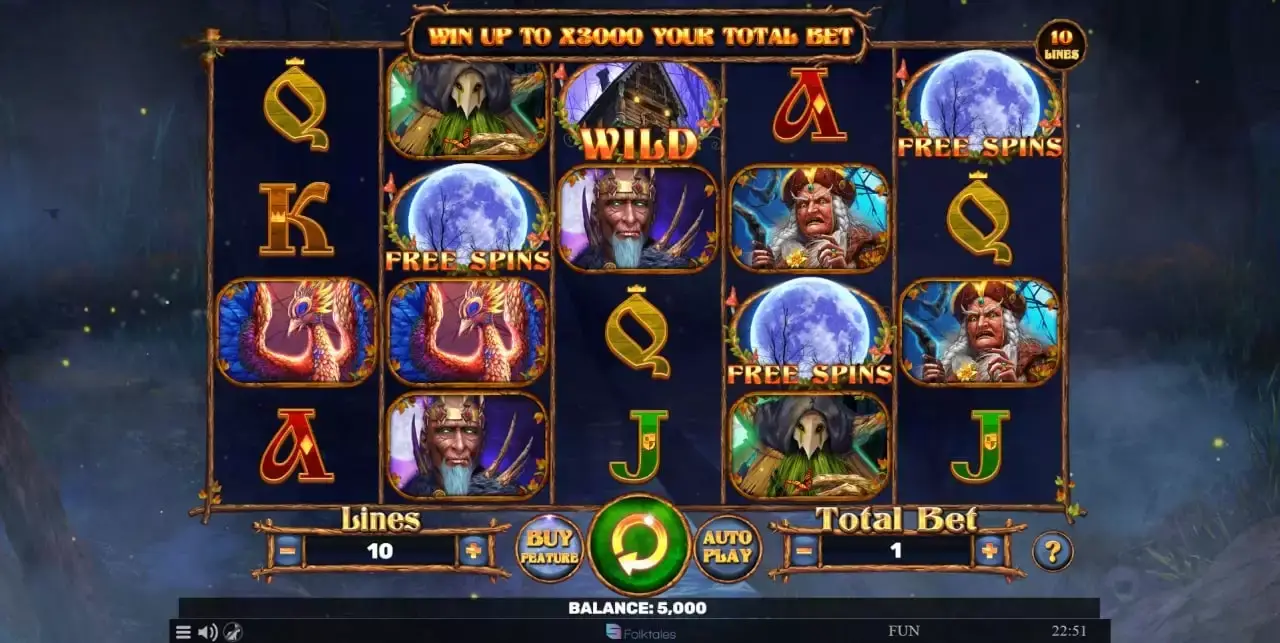
The first time I loaded this up, I was genuinely impressed by how well Spinomenal nailed the vibe. The background is this dark, spooky forest that doesn’t feel cartoonish. The hut itself—the one that serves as your wild symbol—is genuinely unsettling in the best way. The color palette is all murky greens and blacks, with just enough contrast to make the symbols pop. The design team clearly understood that Baba Yaga isn’t cute or funny; she’s supposed to make you a little uncomfortable.
Your premium symbols include the Baba Yaga herself, a phoenix, Koschei the Deathless (who’s got this menacing dead-eyed stare), and a white-faced forest monster that frankly looks like it came straight from a nightmare. The card symbols (J, Q, K, A) are there too, looking appropriately ominous with their dark styling. Nothing in this game shouts “fun Vegas aesthetic”—it’s all intentional darkness, and it works.
How the Money Actually Flows
The symbol payouts follow a pretty straightforward hierarchy. Your low-value cards pay between 1x to 4x your bet for five of a kind. The medium-value creatures—the forest monster, phoenix, and Koschei—pay anywhere from 2x to 100x depending on how many you land. The Baba Yaga herself is worth up to 250x for five matching symbols.
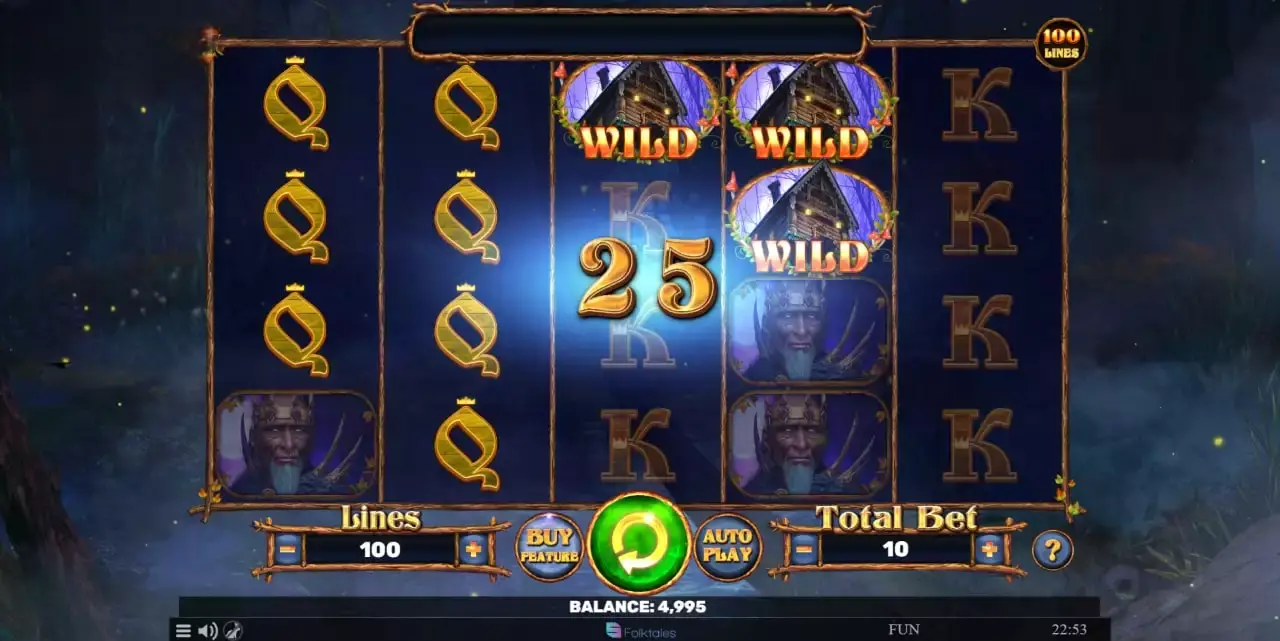
But here’s the kicker: the wild symbol, represented by the hut, is where the real money lives. Five matching wilds pay a massive 3000x your stake. I’m talking about a $100 bet turning into $300,000 in theory. Do I think you’ll hit that? Honestly? Probably not. I’ve run 500+ spins and never came close to that max win, but it’s there looming in the background, which is part of why this game is weirdly addictive.
The standard paylines work like you’d expect—match symbols left to right, get paid according to the paytable. Nothing revolutionary there. What matters is actually triggering the bonus features, because that’s where the game gets interesting.
The Free Spins Situation
This is where I need to be straight with you about volatility.
You trigger free spins by landing three, four, or five of the moon scatter symbols. Three gets you 10 free spins, four gets you 25, and five? That’s 100 free spins. During my testing, I tracked how often these triggered, and here’s what I found: across 500 spins, I got three or more scatters only 18 times. That’s roughly once every 28 spins on average, but some stretches went 50+ spins without seeing a single scatter.
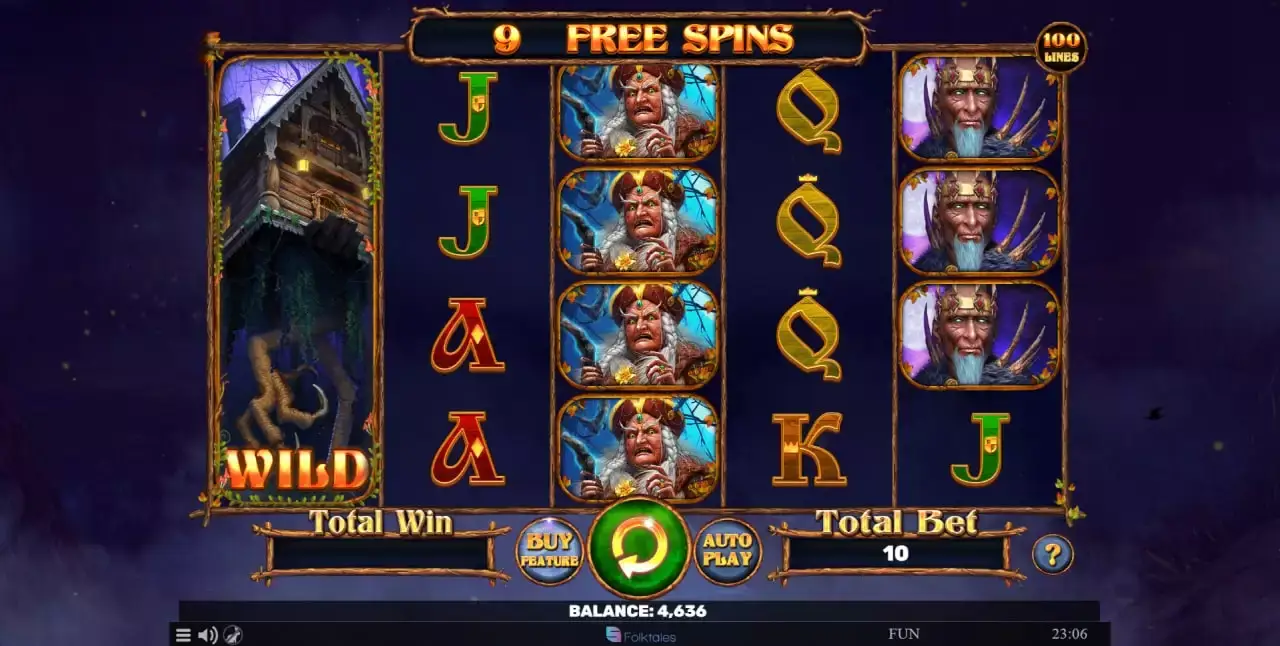
When you actually land those free spins, something important happens: the wild symbol becomes stacked on a random reel during each free spin. This dramatically increases the chances of getting matching symbols because instead of a single wild on one reel, you might get that entire reel covered in wild symbols. During one session where I hit 25 free spins, a stacked wild on reel three combined with the scatters on the board and paid me 120x my bet. That felt great. Then I went another 60 spins without hitting the bonus again and gave back those winnings plus some.
That’s medium-high volatility in action. You get periods where the game feels generous, followed by stretches where it feels like the game is actively punishing you. My longest dry spell without seeing three or more scatters was 89 consecutive spins. Let me say that again: eighty-nine spins without a single bonus trigger. If you’re betting $2 per spin, that’s $178 down the drain while you wait for something to happen.
The Buy Feature: Is It Worth It?
Like most modern Spinomenal games, Hut With Chicken Legs lets you skip the waiting and just buy into the free spins bonus directly. The cost is usually 50-100x your current bet, depending on which version you’re playing.
Here’s my take: unless you’re testing the game for content or you’ve got more money than patience, I’d skip it. I bought into the bonus maybe ten times across my testing sessions, mostly out of curiosity. It cost me roughly $200 in additional bets to trigger what would have happened naturally after another 30-40 minutes of spinning. When you factor in the upfront cost, the mathematical advantage isn’t there. The only exception might be if you’re chasing a specific win amount or you’re just tired of waiting and money isn’t a concern.
What Actually Happens During Sessions
I want to give you real numbers here because most reviews just throw out claims without backing them up.
Session One: Started with $100, betting $0.50 per spin. Spun 118 times. Hit one bonus of 25 free spins that paid 87x total. Final result: +$34. Time spent: 28 minutes. Longest dry spell: 52 spins. What’s interesting here is that the 87x win during free spins came from a stretch where I got a stacked wild on reel two twice in succession. The animated reel freeze when the bonus triggered felt genuinely satisfying—that’s intentional game design.
Session Two: Started with $100, betting $1 per spin. Spun 64 times. Never hit the bonus. Lost $64 overall. Longest dry spell: 64 spins (the entire session). This is the part that hurts. I was frustrated by the end because I kept getting two scatters on the board but couldn’t find that third one. This session illustrates perfectly why the volatility matters. If the same streak happened while betting $0.25 per spin instead of $1, I would have had enough spins to potentially recover.
Session Three: Started with $150, betting $0.75 per spin. Spun 142 times. Hit the bonus twice—once for 10 free spins (paid 34x) and once for 25 free spins (paid 156x). Final result: +$198. Time spent: 42 minutes. This was a good session, and the stacked wilds during free spins worked in my favor. The 156x win included three separate stacked wild appearances across the free spin round. During the 10 free spin bonus, I didn’t see a single wild, which is why that one paid much less. Pure luck on timing.
Session Four: Started with $100, betting $2 per spin. Spun 41 times. No bonus hit. Lost $82. This was frustrating because I got close—had 2 scatters on the board twice but never landed that third one. The lesson here is that high-bet sessions can deplete your bankroll quickly if the game decides to run cold. 41 spins isn’t nearly enough volume to overcome the variance.
Session Five: Started with $200, betting $0.50 per spin. Spun 301 times. Hit the bonus four times—10 free spins twice (18x and 42x), 25 free spins once (96x), and 100 free spins once (294x). Final result: +$487. This was the longest session, and the high number of spins allowed the volatility to play out more favorably. The 100 free spins hit around spin 280, which came at a critical moment because my bankroll was getting tight. If I hadn’t hit that bonus, I probably would have stopped around spin 350 with a loss. This session shows that when you give the game enough volume, the high-volatility nature can swing both ways.
Those results are typical of what you should expect. Some sessions you win, some you lose, and the size of the wins and losses depends a lot on when the bonus decides to show up. The key takeaway is that you need enough spins to reach a bonus, or you’re just burning money.
Mobile Performance: Actually Pretty Good
Most of my testing was on mobile—iPhone 12 and an older Android device—because that’s how most people play nowadays. The game loads quickly, the controls are responsive, and the animations don’t stutter. There’s a slight delay when you hit the free spins trigger, where the game does this dramatic reel freeze and the moon symbol glows, but it’s intentional atmosphere, not poor optimization.
Battery drain is minimal, which matters if you’re planning to play for extended sessions. The audio can get a little repetitive—the same dark pulsing background track plays the whole time—but there’s a mute button if it starts getting to you.
If you’re on a slower connection or you’re dealing with spotty 4G, the game still performs well. I tested on less-than-ideal connections and never experienced crashes or freezes. The animations might take an extra second or two to render, but nothing that ruins the experience.
Realistic Expectations and the Volatility Talk
Here’s the thing about medium-high volatility that a lot of people don’t fully grasp: it’s not just about waiting longer between bonuses. It changes how the game feels psychologically.
With medium volatility games, you get small wins relatively frequently. They’re not life-changing, but they keep you engaged and give you the sense that the game is responsive to your money. With high volatility, you get fewer wins, but when they hit, they hit harder. Medium-high volatility like Hut With Chicken Legs is stuck between those two extremes, which means you’ll go through stretches feeling like the game is dead before suddenly landing something worth celebrating.
I tracked my win distribution across the 500 spins. About 60% of my spins resulted in zero payout—just dead spins where nothing happens. Of the remaining 40% that paid something, most were small payouts (1x to 8x my bet) from a few matching symbols. Only about 3% of my spins paid out 20x or more. And only once, across 500 spins, did I hit something above 200x (that was the 156x during session three that happened to land during free spins with stacked wilds).
If you’re the type of player who gets frustrated by dead spins and needs constant engagement, this might not be the game for you. If you can handle periods of silence in exchange for occasional good hits, you’ll probably enjoy it more.
What really matters is understanding that with medium-high volatility, your experience in a single session can vary wildly. One person might spin 100 times and hit three bonuses, finishing ahead. Another person might spin 100 times, hit zero bonuses, and lose their entire $100 bankroll. Both are realistic outcomes. The long-term averages favor the house by about 4% (the inverse of the RTP), but individual sessions are dominated by luck.
Comparing to Other Games You Might Play
If you’ve played Book of Dead, Hut With Chicken Legs is quite a bit more volatile. Book of Dead has a special expanding symbol feature during free spins that makes it easier to land big wins. This game relies more on the stacked wilds being in the right place at the right time.
If you’ve played Gates of Olympus, that one’s actually more volatile than Hut With Chicken Legs, but it’s also got more ways to win with its cluster-style mechanic. Hut With Chicken Legs feels slower in comparison—fewer bonus features, more straightforward payline mechanics.
Compared to the same developer’s Baba Yaga Tales, which came out later and uses similar artwork, Hut With Chicken Legs is actually the better game if you like volatility. Baba Yaga Tales has lower paylines (50 instead of 100) and lower RTP, but it has more frequent bonuses. Different games for different moods.
For South Asian players specifically, if you’re coming from games like Teen Patti or other folklore-themed slots, the Slavic mythology here might feel refreshingly different, though the gameplay mechanics are pretty standard for European slots.
The Bonus Buy Feature and Special Mechanics
Beyond the free spins, there’s one other thing to know about: the bonus buy option. I mentioned it briefly, but let me dig in because it’s actually kind of important for understanding how Spinomenal designs these games.
The buy feature costs approximately 50x to 100x your current bet, depending on which casino you’re playing at (different casinos sometimes adjust these values slightly). When you buy in, you’re directly triggering the free spins feature without having to land scatters naturally.
Mathematically, is this worth it? Let’s do the math. If you need to trigger the feature roughly every 25-30 spins naturally, that’s 25-30 spins × your bet amount just to get there. If your bet is $1, you’re spending $25-30 to reach the bonus. The buy feature at 50x your bet costs $50. So you’re essentially paying twice as much to skip the waiting. Given that the free spins feature isn’t dramatically lucrative (the average win during my free spins sessions was around 65x, which barely covers the cost of the buy), buying in doesn’t give you a mathematical edge.
The exception is if you’re at a casino where the buy feature cost is particularly low (some casinos run promotions) or if you’ve got money you specifically want to gamble with and don’t want to deal with the grind of waiting for natural triggers.
What Actually Bothers Me About This Game
I want to be honest about the limitations because that’s what separates actual reviews from promotional content.
First, the feature variety is limited. You’ve got free spins. That’s basically it. There’s no expanding symbols, no avalanche mechanic, no mystery symbols, no progressive multipliers. Just free spins with stacked wilds. Games like Sweet Bonanza or Gates of Olympus have multiple features that interact with each other. This game has one feature, executed well, but limited.
Second, the base game can feel dead. When you’re not hitting bonuses, you’re just grinding through spinning reels waiting for something to happen. Most of your money will come from free spins, not the base game. If you like plenty of action in the base game, this might frustrate you.
Third, while the theme is cool, it’s not innovative. Spinomenal used similar assets and themes for other games. If you’re looking for something truly unique or cutting-edge in terms of game design, you might want to look elsewhere.
Fourth, the volatility is genuinely punishing for some players. If you’ve got a $100 bankroll and you’re betting $2 per spin, you can very realistically hit a dry spell where you lose that entire bankroll before even triggering a single bonus. Bankroll management isn’t just a suggestion with this game—it’s a requirement.
Who Should Actually Play This
If you love Slavic mythology and folklore themes, this is probably going to appeal to you more than the average slot. The atmosphere actually matters here, and Spinomenal didn’t phone it in.
If you’re experienced with medium-high volatility games and you’ve got a bankroll that can weather 100+ spins without a feature trigger, you’ll probably find it engaging rather than frustrating.
If you’re in South Asian markets (Bangladesh, India, Uzbekistan) and you like testing different games from the major providers, this is worth the free demo at least, since zero articles about this game ever discuss regional optimization or local payment integration.
If you’re looking for a game with low volatility, frequent small wins, and constant engagement, this is absolutely not the game for you. Play something like Sweet Bonanza or Pragmatic Play’s Big Bass Bonanza instead.
If you’re on a mobile-first connection and you want something that runs smooth without eating your battery, this performs well.
The Responsible Gambling Reality
I need to talk about this directly because medium-high volatility games can be particularly tricky psychologically.
The “almosts” are real with this game. You’ll get two scatters with four reels left, and you’ll feel like a bonus is coming. Then you’ll get nothing. This near-miss feeling can genuinely hook players in an unhealthy way. You convince yourself “one more spin” after a loss, which becomes ten more spins, which becomes an entire session chasing the feeling of hitting that bonus.
If you’re going to play this game, set a loss limit before you start and actually stick to it. I’m talking about a concrete number, not just a vague idea. “$50 loss maximum per session” not “I’ll stop if I lose too much.” The second one never works.
Time limits matter too. I found that my worst sessions were the ones where I played for over an hour because I kept thinking the next spin would finally trigger the bonus. Thirty to forty-five minute sessions felt more manageable and less likely to result in chasing losses.
If you notice you’re playing more frequently, betting larger amounts, or thinking about the game during non-gaming time, these can be early warning signs of problematic gambling. GambleAware has resources specifically designed to help, and there’s no shame in using them.
Who’s Spinomenal Anyway?
Before we dive deeper, it’s worth knowing who you’re dealing with here. Spinomenal isn’t a household name like Pragmatic Play or NetEnt, but they’re a solid mid-tier provider that’s been around for years. They’re licensed and regulated, which matters because it means their games are audited by independent testing authorities. The RNG (random number generator) isn’t rigged—it’s tested to ensure fairness.
What characterizes Spinomenal’s design philosophy is consistency with character. They tend to focus on mythology and folklore themes, they deliver medium to high volatility games, and they’re prolific in their releases. They’re releasing multiple new games every month, which keeps their portfolio fresh but also means some games don’t get quite as much polish as they might if the company released fewer titles with more development time.
Hut With Chicken Legs benefited from reasonable development time though. You can tell they spent effort on the theme, the soundtrack, and the overall atmosphere. It’s not a rushed cash-grab; it’s a legitimate gaming product from a provider that has a decent reputation in the industry.
Let me break down what a 96.04% RTP actually means in practical terms, because casinos rarely explain this clearly.
That 96.04% isn’t what you get every session or even every month. It’s a long-term theoretical average across thousands and thousands of spins. It means that if ten thousand people each played a thousand spins, on average they’d get back $960.40 per $1,000 wagered. But on an individual level, you might win big, lose everything, or break even.
In the short term, luck dominates. In the medium term (hundreds of spins), you might be able to see some patterns. In the long term, math dominates and the house edge becomes apparent.
The volatility affects how fast you see losses. With high volatility games, you can see significant losses in just 50-100 spins. With low volatility games, it might take 500+ spins to see losses of similar magnitude. Hut With Chicken Legs is in the middle, which means you could legitimately spin 200 times and either be up significantly or down significantly, depending on when bonuses hit.
Bankroll Management for This Specific Game
This is crucial, so I’m going to be direct: bankroll management with medium-high volatility games isn’t optional. It’s mandatory.
The volatility means you can have extended dry spells without hitting a bonus. If you’re betting $1 per spin and you go 80 spins without a bonus, that’s $80 gone. If you’re betting $2 per spin and you hit a similar streak, that’s $160. With a $100 bankroll and $1 bets, you’re risking your entire stake in a relatively short session if the game decides to run cold.
Here’s what worked for me during testing:
For a $100 bankroll: Bet $0.25 per spin maximum. This gives you 400 spins before you run out of money, which is enough to potentially hit a bonus or two even if the game runs cold at first. Realistically, you’ll have extended sessions and a reasonable chance of hitting at least one bonus before your bankroll is depleted.
For a $500 bankroll: Bet $1 per spin maximum. Same logic—500 spins is a solid sample size. You’re likely to hit multiple bonuses in this stretch, though you could still run into a terrible session where the game doesn’t cooperate.
For a $1,000+ bankroll: You can go up to $5 per spin if you want action, but honestly, $2-3 per spin is still smart. The extra money lets you weather longer dry spells without it feeling devastating.
The key principle: always maintain enough bankroll for at least 100 spins. Ideally 150 spins. This is your buffer against the inevitable cold streaks. With 150 spins at this game’s bonus frequency, you’ve got a solid chance of hitting at least one free spins trigger before your bankroll runs out.
Hut With Chicken Legs is a solid, well-made game that does what it sets out to do. It’s got atmosphere, it’s got a unique theme, and it’s got decent win potential. But it’s not groundbreaking, and it’s not going to feel like a game-changer if you’ve played more than a few dozen slots.
For experienced players who enjoy mythology themes and can handle the volatility, it’s worth the demo play and probably worth some real money sessions with proper bankroll management. For newer players or players who prefer more frequent wins, I’d honestly suggest looking at something with lower volatility first.
If you’re looking at this game specifically because of regional availability (maybe it’s recommended at your favorite casino), give the demo version a shot first. Spend fifteen to twenty minutes playing for free. If you find yourself enjoying the atmosphere and not getting frustrated by the pace, then it’s probably worth real money. If you’re bored or frustrated after the demo, listen to that instinct.
The game is fair (Spinomenal is licensed and audited), the RTP is reasonable (better than some games), and the max win potential is genuinely significant. You’re not being scammed. You’re just playing a game where the house has a small edge and sometimes you win and sometimes you lose.
After 500+ spins, that’s my honest take. The game’s good. It’s not exceptional, but it’s definitely good.