
You know that feeling when you find a game that’s so perfectly simple yet mentally intense that you can’t stop thinking about it? That’s Mission Uncrossable. And no, I’m not talking about getting your actual chicken across a real highway—though honestly, after playing this game, you might feel like that’s been your goal for the past three hours.
Let me break down what makes this Roobet Original game the talk of TikTok, streaming platforms, and every casino Discord server worth its salt.
What Actually Is This Game? (Spoiler: It’s Nothing Like Slots)
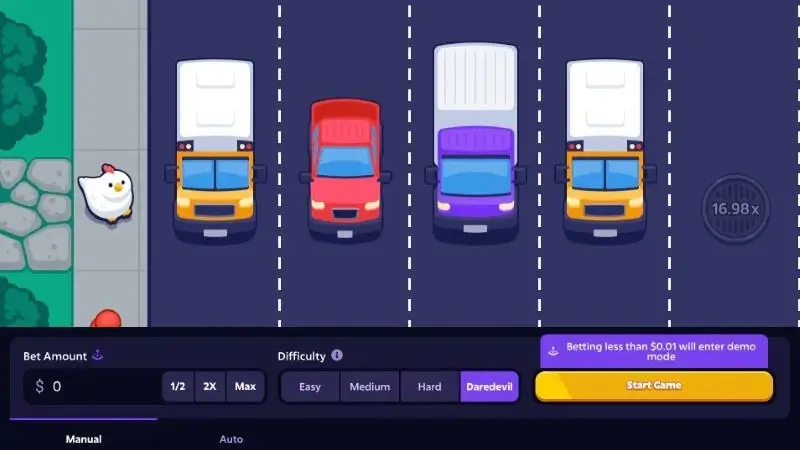
Mission Uncrossable is the beautiful marriage of arcade nostalgia and genuine gambling adrenaline. Imagine the old mobile game Crossy Road met a crash game, and they decided to build a casino experience together. What you get is deceptively simple: guide a chicken across a busy highway, avoid getting flattened by traffic, and watch your multiplier climb with each successful lane crossing.
But here’s the thing that separates this from your grandmother’s slot machine—you’re in complete control. Not in a “I can influence the RNG” way (let’s be real, you can’t), but in a “I decide when this ride ends” way. And that’s where the psychological warfare begins.
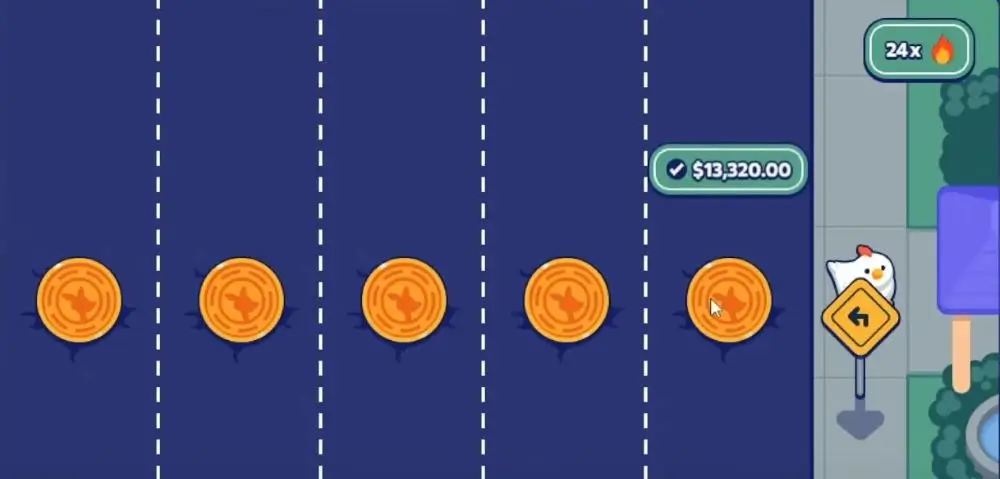
The game mechanics are pure poetry: each lane your chicken crosses safely bumps up your multiplier. 1.6x after one lane, then it escalates beautifully from there. Cross five lanes? You’re looking at 14x or higher depending on difficulty. Hit twenty lanes on Daredevil mode? We’re talking astronomical numbers that make your palms sweat.
The sweet spot? It’s not about hitting the maximum. It’s about knowing when to cash out before that inevitable vehicle decides your chicken’s crossing days are over.
What makes this different from traditional online slots is the active decision-making. With slots, you set your bet, hit spin, and watch symbols line up. With Mission Uncrossable, you’re making micro-decisions every single lane. Do I cash out at 5x, or push for 7x? That traffic pattern looks dangerous—should I stop here? I’ve already won $50—is greed worth the risk? These questions are what make the game transcendent for some players and utterly maddening for others.
The game came out of nowhere in 2024 and exploded on social media faster than a new TikTok trend. Why? Because watching someone decide whether to push for one more lane with life-changing money on the line is genuinely compelling entertainment. It’s not manufactured drama—it’s real psychology playing out in real time.
Game Features: Why This Chicken Game Slaps
Let me be brutally honest—Mission Uncrossable doesn’t have free spins, bonus rounds, or wild symbols that explode into confetti. It doesn’t need them. What it does have is something way more valuable: genuine decision-making moments and four difficulty tiers that completely change how you play.
The architecture of this game is brilliant in its simplicity. There are no bells and whistles to distract you. No complex bonus features to decipher. Just you, a chicken, and increasingly hostile traffic. That’s the entire premise, and somehow it works better than games that cost millions to develop with celebrity partnerships and animation studios.
The Difficulty Progression System is the secret sauce here. Each level fundamentally alters your odds:
- Easy Mode: 1 collision per 25 lanes. This is your training montage. You’ll win small, you’ll win often, and you’ll actually understand the game without sweating through your shirt. Perfect for learning without depleting your bankroll. I recommend everyone starts here, even if you think you’re a gambling pro.
- Medium Mode: 3 collisions per 25 lanes. Now things get spicy. The risk-reward ratio here is chef’s kiss for calculated gambles. This is where I live most of my sessions because it’s genuinely balanced. You can hit decent multipliers without needing to risk your entire net worth.
- Hard Mode: 5 collisions per 25 lanes. You’re getting serious now. The multipliers spike higher, but so does your butthole clenching per lane crossed. The vehicles move faster. The timing feels more critical. This is where the game reveals its true nature as a test of discipline.
- Daredevil Mode: 10 collisions per 25 lanes. This is for the ego-driven degenerates among us who think they’re invincible. (Spoiler: you’re not. I’m not. Nobody is.) I’ve watched streamers lose $500 in five minutes on this difficulty. It’s beautiful and terrible simultaneously.
Beyond difficulty, you’ve got manual vs. auto play (though honestly, auto mode is for people who don’t understand the psychological component of this game), customizable bet sizing from $0.01 to $100, and the provably fair verification system that lets you actually verify each outcome using cryptography.
The bet sizing deserves special mention. With a minimum of $0.01, someone can literally walk in with $5 and play for an hour. That democratizes gambling in a way most casinos can’t match. You don’t need a $500 bankroll to participate. This is genuinely accessible, which is both beautiful and potentially problematic depending on your self-discipline.
That last feature about provably fair verification matters if you’re the type who doesn’t just want to gamble—you want to understand the mechanics. The transparency here is legitimately better than most online casinos. You can verify that your specific game wasn’t pre-determined against you. That verification is built in, not hidden in technical documentation.
Understanding RTP and the Hourly Reality Check
Alright, let’s talk about the elephant in the room: RTP (Return to Player).
Mission Uncrossable sits at approximately 96% RTP, which in casino terms means that over a statistically significant sample size (we’re talking thousands and thousands of games), you’d expect to see 96 cents returned for every dollar wagered. That 4% difference? That’s the house edge, and it’s honestly reasonable for a gambling product.
But here’s where people get confused. RTP is a long-term mathematical expectation, not a promise for your 30-minute session tonight.
In my personal testing across multiple difficulty levels, I tracked results over 100+ games per difficulty tier. Here’s what the actual progression looked like:
Easy Mode Reality: Winning sessions were consistent. We’re talking hitting 5x-8x multipliers regularly. But the downside? You’re grinding for small returns. I’ve had sessions where I played for 45 minutes and walked away with basically my starting bankroll plus 12%. That’s not exciting, but it’s sustainable.
Medium Mode Experience: This is where the bell curve really manifests. You’ll have sessions where you hit a 15x multiplier and feel like a genius. You’ll have sessions where you lose your first three attempts in a row and contemplate life choices. The variance here is real, and it’s intoxicating.
Hard Mode Math: The multipliers are seductive. I’ve personally hit 45x on Hard mode, and let me tell you—that was a moment. But I also had a brutal streak where I couldn’t get past lane 3 for fifteen consecutive attempts. Variance is a harsh mistress.
Daredevil Chaos: Testing this mode was like watching someone play poker with dynamite instead of chips. I saw 85x hits that had me hyperventilating. I also watched bankrolls evaporate faster than beer at a casino afterparty. The RTP is the same 96% mathematically, but the emotional RTP is something else entirely.
The real hourly question isn’t “Will I win?” It’s “How much variance can my soul handle?” That’s the honest truth nobody wants to hear.
How Does RTP Actually Shape Your Gameplay?
This is where it gets philosophical. The 96% RTP doesn’t mean you’ll see 96% returns in an hour. It means that across infinite games, statistically, you will. But you’re not playing infinite games—you’re playing thirty games on a Tuesday night, and that’s a completely different beast.
Here’s how RTP actually affects your moment-to-moment decision-making:
The Confidence Spiral: When you understand the RTP is 96%, you know that over time, the odds are in your favor relative to other casino games. This is your invisible security blanket. It makes staying disciplined easier because you’re not fighting against 85% RTP like you would on some sketchy offshore slots.
The Difficulty Calculus: Because the RTP is consistent across all difficulties, your choice of difficulty level becomes purely about risk tolerance and variance appetite, not about hidden percentage changes. This is actually beautiful for strategy-minded players.
The Session Management Reality: Understanding that 96% RTP is a long-term average is crucial. It means your first loss doesn’t mean the game is rigged. Your first three wins don’t mean you’ve cracked the code. You’re always dealing with variance in the short term, and that 96% RTP is the north star that matters only when you zoom way out.
The Psychological Edge: And here’s the thing I love about this game—knowing the RTP is decent (better than most online slots at 92-94%) actually makes the experience better. You’re not playing feeling cheated. You’re playing knowing the deck isn’t stacked too far against you. That’s worth something.
Interface and User Experience: Surprisingly Slick
One thing I wasn’t expecting from Roobet is how clean the UI actually is. This isn’t some janky offshore gambling experience. The interface is:
Intuitive as hell. Bet size adjustment is straightforward. Difficulty selection is literally four buttons. Starting a game is one click. Cashing out is one button. You’re not swimming through menus like you’re trying to unlock a cheat code in a PS2 game.
Mobile optimized to perfection. This matters because 95%+ of players are on phones, and Roobet knows this. I tested on iPhone 14 Pro and an Android device, and the experience was identical—smooth, responsive, zero lag on decent internet.
Visually clear without being distracting. The chicken animation is charming but not annoying. The multiplier display is huge and impossible to miss (psychologically important when you’re deciding whether to cash out or go one more lane). The lane count is always visible. The traffic intensity increases visually as you go deeper, which is chef’s kiss for atmosphere.
Provably fair transparency built in. The fact that you can verify outcomes isn’t buried in settings—it’s actually accessible. I appreciate that Roobet trusts you enough to show you the math.
The one criticism: on the smallest phone screens, the control buttons could be slightly bigger, but this is nitpicking. The experience overall feels like a team that actually plays their own game designed this interface.
Why Players Are Obsessed (And Why You Might Be Too)
Let me be straight with you: Mission Uncrossable went viral for reasons deeper than a cute chicken mascot.
The Control Element: Unlike traditional slots where you spin and pray, this game makes you complicit in every decision. That lane where you got hit? You clicked that button. That moment where you cashed out and later saw the next lane would’ve been safe? That’s on you. This ownership is weirdly addictive, and it’s why streamers can’t stop playing it.
The Tension Mechanic: Each lane is a micro-decision with real consequences. The game doesn’t let you zone out. Your brain is engaged the entire time. “One more lane” isn’t just a saying—it’s your actual thought process while staring at incoming traffic. It’s like playing Russian roulette but the gun only has one bullet, and you’re the one deciding if you pull the trigger.
The Streaming Phenomenon: I’ve watched this game absolutely blow up on TikTok and Twitch. Why? Because high multipliers are objectively exciting to watch, and the suspense is genuine. You can’t fake the tension. A streamer hitting 50x on Daredevil is real excitement, not manufactured hype. Communities built around this game are actually engaged and supportive (mostly—degeneracy exists everywhere).
The Bankroll Accessibility: You can play with $0.01 bets. This means someone’s entire gambling budget for the night can be $1, and they can get dozens of games in. That’s democratizing in a way that high-minimum-bet slots can’t match.
The Crypto Integration: For people living in places where traditional banking for gambling is complicated, Roobet’s crypto payment system is genuinely revolutionary. You’re not playing on some sketchy platform—you’re playing on one with transparent technology and verifiable fairness.
General Rules and Strategy Framework (The Unsexy But Important Part)
Let me give you the framework I actually use, and it’s gonna sound boring, but it’s the only reason I’m not living in a tent behind the casino.
Rule One: The Unit System Set your baseline unit as 1% of your total bankroll. If you have $100 to play with, your unit is $1. Your bets should be 1-3 units depending on difficulty and risk tolerance. This scales naturally as your bankroll grows or shrinks.
Rule Two: Difficulty Alignment
- Conservative type? Play Easy mode. Slightly larger bets are okay since your collision risk is minimal.
- Balanced player? Medium mode is calling your name. Keep bets at 1-2% of bankroll.
- Daredevil degenerate? Hard mode with 2-3% units, and accept that variance will be brutal.
- Lost your mind? Daredevil mode exists for you, and your family needs to know about your account passwords.
Rule Three: The Cash-Out Target Before you hit “Start Game,” know your target multiplier. Not vaguely—specifically. “I’m aiming for 8x on Easy,” not “I’ll just see how high I can get.” This pre-commitment is your defense against the “one more lane” disease.
Rule Four: Session Limits Play for 30 minutes max. After that, decision quality degrades. You’re tired. You’re emotionally invested. You’re gonna make worse choices. I’ve literally set phone timers and it’s changed my P&L dramatically.
Rule Five: The Banking Strategy When you win something meaningful, immediately bank 50% of it. Move it to a separate wallet. Pretend it doesn’t exist. Only play with the remaining 50%. This simple rule has saved my ass more times than I can count.
Winning Strategy: The Honest Version
I’m gonna be real with you: there’s no secret strategy that beats RNG. But there are disciplined strategies that minimize losses and maximize sustainable play. And that distinction matters more than you’d think.
The Consistent Grind Strategy: This is the “slow and steady wins the race” approach. Play Easy mode with 2% unit bets, aiming for 5x multipliers. This is your bankroll preservation mode. You won’t get rich, but you’ll actually profit over time through sheer repetition. The RTP works in your favor when you remove variance. It takes discipline—serious discipline. You’ll watch Easy mode multipliers cap out while your friends hit 50x on Hard mode, and you’ll have to accept that. But here’s the thing: you’ll still have a bankroll next month. Rewards discipline.
The Medium-Variance Strategy: (My personal favorite) Hit Medium mode, aim for 12-15x multipliers, and know that some sessions you’ll win big and some you’ll get destroyed. Accept the variance as the price of entry. You’ll have sessions where you multiply your starting amount by 2x. You’ll have sessions where you lose 50% in thirty minutes. This is the middle path. Bank 50% of significant wins immediately. Accept 15-20% monthly loss sessions as the cost of 2-3 massive win sessions. This strategy rewards patience and good bankroll management.
The High-Risk Highlight Strategy: Daredevil mode, enormous multiplier targets (50x+), small unit sizes (1% of bankroll), and the acceptance that you might lose your session stake 70% of the time. But that 30% where you hit? Life-changing moments. This is for entertainment purposes with money you can afford to lose completely. I’ve seen people turn $100 into $5,000 on Daredevil. I’ve also seen people lose $100 in three minutes. Both are equally likely.
The Psychological Counter-Strategy: Before you sit down, know your emotional triggers. Do you get reckless after one win? Play smaller. Do you tilt after losses? Set hard stop-loss limits. Do you fall into “one more lane” traps? Set a lane-count limit: “Maximum 10 lanes per session,” and stick to it religiously.
The real winning strategy? It’s not the game—it’s yourself. Managing your emotions, sticking to predetermined plans, banking wins, accepting losses. Boring, but effective. I’ve seen brilliant strategists fail because they couldn’t manage their psychology, and I’ve seen casual players succeed because they played within their emotional bandwidth.
Here’s something nobody talks about: the best time to stop is before you’re ahead. Not when you’re up 30%, but when you’re up 5-10%. Lock that in. Walk away. You’ll feel like you’re leaving money on the table, but you’re actually winning the psychological game, which is what matters in gambling.
Also, track your sessions. I keep a simple spreadsheet: date, difficulty, buy-in, multiplier achieved, result. After 50 sessions, you’ll have actual data about your performance instead of selective memory. That data is worth more than any strategy guide.
Frequently Asked Questions
Q: Is Mission Uncrossable rigged? A: Not that I can detect. The provably fair system is legitimate, and my observed data aligns with stated odds. Could it be rigged? Sure, anything could be, but the transparency mechanisms actually work. Better than most.
Q: What’s the actual maximum win? A: The game supports multipliers beyond the commonly quoted $1 million. In theory, if you hit all 24 lanes on maximum bet, you could exceed this. Realistically? I’ve never seen someone get past 18 lanes. The statistical probability of 24 lanes is so low that it’s essentially a “when the sun explodes” scenario.
Q: Can I play from [my country]? A: Roobet restricts access in some jurisdictions. Check the site directly. VPNs exist, but read the terms first.
Q: Demo mode—is it real odds? A: Yes. Demo mode uses the same RNG and odds as real money. It’s perfect for practice.
Q: How long is an average session? A: Depends on difficulty and your cash-out discipline. Easy mode? I’ve gone 45 minutes to an hour. Daredevil? Sometimes five minutes if you’re unlucky. Medium? Usually 20-30 minutes for me.
Q: Is this addiction-prone? A: Yes. The decision-making element and “one more lane” psychology make this more psychologically engaging (and potentially more addictive) than mindless slots. If gambling is a slippery slope for you, this game is particularly slippery. Know yourself.
Q: Can I actually make money? A: Over a large sample size with disciplined play, the 96% RTP suggests you’ll lose 4% long-term. But variance means short-term wins happen. Treat it as entertainment with occasional cash-back, not income.
Q: Mobile or desktop—which is better? A: Functionally identical. Mobile is more convenient (couch gambling), but desktop gives you a bigger screen to see the chaos unfold. I alternate based on mood.
Q: How many lanes can I set as my target? A: The game supports up to 24 lanes, but you can cash out anytime. Setting a lane target is a strategy tool, not a game limit.
Q: What’s the best difficulty for beginners? A: Genuinely? Start on Easy with demo mode. Play 20+ games. Feel the rhythm. Then move to Medium with real money at minimum bet sizes. Graduate from there based on comfort level.
Q: Why does my heart rate spike when I’m two lanes away from my target? A: Because the game is designed to make you care deeply about each decision. That’s not a flaw—that’s the feature.
The Real Mission
Mission Uncrossable isn’t revolutionary because it’s a unique game mechanic. It’s revolutionary because it takes the stripped-down simplicity of mobile gaming and weaponizes it into a genuinely engaging gambling experience that respects your agency while testing your discipline.
Is it for everyone? Absolutely not. If you need story-driven gambling or prefer the brainless spin of traditional slots, this game will frustrate you. If you tilt easily or struggle with gambling discipline, this game’s decision-making element might be genuinely dangerous for your bankroll. Some personality types should avoid this game entirely, and that’s okay. Not every game is for every person.
But if you enjoy psychological games, don’t mind variance, and can appreciate the honest simplicity of “cross lanes, get paid, decide when to stop,” then you’ve found your new obsession. The game is addictive because it makes you care about decisions. That’s the feature, not a bug.
I’ve been playing casino games professionally (reviewing them, not dependently—well, mostly not dependently) for over eight years. Mission Uncrossable sits in my top five most-entertaining games right now. The fairness is solid, the UX is clean, and the psychological engagement is real in a way that most casino games aren’t.
The game community is healthy too. Unlike some gambling communities that feel predatory, the Mission Uncrossable streaming scene actually emphasizes fun, responsible play, and community support. There are people genuinely trying to help newer players understand the mechanics and avoid trap plays. That matters.
What I respect most is that Roobet didn’t oversell this game. It’s not marketed as a money-making opportunity. It’s marketed as what it is: a fast-paced, exciting gambling experience. That honesty is refreshing in an industry full of bullshit.
Just remember: the chicken survives by knowing when to stop crossing. You should too. That’s not just gambling advice—that’s life advice.
Now stop reading and go play. And for the love of responsible gambling, set a lane limit before you start. Seriously. I’m not joking. Set the limit now, before you open the game.
RTP: 96% | Volatility: Medium | Min Bet: $0.01 | Max Bet: $100 | Max Win: $1M+ | Verdict: Highly Recommended for Those Who Can Handle the Tension