Massive Studios released Rooster’s Revenge in October 2023, and by early 2026 it’s still one of the most talked-about games in the provider’s catalog. That’s not because it’s flashy in an overdone way, or because the farm theme breaks new ground — it doesn’t. What keeps people coming back, or at least keeps them arguing about it on forums, is a mechanical core that genuinely rewards understanding the game. There’s a real ceiling of 25,000x your stake. Getting there requires a very specific set of things to go right. Most sessions, they don’t. That’s the deal.
This review breaks down everything you actually need to know: how the base game works, why there are two completely different bonus tracks, what each of the four bonus buy options does (and whether any of them are worth the cost), and what kind of player this game is built for. No padding, no hype.
Quick Stats
| Provider | Massive Studios |
| Grid | 6 reels × 4 rows |
| Paylines | 20 fixed |
| RTP | 96.5% (97.1% with Golden Wheel Bonus Buy) |
| Volatility | High — extremely high in practice |
| Bet range | $0.20 – $100 per spin |
| Max win | 25,000× stake |
| Released | October 18, 2023 |
Who Is Massive Studios?
Before getting into the game itself, worth a quick note on who made it. Massive Studios is an Australian developer with offices in Melbourne, London, and Lisbon, founded in 2022. Their catalog is still compact — around 20 titles as of early 2026 — but their games consistently come in above-average on RTP (usually above 96.5%) and lean hard into high volatility. The studio built its early reputation largely through Stake, where most of its games launched exclusively. Rooster’s Revenge was part of that wave.
The Stake connection matters for availability. As of early 2026, the game’s distribution has expanded beyond Stake, with SlotCatalog listing it across 14 countries, concentrated in markets like Austria, Vietnam, Thailand, and Poland. It’s not yet the kind of title you’ll find at every major European operator, but its footprint has grown steadily from the initial exclusive launch.
Massive Studios is still a small operation compared to Pragmatic Play or NetEnt, but their games are being taken seriously. Rooster’s Revenge is probably their best-known slot. It’s a fair representative of what the studio does.
Theme and Visual Design
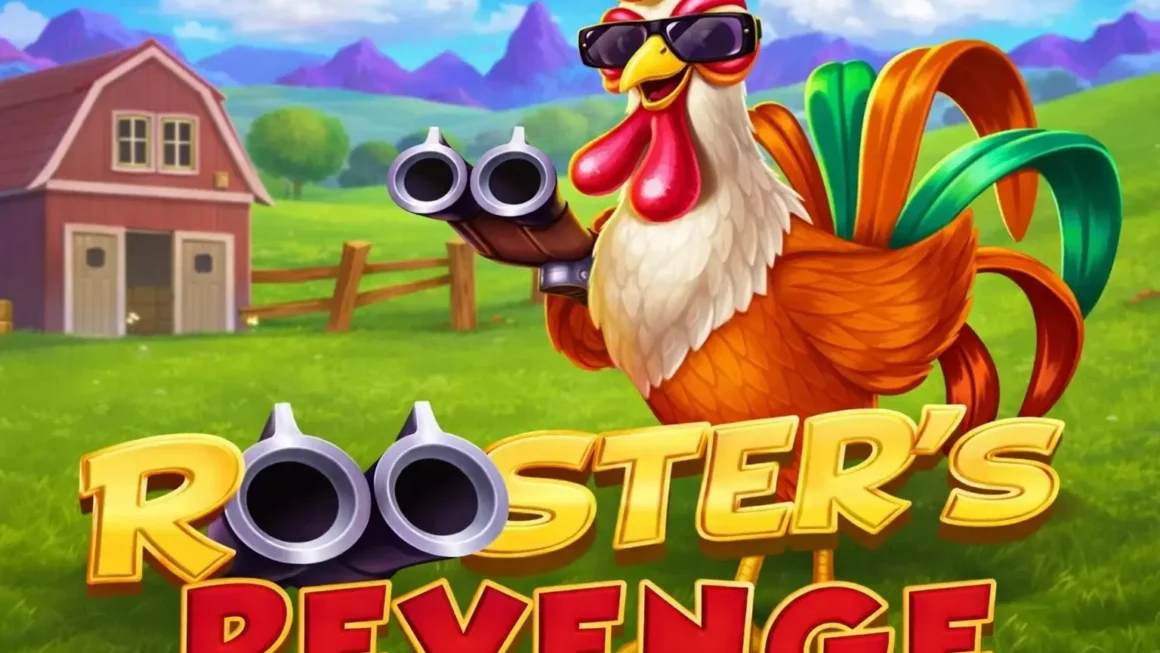
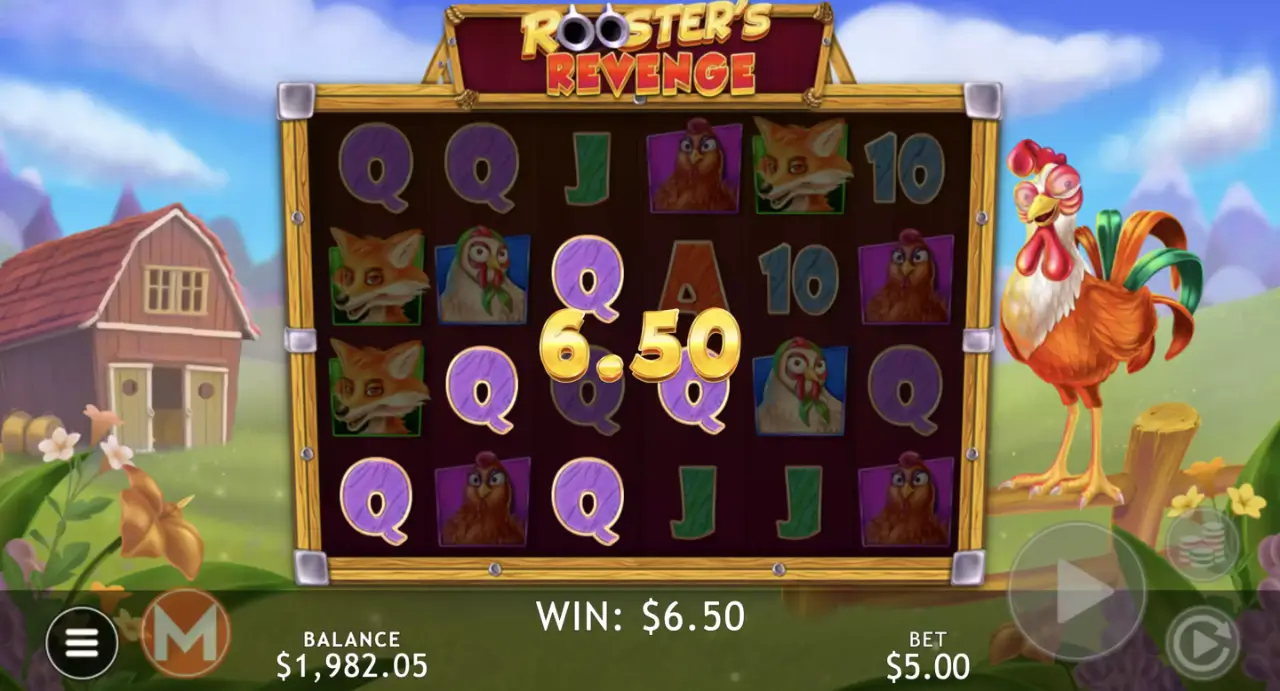
The game is set on a cartoon farmyard. That description could apply to a dozen slots, but Rooster’s Revenge leans into its characters more than most. The lead figure is a rooster in sunglasses — swagger intact, clearly armed with grievances. The fox appears on the reels as a villain figure. Hens, eggs, and assorted barnyard symbology fill out the paytable. The backdrop is countryside scenery: wooden fences, hay bales, the kind of sun-drenched pastoral scene you’d expect.
The art style is polished. Animations are fluid rather than perfunctory — wild expansions have real visual weight, the bonus wheel looks good, and the sound design is consistent with the cartoon tone. Clucking chickens, crowing audio cues, no jarring shifts in tone between base game and bonus.
This isn’t a theme that’s going to grab a player for aesthetics alone. But the presentation is clean and the character-driven symbols give the game more personality than a generic fruit machine with a farmyard skin. It works.
Base Game: How Wins Actually Happen
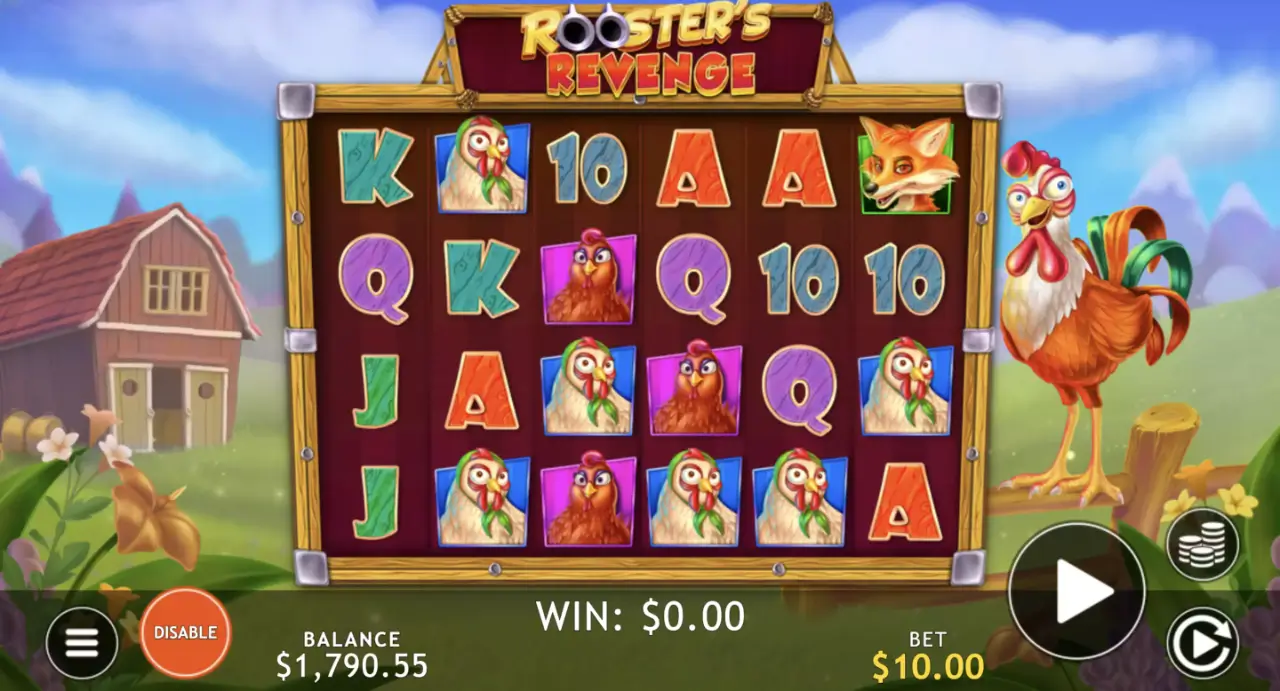
The grid is 6 reels by 4 rows. You’re playing on 20 fixed paylines. That’s a notably restrained number for a 6×4 setup — Megaways titles running the same grid size can push into hundreds of thousands of ways to win. Rooster’s Revenge doesn’t do that. Twenty lines means wins aren’t scattered everywhere on every spin, which is part of why the base game can feel dry for stretches.
The Two Wild Types
The mechanic that defines the base game is the pair of Rooster Wilds — White and Dark. Both behave similarly in their core function but diverge in ways that matter significantly.
White Rooster Wild: substitutes for all symbols except scatters. When it lands on a reel, it expands to cover the entire reel and triggers a respin of all other reels. If another wild lands during that respin, you get another respin. This can chain. It’s a direct relative of the Starburst expanding wild mechanic — same DNA, slightly evolved.
Dark Rooster Wild: does everything the White Rooster does — expands, triggers a respin — but it also adds a random multiplier to the mix. If multiple Dark Rooster Wilds are in play simultaneously, their multipliers add together. Two Dark Roosters each showing a 5× multiplier don’t give you one 5× — you get 10×. That additive stacking is where the base game’s larger hits come from.
The base game can pay meaningfully on its own. Landing six or more Rooster Wilds during the respin chain pays up to 20,000× the bet directly. That’s the theoretical ceiling on the base game path, though hitting it without the bonus round obviously requires a very specific combination to come together.
Hit Rate and Patience
The base game is dry. Not “busy but not paying” dry — genuinely sparse. Winning spins with meaningful returns don’t come frequently. The expanding wild respins happen often enough to keep you engaged, but most of them resolve to small returns or nothing. You’re waiting for the Dark Roosters to multiply something worth multiplying, or for the scatter eggs to trigger the bonus. On many sessions, neither happens at a frequency that makes the bankroll feel comfortable.
There’s also a specific frustration pattern that players report repeatedly: the White Rooster Wild expands and triggers a respin, the respin doesn’t land anything useful, and you’re back to the base game having spent the equivalent of a spin to watch an animation. That’s fine on the fifth occurrence. It wears on you by the fiftieth. The expanding wild mechanic is exciting when it chains — genuinely so — but chain expansions with Dark Roosters and multipliers aren’t frequent. Single White Rooster expansions that resolve to nothing are the dominant outcome of most base game sessions.
This isn’t a flaw, exactly — it’s the contract of a high-variance game. But if you’re coming from something like a medium-volatility slot with steady small wins, the adjustment period is real. The game doesn’t pretend to be something it isn’t, but going in without realistic expectations about base game activity is one of the more common reasons players bounce off it quickly.
The Scatter System: Two Paths, Very Different Ceilings
The scatter symbol is an egg. There are two types: the standard egg and the Golden Egg. Both can trigger the free spins feature, but they lead to completely different bonus rounds.
Landing three or more egg scatters anywhere on the 6×4 grid in the base game activates the Feature Wheel. Whether you get a standard or enhanced bonus depends on whether a Golden Egg was part of the triggering combination.
This two-tier scatter structure is one of the more interesting design choices in the game. It means the bonus isn’t just “good” or “bad” depending on how many spins you get — it’s mechanically different depending on which path you enter. That distinction matters enormously for max win potential.
Free Spins: Standard Feature Wheel
The standard path opens when three or more regular egg scatters trigger the bonus. A wheel spins and determines two things: the number of free spins awarded (up to 12) and the round multiplier applied to all wins during the feature (up to 25×).
During the free spins, the expanding wild and respin mechanic from the base game remains active. Dark Rooster Wilds that land during free spins store their multiplier values — and these stored values add to the round multiplier rather than being a separate calculation. If the round multiplier is 10× and a Dark Rooster adds 5×, the effective multiplier for the rest of the feature becomes 15×.
The retrigger mechanic: every five scatter eggs collected during the free spins retriggers the Feature Wheel. A fresh spin awards additional spins and a new multiplier, which is added to the running total. This is where chains start forming. A session with multiple retriggers and accumulated multipliers can pull the standard Feature Wheel well above its base ceiling.
The standard path has a theoretical max multiplier of 25× going into the round, with accumulation on top of that. It’s solid. It’s not where 25,000× comes from.
Free Spins: Golden Wheel
This is the one that matters if you’re thinking about the game’s ceiling.
When a Golden Egg scatter is part of the combination that triggers the bonus, the Feature Wheel is replaced with the Golden Wheel. The numbers are different in every meaningful way: up to 25 free spins instead of 12, and a round multiplier that can reach 100× instead of 25×.
The mechanics inside the feature work identically — expanding wilds, respins, Dark Rooster multiplier accumulation — but you’re starting with a higher multiplier base, you have more spins to work with, and critically, if the bonus retriggers while you’re on the Golden Wheel path, the Golden Wheel is offered again rather than reverting to the standard version.
How 25,000× becomes reachable: a 100× round multiplier applied across 25 free spins, with Dark Rooster multipliers stacking on top of that, and retriggers adding to both the spin count and the accumulated multiplier. The math works. Getting there requires the stars to align — the Golden Wheel, a high multiplier from the spin, multiple Dark Rooster appearances, and a retrigger or two. Each element is possible but not reliable. Together, they’re rare.
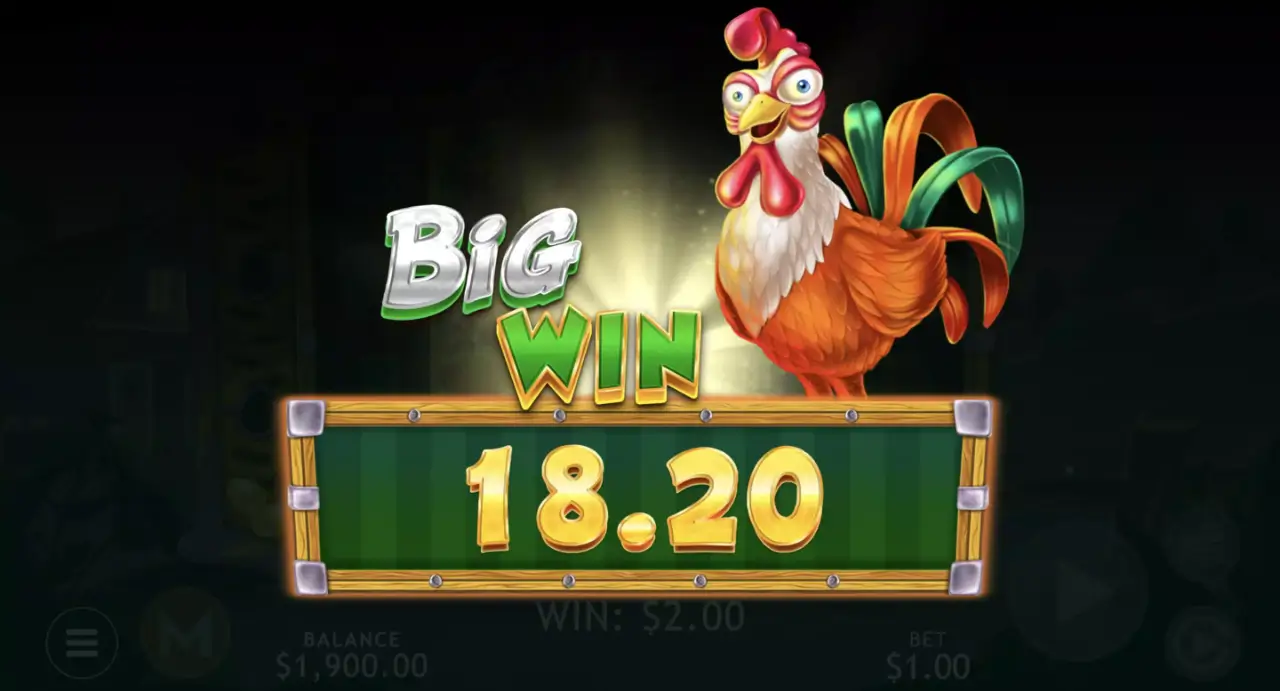
Rare isn’t the same as impossible. This game has generated documented significant hits. ClassyBeef reportedly posted a stream session in March 2024 where the game produced a win in excess of $2 million, though exact figures from streamer sessions should be treated as reported rather than verified. What’s not in dispute is that the Golden Wheel path is where the game’s top end lives.
Bonus Buy and Game Enhancers: Four Options
Rooster’s Revenge gives you four ways to modify how you reach the feature. This is worth understanding properly because the options have different cost structures, different effects, and — unusually — one of them actually changes the RTP.
Game Enhancer 1 — 2× Your Stake Per Spin
Instead of a direct buy, this doubles the cost of each spin in exchange for a significantly higher probability of triggering the Free Games. The increase is described as more than 4× the base probability. RTP stays at 96.5%.
This is the most conservative option. You’re paying twice as much per spin for a better chance of hitting the bonus organically through the standard scatter mechanism. It’s useful if you want more feature frequency over a longer session without the one-time cost of a direct bonus buy. The per-spin cost doubles fast if you’re running through many spins, so it suits players who prefer sustained higher-cost play over a single large investment.
Game Enhancer 2 — 10× Your Stake Per Spin
Ten times the base stake per spin, with nearly 5× the base probability of triggering Free Games with at least one Golden Egg scatter included. RTP stays at 96.5%.
This is aggressive. You’re running ten times the base cost for every spin in exchange for materially increased odds of landing on the Golden Wheel path specifically. The cost accumulates very quickly. At a $1 base stake, you’re spending $10 per spin. It’s a mode for players who are specifically trying to access the Golden Wheel frequently and have a bankroll that can absorb the cost of long stretches without a trigger.
Bonus Buy 1 — 100× Your Stake
Direct entry to the standard Free Games round. No waiting. No scatters needed. RTP stays at 96.5%.
At a $1 base bet, this costs $100 per purchase. You land directly in the Feature Wheel bonus with up to 12 spins and up to a 25× multiplier. The ceiling on the standard path is lower than the Golden Wheel, so this buy is most useful when you specifically want the standard feature experience without variance in timing. Whether the math works out depends entirely on what the wheel gives you and whether multipliers accumulate during the round.
Bonus Buy 2 — 500× Your Stake
Direct entry to the Golden Wheel Free Games. This is the only option that changes the RTP: it goes up to 97.1%.
At a $1 base bet, this is $500 per purchase. You’re going straight into the enhanced round with up to 25 spins and up to a 100× starting multiplier. This is the most expensive option and the closest thing to a premium bet on the game’s top-end outcome.
The RTP bump to 97.1% is notable. Most bonus buy options in high-variance slots either maintain the base RTP or, in some cases, slightly reduce it. Here the 500× buy actually improves expected return. That makes it more EV-efficient than Bonus Buy 1 in a strict mathematical sense — though 500× is obviously a much larger single outlay.
For players who specifically want Golden Wheel access and have the bankroll, the math supports Bonus Buy 2 over Bonus Buy 1. For everyone else, the cost is prohibitive for regular use.
RTP and Volatility: What the Numbers Mean in Practice
RTP 96.5%
At 96.5%, Rooster’s Revenge sits above the industry average. Most high-volatility slots from major providers land around 95–96%. The above-average RTP is a Massive Studios pattern — their games consistently come in at or above 96.5%.
What 96.5% means in practice: over a very long sample size, the game returns 96.5 cents of every dollar wagered. Over any individual session, the distribution of those returns is extremely uneven. You can run through 200 spins and return 20% of your stake. You can also hit a Golden Wheel bonus with accumulated multipliers and return 3,000% in a single round.
The RTP number tells you about the long-run distribution. It doesn’t predict what a session looks like.
Volatility: Actually Brutal
“High volatility” is a phrase so overused in slot descriptions that it’s lost most of its meaning. Rooster’s Revenge warrants a more specific characterization. SlotCatalog’s review describes it as “extremely volatile at times” — which is accurate. Features are genuinely elusive. It’s realistic to trigger no bonus rounds in 300+ base game spins at a session. The expanding wilds provide some base game activity, but meaningful returns are concentrated in the bonus, and the bonus is not frequent.
One hands-on review account noted 30 bonus buy attempts with a highest single return of 120× stake, with only one retrigger across all attempts. That’s not a cherry-picked bad run — it’s an illustration of what the standard deviation looks like on this game.
To put that in concrete terms: at $1 per spin, 300 spins costs $300 in base game play. If the bonus doesn’t trigger in that stretch, you might return $80–$120 from base game wins. That’s a significant draw-down before the feature even has a chance to run. Players who treat the base game as a fee they’re paying to access the bonus eventually will have more manageable expectations than those waiting for the RTP to “even out” over a short session.
That’s not a reason not to play it. It’s information about what kind of sessions to expect and how much bankroll actually constitutes a reasonable stake for the game’s variance profile.
Max Win: How 25,000× Is Actually Structured
The 25,000× ceiling is real, not a marketing number detached from the game’s mechanics. Understanding how it’s structured makes it a more honest figure.
The building blocks: Golden Wheel Free Spins start with up to 100× round multiplier. Dark Rooster Wilds that appear during the round add their individual multipliers to that base. Retriggers add more free spins and a new multiplier value to the running total. The expanding wild and respin chain can produce multiple wins within a single free spin, each benefiting from the accumulated multiplier.
At the outer edge of the probability distribution — highest wheel result, maximum Dark Rooster contributions, favorable retrigger — the compounding effect across those elements reaches 25,000×. It requires everything to align. The probability of that is very low. The theoretical ceiling is constructed from real game mechanics, not a regulatory floor that the game can’t actually reach.
For comparison, landing six Rooster Wilds in the base game through respin chains can pay up to 20,000× without the bonus round. That’s a different path to the game’s upper end.
Bonus Buy: Is It Worth It?
This is a question worth answering directly rather than deflecting.
Enhancer 1 (2×): Reasonable if you’re playing a longer session and want more feature frequency without a single large purchase. The cost doubles fast. Monitor total spend.
Enhancer 2 (10×): High-risk play mode. Specifically for players targeting the Golden Wheel with sustained high-cost spins. Drains bankroll quickly on a dry run.
Bonus Buy 1 (100×): Standard path access. The math is neutral compared to base game play at 96.5% RTP. Useful for patience reasons, not EV reasons.
Bonus Buy 2 (500×): The most EV-efficient of the buys due to the RTP bump to 97.1%. It’s also the highest single-purchase cost. If you’re going to buy, the math favors this one over Bonus Buy 1. Whether you can afford it is a separate question.
None of the buys change the fundamental probability of a good outcome on any given bonus round. You’re still subject to what the Feature Wheel gives you and whether the Dark Roosters cooperate.
Who Should Play Rooster’s Revenge
Good fit:
- Players with genuine high-variance tolerance — the kind who can sit through 100 dead spins without adjusting their judgment of the game
- Bonus buy users who specifically want Golden Wheel access and have the bankroll to support 500× purchases without over-investing on a single session
- Players who enjoy mechanically layered bonuses where understanding the structure affects how you approach the feature when it arrives
- Streamers and viewers looking for a game with a credible high ceiling
Poor fit:
- Casual players or anyone running a limited session bankroll
- Players who need frequent small wins to feel engaged — this game doesn’t offer that
- Anyone who finds slow stretches frustrating rather than acceptable
- Players looking for steady returns where the RTP “feels” true over a short sample
How Rooster’s Revenge Compares
The obvious comparison is Starburst. The expanding wild plus respin mechanic is the same idea. Rooster’s Revenge adds the Dark Rooster multiplier layer and a proper bonus round, both of which make it considerably more volatile and considerably more interesting than Starburst’s flat volatility profile. Starburst is still played because it’s familiar and low-pressure. Rooster’s Revenge is played because the ceiling is real and the mechanics reward understanding them. Different purposes, different audiences.
Some reviewers draw a visual and tonal comparison to Wanted Dead or a Wild by Hacksaw Gaming — the cartoon Western swagger translates to cartoon barnyard swagger in a similar way. The mechanics are different, but the energy is comparable: absurd-funny setting, deceptively serious math underneath. If Wanted Dead or a Wild clicks for you from a tone perspective, Rooster’s Revenge will feel comfortable aesthetically while offering a different mechanical experience.
Within Massive Studios’ own catalog, Rooster’s Revenge sits as one of the cleaner examples of their design philosophy. Drac’s Stacks carries a higher RTP (96.74%) and a higher max win ceiling (50,000×). Zombie Rabbit runs a different mechanic entirely — 4,096 ways to win versus 20 fixed paylines — which changes the hit rate profile significantly. If Rooster’s Revenge works for you, the catalog has more in the same direction, and the studio’s output has been growing since 2024 in both volume and distribution reach.
Final Verdict
Rooster’s Revenge earns its reputation. The mechanics are layered and coherent, the RTP is above average, and the 25,000× ceiling is legitimately accessible through the Golden Wheel path rather than being a theoretical footnote. Massive Studios built a game where understanding the structure gives you something — not an edge over the RNG, but a clearer read on what you’re actually waiting for and why.
The bonus buy system is one of the better-designed versions of the concept in a high-variance slot. Most providers offer direct feature access as a premium cost with the same or worse RTP. Rooster’s Revenge gives you four genuinely distinct options at different price points, and the most expensive one is also the most EV-efficient. That’s a coherent design, not an afterthought.
The volatility is the caveat. Not “high” as a checkbox — genuinely brutal in session-to-session experience. The bonus round is elusive. Most Golden Wheel sessions won’t return anywhere near the theoretical maximum. Bankroll management isn’t optional here; it’s the difference between a bad session and a catastrophic one. A player going in with 50 base-game spins worth of budget is not really playing Rooster’s Revenge — they’re taking a lottery ticket at it.
If you come in with a budget built around 200–300 spins minimum, patience for feature drought, and an accurate picture of what the bonus actually needs to produce to generate big returns, this is one of the more mechanically satisfying high-variance slots available in 2026. The farm theme is just a skin. The math underneath it is legitimately interesting.
If you can’t make peace with the volatility, there are more forgiving games. Neither answer is wrong — they just describe different kinds of players.
RTP 96.5% is real and above average. The game pays where it says it pays. Getting there is just patient work.
Gamble responsibly. Set limits before you play. If gambling stops being fun, take a break.