
Quick Stats
| Parameter | Value |
|---|---|
| Developer | Switch Studios (Microgaming network) |
| Game Type | Arcade / Instant Win |
| Release Date | October 20, 2025 |
| RTP | 96% |
| Volatility | Medium |
| Hit Frequency | 56.1% |
| Min Bet | $0.10 |
| Max Bet | $100.00 |
| Max Win | 300x / $30,000 |
| Stages | 9 |
| Multiplier Range | 1.4x – 300x |
What Is Runaway Chicken?
Runaway Chicken is an arcade-style instant win game released by Switch Studios in October 2025. It does not have reels, paylines, wilds, scatters, free spins, or bonus rounds. The entire game is built around a single mechanic: a chicken attempts to cross a nine-stage highway, and the player collects a payout multiplier at whichever stage they decide to stop.
That premise is simple enough to grasp in about ten seconds, which is exactly the point. Switch Studios — a studio operating within the Microgaming network and known for table game products — made a deliberate move away from the five-reel format that accounts for the overwhelming majority of casino releases. The result sits somewhere between a crash game and an arcade game, and it does not fit cleanly into either category. How that works in practice, and whether it works well, is what this review covers.
The Developer: Switch Studios
Switch Studios is a development studio within the Microgaming ecosystem. The studio has primarily built its catalogue around digital table games — blackjack, roulette, and baccarat variants distributed across Microgaming-powered casinos. Those products are technically polished but conservative in format by design: they service players who want a digital version of a physical casino table, not something unfamiliar.
Runaway Chicken represents a deliberate departure from that catalogue. It is the studio’s most visible move into the arcade and instant win segment, applying a simpler, more casual visual style and an entirely different interaction model. Whether this signals a broader strategic shift or is a standalone experiment is not publicly confirmed at the time of writing.
The game launched on October 20, 2025, and is distributed through the Microgaming network. Geo-restrictions are extensive: the game is unavailable in a large number of jurisdictions including the US, UK, Australia, Germany, France, and several others. Players in regions where it is available can access it through casinos running Microgaming content.
How Runaway Chicken Works: Core Mechanics
The Road-Crossing Format
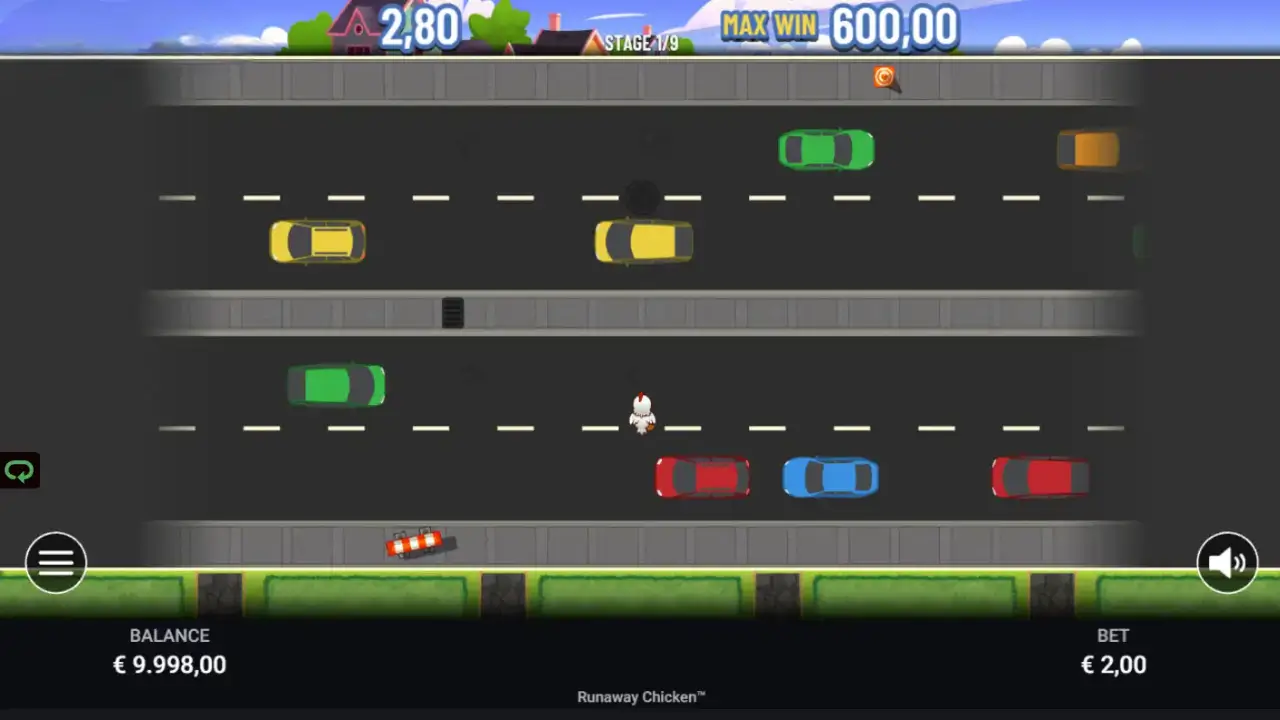
There are no reels. There is no spin button. The game presents a top-down view of a multi-lane road with cars moving horizontally at varying speeds. A chicken stands at the bottom of the screen, and the player places a bet and initiates a round. The chicken then attempts to cross the traffic lanes.
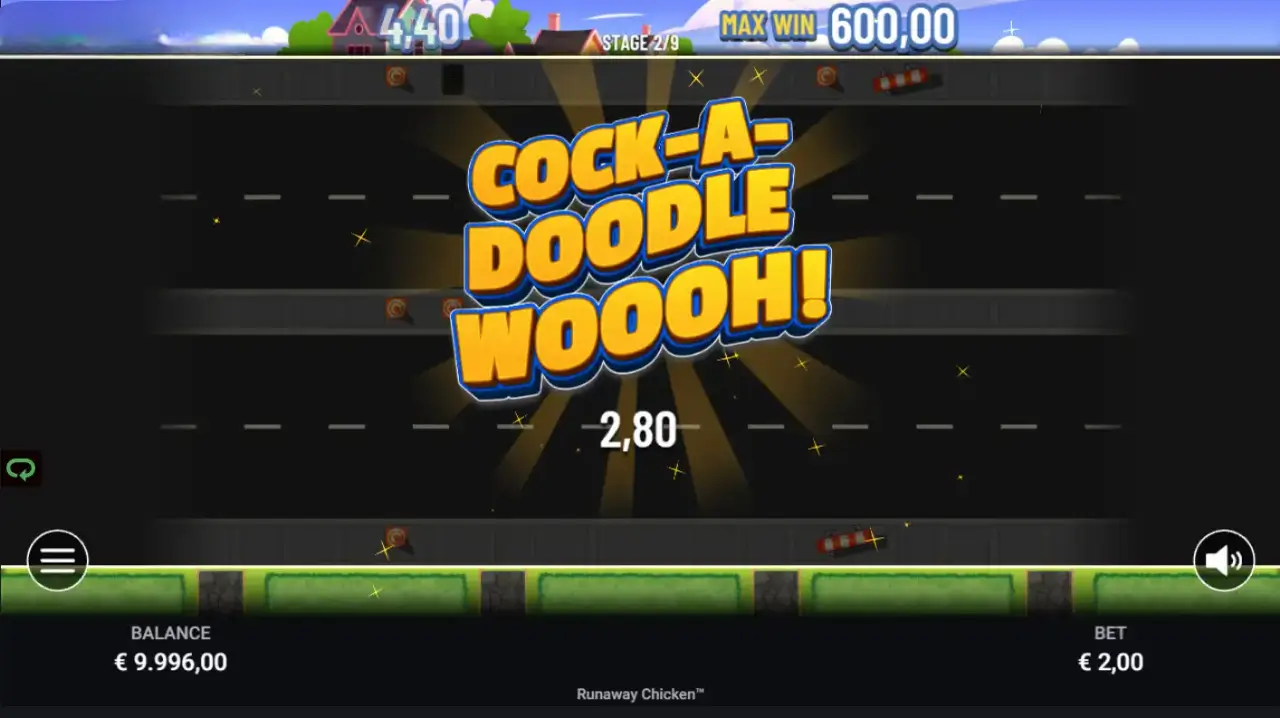
Each crossing that ends without the chicken being hit by a car counts as a completed stage. After completing a stage, the player is presented with two options: cash out the current payout multiplier, or continue to the next stage for a higher one. Choosing to continue means the chicken faces the next set of traffic. If it gets hit, the round ends and the full stake is lost — there is no partial return, no consolation multiplier, no second chance.
That binary outcome is the defining mechanical feature of the game. Every stage is either a clean crossing or a complete loss of the round. There is no middle ground.
Stage Progression and Multiplier Values
The game runs across nine stages. Each stage completed increases the active payout multiplier according to the following confirmed table:
| Stage | Multiplier |
|---|---|
| 1 | 1.4x |
| 2 | 2.2x |
| 3 | 4.3x |
| 4 | 8.6x |
| 5 | 17.3x |
| 6 | 34.6x |
| 7 | 69.5x |
| 8 | 138.5x |
| 9 | 300x |
The progression is not linear. The jump from stage 1 (1.4x) to stage 2 (2.2x) is modest. By stage 4 the multiplier has crossed 8x, and by stage 6 it has passed 34x. The steepest proportional growth happens in the later stages, which is consistent with the increasing traffic difficulty those stages present.
Reaching all nine stages with a $100 maximum bet produces the game’s hard ceiling win of $30,000. That is the absolute maximum payout the game can produce.
The Cash Out or Continue Decision
After each successful stage, the player is shown their current multiplier and asked to decide. There is no time pressure imposed by the game — the decision point is open-ended. Cashing out at stage 1 returns 1.4x the stake. Cashing out at stage 4 returns 8.6x. Walking away at stage 6 returns 34.6x.
The decision is not skill-based in any meaningful sense. The player has no information about whether the next stage will result in a hit or a crossing — the outcome is determined by the game’s RNG. What the player controls is purely their own risk threshold: how much of the accumulated multiplier they are willing to put back at risk in exchange for a shot at the next level.
This is materially different from strategy in a skill-based game. The cash-out decision is a risk calibration exercise, not an informed strategic choice based on game state. That distinction matters because some coverage of this game frames the mechanic as giving players “control,” which overstates what the decision actually involves.
The decision point can feel more meaningful than it is. After clearing four or five stages, there is a genuine psychological pull to continue — the multiplier is high enough to be significant, and stopping can feel like walking away from an easy opportunity. That feeling has no mechanical basis. The probability of clearing any given stage is not influenced by how many stages the player has already cleared in that round. Each crossing is an independent event. The game does not track momentum or adjust outcomes based on session history.
Players who understand this will approach the cash-out decision as a fixed-probability bet at each stage: is the potential gain from continuing worth the risk of losing the accumulated multiplier? That framing is the accurate one. Any other framing — hot streaks, momentum, being “due” a hit — does not reflect how the game works.
RTP, Volatility, and Hit Frequency
RTP: 96%
The game carries a default RTP of 96%. This is a respectable figure by modern standards — above the 94–95% range common among high-variance slots, and in line with competitive mid-range titles from established providers. No operator-configured RTP variants have been publicly disclosed for this game at the time of writing. Players should check the information panel within the game client at their specific casino, as RTP can vary depending on the operator’s configuration.
Volatility: Medium
Switch Studios classifies Runaway Chicken as medium volatility. This rating requires some context given the game’s binary loss structure.
In a traditional reel slot, medium volatility typically means a reasonable frequency of small-to-mid-size wins with occasional larger payouts, and relatively limited stretches of complete dead sessions. In Runaway Chicken, the situation is different. The 56.1% hit frequency means the chicken successfully completes at least one stage in roughly 56 out of every 100 rounds. That is a high completion rate compared to many slots. However, completing stage 1 and collecting 1.4x is a net loss on the round — the player gets back $0.14 for every $0.10 bet but does not profit.
For a round to be genuinely profitable, the player either needs to collect at a stage that produces a meaningful return, or reach a higher stage. The medium volatility label applies to the overall session distribution of outcomes, not to any individual round. Within any single round, the risk is always binary: either the stage is cleared or the full stake is gone.
Players used to slots where losing a spin still produces a visible outcome — a partial win, a bonus trigger, a near-miss — will find Runaway Chicken starker. When the chicken gets hit at stage 1, there is simply nothing to show for the round.
The medium volatility label becomes more meaningful when looking at session-level behaviour rather than individual rounds. A player who consistently cashes out at stage 2 or 3 will experience something closer to a steady-state session: frequent completions, small net returns, and relatively controlled bankroll movement. A player who repeatedly pushes for stages 7, 8, or 9 — where the multipliers jump dramatically — will experience something that behaves more like a high-variance game in practice. The volatility classification describes the game at a population level across all play styles and cash-out patterns. Any individual player’s actual session variance will depend heavily on where they choose to collect.
Hit Frequency: 56.1%
A 56.1% hit frequency is high by slot standards, where 25–35% is more typical. In the context of this game, it means the chicken clears the first stage in the majority of rounds. The practical implication is that players will frequently reach at least the 1.4x collection point, which keeps the game from feeling relentlessly brutal in short sessions.
What the hit frequency does not tell you is the probability of clearing each subsequent stage. Those probabilities decrease with each crossing, and the exact per-stage bust rate is not published in the game’s available documentation. The 56.1% figure refers to the frequency of clearing at least one stage — not the frequency of clearing all nine.
Visuals and Sound Design
The presentation is deliberately minimal. The game uses a top-down perspective with a bright, cartoonish art style. Cars are rendered in simple, bold colors. The chicken is animated with basic movement frames. There are no elaborate background scenes, no character animations beyond the crossing action, and no decorative bonus screens because there are no bonus features to trigger.
The sound design follows the same approach. There are arcade-style sound cues on successful crossings, a deflating effect when the chicken is hit, and background audio that does not demand attention. The audio does include some humorous chicken sound effects that land reasonably well within the game’s tone.
Some reviewers have drawn comparisons to the first Grand Theft Auto title’s top-down perspective, and to Frogger. Both references are fair. The visual language is clearly informed by classic arcade games, and the top-down highway layout is unmistakably Frogger-adjacent. The difference is that Frogger was a skill game where player reflexes determined the outcome. In Runaway Chicken, the crossing result is RNG-determined — the player watches rather than navigates.
That gap between the visual language (which implies agency) and the actual mechanics (which offer none during the crossing itself) is worth understanding before playing. The sense of involvement comes entirely from the cash-out decision point, not from the crossing animation.
Comparing Runaway Chicken to Crash Games
The crash game genre — typified by titles like Aviator from Spribe and JetX from SmartSoft — shares Runaway Chicken’s core structure: a multiplier climbs over time, and the player must decide when to cash out before losing everything.
There are meaningful differences between Runaway Chicken and standard crash games worth noting.
In Aviator, the multiplier is a continuous curve with no defined endpoint. It can theoretically climb to enormous values before crashing. The player watches the curve in real time and must react. In Runaway Chicken, there are exactly nine stages with fixed multiplier values. The maximum outcome is always 300x — there is no scenario where the game pays 1,000x or 5,000x. The ceiling is hard and known.
That fixed ceiling is a limitation relative to crash games. Players drawn to crash games partly because of the theoretical possibility of enormous multipliers will find Runaway Chicken’s 300x cap restrictive. Aviator has recorded multipliers well above 1,000x in documented play sessions. Runaway Chicken cannot match that.
On the other hand, the discrete stage structure provides a different psychological experience. After each crossing, there is a defined pause point. The player can take stock without the pressure of a rising curve. Some players will find that more manageable than the continuous tension of watching a crash game multiplier climb.
The staged format also means Runaway Chicken is more predictable in structure. There are always exactly nine stages, always the same multiplier values at each stage, and always a clear stopping point at the end. Crash games have no natural ceiling and no defined stage structure — rounds can be over in fractions of a second or run for minutes.
Neither format is objectively better. They serve different tolerances for uncertainty and different preferences for session pacing.
Runaway Chicken vs. Traditional Reel Slots
The contrast with standard video slots is more pronounced than the contrast with crash games. A typical five-reel video slot offers symbols, paylines, wilds, scatters, free spins, bonus rounds, and in some cases additional features like multiplier trails, hold-and-respin mechanics, or jackpot networks. A player spinning a title from Pragmatic Play or Hacksaw Gaming is navigating a system with multiple interlocking features.
Runaway Chicken has none of that. There is one mechanic, applied nine times per round. No free spins can be triggered. No bonus round will appear. No wild symbol will save a near-miss. The game’s depth comes entirely from the multiplier progression and the cash-out decision.
For players who spend most of their time in slots with complex bonus structures, this will feel either refreshingly direct or frustratingly bare, depending on what they are looking for. There is no feature-hunt. There is no anticipation of a bonus trigger. There is only the crossing and the choice.
That simplicity is the game’s design intention, not an oversight. Switch Studios built a product for an audience that finds the average slot’s feature complexity a barrier rather than an attraction. Whether that audience overlaps with the casino player base broadly enough to sustain the game’s commercial relevance is a different question — but the design direction is clear.
Who Is Runaway Chicken For?
Crash Game Players
Players already familiar with crash games will find the format intuitive. The cash-out decision mechanic is a known quantity. The main adjustment is the fixed 9-stage structure and the 300x ceiling, both of which are more constrained than what crash game regulars are used to. If the appeal of crash games for a given player is partly the theoretical possibility of enormous multipliers, Runaway Chicken will feel like a scaled-down version of the genre.
Casual Players and Arcade Fans
The low minimum bet of $0.10, combined with short round duration and simple rules, makes the game accessible for casual play. Players who grew up with mobile or browser-based arcade games will find the format familiar and non-intimidating. The learning curve is effectively zero. There is nothing to research, no feature mechanic to understand, and no bonus system to wait for.
Traditional Slot Players
Players whose primary experience is reel-based slots face the steepest adjustment. The absence of any feature mechanics — no wilds, no free spins, no bonus game — removes the elements that many slot players find engaging. The game also produces no near-miss feedback the way a slot does when two bonus symbols land and a third just misses. When the chicken is hit, the round simply ends. For players accustomed to the rhythmic near-miss patterns of slot play, this can feel abrupt.
High-Stakes Players
The $100 maximum bet and $30,000 maximum win are reasonable figures for a mid-range game. However, high-variance slot players used to titles with 10,000x–25,000x potential will find the 300x ceiling significant. At maximum bet, $30,000 is a substantial absolute win, but the multiplier cap means the game does not compete with premium high-variance slots on raw upside potential. The risk-adjusted expectation at high bet levels will not match what the same stake can return in a high-variance slot with an uncapped multiplier structure.
Limitations and Weaknesses
Hard Maximum Win of 300x
The 300x ceiling is the most significant structural limitation. In a market where crash games can return 1,000x or more, and where high-variance slots like Wanted Dead or a Wild regularly produce wins above 10,000x, a 300x maximum is modest. Players seeking large-multiplier outcomes will find the game’s upside constrained.
No Bonus Features Whatsoever
There are no free spins, no bonus rounds, no multiplier wilds, no hold-and-respin mechanic, no jackpot, no progressive prize. For a player who enjoys the anticipation of triggering a bonus feature — which is a central appeal of most modern slots — Runaway Chicken offers nothing comparable. The game does not attempt to compensate for this absence; it simply does not have those features.
Binary Loss Structure
When the chicken is hit, the entire stake for that round is lost with no partial return. Many slots pay back small fractions on losing spins — 0.2x, 0.5x — which keeps sessions from depleting quickly. Runaway Chicken does not do this. A player who loses five rounds in a row at the first stage loses five full bets with nothing to show. The 56.1% hit frequency mitigates this somewhat, but players on a losing run will feel the sharp edges of binary outcomes more acutely than they would in most slots.
Limited Geo-Availability
As of early 2026, the game is restricted in a large number of markets. Players in the US, Australia, Germany, France, the UK, and many others cannot access it. This limits the practical relevance of the game for a significant portion of the global casino audience.
No RTP Variant Transparency
No operator-configured RTP variants have been publicly documented for this game. In practice, Microgaming-network operators sometimes deploy games with adjusted RTP settings below the default 96%. Players have no reliable way to verify which RTP configuration is active at their specific casino without the operator explicitly disclosing it.
Verdict
Runaway Chicken is a functional, clearly designed arcade instant win game that does exactly what it sets out to do. The road-crossing format translates a recognizable arcade concept into a casino product without significant distortion. The nine-stage structure is clean, the multiplier progression is logical, and the cash-out decision provides a genuine moment of player involvement in each round.
The game is best suited to players who want short, direct sessions with no feature complexity. It will also appeal to crash game players who prefer a structured stage format over a continuous multiplier curve. The 96% RTP and 56.1% hit frequency are competitive figures that compare favourably against many slot titles in the same bet range.
The limitations are real and should be weighed accordingly. The 300x maximum win is modest against what the broader market offers. The absence of any bonus features will be a dealbreaker for players who choose slots primarily for their feature mechanics. The binary loss structure — full stake lost on any hit — produces a sharper session variance than the medium-volatility classification might suggest to players accustomed to reel slots.
Runaway Chicken is not trying to be a replacement for feature-rich video slots. It is a different type of product occupying a different part of the player preference spectrum. For players who fit the target profile, it works. For those who do not, the absence of features will be immediately apparent.
FAQ
What is the RTP of Runaway Chicken? The default RTP is 96%. Operator-configured variants have not been publicly confirmed at the time of writing.
How many stages does Runaway Chicken have? The game has 9 stages. Each stage represents a successful crossing of a road segment.
What is the maximum win in Runaway Chicken? The maximum win is 300x the stake, which equals $30,000 at the maximum bet of $100.
Does Runaway Chicken have free spins or bonus rounds? No. The game has no free spins, no bonus round, no wild symbols, and no scatter symbols.
What is the minimum bet in Runaway Chicken? The minimum bet is $0.10.
Is Runaway Chicken a slot game? It is classified as an arcade / instant win game, not a traditional slot. There are no reels or paylines.
Who developed Runaway Chicken? Switch Studios, a development studio within the Microgaming network.
What are the per-stage multipliers in Runaway Chicken? Stage 1: 1.4x | Stage 2: 2.2x | Stage 3: 4.3x | Stage 4: 8.6x | Stage 5: 17.3x | Stage 6: 34.6x | Stage 7: 69.5x | Stage 8: 138.5x | Stage 9: 300x.
What does the hit frequency of 56.1% mean in practice? It means the chicken successfully completes at least the first stage in approximately 56 out of every 100 rounds.
How does Runaway Chicken compare to Aviator? Both use a cash-out mechanic. The key difference is that Runaway Chicken has a fixed 9-stage structure with a 300x ceiling, while Aviator has a continuous, open-ended multiplier with no defined maximum.