Octoplay has been building its Hold & Win catalogue at a steady pace since 2022, and The Grand Rooster is one of those releases that fits neatly into that strategy. The premise is familiar — a farmyard setting, a coin-collecting mechanic, a bonus round that locks symbols in place while you chase jackpots — but the game earns its place in the library through a specific feature that most similar titles skip: a multiplier that carries its value between spins rather than resetting every time it fires. That one mechanical detail changes how the base game feels, and it’s worth understanding before you sit down to play.
This review covers everything confirmed: the layout, the symbols, how the Hold & Win bonus actually triggers and pays out, the RTP situation including what “RTP Ranges” means in practice, and who this game makes sense for. Nothing invented, nothing inflated.
Provider, Layout & Betting Range
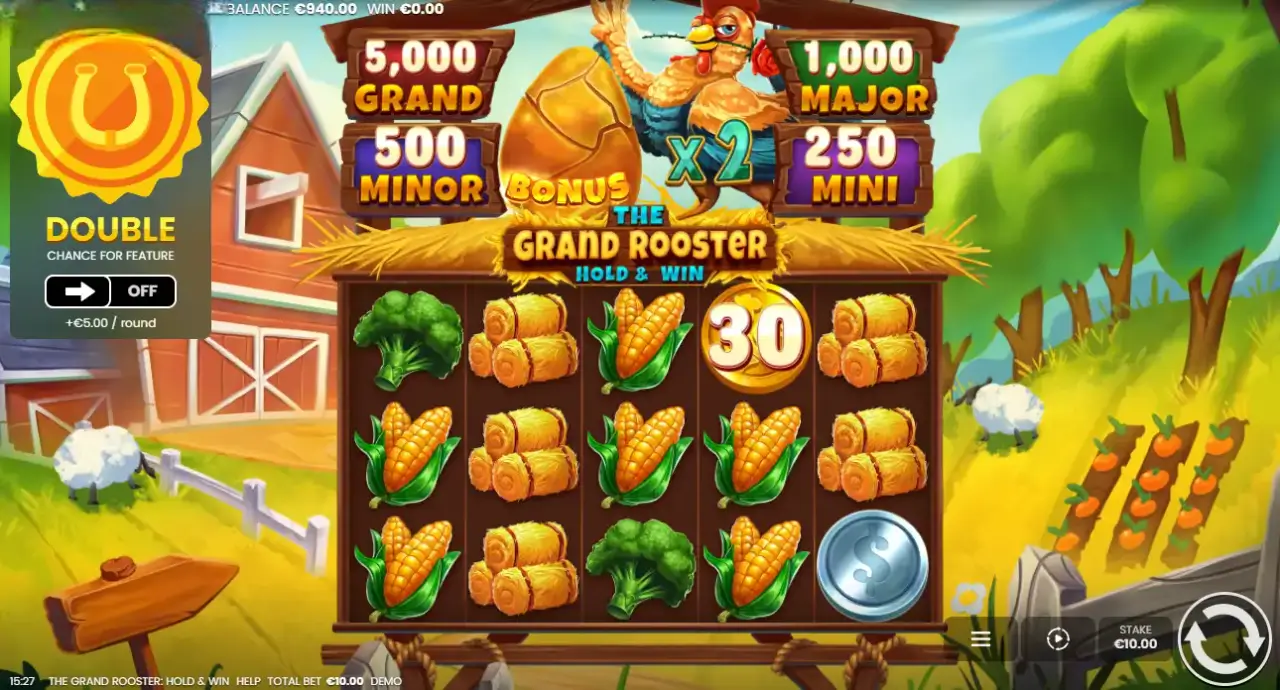
The Grand Rooster: Hold & Win is developed by Octoplay, a Malta-based studio licensed across multiple regulated markets including the UK, Sweden, Romania, Greece, Ontario, and Denmark. The game runs on 5 reels, 3 rows, and 5 fixed paylines — a deliberately compact setup. Winning combinations form from three or more matching symbols on adjacent reels, starting from the leftmost reel.
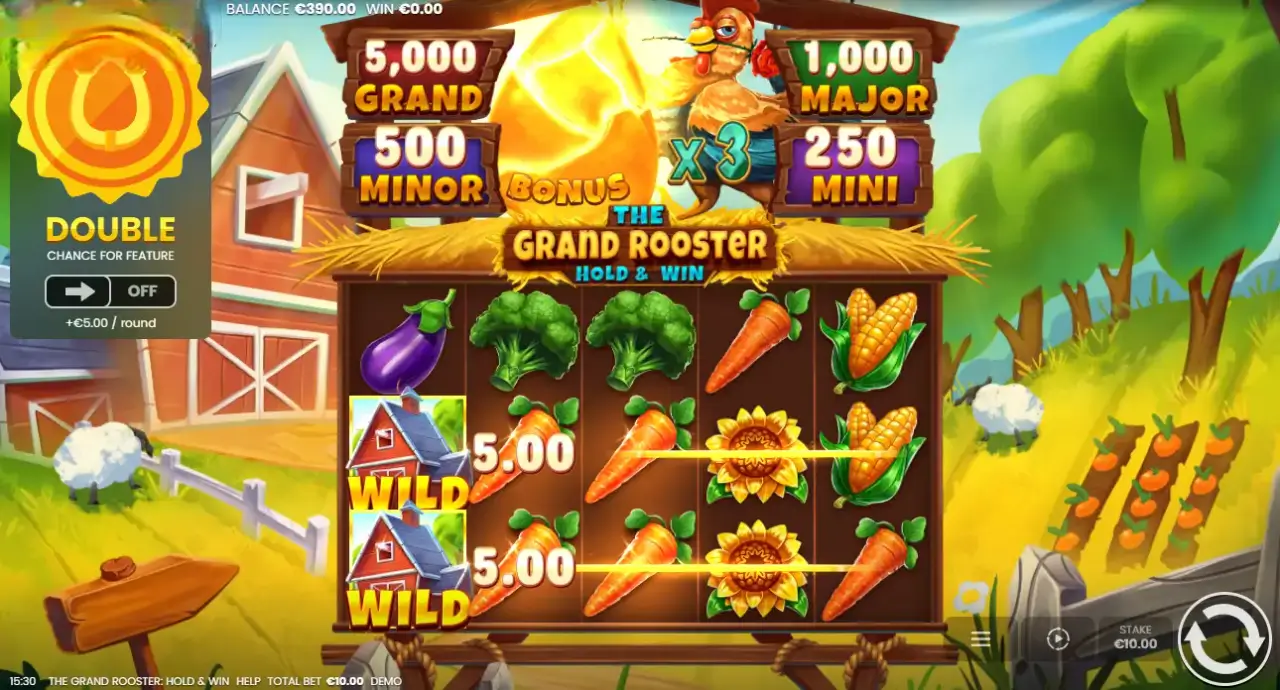
Bet range runs from 0.10 to 100 per spin in the standard mode. Enabling the Double Chance option raises the cost of each spin by 50% (so a 1.00 base bet becomes 1.50), which doubles the probability of triggering the Hold & Win bonus. The game is HTML5 and mobile-compatible across Android and iOS without any download required.
There is no bonus buy option. All features must trigger organically during play.
Theme and Visual Design
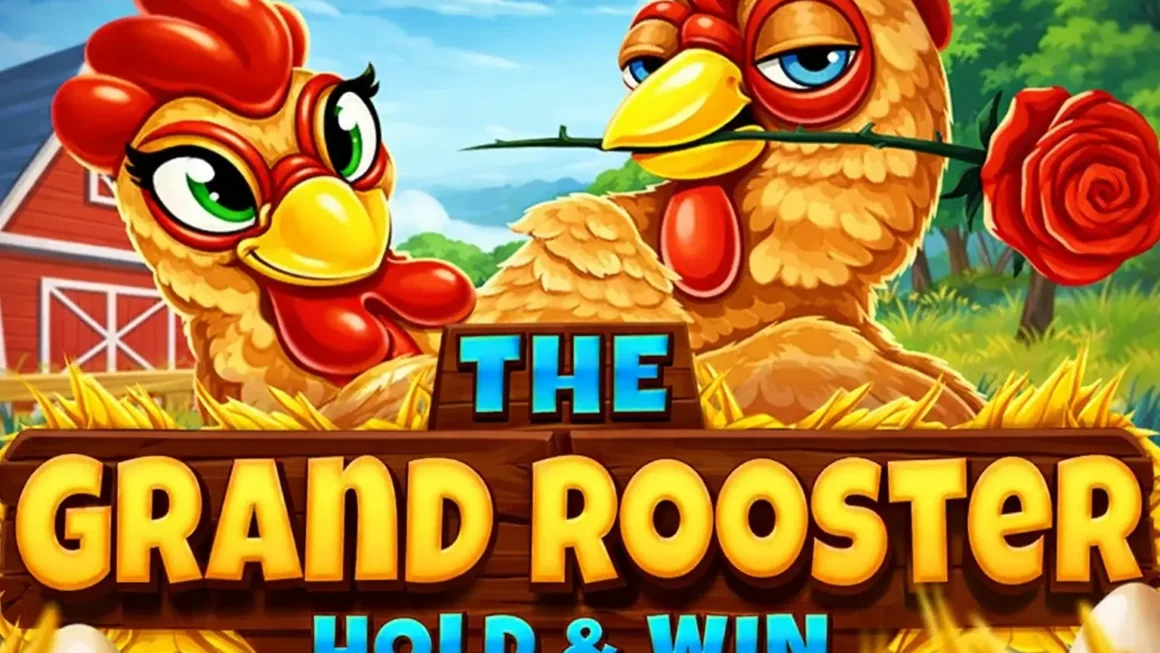
The Grand Rooster is not trying to be subtle about its aesthetic. The backdrop is a bright, cartoonish farm scene — fields, crops, trees, a few sheep wandering around, and a chicken coop positioned at the center of attention. The color palette leans heavily into yellows, oranges, and greens, which gives the whole thing a cheerful, almost animated-series quality.
The rooster himself is the personality of the game — a self-satisfied-looking bird who clearly considers himself the star of the operation. The Treasure Chicken, the game’s collect symbol, is almost as prominent on the reel set. Compared to Octoplay’s darker-themed titles, this is a straightforwardly lighthearted release that doesn’t take itself seriously at any point.
The soundtrack matches: upbeat, slightly country-inflected, pleasant enough that it doesn’t demand you hit the mute button after ten minutes. It’s not particularly memorable but it does the job of keeping the session feeling lively.
Symbol Breakdown and Paytable
The paytable runs from low-paying vegetable symbols to a premium Wild and a set of special symbols that drive most of the meaningful action.
Standard symbols (5-of-a-kind payouts):
- Low-pays — broccoli, aubergine, carrot, tomato: 4x the bet
- Mid-pays — corn, hay, eggs, sunflower: 8x to 50x the bet
- Wild — a red barn marked “Wild” — substitutes for all standard symbols; 5 of a kind pays 75x the bet
Special symbols:
- Golden Coin — the cash symbol; carries a printed value between 1x and 10x per coin. Does not pay out on its own — it needs the Treasure Chicken present to collect those values.
- Treasure Chicken — covers a full reel when it lands and immediately collects all Golden Coin values on screen. The collected total is then multiplied by whatever the active Rooster Multiplier value is at that moment.
- Plus Coin — a silver coin marked with a “+”. Every time one lands, it adds +1 to the Rooster Multiplier. Only one Plus Coin can land per spin. If the multiplier triggers (i.e., a Treasure Chicken collects), it resets to 1x. If no collection occurs, the multiplier holds its accumulated value into the next spin.
- Jackpot Coins — Mini, Minor, Major, and Grand jackpot symbols. These only appear during the Hold & Win bonus round.
The Wild substitutes for all standard symbols but not for the special cash symbols. It contributes to normal line wins only.
The Rooster Multiplier: The Mechanic Worth Paying Attention To
Most multipliers in slots of this type are round-scoped — they build during a bonus feature and disappear when the round ends. The Rooster Multiplier in The Grand Rooster behaves differently.
It starts at 1x at the beginning of a session at a given stake level. Each Plus Coin that lands adds 1 to its value. The maximum it can reach is 10x. When the Treasure Chicken appears and collects the Golden Coin values on the reels, the multiplier applies to the collected total — and then resets to 1x.
Here’s the part that matters: if a spin ends with no Treasure Chicken landing, but a Plus Coin did land, the multiplier retains its new higher value going into the next spin. It only resets when it activates, not on every spin. This means the multiplier can build over several spins of base game play before being used, and its accumulated value carries into the Hold & Win bonus if the bonus triggers while the multiplier is elevated.
In practice: if you’ve been running a session and the Rooster Multiplier has climbed to 7x through a string of Plus Coin landings, and then the Hold & Win bonus triggers — every coin value collected during that bonus is multiplied by 7x before being added to your total. The difference between entering the bonus at 1x and entering at 8x or 9x is substantial.
One important technical note: the multiplier accumulation is saved at the current stake level. If you change your bet size, the multiplier may reset. Playing consistently at the same stake maintains the carried value.
To put this in practical terms: imagine opening a session and spending 20 spins in the base game. During that stretch, three Plus Coins have landed — no Treasure Chicken in between — so the Rooster Multiplier is sitting at 4x. On spin 21, a Treasure Chicken lands alongside two Golden Coins showing 5x and 8x. The collection pays (5x + 8x) × 4x = 52x the bet from that single interaction, without the Hold & Win feature ever triggering. Then the multiplier resets to 1x and the cycle starts again. That’s not a bonus round — that’s a base game mechanic generating a return that would otherwise be 13x from the same coin values at the default 1x multiplier.
The degree to which the Rooster Multiplier actually builds before being consumed depends entirely on how often the Treasure Chicken and Plus Coins appear in relation to each other. There’s no way to predict or manipulate the sequence. But understanding that the multiplier persists means you shouldn’t assume the base game is just filler between bonuses. There are sessions where the Treasure Chicken stays cold and the multiplier climbs significantly; when it does eventually trigger, the payout reflects that accumulated value.
Bonus Egg and How Hold & Win Triggers
The Hold & Win feature in The Grand Rooster does not use a Scatter symbol trigger. Instead, it uses a coin-toss mechanic tied to the Bonus Egg displayed above the reels.
Every time a Golden Coin lands on the reels, it tosses 1 coin toward the Bonus Egg. Every time a Treasure Chicken lands, it tosses 5 coins toward the egg. Each individual toss has a random chance to trigger the Hold & Win bonus. The egg’s hatching animation plays during this process, but it is purely cosmetic — the animation does not affect the probability of the feature triggering. Whether the bonus fires or not is determined by the RNG independently of how the egg looks while the coins are being tossed at it.
This means the trigger is entirely random, and the probability is not fixed to any specific coin count reaching the egg. The feature can technically trigger on the very first coin toss of a session. The confirmed average trigger frequency is approximately once every 134 spins under standard play, or roughly once every 67 spins with the Double Chance active.
There is no in-game progress bar toward the bonus. Every toss is an independent event.
This trigger structure has a psychological effect that’s worth acknowledging. Because every coin toss is independent and random, there is no “almost there” state. You’re not filling a meter. The bonus either fires or it doesn’t on each individual toss, and the egg animation exists purely to add visual feedback to an otherwise invisible RNG event. Some players find this less satisfying than a visible progress mechanism; others prefer it because it removes the false sense that a bonus is “due” after many non-triggering spins. Understanding this mechanic as it actually works helps set appropriate session expectations — a long stretch without triggering isn’t evidence that the bonus is about to land on the next spin.
Hold & Win Bonus: How It Works
When Hold & Win triggers, the game transitions into bonus mode. Before the feature starts, the game ensures a minimum starting board: at least 1 Golden Coin and 1 Treasure Chicken are guaranteed to be placed on the reels when the round begins (added if necessary).
The feature starts with 3 respins. During the bonus:
- Only four symbol types can land: Golden Coins (with cash values), Jackpot Coins (Mini/Minor/Major/Grand), Plus Coins, and blank spaces.
- Any Golden Coin, Jackpot Coin, or Plus Coin that lands is locked in its position on the reels.
- Every time a non-blank symbol locks in, the respin counter resets back to 3.
- Blank spins do not reset the counter; the respin count counts down by 1 each time only blanks appear.
- The round ends when the respin counter reaches zero, or when all 12 coin positions on the reels are filled (full board).
It’s worth understanding the structure of a typical Hold & Win round in this game before playing. In practice, many bonus rounds will start, lock in a few coins and possibly a Jackpot symbol or two, then expire with 3 or fewer symbols locked. This is normal. The respin reset mechanic means the round extends each time something locks in, but blank-heavy spin sequences will drain the counter quickly. A round that locks in a Mini Jackpot (25x), two Golden Coins worth 4x each, and then ends on three blank respins has produced roughly 33x from a single feature — not transformative, but meaningful at reasonable stakes.
The exciting scenarios are the ones where non-blank symbols keep landing and the board fills progressively. The more symbols that lock in, the more likely subsequent spins are to land on something (since the board is partly occupied), and the longer the round extends. Rounds that reach 8–10 locked symbols before concluding tend to be the ones that produce significant payouts, especially if a Major or Grand Jackpot lands or the Rooster Multiplier is elevated.
Jackpot tiers during Hold & Win:
| Jackpot | Value |
|---|---|
| Mini | 25x the bet |
| Minor | 50x the bet |
| Major | 100x the bet |
| Grand | 500x the bet |
The Grand Jackpot is a special case: it is awarded if all 12 Golden Coin positions are filled AND a Treasure Chicken is locked on the reels. This is the maximum fill condition — it terminates the feature immediately and triggers the Grand Jackpot payout alongside all the coin values already locked.
Plus Coins that land during Hold & Win continue to add to the Rooster Multiplier. The multiplier built during the bonus is applied at the end of the feature when the Treasure Chicken collects all locked coin values.
After the Hold & Win feature ends, the Rooster Multiplier retains whatever value it reached during the bonus. It does not reset when the feature closes out — it carries back into the base game at its post-bonus value. This is a meaningful carry-over mechanic that can compound session outcomes.
Maximum Win: How 5,500x Is Calculated
The theoretical maximum win of 5,500x requires a specific convergence of conditions:
- All 12 Golden Coin positions on the reels are filled, with each coin carrying its maximum printed value of 10x the bet (12 × 10x = 120x)
- The Treasure Chicken is locked on the reels, triggering the Grand Jackpot (500x)
- The Rooster Multiplier is at its maximum value of 10x when the collection occurs
The collected total — coins plus Grand Jackpot — is multiplied by the 10x Rooster Multiplier: (120x + 500x) × 10x would exceed 5,500x, but the game applies a hard cap at exactly 5,500x. If the sum of a single round exceeds this ceiling, the feature ends immediately and 5,500x is awarded.
In realistic play, a full board with max multiplier is a rare event. The 5,500x figure represents the absolute ceiling, not an expected or even frequent outcome. Most Hold & Win sessions will produce considerably more modest results, and the low-to-medium variance profile of the game reflects this.
RTP, Variance, and What “RTP Ranges” Actually Means
The certified default RTP for The Grand Rooster is 95.71%. With the Double Chance option active, RTP adjusts to 95.75% — a marginal difference that offers essentially no practical advantage from a long-term return perspective, even though it doubles the bonus trigger rate.
The 95.71% figure is below what is commonly cited as the industry benchmark of 96%. For context, a 0.29% difference from the benchmark is not dramatic, but it is worth noting honestly rather than glossing over.
RTP Ranges — what this means for players: Octoplay, like most modern providers, publishes games with RTP variant options. The 95.71% figure is the default certified rate, but operators who license the game can configure the active RTP from a range of available values. This means the actual RTP running on the version of this game at your specific casino may differ from the default 95.71%. It could be lower.
The only reliable way to confirm which RTP variant is active on a given platform is to open the in-game information or paytable screen on that specific casino. If the displayed RTP differs from 95.71%, the operator has deployed a lower variant. This is entirely standard practice in the industry, but it’s information players often don’t know to look for.
Why does this matter beyond a few decimal points? Consider two operators running The Grand Rooster: one has the default 95.71% variant active, another has configured a lower variant of, say, 94%. Over 10,000 spins at 1.00 per spin (10,000 total wagered), the theoretical difference in expected return is 171.00. That’s not a small number over extended play. The actual figure varies depending on which variants Octoplay makes available to operators, but the principle stands: two players playing the same game on different casinos are playing a functionally different version of it, and neither will know unless they check.
Checking is simple. Open the game, find the information or paytable button (usually an “i” icon or a “?” in the corner), and look for the stated RTP. If it shows 95.71%, you have the default variant. If it shows something lower, the casino has configured it differently. This takes about ten seconds and is genuinely useful information before committing real money to a session.
Hit frequency: ~15.3%. Roughly 1 in 7 spins returns something to the player in the base game. This is consistent with the low-to-medium variance profile — the game delivers relatively frequent small wins through the Treasure Chicken collecting Golden Coins, keeping the balance moving in short bursts. The Hold & Win bonus, triggering approximately 1 in every 134 spins, is where larger payouts concentrate.
Double Chance Option
The Double Chance feature is an optional modifier. Enabling it increases each spin’s cost by 50% of the current base bet. In exchange, the probability of the Hold & Win bonus triggering doubles.
The RTP shifts slightly to 95.75% when Double Chance is active — marginally higher than the base 95.71%, though this is not a reason to always use it. The practical calculation is straightforward: you’re paying 50% more per spin for twice the bonus frequency. If you specifically want more Hold & Win rounds per session and are willing to spend more to get them, it’s a reasonable trade-off. If you prefer to extend session length at a lower cost per spin, standard mode is more efficient.
There is no free spins feature, no multiplier trail, and no scatter symbol in this game. Double Chance is the only optional modifier available.
Comparing to Octoplay’s Hold & Win Library
The Grand Rooster uses the same structural foundation as several other Octoplay Hold & Win titles — notably Flame & Fortune: Hold & Win. Multiple independent reviewers have noted the functional overlap: same respin mechanic, similar jackpot tier structure, same general trigger system. The differences are the farmyard visual identity and the Rooster Multiplier’s cross-spin persistence, which Flame & Fortune handles differently (the multiplier mechanics and values vary between titles).
If you’ve played Flame & Fortune and found the formula enjoyable, The Grand Rooster will feel immediately familiar. If you played it and found the Hold & Win loop repetitive, this title won’t change that assessment. The Rooster Multiplier carry-over is a genuine structural addition that can make base game sessions feel more dynamic — watching the multiplier climb to 6x or 7x across several spins while you wait for the bonus creates a real sense of build-up — but it doesn’t fundamentally reinvent the format.
Within the broader Hold & Win market, the format is well-established and, at this point, well-saturated. Titles from Pragmatic Play’s Money Train series, BGaming’s coin-collect releases, and Red Tiger’s various Hold & Win iterations all operate in the same space. The Grand Rooster is a clean, competently executed version of the format, but it isn’t making an argument that it does something no other game does.
Session Behavior and Bankroll Considerations
With a hit frequency of 15.3% and low-to-medium variance, the base game of The Grand Rooster has a reasonably defined pattern: small Treasure Chicken collections come along regularly, keeping the balance from depleting too quickly between bonuses. These aren’t large wins — a typical Treasure Chicken collection in the base game, even with a 3x or 4x Rooster Multiplier applied, will often return something in the 5x–30x region rather than anything dramatic.
The Hold & Win bonus, triggering once every ~134 spins on average, is where the meaningful return potential lives. On a standard session of 200-300 spins, you might expect one or two bonus rounds at most. Whether those rounds produce 50x or 500x depends on how many symbols lock in, which jackpots appear, and what the Rooster Multiplier is doing.
For bankroll planning, the 5-payline structure and low-medium variance mean the game doesn’t burn through stakes as fast as higher-volatility alternatives. A session of 100 spins at a moderate stake is unlikely to produce dramatic swings in either direction. The risk is less in sudden losses and more in slow erosion if the Hold & Win bonus stays cold.
There is no ability to buy the bonus, which means that if you’re specifically targeting the Hold & Win feature, you need to play through the base game organically to reach it. Players who find the base game collection mechanic engaging will have a better time than those who are purely interested in the bonus and find the base game filler. It’s worth being clear-eyed about which type of player you are before starting a session.
Who This Game Is Best Suited For
The Grand Rooster is a reasonable choice for players who:
- Like the Hold & Win / respin format and want a well-implemented version of it with a clean visual design
- Want a low-to-medium variance game that doesn’t swing too aggressively between sessions
- Find the cross-spin multiplier build-up engaging as a base game mechanic
- Prefer straightforward rules that are easy to understand within the first few spins
- Are comfortable with a 95.71% RTP (after verifying which variant their platform is running)
It’s less likely to satisfy players who:
- Want free spins or free spins with multipliers as the main event
- Specifically want a bonus buy option to skip the base game
- Have played several other Hold & Win releases and are looking for something mechanically different
- Are targeting high-variance, potentially transformative single sessions
Quick Reference
| Specification | Value |
|---|---|
| Provider | Octoplay |
| Layout | 5 reels × 3 rows |
| Paylines | 5 fixed |
| RTP (default) | 95.71% |
| RTP (Double Chance) | 95.75% |
| RTP Ranges | Operator-configured variants possible — verify in-game |
| Variance | Low-Medium |
| Hit Frequency | ~15.3% |
| Bonus Trigger Frequency | ~1 in 134 spins |
| Max Win | 5,500x |
| Min Bet | 0.10 |
| Max Bet | 100 |
| Grand Jackpot | 500x |
| Rooster Multiplier Max | 10x |
| Bonus Buy | No |
| Free Spins | No |
Final Assessment
The Grand Rooster: Hold & Win is a solid entry in a crowded format. It doesn’t pretend to be something it isn’t: it’s a Hold & Win slot with a farmyard theme, a coin collect mechanic, and four jackpot tiers. The Rooster Multiplier’s cross-spin persistence is the one thing that sets it apart from close relatives in the same library, and it does add a layer of genuine session-to-session tension that purely round-scoped multipliers don’t replicate.
The RTP of 95.71% is below the benchmark, and the lack of a bonus buy means players relying on short sessions may see minimal Hold & Win action. These are real drawbacks, and worth factoring into the decision to play — especially once you’ve confirmed which RTP variant is actually running on your platform of choice.
Where the game succeeds is in execution. The mechanics are clean, the rules are transparent, the visual design is consistently pleasant, and the Hold & Win bonus, when it does land, delivers a clearly communicated round that builds logically through the respin system. There are no hidden catches in the feature structure, no misleading mechanics, no confusing side rules. For a game in a format that can easily become chaotic, that clarity is worth something.
If you already enjoy Hold & Win slots and are looking for a version that runs smoothly and offers the bonus trigger frequency of approximately 1 in 134 spins at a low-to-medium variance profile, The Grand Rooster is a reasonable session choice. If you’re new to the format, it’s an approachable introduction. If you’ve played everything Octoplay and its Hold & Win competitors have put out and are looking for something genuinely new, you won’t find it here.
Gamble responsibly. Set limits before playing, and check the in-game information screen on your platform to confirm the active RTP variant before starting a session.