There’s no shortage of farmyard slots on the market right now. Roosters, foxes, chickens, eggs — the barnyard theme has been done to death by providers ranging from Lightning Box to Quickspin to Massive Studios. So when Arrow’s Edge released The Rooster & The Fox, the question was never really about the theme. The question was whether this game brings anything to the table that justifies sitting down at it.
The short answer: it’s a niche fit. The longer answer follows.
What Is The Rooster & The Fox?
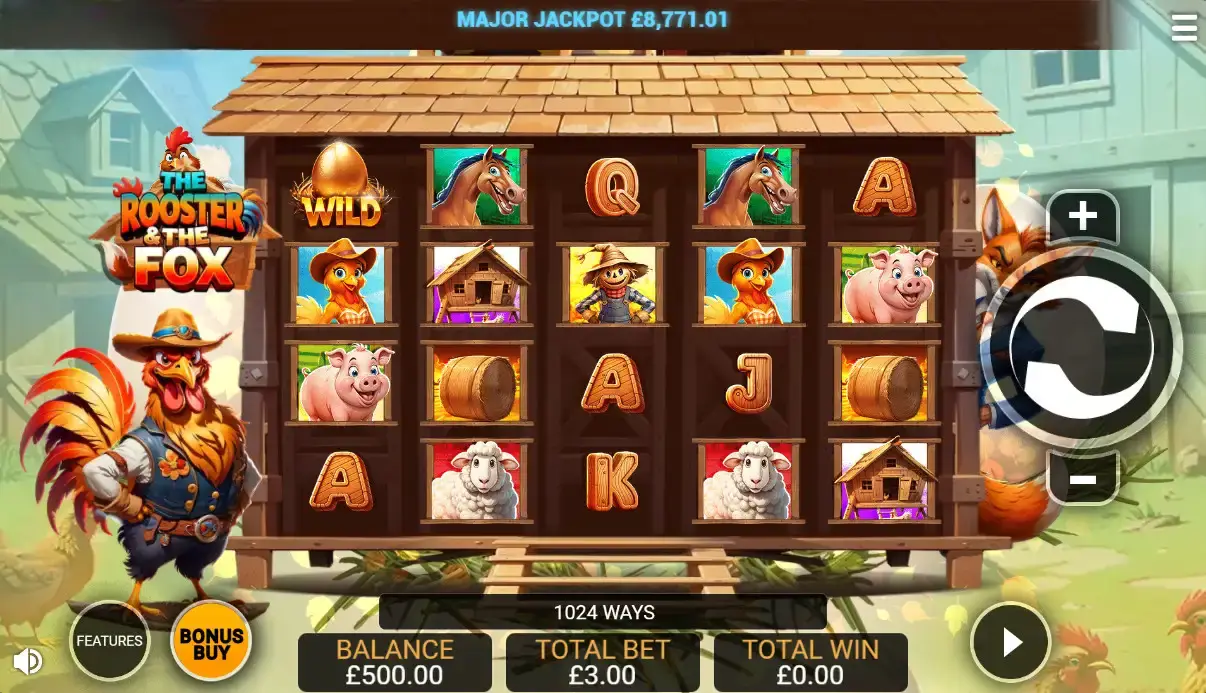
The Rooster & The Fox is a 5-reel video slot from Arrow’s Edge, a US-facing software provider founded in 2014 and certified by NMi Gaming (part of the GLI Group). The game runs on a 1024 ways-to-win format rather than fixed paylines, which means wins are formed by matching symbols on adjacent reels from left to right — no need to track specific line patterns.
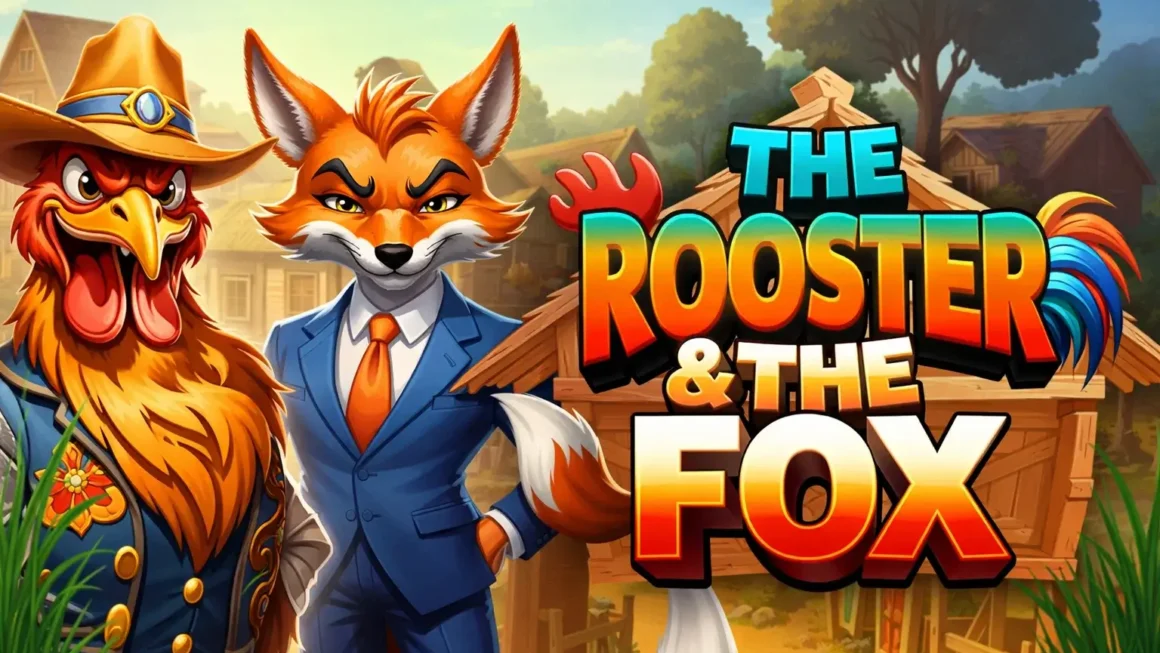
The theme is exactly what the title describes: a classic farmyard standoff between a rooster defending his turf and a fox with ulterior motives. The visual style fits Arrow’s Edge’s broader catalogue — 3D cartoon characters with enough polish to not look embarrassing, but not quite the cinematic quality you’d get from a Pragmatic Play or Nolimit City release. It sits comfortably in the mid-tier aesthetic range: clean, colourful, functional.
Before the specs, it’s worth briefly covering what the game actually looks like, because Arrow’s Edge occupies a specific visual tier that will matter to some players more than others.
The farmyard setting is rendered in a 3D cartoon style — bright colours, rounded character design, smooth animations. The rooster and fox are the two central characters, styled as opposing forces in a classic predator-prey dynamic. The fox is sly, the rooster is alert. It’s a familiar fable setup and the visuals lean into it without overdoing the anthropomorphism. Background details include a barn setting with the kind of countryside staging you’d expect: haystacks, wooden fencing, pastoral scenery.
This isn’t a dark or atmospheric slot. There’s nothing cinematic or story-driven beyond the basic theme concept. The soundtrack sits in the same register — upbeat, vaguely rural, functional. Arrow’s Edge has never been the provider players choose for audio-visual ambition. Their games are built to run cleanly, load fast, and present their math models without getting in the way. The Rooster & The Fox follows that pattern. If you want stunning graphics, look elsewhere. If you want a clean, stable game that does what it says, this delivers.
Here’s what matters on the spec sheet:
| Spec | Value |
|---|---|
| Provider | Arrow’s Edge |
| Reels / Format | 5 reels, 1024 ways to win |
| RTP | 94.25% (fixed) |
| Variance | Low |
| Max Win | x1700 |
| Jackpots | 3 tiers (including Arrow’s Edge MEGA progressive) |
| Buy Bonus | Yes |
| Free Spins | Yes, with multiplier |
| Certification | NMi Gaming (GLI Group) |
That RTP figure is the first thing worth addressing — and we’ll get into it properly.
The RTP Situation: Honest Numbers
The Rooster & The Fox carries a certified RTP of 94.25%. That number is fixed — there’s no operator-configured variant sitting at 92% or 88% that casinos can silently activate, which is a transparency point worth acknowledging in an industry where RTP opacity is genuinely widespread.
But 94.25% as a fixed rate is still below the market standard. The widely accepted industry benchmark for online slots sits around 95–96%. Games like Rooster’s Revenge (Massive Studios) carry 96.5%, Feasting Fox (Quickspin) reaches up to 96.29%, and even Chicken Fox Jr by Lightning Box — another low-variance farmyard game in the same niche — comes in at 95%.
What does 94.25% actually mean for a player? Over a very large number of spins, for every $100 wagered, the game is mathematically calibrated to return $94.25 to the player pool. That leaves a house edge of 5.75% — higher than most comparable online slots. In short sessions, variance still governs individual outcomes, so this doesn’t mean you’ll lose exactly $5.75 every hundred dollars. Some sessions will be profitable. Most extended sessions will feel the weight of that edge.
To put it in more concrete terms: if you’re playing at a $1 stake per spin and averaging 300 spins per hour, your theoretical hourly cost at 94.25% RTP is around $17.25, compared to roughly $12 per hour on a 96% RTP game at the same stake. Over a two-hour session, that difference compounds. It’s not catastrophic, but it’s not trivial either. Players who are conscious of their expected loss rate per session should factor this in when choosing between available options.
There’s also the question of where the Arrow’s Edge MEGA jackpot sits within this RTP figure. In most progressive jackpot systems, a portion of each wager — often 1–3% — is diverted to the progressive jackpot pool and is technically included in the advertised RTP figure. If that’s the case here, the base game’s return to the player in non-jackpot outcomes is lower than 94.25%. This is standard industry practice rather than deception, but it’s worth understanding. A game advertising 94.25% with an embedded progressive contribution is structurally different from a non-progressive game with the same headline RTP.
The fixed nature of the RTP is a genuine positive despite all of the above. You know what you’re getting into. Casinos running this game can’t quietly swap to a stripped-down variant. That transparency matters, even if the number itself is on the lower end.
Low Variance + Jackpots: How That Combination Works
This is the most interesting mechanical aspect of The Rooster & The Fox, and it’s something that doesn’t get discussed clearly in most brief slot listings.
Low variance slots are designed to pay out more frequently, with smaller individual wins. High variance slots do the opposite — long dry runs punctuated by larger hits. So when you see a low variance game also carrying three progressive jackpots — including a network MEGA jackpot — it raises a reasonable question: how does that work?
The answer is in how progressive jackpot systems are structured. The MEGA jackpot in this game is part of Arrow’s Edge’s network-wide progressive pool, which is funded by contributions from wagers across multiple Arrow’s Edge titles simultaneously. This jackpot pool sits outside the base game’s RTP calculation. It’s funded separately, shared across games, and hit randomly — the 94.25% RTP covers the base game outcomes, while the jackpot contributions come from an additional percentage of each wager that feeds the network pool.
The Arrow’s Edge MEGA progressive jackpot typically accumulates and pays out in the $40,000–$75,000 range. That’s not life-changing money by progressive standards, but it’s a meaningful prize accessible from a low-variance game with modest bet levels.
The practical result of this setup: during the base game, you get the frequency of wins typical of low-variance play — lots of small returns, a steady rhythm, fewer dead spins. The jackpot is effectively a parallel lottery running alongside that base game. The three jackpot tiers (MINI, MIDI, MEGA) mean there are smaller jackpot prizes that hit more regularly, not just the top-end MEGA prize.
For a player who wants session stability without completely giving up jackpot exposure, this structure is genuinely unusual. Most jackpot slots trend toward medium-to-high volatility. The low-variance jackpot combination is a real differentiator for this game, not just a marketing angle.
1024 Ways to Win: What It Means in Practice
Arrow’s Edge chose 1024 ways rather than a fixed payline structure for this game. In practical terms, this changes how you think about each spin.
With 1024 ways on a 5-reel grid, winning combinations are formed whenever matching symbols appear on consecutive reels from left to right — reel 1, then reel 2, then reel 3, and so on. You don’t need to track whether a specific diagonal or horizontal line is active. Three of a kind wins if any three matching symbols appear consecutively starting from reel 1.
The 1024 ways format naturally increases the hit frequency compared to a 20- or 25-payline fixed format, which aligns well with the low variance math model. You’ll see winning combinations land more often, though most of them will be modest. It also makes the game easier to follow — you’re watching reels, not counting lines.
On a 5-reel grid with 4 rows (4 × 4 × 4 × 4 × 4 = 1024), every position on every reel can contribute to a win. The visual result is a game that feels more “active” even without large individual payouts.
There’s also a practical budget implication. Many fixed-payline slots require you to activate all lines to play optimally — playing fewer lines doesn’t reduce the house edge, it just reduces your stake while keeping the same per-line cost. With 1024 ways, all ways are always active regardless of your bet size. You set your total bet, and every possible combination is always in play. This simplifies betting decisions considerably and removes the temptation to play fewer lines as a budget tactic that doesn’t actually help.
For new players unfamiliar with Arrow’s Edge games, the 1024-ways format is one of the more approachable setups in their catalogue. You stake what you can afford per spin, watch the reels, and wins appear across whatever adjacent combinations land. It’s a clean, intuitive structure that suits the game’s casual, low-pressure character.
Bonus Features: What Fires and What It Pays
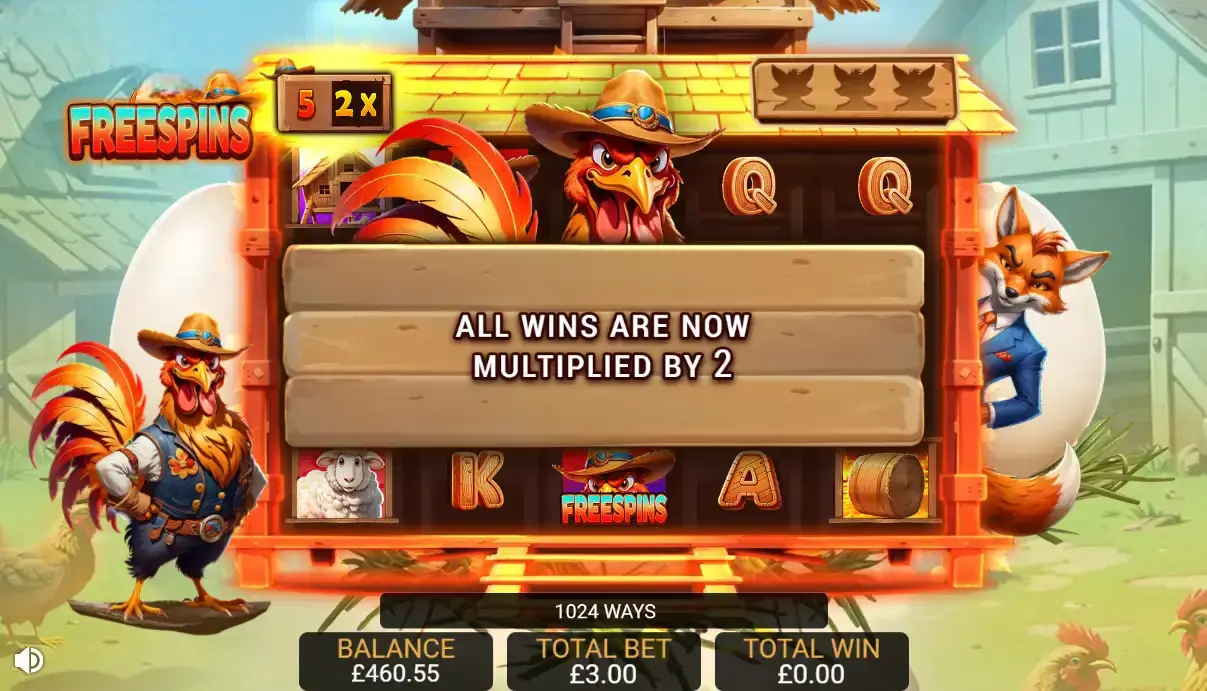
Free Spins with Multiplier
The game’s primary bonus round is a free spins feature with a multiplier component. Free spins are triggered by landing scatter symbols — the standard trigger format for this type of slot. Once inside the bonus, a multiplier applies to wins, boosting the value of each combination that lands.
The specific multiplier values and exact scatter trigger requirements aren’t disclosed in publicly available documentation at the time of writing — Arrow’s Edge doesn’t publish full paytable breakdowns on their site, and third-party databases haven’t captured the complete detail for this title. What’s confirmed: the multiplier mechanic exists in the free spins round and is specifically listed as a feature alongside the jackpots and buy bonus. Given the low variance profile of the base game, the free spins likely play in a similar rhythm — more hits, more modest scaling, with the multiplier providing the upside.
The max win of x1700 is the ceiling for what this bonus can deliver. That’s a conservative ceiling by 2026 standards — many comparable titles offer 5,000x to 25,000x — but it’s consistent with the low volatility design intent. The game isn’t trying to be a life-changer in the base multiplier structure; the jackpot network handles that role.
Buy Bonus
The Buy Bonus option lets players purchase direct access to the free spins round without waiting for organic scatter triggers. This is a standard feature across a growing number of modern slots, and it serves a specific player type: someone with a limited session window who wants to go straight to the bonus action, or someone specifically evaluating the bonus round’s behaviour.
The cost of the Buy Bonus is a multiple of the current stake — the exact multiplier isn’t confirmed in available sources, but industry standard for this type of feature typically runs between 80x and 150x the base bet. Whether it’s worth using depends heavily on how you weigh time efficiency against cost. The Buy Bonus doesn’t change the RTP of the feature — it just removes the waiting time for organic triggers.
One consideration: at an RTP of 94.25%, buying the bonus means paying a premium to access a feature that’s already priced at below-average returns. For bonus hunting or evaluation purposes it makes sense. As a regular play strategy, it’s a more expensive route to the same mathematical outcome.
Jackpot Tiers
The three jackpot tiers — MINI, MIDI, and MEGA — are accessible during play, though the exact trigger mechanism (random, scatter-based, or meter-based) isn’t confirmed in available public sources. The MEGA is the Arrow’s Edge network progressive shared across multiple titles. The MINI and MIDI are smaller, faster-cycling prizes.
The MEGA’s typical range of $40,000–$75,000 at hit time makes it an attractive secondary objective for players who are in a low-variance base game session anyway. You’re not grinding a brutal high-volatility slot waiting for a jackpot that fires every few months — you’re playing a game that pays relatively often in the base game, while the jackpot is running in the background.
The 1700x Max Win: Context and Honesty
The maximum win of x1700 is the lowest in the farmyard/rooster slot niche right now. Rooster’s Revenge offers 25,000x. Feasting Fox goes up to several thousand times the stake. Chicken Fox Jr has a higher relative ceiling despite similar low-variance mechanics.
For a straightforward slot review, this needs to be said plainly: if you’re chasing big multiplier wins, this is the wrong game. The x1700 ceiling is consistent with the low variance design — the math model is calibrated for frequency, not peaks. But players who pick up this game expecting a slot with “three jackpots” to also have a high multiplier ceiling will be disappointed. The jackpots operate outside the multiplier structure; the base game ceiling is capped at a level that suits casual, budget-aware play.
Arrow’s Edge as a Provider: What You’re Getting Into
Arrow’s Edge isn’t a household name in the way Pragmatic Play or Play’n GO is. Founded in 2014, they’ve built a catalogue of around 80+ games primarily servicing the US-facing market, with a presence in a smaller selection of international casinos. Their games are certified by NMi Gaming, part of the GLI Group — which is a legitimate third-party testing lab, not a red flag, but also not the most prominent certification body in the European regulated markets.
The company’s history is worth a brief note. Some of their catalogue includes older titles that were originally NextGen Gaming games — those are legacy acquisitions. Their newer titles, built under the “Super Slots” label in their own terminology, represent their original development work and are where The Rooster & The Fox sits. These newer releases have progressively better production values than their older library, and the network jackpot infrastructure they’ve built — the MEGA, MIDI, and MINI system — is a legitimate differentiator for their ecosystem.
Arrow’s Edge also operates the casino platform itself for several of their operator partners. This means the games integrate tightly with the casino back-end, supporting features like custom bonus structures, tournaments, and VIP rewards that are native to the Arrow’s Edge platform. Players at casinos built on the Arrow’s Edge system often find that loyalty programs and tournament events specifically involve these games. That’s a positive if you’re playing at those operators — the games aren’t just content sitting in a library, they’re embedded in the casino experience.
The practical consequence of being an Arrow’s Edge title in 2026 is that The Rooster & The Fox is available in fewer casinos than comparable games from larger providers. If your preferred casino runs Pragmatic Play and Quickspin, you may not encounter this game at all. The Arrow’s Edge network is concentrated in Drake Casino, Gossip Slots, Liberty Slots, and a selection of smaller US-accepting operators.
For players inside that ecosystem, the game is a natural fit for their library — low-variance farmyard theme with jackpot access. For players outside that ecosystem, it may take some deliberate searching to find it. The trade-off for that limited availability is a tighter, more integrated casino experience where jackpots, tournaments, and promotions are built around the game rather than treating it as interchangeable content.
How It Compares to Competitors
The farmyard/rooster niche is genuinely competitive in 2026. Three games are the most direct comparisons:
Rooster’s Revenge (Massive Studios) — High volatility, RTP 96.5%, max win 25,000x, expanding wild re-spins with random multipliers in the base game, a multiplier wheel in free spins that determines both spin count and a round-wide multiplier, bonus buy available. This is a significantly more complex game mechanically, and that complexity comes with genuine upside potential. The trade-off is volatility that most casual players will find punishing. Bankroll swings in Rooster’s Revenge can be severe — features are elusive, and dry spins accumulate between hits. It’s a game for players who have the bankroll depth and patience to ride out the variance curve. The 25,000x ceiling is real but rarely approached in practice.
Feasting Fox (Quickspin) — Medium-high volatility (4 out of 5 on their own scale), up to 96.29% RTP depending on operator configuration, 20 fixed paylines, stacked fox wild symbols that can cover entire reels, free spins accessible via bonus buy at 60x stake. Quickspin’s production values are notably higher than Arrow’s Edge — the animation quality and visual design are meaningfully better. The RTP ceiling is better, the theme execution is more polished, and the feature mechanics are more interesting. No jackpot network, however. If you’re playing Feasting Fox, you’re playing for the multiplier potential in the bonus round, not a progressive prize.
Chicken Fox Jr (Lightning Box) — Low volatility, 95% RTP, 20 paylines, a Fox Archer random base game feature that upgrades low-paying symbols mid-spin, no jackpots. This is the closest structural comparison to The Rooster & The Fox — both are low-variance farmyard games with similar casual play intentions. Lightning Box has a longer history in the farmyard niche (Chicken Fox and its sequels predate this game), and Chicken Fox Jr’s feature set is well-regarded. The RTP advantage of 95% vs 94.25% is real over extended sessions. The absence of any jackpot is the clear gap.
Putting it plainly in a table format:
| Game | Provider | RTP | Variance | Max Win | Jackpot |
|---|---|---|---|---|---|
| The Rooster & The Fox | Arrow’s Edge | 94.25% | Low | x1700 | Yes (3 tiers, network MEGA) |
| Rooster’s Revenge | Massive Studios | 96.5% | High | x25,000 | No |
| Feasting Fox | Quickspin | up to 96.29% | Medium-High | Several thousand x | No |
| Chicken Fox Jr | Lightning Box | 95% | Low | — | No |
The Rooster & The Fox occupies a specific gap: the only low-variance game in this niche with jackpot network access. It loses on RTP against all three. It loses on max multiplier against all three. It wins on: jackpot availability combined with low variance mechanics, 1024 ways vs fixed paylines in some comparisons, and the Arrow’s Edge MEGA network prize that none of the competitors connect to.
The honest summary: if RTP is your primary filter, play Chicken Fox Jr. If you want maximum ceiling potential and can absorb the volatility, play Rooster’s Revenge. If you specifically want a low-variance session with a jackpot in play, The Rooster & The Fox is the option that fills that role.
Who Should Play This Slot
A good fit for:
- Players with a modest session bankroll who want extended playtime without brutal variance
- Jackpot chasers who prefer not to grind high-volatility games while waiting for a jackpot trigger
- Players in the Arrow’s Edge casino ecosystem looking for variety within a familiar provider
- Casual players who enjoy a farmyard theme and don’t need extreme multiplier potential
Worth skipping if:
- You’re comparing RTP across available slots and optimising for long-run return — 94.25% is a real disadvantage
- You’re chasing a large multiplier win — x1700 ceiling is a firm limit
- You want cinematic production values or a feature set with meaningful strategic depth
- Your preferred casino doesn’t carry Arrow’s Edge titles
Technical Notes for 2026
Arrow’s Edge titles run in-browser via HTML5, compatible with Android and iOS mobile devices. No download is required. The game is fully mobile-optimised — Arrow’s Edge shifted to a mobile-first development strategy some years ago, and The Rooster & The Fox reflects that. Performance on mid-range smartphones is stable.
Autoplay is available with configurable settings, including loss limit stops and single win caps — useful for managing session duration responsibly.
The Buy Bonus availability means players should check whether their jurisdiction permits bonus buy features before loading the game. Several regulated markets (including the UK) restrict or prohibit bonus buy functionality for licensed operators.
Verdict
The Rooster & The Fox is a modest, honest low-variance slot with a jackpot network attached. It doesn’t pretend to be something it isn’t. The 94.25% RTP is a genuine weakness, and it puts the game behind most of its direct competitors in raw return terms. The x1700 max win is conservative. The production is competent rather than impressive.
What it does well is fill a specific structural gap: low variance play with jackpot exposure. That combination is genuinely uncommon in the farmyard niche. For a player who wants session stability — regular small wins, few dead spins, a manageable bankroll burn rate — while still having a MEGA jackpot running in the background, this game delivers. It’s not the best slot Arrow’s Edge has made. It’s not the best farmyard slot on the market. But for its specific target audience, it’s a reasonable choice.
If you’re sitting down with a defined session budget, prefer calm gameplay to volatility swings, and happen to be at an Arrow’s Edge casino, The Rooster & The Fox is worth a go. If you’re optimising for RTP or max win potential, look at Feasting Fox or Rooster’s Revenge instead.
Play within your means. If slots are feeling less like entertainment and more like a necessity, most regulated operators offer self-exclusion and deposit limit tools — use them.
All game data in this review reflects confirmed public information available as of early 2026. Technical specs: 5 reels, 1024 ways to win, RTP 94.25% (fixed), low variance, max win x1700, Buy Bonus, 3 jackpot tiers including Arrow’s Edge MEGA network progressive, free spins with multiplier. Provider: Arrow’s Edge (est. 2014, NMi/GLI certified).