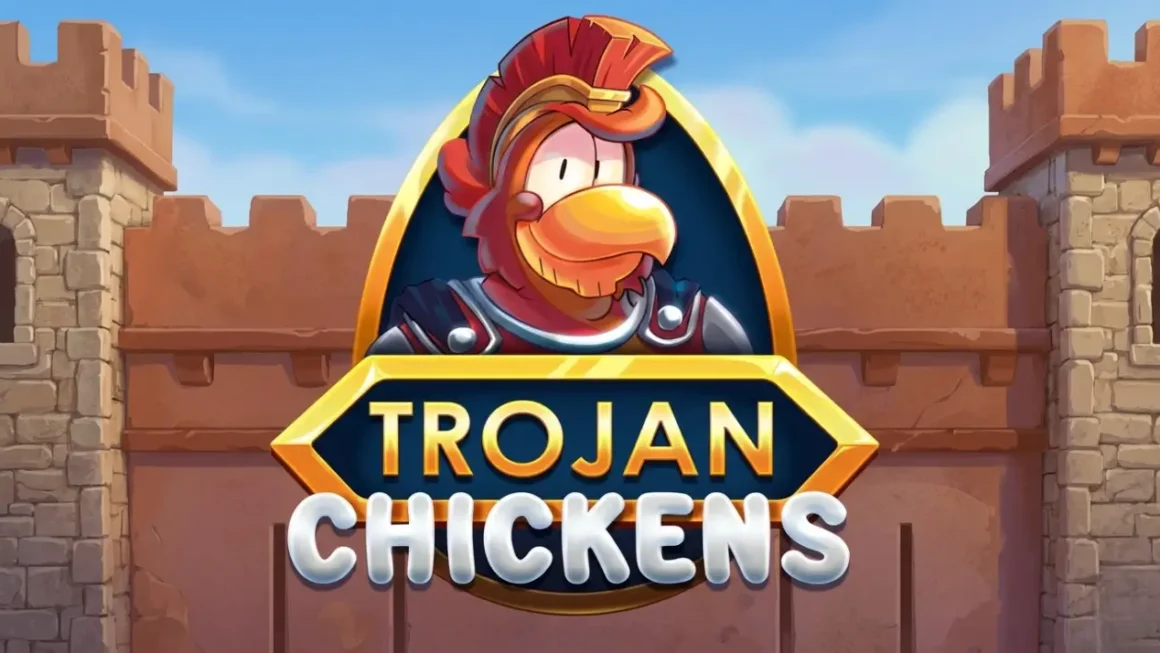
Triple Cherry is a Spanish studio that has been quietly building a catalogue worth paying attention to since 2018. Most of their output leans on strong visual concepts and mechanics that feel thought through rather than borrowed. Trojan Chickens sits somewhere in the middle of their lineup — not their loudest game, but one with a structural logic that rewards players who actually take the time to understand how it works.
The premise is a parody of the Trojan Horse myth. Instead of Greek soldiers hiding inside a wooden horse, you have a rooster — the Trojan Chicken — advancing toward the city of Troy across a 5×7 grid. It is cartoonish by design, and that tone carries through the whole experience. What holds the game together, though, is not the theme but the mechanics: a Cherry Ways win system that eliminates traditional paylines, three types of explosive vessels that convert symbols into Wilds, a banner collection system that gates entry to Free Spins, and a bonus phase with a column-locking structure that has a built-in ejection risk. That last part — the Crimson Vessel threat during Free Spins — is almost never discussed in the handful of articles that mention this game, and it matters.
This review covers the base Trojan Chickens title. The Deluxe variant released later carries different specifications (RTP ceiling of 97.56%, max win of ×660.8) and is a separate product.
Core Specifications
Before getting into how the game plays, here is what Triple Cherry’s official page confirms:
- Grid: 5 reels, 7 rows
- Ways to win: 16,807 Cherry Ways
- RTP variants: 96.01% / 94.03% / 92.13% / 90.05% / 88.02%
- Hit rate: 21.64%
- Max win: ×739.2
- Platforms: mobile, desktop, Smart TV — both landscape and portrait orientations
Two things are notably absent from Triple Cherry’s own documentation. The game’s volatility is not publicly stated anywhere on the developer’s page or in their press materials. That is unusual enough to be worth flagging — most studios at minimum classify their games as low, medium, or high. It is not a dealbreaker, but it makes session planning harder. The other absent figure is the bet range. Neither the minimum nor maximum stake is listed on the official product page, which means players need to check at individual casinos.
16,807 Cherry Ways: What the Number Actually Means
The name Cherry Ways comes from Triple Cherry’s proprietary win system. It is worth understanding properly because it affects almost everything about how the game pays.
On a standard fixed-payline slot, wins follow specific paths across the reels — line 1 might run along the top row, line 2 might zigzag, and so on. You need symbols to land on those exact paths. Cherry Ways throws that framework out. Any matching combination of symbols running from left to right through consecutive columns counts as a win, regardless of which row position the symbols occupy.
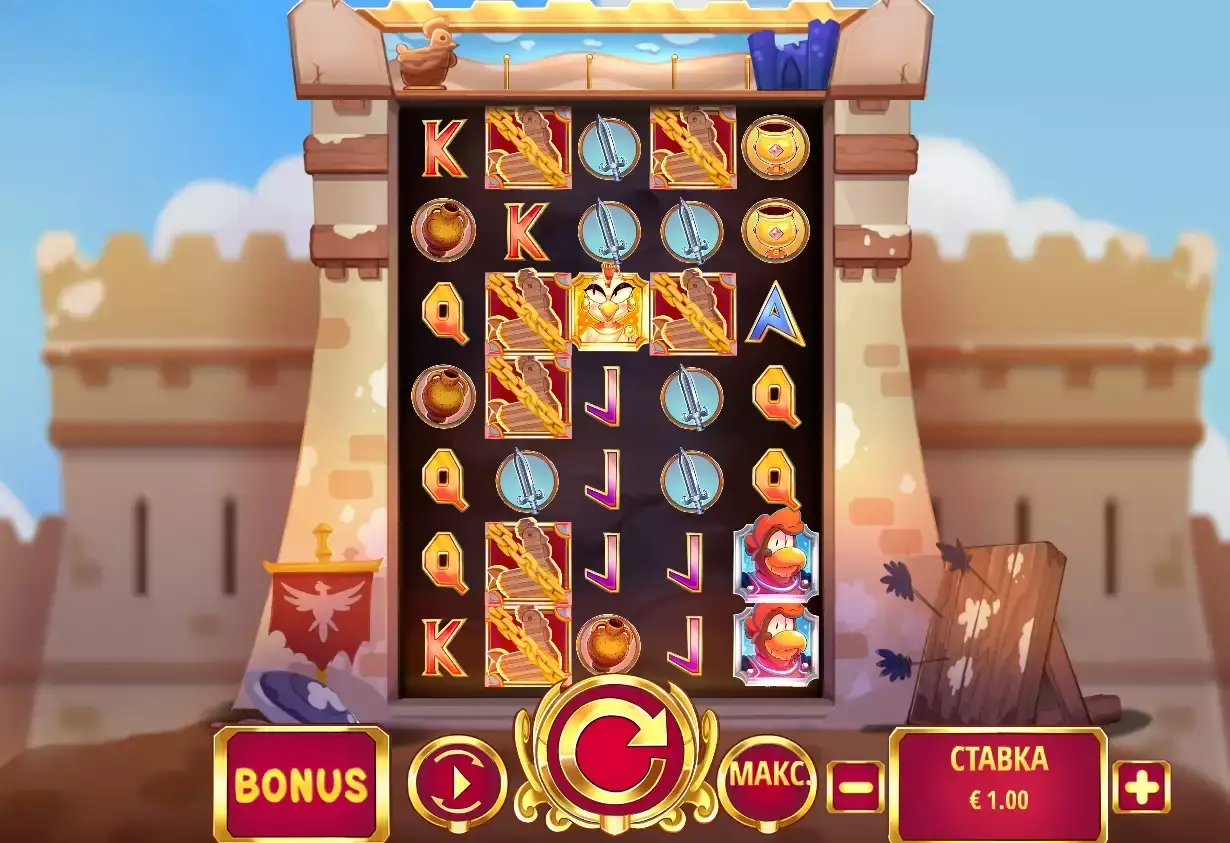
The 16,807 figure comes from the grid dimensions. With 7 rows per column and 5 columns, there are 7^5 possible left-to-right paths — which is 16,807. Every one of those paths is active on every spin.
In practice, this means two things. First, win combinations that would miss entirely on a payline game register here because the row positions do not need to align. A symbol in row 2 on reel 1 can connect with a symbol in row 6 on reel 2, and that still pays. Second, because the system counts all qualifying paths simultaneously, a single set of symbol placements can generate multiple overlapping wins across different row configurations.
For comparison, Megaways games use a dynamic reel height that changes with each spin to create their large way counts. Cherry Ways is a fixed system — the 16,807 ways are always the same 16,807 ways, spin to spin. The distinction matters when thinking about how win frequency works versus those systems.
The hit rate of 21.64% is the figure that reflects all of this in practice. It means roughly one in every five spins produces a win in the base game. For a high-way-count format on a 5×7 grid, that is a reasonable frequency. It is not the kind of rate that strings wins together constantly, but it is consistent enough that dry spells during base play tend to stay manageable.
It is worth being specific about what “win” means in this context. The hit rate counts any spin where at least one paying combination is registered. It does not say anything about the size of those wins — a ×0.2 payout on a minimum bet qualifies as a win in the same way a ×50 hit does. High-way-count games often have elevated hit rates relative to low-payline games precisely because the win paths are so numerous, but many of those hits return a fraction of the bet. The 21.64% figure tells you how often something pays. The size distribution behind it requires either looking at independent mathematical analysis or playing a meaningful volume of rounds to observe empirically.
The Vessel System: Three Types of Wild Generator
The vessel mechanic is the primary source of Wild symbols and one of the more interesting parts of the base game structure. Three types of explosive vessels can appear on the reels, each with a different blast pattern:
Horizontal Vessel — When this lands and triggers, it explodes across its entire row. Every symbol in that row is converted into a Wild for the purposes of that spin evaluation.
Vertical Vessel — This one detonates through the full height of the column it lands in. The entire column becomes Wilds.
Cross Vessel — The most expansive of the three. It explodes both horizontally across its row and vertically through its column simultaneously, creating a cross-shaped zone of Wild coverage that extends from its position in both directions.
The practical effect varies significantly depending on which vessel type lands and where. A Cross Vessel landing in the centre of the grid — say, reel 3, row 4 — converts all 7 symbols in column 3 and all 5 symbols in row 4 into Wilds. That is a large section of the grid covered by a single event. A Horizontal Vessel near the top of reel 5 converts a much smaller effective area.
When multiple vessels land on the same spin, their blast zones can overlap. A Vertical Vessel on reel 2 and a Horizontal Vessel in row 5 will both fire independently, and any symbol sitting at their intersection gets converted either way. The result is that multi-vessel spins can blanket substantial portions of the 5×7 grid with Wilds, which creates conditions for large win evaluations across the Cherry Ways system.
The vessels are not a separate bonus feature — they land during regular base game spins. Their frequency is part of what makes the base game feel more active than a standard slots setup.
The Banner Progression: How You Get to Free Spins
Free Spins in Trojan Chickens are not triggered by landing scatter symbols. The entry mechanic works differently, and it is one of the details that most casual descriptions of the game get wrong or skip over entirely.
During the base game, banner symbols land on the reels. Each banner collected advances the Trojan Chicken character forward — visually, the rooster moves closer to the gates of Troy across a progress bar. The Free Spins phase unlocks when enough banners have been collected to complete the march.
This is a persistent progression mechanic. Unlike a scatter trigger that fires the moment three symbols land simultaneously, the banner system accumulates across multiple spins. A single spin rarely fills the progress bar on its own. Players are building toward the feature over the course of their session.
The implications for how the game plays are significant. There is an ongoing mid-term objective running in parallel with the base game. Each spin does two things at once — it evaluates wins through Cherry Ways and vessels, and it potentially moves the progression forward. The sense of building toward something is more pronounced here than in games that rely on instant scatter triggers.
What the official documentation does not specify is the exact number of banners required to unlock Free Spins, or whether the progression resets between sessions. These are details that players need to check at their specific casino or through in-game paytable information.
One thing to note about persistence mechanics of this type: they can work in favour of a player who joins mid-session or against a player who builds up progress and then loses connection. The exact rules around session continuity vary by operator and platform. Before committing significant stake volume to chasing the Free Spins trigger, it is worth confirming how the progression is handled at the specific casino you are playing at.
Free Spins: The Link Bonus and How Column Locking Works
The Free Spins phase in Trojan Chickens uses a Link Bonus structure, which operates on different logic than standard free spins rounds.
When the feature activates, the reels spin and continue spinning with no preset spin limit — the round is not over after 10 or 15 spins. Instead of counting down, the round ends through a locking mechanism: when a column fills completely, it locks in place and stops spinning. The round continues on the remaining unlocked columns until all five columns have locked.
While the reels are spinning, symbols land with attached multiplier values ranging from ×1 to ×10. Each of these symbols awards a direct prize equal to the current bet multiplied by that value. The prizes accumulate as columns fill. Higher-value multiplier symbols (×8, ×9, ×10) landing in the later stages of the round, when fewer columns remain active, represent the ceiling of what the feature can pay.
The column-by-column locking creates a readable progression. As the feature runs, you can see exactly how much has been collected in locked columns and gauge what remains to be filled. This structure is used across several game families — it appears in various forms from other studios — but the execution in Trojan Chickens is clean. The 5×7 format means each column has seven positions to fill before locking, which gives the feature more room to breathe than a tighter grid would.
The theoretical maximum the feature can pay — which, combined with base game wins, produces the ×739.2 total max win figure — is not especially large. That number will be addressed directly in the limitations section below.
Crimson Vessels: The Ejection Risk
This is the mechanic that gets almost no coverage in existing articles about the game, and it deserves proper attention because it fundamentally changes the risk profile of the Free Spins phase.
During the Link Bonus, Crimson Vessels can appear on the reels. Unlike the standard vessels in the base game — which generate Wilds and generally help — Crimson Vessels are an obstacle. They can block columns, preventing them from filling with the multiplier symbols that generate prizes.
The critical risk is this: if Crimson Vessels block all five columns simultaneously, the player is ejected from the Free Spins phase before all columns have locked through normal play. The round ends early.
An early ejection means the final prize is calculated from whatever has been collected in locked columns up to that point. Columns that were blocked but not locked do not contribute their potential multiplier values to the total. In practice, a poorly timed cluster of Crimson Vessels can truncate a bonus round significantly.
This mechanic introduces a downside variance element that is not present in most Link-style features. The standard Link Bonus format elsewhere tends to be purely accumulative — you collect symbols, columns lock, and the round ends when all columns are done. Trojan Chickens adds a genuine negative outcome to the feature itself. It is not just a slower bonus; it can be a shorter bonus.
Whether this is a design strength or weakness depends on perspective. For players who want tension and variance inside the bonus round itself, it adds something. For players who expect the Free Spins to be a straightforward collection phase once triggered, the ejection risk can feel punishing. Either way, going into the feature unaware of it leads to confusing outcomes.
The frequency with which Crimson Vessels appear during the bonus phase is not documented in Triple Cherry’s public materials. That means the probability of early ejection cannot be calculated from available information. Players should treat it as a real risk rather than a theoretical edge case — the mechanic exists precisely because it will fire with enough regularity to affect outcomes.
RTP and the Operator Configuration Problem
Trojan Chickens has five RTP settings: 96.01%, 94.03%, 92.13%, 90.05%, and 88.02%.
The top figure — 96.01% — is the one that most review aggregators cite. It is in the acceptable range for a video slot in 2025, sitting close to the rough industry average of around 96%. That figure is accurate. It is also not the whole picture.
The five settings are operator-configurable. Triple Cherry supplies all five to casino operators and each operator deploys whichever variant they choose. The player does not select the RTP they play at. The casino does.
The gap between the top and bottom variant is 8 percentage points. At 88.02%, the theoretical house edge is approximately 11.98%. For context, that is a house edge roughly three times larger than the 96.01% configuration. Both versions of the game look identical to a player who has not checked the paytable — same grid, same mechanics, same visual style. The RTP difference is invisible unless you know where to look.
Most licensed operators in regulated markets are required to display the active RTP in the game’s information screen or paytable. Before playing for real money, opening the game’s help section and confirming which RTP variant is active is worth the thirty seconds it takes. The 96.01% figure is meaningless if the casino is running 88.02%.
This is a common practice across many studios, not something unique to Triple Cherry. But the 8-point range here is wider than many games, and the floor of 88.02% is genuinely low. Players in markets with weaker regulatory requirements are more likely to encounter the lower variants.
What Works
The Cherry Ways format and 21.64% hit rate sit reasonably well together. The high way count means the base game produces wins with enough regularity to sustain session momentum. Dry runs of ten or fifteen consecutive losing spins are not the norm. That is partly a result of the 16,807 ways catching combinations that fixed paylines would miss.
The three-directional vessel system adds genuine variety to how Wilds are generated. The difference between a Horizontal explosion and a Cross explosion is not just cosmetic — it changes which parts of the grid get covered and which win paths get activated. Multi-vessel spins can cover large sections of a 5×7 grid, and those events are visually readable because each blast type has a clear, distinct pattern.
The banner progression gives the base game a direction. Having an ongoing mid-term objective running through base spins keeps the experience from feeling like a flat series of spin-evaluate-repeat cycles. The march toward Free Spins creates a loose narrative within a session even when individual spins are small.
The Free Spins column-lock structure is transparent. As columns fill and lock, the accumulated total is visible. Players can see exactly what the feature has produced so far and what potential remains in unlocked columns. That legibility is better than bonus rounds where the payout potential is opaque until the round ends.
The theme is distinct. Slots based on Greek and Trojan mythology are common. Slots where the Trojan Horse is a rooster marching toward Troy are not. The parody framing is light-handed enough that it does not become tiresome, and it gives Triple Cherry’s characteristic cartoon visual style a natural context.
What Doesn’t
The max win of ×739.2 is modest. This is probably the most significant limitation for players who factor max win potential into game selection. In 2025, Link-style bonus mechanics and high-way-count formats are regularly paired with max wins of ×2,000 to ×5,000 or higher. A ceiling of ×739.2 on a medium-to-high session budget means the game simply cannot produce the kind of outlier result that comparable mechanics can deliver elsewhere. This is not a dealbreaker for every player — casual sessions with modest stakes are not chasing ×5,000 outcomes — but for players who use volatility and max win ceiling as primary selection criteria, the number is limiting.
Volatility is not disclosed. Triple Cherry does not state a volatility classification anywhere in their official documentation for this title. That makes it genuinely harder to calibrate bankroll and session expectations. A hit rate of 21.64% suggests the base game is not extremely volatile, but what the distribution of wins looks like — particularly in the tails — is unknown without either playing a large volume of rounds or finding independent mathematical analysis.
The RTP floor of 88.02% is low. As noted above, the configurable range extends down to a level that significantly disadvantages players at operators who deploy the lower variants. The 96.01% ceiling is fine. The floor is not.
The Crimson Vessel ejection risk adds negative variance to the bonus phase. Whether this reads as a design strength or a frustration depends on the player, but the practical effect is that Free Spins can end before full value is realised. In a game where the max win ceiling is already limited to ×739.2, a mechanic that can cut the primary value-generation phase short compounds the ceiling problem. The expected value of the bonus phase is lower than it would be in a pure accumulation format with no ejection risk.
Coverage is thin, which means finding reliable information about this game is harder than it should be. Many aggregator sites either do not list Trojan Chickens at all, cover the Deluxe variant instead, or reproduce only the top RTP figure without acknowledging the five-variant range. This is a research problem for players rather than a game design problem, but it is worth noting because it means players need to go to the official developer page to get accurate specs.
Trojan Chickens vs. The Deluxe Version
Triple Cherry released Trojan Chickens Deluxe as a follow-up title. The core concept is the same — same theme, same general mechanic family — but the specifications differ enough to treat them as separate products.
Trojan Chickens Deluxe carries an RTP ceiling of 97.56% (with a floor of 88.31% in its configurable range), and a max win of ×660.8 — actually lower than the base game’s ×739.2. The Deluxe version’s higher RTP ceiling is a meaningful improvement for players at operators running the top variant.
When choosing between the two, the RTP ceiling difference is the most actionable factor. If both variants are available at the same casino and the operator is running the top RTP for each, the Deluxe version’s 97.56% is preferable to the base game’s 96.01%. If the casino is running lower variants of both, the Deluxe floor of 88.31% is marginally better than the base game’s 88.02%.
The max win comparison goes the other way — ×739.2 in the base game versus ×660.8 in the Deluxe. Neither figure is competitive with higher-ceiling alternatives in the same mechanic family.
Mobile Performance
Triple Cherry builds all their titles with multi-platform compatibility as a baseline rather than an afterthought. Trojan Chickens runs on mobile, desktop, and Smart TV, with both landscape and portrait orientations supported.
The 5×7 grid is larger than average and could present layout challenges on smaller screens in portrait mode — seven rows stacked vertically on a phone display is a lot of visual real estate. Triple Cherry’s adaptation to portrait orientation compresses the grid to fit, which can make individual symbols smaller. Landscape mode on mobile is generally the more comfortable orientation for this format.
The game is built in HTML5, which means no separate download or app installation is required. Browser-based play on mid-to-high-range Android and iOS devices runs without reported performance issues. On lower-specification devices, the vessel explosion animations — particularly the Cross Vessel with its wider blast radius — may take slightly longer to resolve, but this is a minor consideration.
Final Assessment
Trojan Chickens is a coherent game with a clear structural logic. The Cherry Ways format works with the vessel system to produce an active base game. The banner progression gives sessions direction. The Free Spins column-lock mechanic is legible and builds tension as columns fill.
The limitations are real and worth stating plainly. A max win of ×739.2 means the game’s ceiling is below what the mechanic format is capable of elsewhere. The Crimson Vessel ejection risk introduces negative variance into the bonus phase that compounds that ceiling limitation. The volatility figure is undisclosed. And the configurable RTP — which can drop to 88.02% at operators running lower variants — creates meaningful risk for players who do not check before playing.
For players who prioritise base game activity over big-win potential, the 21.64% hit rate and the vessel Wild system make this a more engaging session than a lot of fixed-payline alternatives at similar stakes. For players who are primarily chasing high-multiplier bonus outcomes, the ×739.2 ceiling and the ejection risk make Trojan Chickens a difficult recommendation against games with more room at the top.
Triple Cherry’s execution is clean throughout. The mechanics are distinct, the theme holds together, and the game does what it sets out to do. Whether what it sets out to do is what a specific player is looking for is the honest question to ask before loading it up.