Developer: BF Games | RTP: 96.06%–96.15% | Volatility: High | Max Win: 90,322x | Reels/Rows: 5×3 | Paylines: 10 | Release: May 2025
There’s a peculiar art to building a slot that looks like it shouldn’t work on paper but keeps pulling you back for just one more spin. BF Games has been doing this quietly for over a decade — no flashy press releases, no industry-award campaigns — just a steady stream of technically competent, often genuinely creative games that pop up across operator lobbies without much fanfare. Chicken Madness Dice is one of those titles. On the surface: farmyard animals, oversized dice, a 5×3 grid with ten paylines. Sounds like filler content. Play it for thirty minutes and you’ll start to revise that opinion.
I’ve sat with this one through several extended sessions since it dropped in May 2025. What follows is everything I found worth knowing.
Who Made It and Why That Matters
BF Games was founded in 2013 in the UK. They’re not Pragmatic Play. They’re not NetEnt. They don’t have the marketing budget or the portfolio breadth to dominate headlines. What they do have is a library of over 75 slots with a reputation for doing something slightly unexpected within familiar frameworks. Squid From The Deep. Ramses Rising. The original Chicken Madness. These aren’t titles you’ll see on every influencer’s highlight reel, but operators keep licensing them for a reason: they hold up under repeated play.
Chicken Madness Dice isn’t just a cosmetic reskin of the original Chicken Madness — it’s a separate product with its own mathematical model, its own bonus structure, and a few mechanical ideas that the original didn’t carry. The dice branding ties both titles into a franchise feel without forcing the sequel to be a copy. That’s the right approach, and BF Games executes it cleanly.
The “Dice” branding is part of a broader pattern within BF Games’ catalogue. They’ve applied the dice variant treatment to multiple franchises — Wolf Gold Dice being another notable example — creating a sub-series identity that signals a particular type of mechanical emphasis without requiring the player to read a press release to understand what’s different. It’s smart product strategy from a studio that often makes smart product decisions quietly.
One thing that distinguishes BF Games from some of their mid-tier peers is a willingness to build games that are genuinely playable on the minimum bet. Too many studios design their maths for high stakes and then technically offer a low minimum as a box-ticking exercise. BF Games’ titles tend to feel balanced across the bet range, and Chicken Madness Dice is no exception. The consecutive multiplier feature functions exactly the same at £0.10 as it does at £5.00. The Cash Mesh triggers at the same frequency. The jackpot symbols are seeded and progressive regardless of your stake level. You’re not being penalised for playing cautiously.
First Impressions: The Table of Contents on Your Screen
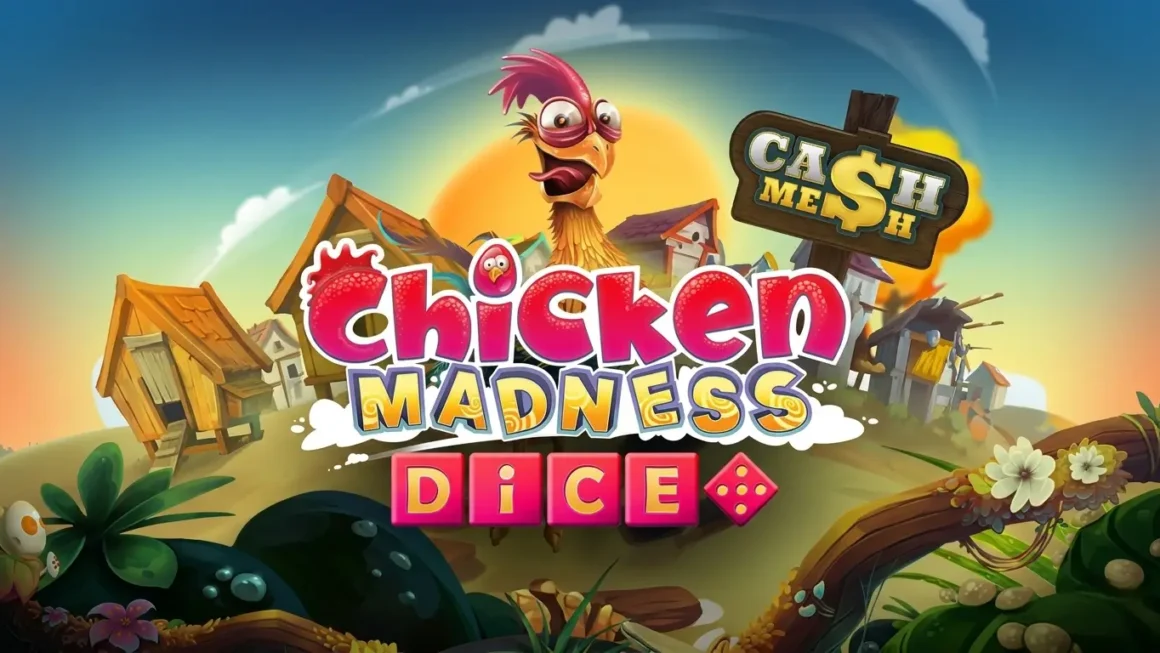
Load the game and the first thing you notice is that BF Games isn’t trying to reinvent visual language. The 5×3 grid sits against a countryside backdrop — rolling hills, quaint village buildings, the kind of pastoral scene that telegraphs “farmyard chaos” without being obnoxious about it. The characters occupying the reels are immediately readable: there’s the maniacal chicken — bulging eyes, clearly unhinged — flanked by a sly fox, a portly chef, a clueless hunter, and a raccoon who looks like he’s done worse things than steal eggs.
Every symbol on the reels has a dice face embedded within it. This is mostly decorative — the game rules make this explicit, stating that the dice values shown on symbols are “a visual element” that do not affect outcomes — but the effect is that the whole grid feels thematically unified in a way a lot of branded slots don’t manage. Nothing looks like an afterthought. The animations are bouncy and expressive, and the character designs have the kind of distinct personality you’d expect from a studio that actually cared what the game looked like.
The soundtrack is a lighthearted country arrangement that doesn’t outstay its welcome over a long session — no repetitive jingle that starts drilling into your skull after twenty minutes. The audio punctuation during the Cash Mesh feature — coin symbols pulsing, the grid filling with light — is satisfying in a physical, tactile way that a lot of hold-and-spin implementations miss.
The Maths: What You’re Actually Working With
Let’s be direct about the numbers, because they matter.
RTP: Sources differ slightly depending on the operator configuration. SlotCatalog and Respinix report 96.15%; SlotsHawk and SlotCatalog’s Chicken Madness (original) data lists 96.06%. The game comes in multiple RTP versions — documented ranges across the BF Games portfolio include configurations at 92.03% and 94.08% as lower operator options. If you care about your expected return (and you should), verify which configuration the casino you’re playing at uses. The headline 96.06%–96.15% is solid for the category.
Worth noting: a portion of that RTP is allocated to the progressive jackpots — 0.7% to the Major and 0.8% to the Grand. If you’re someone who never triggers bonus features, you’re effectively playing with a slightly lower return than the stated headline. Standard with progressive jackpot slots, but worth flagging.
Max Win: 90,322x the bet across most documentation. At maximum stake (£5 on the UK configuration), that translates to over £450,000 theoretically. Ispinix documents a 3,922x via the Full House multiplier path, which at a €25 max bet gives approximately €98,000. The gap between these numbers reflects different calculation methodologies — the 90,322x is the game’s global theoretical ceiling, while 3,922x represents the more practical Full House bonus outcome. Either way, there’s genuine ceiling here for a game with a £5 max stake.
Volatility: Listed as high by most aggregators, though Ispinix characterises it as medium volatility. The discrepancy isn’t unusual — volatility classifications aren’t standardised across the industry, and the game’s 27% hit frequency (you can expect a winning outcome on roughly one in every four spins) does push it toward the more forgiving end of what most players would call “high variance.” You’ll get regular small wins from the consecutive multiplier system in the base game; the real swings come when the Cash Mesh bonus finally fires.
Bet range: £0.10 minimum, £5.00 maximum. This is a budget-conscious stake ceiling, and it’s intentional. BF Games titles tend to sit in this bracket. For casual players, it’s accessible. For high rollers, this isn’t your game.
Hit frequency: 27%. One winning spin in roughly four. That’s reasonable. The base game doesn’t feel barren between bonus triggers.
How the Base Game Actually Plays
Ten fixed paylines on a 5×3 grid. Wins pay left to right from reel one. Higher-value symbols are the character icons — the chef chicken, the raccoon, the two farmer figures — while lower-value positions are held by card rank symbols (J, Q, K, A) dressed up in the game’s wooden letter aesthetic.
The Wild symbol substitutes for regular symbols and pays on its own when three, four, or five land on a payline. That’s a meaningful distinction — a Wild that pays independently rather than purely acting as a substitute adds a layer of value to landing multiple Wilds on adjacent reels.
But the base game’s defining mechanic is the consecutive win multiplier system. Land a winning spin and your multiplier stays at 1x. Land a second consecutive win and it jumps to 2x. Third consecutive win: 3x. Fourth: 4x. Fifth and beyond: 5x — and here’s the critical nuance that separates this from more pedestrian multiplier implementations: once you hit 5x, it stays at 5x until you spin without a win. You don’t lose the 5x on the very next winning spin. The multiplier only resets on a non-winning outcome.
In practice, this means you can occasionally ride a hot streak through several 5x-multiplied wins in a row. That’s where the base game’s real money moments come from. A reviewer at SlotsMate reported a 3,200-unit win driven substantially by the base game multiplier chain — not from the Cash Mesh bonus at all. That tells you something about how the maths distributes between the two reward pathways.
For five consecutive wins (reaching the 5x cap), you need a 27% hit rate to do the compound probability: 0.27 × 0.27 × 0.27 × 0.27 × 0.27 ≈ 0.14%. It happens. When it does, and when the underlying wins are meaningful, the experience is satisfying in a way that binary jackpot slots rarely deliver — because you feel the progression rather than just receiving a number.
It’s also worth noting how the hit frequency interacts with session pacing. At 27%, you’re winning roughly once every four spins. In a typical session of 200 spins, you can expect around 54 winning outcomes in the base game. That’s frequent enough to maintain engagement and generate multiplier sequences without making the game feel like a fruit machine parody. The wins that hit on those spins won’t all be significant — many will be small recoveries of part of your stake — but they keep the multiplier chain alive, and a multiplier chain that reaches 3x or 4x before the next big symbol combination is a different proposition entirely from a zero-multiplier landing.
The Wild symbol, which pays independently with three or more on a payline, adds an extra source of base game value that’s easy to overlook in reviews that focus on the consecutive multiplier mechanic. Three Wilds on a payline at a multiplier of 4x or 5x is a genuinely solid base game moment. It won’t set records, but it’s the kind of thing that makes a session feel worthwhile even when the Cash Mesh is slow to trigger.
Cash Mesh: The Feature You’re Actually Playing For
Land five or more coin symbols anywhere on the reels in a single base game spin and you trigger the Cash Mesh bonus. The coin symbols are scatters — they don’t need to land on paylines to count, which meaningfully increases the frequency of trigger opportunities compared to payline-restricted scatter systems.
The number of Cash Mesh spins you receive equals the number of coins that triggered the feature: five coins gives you five spins, ten coins gives you ten, up to a maximum of ten spins for ten or more triggering coins.
During Cash Mesh, the grid locks and you’re collecting coin symbols. Each new coin that lands stays in position. The goal is to fill as many of the 15 grid positions as possible with coins, because:
- All coin values collected are summed at the end of the feature
- If the grid isn’t full when spins expire, you receive between one and three bonus respins to keep building
- If you manage to fill all 15 positions — a Full House — a 2x multiplier applies to your total collected coin value
The jackpot symbols can also appear during Cash Mesh. There are four tiers:
- Mini: Fixed payout at 30x
- Minor: Fixed payout at 50x
- Major: Progressive jackpot, minimum value seeded at €5,000
- Grand: Progressive jackpot, minimum value seeded at €10,000
The Major and Grand jackpots are where the headline max win numbers come from. They’re rare — genuinely rare, not “rare but you’ll hit it within a session” rare — but they set a ceiling that keeps the game categorised as a jackpot product with real aspirational value.
Triggering Cash Mesh requires patience. You need five or more coins to land simultaneously, and with a 27% hit rate on the base game, there are plenty of near-miss spins where you’ll see two or three coins appear without reaching the threshold. This is intentional. The tension is part of the design. SlotsHawk’s reviewer noted it took a while before the Cash Mesh triggered during their playthrough, ultimately producing a £35 win — a modest but respectable result for a single feature trigger.
The respin economy within Cash Mesh is worth understanding clearly, because it determines whether the feature delivers or underwhelms. The bonus spins counter at the start of Cash Mesh is set by how many coins triggered it — five coins gives five spins, ten coins gives ten, with the maximum being ten respins. Each additional coin that lands during the feature doesn’t reset the counter; it simply stays in position and adds its value to the final payout. When spins expire without filling the grid, the game awards between one and three extra spins automatically — a small but meaningful mechanic that reduces the frequency of frustrating near-full-grid outcomes.
The Full House bonus — filling all 15 grid positions — is the scenario where the 2x multiplier dramatically amplifies total collected value. If you manage to land jackpot symbols alongside a Full House, you’re in the territory of the game’s maximum theoretical payouts. In practice, a Full House requires the right density of coin symbols landing across all five reels during the bonus. It happens. It’s not purely aspirational math. Players have reported significant wins from Full House completions, and when the grid is filling in its final stages, the anticipation the game generates is genuine — not manufactured through artificial sound effects, but from the actual mechanics of watching one remaining position light up.
The Dice Gimmick: Does It Add Anything?
This is the honest question worth asking. BF Games markets this as a “dice” variant of Chicken Madness, and the dice imagery is everywhere — on every symbol, in the multiplier displays, in the general aesthetic. But the game rules explicitly state that the dice values shown are visual elements that don’t affect gameplay mechanics.
So what’s the point?
Thematic coherence, primarily. The dice motif ties the game into BF Games’ broader “Dice” series — they’ve applied similar treatment to other titles in their portfolio — and it gives the multiplier system a visual language that feels like rolling dice rather than spinning reels. When consecutive wins stack and the multiplier climbs from 2x to 3x to 4x, watching the dice face increment has a satisfying tactile quality even if the underlying randomness is identical to any other slot system.
Is it substantive? Not mechanically. Does it make the experience feel more cohesive and less arbitrary? Yes, actually. Presentation matters, and this is a case where a cosmetic choice improves player experience without overstating its own importance.
Comparing It to the Original Chicken Madness
The original Chicken Madness from BF Games operates on the same thematic territory — same farmyard cast, same Cash Mesh bonus framework, same four-jackpot structure. The max win on the original is documented at 472x for the base symbol combinations, with the jackpots providing the higher ceiling. The maximum bet on the original goes up to £50 per spin, making it a different product category altogether for stake range.
Chicken Madness Dice brings two notable changes: the dice visual system layered across all symbols, and the consecutive win multiplier in the base game operating slightly differently from the original’s implementation. Whether you find that worth engaging with as a separate product depends on your appetite for franchise variants. If you liked Chicken Madness and want more of it with some base game variety, Dice delivers. If you’ve never played either, start with Dice — the base game multiplier chain is a more engaging way to spend time between bonus triggers than most alternatives at this stake level.
Who Should Play This, and Who Should Skip It
Play Chicken Madness Dice if:
You want a slot with a genuine feature hierarchy — base game multipliers that keep things interesting between Cash Mesh triggers, a hold-and-spin bonus that feels mechanically substantial rather than just a reskin of the standard Hold & Win formula, and a four-tier jackpot structure that gives you something to aim at in the longest sessions. The 27% hit frequency means you won’t be sitting through dead-air stretches waiting for anything to happen. The £0.10 minimum means you can genuinely manage your session budget.
Approach with caution if:
You’re expecting a low-stakes, low-volatility experience. Despite the cartoonish presentation and moderate hit frequency, the real money sits in the Cash Mesh and jackpot features, which can be elusive in shorter sessions. The £5 maximum stake also means this isn’t a game for players who want to put serious money through with proportionate upside — the ceiling exists and it’s firm.
Skip it entirely if:
You exclusively play high-variance, buy-bonus titles where every session is a high-stakes sprint. Chicken Madness Dice is designed for session play, not jackpot hunting with max bet turbo spins. The maths doesn’t reward that approach.
Technical Notes for Early 2026
As of early 2026, Chicken Madness Dice is available across a reasonable spread of operator lobbies in Europe and select other markets — SlotCatalog documents availability in 44 countries. It does not appear on the US New Jersey market at time of writing. Mobile optimisation is confirmed across iOS and Android, with a game file size of 36.5 MB — lightweight enough that load times aren’t an issue even on lower-spec mobile connections.
The Turbo feature (sometimes listed as a “Lightning” button) enables quick spin mode if you prefer reduced animation length per spin. Autoplay is not available in the version reviewed here — likely a regulatory default for the UK market configuration.
The RTP range matters more than it might seem: the 92.03% lower operator configuration is a meaningful reduction from the 96.06% headline. If your casino isn’t disclosing which RTP variant they’re running, ask. The difference in expected return over a long session is not trivial.
Where It Sits in the Hold-and-Win Market
The hold-and-win / Cash Collect mechanic has been one of the dominant structural trends in slots design for the last four or five years. Everyone is doing it. Pragmatic Play, Playtech, Hacksaw, a dozen smaller studios — the market is saturated with variants on the “land scatter coins, collect in respins, hit jackpot symbols” template. So the fair question is: does Chicken Madness Dice offer anything beyond another iteration of a formula that players have seen a hundred times?
The honest answer is: yes, marginally, in a way that matters if you play a lot of slots.
The differentiator isn’t the Cash Mesh itself — that’s a competent implementation of a standard mechanic, no more. The differentiator is the combination of Cash Mesh with the base game consecutive multiplier. Most hold-and-win slots have a base game that’s purely a delivery mechanism for the bonus — you spin until the bonus triggers and the real play begins. In Chicken Madness Dice, the base game has its own momentum. Consecutive wins build multiplier chains that pay out independently of whether the Cash Mesh ever fires. A session that never triggers the Cash Mesh isn’t necessarily a bad session, because the base game multiplier has been working throughout.
That balance — between a meaningful base game and a substantive bonus — is harder to achieve than it looks. Most studios default to one or the other. BF Games manages both in this title without either element undercutting the other, and that’s a genuine design achievement within a crowded category.
Chicken Madness Dice is the kind of game that doesn’t announce itself. It’s not dressed to impress conference attendees or designed to generate viral clip moments. What it is, is a carefully constructed slot with a base game that rewards sustained attention, a hold-and-spin bonus that uses its respin economy well, and four jackpot tiers that give the game real ceiling without making the experience entirely dependent on hitting one.
BF Games continues to do what they’ve done since 2013 — build games that are better than their marketing suggests. Chicken Madness Dice fits that pattern. The 96.06%–96.15% RTP is a fair deal. The consecutive multiplier system is one of the more engaging base game mechanics I’ve encountered in this volatility range in recent memory. The Cash Mesh feature, while requiring patience to trigger, delivers when it arrives.
It won’t replace your favourite high-variance title for adrenaline sessions. But for the player who wants a game they can actually sit with — something that builds momentum rather than just swinging between nothing and everything — Chicken Madness Dice earns its place in the rotation.