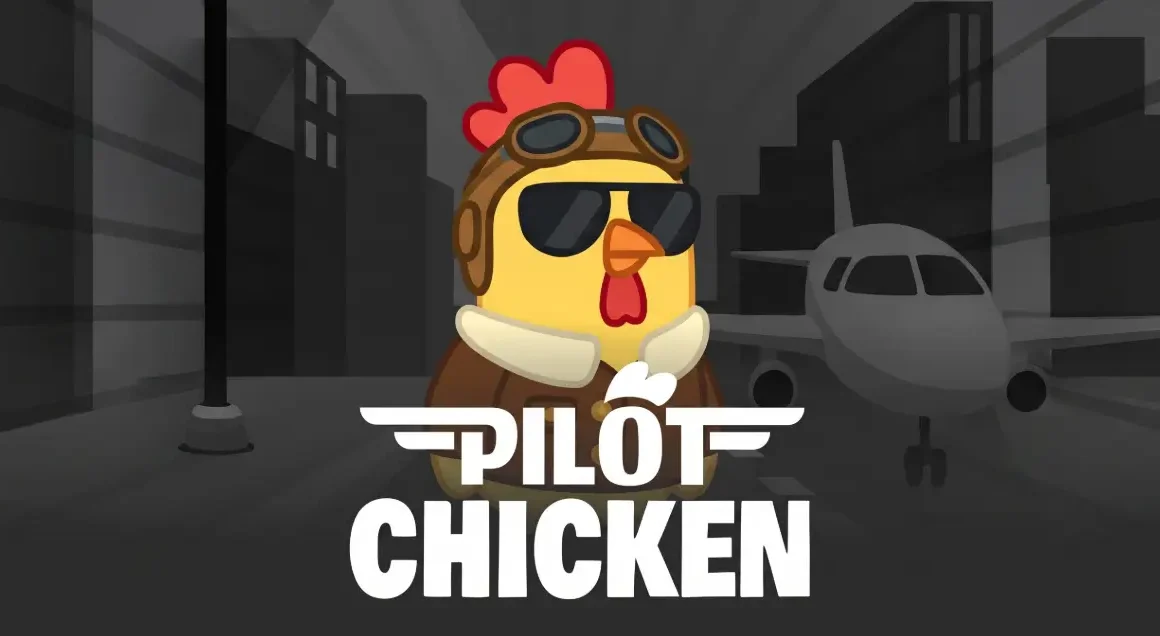
Spribe built the crash genre. Aviator alone pulls more than 77 million unique players a month, and for years the studio set the pace everyone else copied. Pilot Chicken flips that relationship. It launched on 19 January 2026, and it’s Spribe arriving late to a format InOut Games and Evoplay have already been running for over a year — the cross-the-road, step-multiplier game. The question this review actually needs to answer isn’t “is it fun” (it is, in short bursts). It’s whether the studio that invented the genre brings anything to a format it didn’t build.
The numbers say: mostly not. RTP sits at 97%, difficulty is player-selectable across three tiers, and the theoretical ceiling reaches x1,000,000 — but every real payout is hard-capped at €10,000, no matter what multiplier you hit or what you staked to get there. That cap is the single most important number in this review, and it shapes almost everything below.
It’s also worth being upfront about where Pilot Chicken sits visually and structurally next to its closest rival. InOut Games’ Chicken Road already occupies this exact space — same road-crossing premise, same step-by-step multiplier climb, same cash-out-or-push decision loop — and has done since well before Pilot Chicken existed. Spribe hasn’t hidden the influence; if anything, the resemblance in how multipliers are displayed and how the interface is laid out makes it obvious which game came first. That’s not automatically a problem. Plenty of strong titles are built on a proven mechanic rather than a new one. The real test is whether Pilot Chicken’s execution — the RTP, the payout structure, the extras layered on top — actually improves on what’s already out there, or just repeats it with a different mascot.
The math and the mechanics
Pilot Chicken drops the reels, the paylines, and the grid entirely. This is a step-based, decision-driven game: you set a stake between €0.10 and €100, pick a difficulty, and then move a chicken forward one lane at a time. Each safe step raises your potential payout. One bad step ends the round and takes your stake with it. There’s no spin button doing the work for you — the entire game is built on the tension between pushing for one more lane and cashing out what you’ve already banked.
The RTP is fixed at 97%, which is the figure listed directly on the game’s SlotCatalog record and matches what Spribe stated at launch. That’s a genuinely strong number for the step-multiplier category — ahead of Chicken Road 2.0’s 95.5% and Evoplay’s Uncrossable Rush at 96%, though behind the original Chicken Road’s 98%. Worth flagging: because this is a decision-driven format, that 97% is a long-run theoretical average across all play styles, not a fixed return you’ll see session to session. Push deeper into the road and your variance climbs with it; cash out early and often and you flatten both the risk and the return toward something closer to break-even.
Volatility here isn’t a fixed label — it’s something you choose every round, via the difficulty selector. That’s effectively your variance slider:
| Difficulty | Track length | Max multiplier |
|---|---|---|
| Easy | 15 lanes | 25x |
| Medium | 20 lanes | 1,000x |
| Hard | 25 lanes | 1,000,000x |
Easy mode is close to low-to-medium volatility in practice — traffic is forgiving, small runs feel achievable, and the ceiling is correspondingly low. Medium is where the game gets interesting: a 1,000x max multiplier on a 20-lane track is a meaningful jump in both risk and reward over Easy. Hard mode is where the marketing numbers live, and where the game is least honest about what’s actually reachable — even surviving the first few lanes on Hard is a genuine test, long before you’re anywhere near lane 25.
Here’s the number that actually matters more than the headline multiplier: the €10,000 cash cap applies regardless of stake or multiplier. Hit x1,000,000 on a €10 bet and the maths says you’ve won €10 million. You haven’t. You’ve won €10,000, the same ceiling that applies to a €0.10 bet that somehow reaches the same multiplier. That 1,000,000x figure is not a number you should ever expect to see reflected in your balance — it’s a probability exercise, not a realistic outcome, and treating it as marketing rather than math is the correct read.
Run the numbers on a realistic bet size and the cap stops being an abstraction. Stake €10 on Hard mode and reach, say, a x2,000 multiplier partway through the run — that’s a theoretical €20,000 payout, already double the cap before you’re anywhere close to the 25th lane. The cap isn’t something that only bites at the extreme end of the probability curve; on Hard mode specifically, it becomes the practical ceiling well before the headline multiplier is even relevant. On Easy and Medium, by contrast, the cap rarely enters the picture at all — a 25x max on Easy or a 1,000x max on Medium at typical stakes stays comfortably under €10,000, so those two difficulty tiers are the ones where the stated multiplier and the actual payout line up honestly.
There’s no published hit-frequency figure for Pilot Chicken — SlotCatalog’s attribute table lists it as N/A, which is standard for step-based games where “hit frequency” doesn’t map cleanly onto a fixed-reel concept. What replaces it is survival probability per step, and that’s not published either; it’s inferred from the difficulty curve itself. In practice, Easy mode’s 15-lane track with a 25x ceiling implies survival odds high enough that reaching the midpoint feels achievable most rounds, while Hard mode’s traffic density is built specifically to make even the first handful of lanes a genuine coin-flip. That’s a meaningfully different risk profile from a low-volatility slot with a fixed 95%+ hit rate — here, “hit frequency” is a dial you’re actively turning, not a fixed property of the game.
Feature breakdown
Difficulty selector. This is the game’s only real mechanical lever, and it does the job of a volatility setting in a traditional slot. Trigger condition: chosen before each round starts, adjustable freely between rounds. What it does: sets track length (15/20/25 lanes) and the odds of surviving each individual step — harder settings mean denser traffic and lower per-step survival odds, in exchange for a steeper multiplier curve. There’s no re-trigger mechanic because there’s nothing to trigger; you’re either on the road or you’ve cashed out. The honest limitation: Hard mode’s headline 1,000,000x is functionally decorative once you factor in the €10,000 cap and the practical odds of stringing together 25 consecutive safe steps.
Auto Play system. This is the most developed feature in the game, and it’s genuinely more sophisticated than most crash-adjacent titles bother with. You set a round count from 3 to 500, an automatic cash-out target (a specific multiplier the system will bank for you without manual input), and stop conditions tied to balance increase, balance decrease, or a single win exceeding a threshold you define. Bet adjustment logic sits on top of that: after a win or loss, Auto Play can reset your stake to the starting amount or scale it up or down by a percentage you set, anywhere from 1% to 100%. In a typical session, this is what most players will actually lean on rather than manually tapping through each lane — the manual mode is closer to a novelty for testing pacing than the primary way people will play once real money is involved. The catch: none of this changes the underlying odds or the payout cap. Auto Play manages when you cash out, not how much you can win.
Provably Fair verification. Standard for Spribe, and it works as expected here — server and client hashes can be checked independently through a hash generator to confirm round outcomes weren’t manipulated after the fact. This is table stakes for the genre at this point, not a differentiator, but its absence would be a real problem, so it’s worth confirming it’s present and functioning rather than assumed.
What’s absent. No bonus rounds, no modifiers, no temporary power-ups, no progressive jackpot. Every round runs the identical structure from the first lane to the last. For a studio known for building entire genres, that’s a strikingly thin feature set — the game leans entirely on the difficulty selector and Auto Play to generate replay value, with nothing sitting on top of the core loop to change how a session feels round to round.
Presentation. This isn’t a mechanic, but it’s worth stating plainly because it affects whether anyone sticks around long enough to notice the RTP: the visual design is grey, low-contrast, and flat. The setting swaps Chicken Road’s cars for jets on an airstrip, which is the one genuine reskin choice Spribe made, but the UI layout, the way multipliers pulse and display, and the general tone of the interface track closely with Chicken Road’s own presentation. There’s nothing broken about it — the game runs cleanly on JS/HTML5 at a lean 10MB, so it loads fast on mobile connections, which matters more in practice than most players give it credit for. But there’s no visual identity here that separates Pilot Chicken from the half-dozen other chicken-and-road titles that have shipped across the industry over the past two years.
Where this sits in 2026
Spribe hasn’t released a Power Reels or Megaways-style variant of Pilot Chicken, and there’s no announced sequel. What exists is what you get: one game, three difficulty settings, no roadmap for an expanded version. That’s worth noting up front because the comparison that matters here isn’t Pilot Chicken versus a future version of itself — it’s Pilot Chicken versus the three or four titles that already own this space.
Chicken Road (InOut Games) is the clearest benchmark. It runs a 98% RTP — a full point above Pilot Chicken — with a theoretical max win north of x3.2 million on its Hardcore setting, though real payouts are capped around €10,000/$10,000, essentially matching Pilot Chicken’s ceiling. On raw RTP, Chicken Road wins outright.
Chicken Road 2.0, InOut’s sequel, actually drops to a 95.5% RTP — a genuine step backward from the original — but raises the cash cap to $20,000, double what Pilot Chicken offers. It also runs four difficulty tiers instead of three, giving players a finer gradient between “safe” and “reckless” than Pilot Chicken’s three-step ladder.
Uncrossable Rush (Evoplay, built on the licensed CrossyRun mechanic) sits at 96% RTP with a commonly cited max win around 10,000x and four difficulty levels across a 24-lane track. It’s the closest direct mechanical twin to Pilot Chicken — same core tension, same cash-out decision loop, similar bet range — and the RTP gap between the two titles (96% vs. 97%) is close enough that it won’t meaningfully change your expected long-run outcome either way. Where Uncrossable Rush pulls ahead is the fourth difficulty tier, giving players a finer-grained choice between Easy and Hardcore than Pilot Chicken’s flatter three-step ladder.
Laid out side by side, the RTP picture across the genre looks like this:
| Game | Provider | RTP | Cash cap |
|---|---|---|---|
| Chicken Road | InOut Games | 98% | ~€10,000 |
| Pilot Chicken | Spribe | 97% | €10,000 |
| Uncrossable Rush | Evoplay | 96% | 10,000x (varies by source) |
| Chicken Road 2.0 | InOut Games | 95.5% | $20,000 |
Pilot Chicken lands in the middle of the pack on RTP — ahead of Chicken Road 2.0, behind the original Chicken Road — while sitting at the tighter end on cash cap alongside the original Chicken Road, both of which are undercut by Chicken Road 2.0’s doubled ceiling. No single competitor beats Pilot Chicken on every number simultaneously — the most interesting thing about this comparison is that the format has matured to the point where providers are trading off RTP against cap size rather than one title dominating outright.
Buy-bonus mechanics don’t exist in this format at all — there’s no bonus round to buy into, since the entire game is the “bonus round” in slot terms. Progressive jackpots are equally absent, here and across every competitor in this genre; step-multiplier games pay out through the multiplier curve itself, not through a side jackpot pool. If either of those is a dealbreaker for how you normally play, this entire genre — not just Pilot Chicken specifically — is the wrong fit, and a traditional slot with a linked jackpot network will serve that preference better than any chicken-crossing title currently on the market.
So who is this actually for? Pilot Chicken is a recreational, short-session game — the format rewards players who want a fast, decision-driven round they can start and finish in under a minute, not players chasing a life-changing single hit. The €10,000 cap makes that explicit: this was never built for the high-roller staking four figures per round in hopes of a seven-figure multiplier. For a player treating this as a quick, controlled-risk diversion between other games, the 97% RTP is genuinely competitive within its category. For anyone drawn in by the 1,000,000x headline number expecting it to mean something at the table, this is the wrong game — that number exists to be advertised, not won.
Verdict
Play it if you want a fast, decision-driven session with better-than-average RTP for the genre and don’t mind that the visual presentation is flat — grey, low-contrast, and a fairly direct visual lift from Chicken Road’s UI, right down to how multipliers are displayed. Skip it if Chicken Road’s 98% RTP or Chicken Road 2.0’s $20,000 cash cap matter more to you than novelty; both direct competitors beat Pilot Chicken on the number that decides most of the outcome here.
The one figure that limits this game more than any other: the €10,000 payout cap, applied flatly regardless of the multiplier you land. It turns Hard mode’s headline 1,000,000x into a statistic for the marketing copy, not a realistic target. If you’re the kind of player who reads “1,000,000x” and mentally converts it into a life-changing win, recalibrate before you deposit — the actual ceiling is a four-figure number, the same one the genre’s other major titles already offer, some at a higher cap.
For Easy or Medium players — anyone treating this as a quick, low-stakes way to fill a few minutes between other games — the cap barely matters, and the 97% RTP genuinely works in your favour against most of the direct competition. For Hard-mode players chasing the headline number, temper expectations early: the realistic outcome on any given round is losing the stake within the first few lanes, and even a successful deep run gets flattened by the cap the moment it crosses €10,000 in theoretical value. Neither profile is wrong to play this game. Only one of them is playing it for the reason Spribe’s marketing is selling.
Pilot Chicken doesn’t lose to its competitors on RTP by much, and it has the best Auto Play system of the three titles compared here. It just doesn’t win on anything else, and for a studio that built Aviator, “competitive but not distinctive” is a modest result.