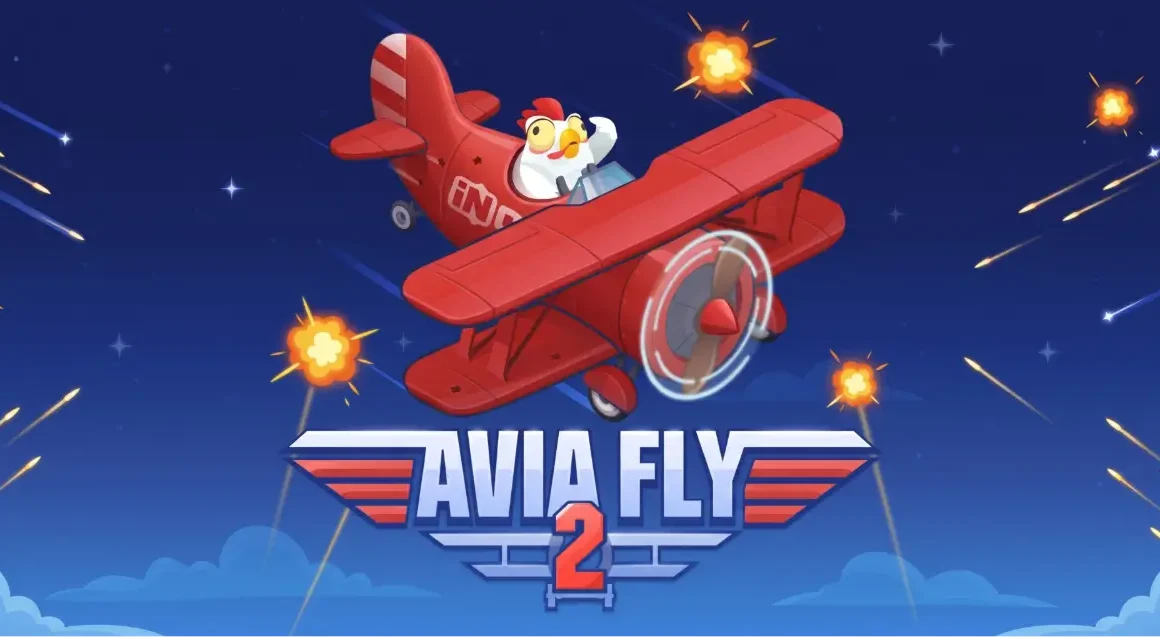
InOut Games released the original Avia Fly in November 2023, and it did what most crash titles do: a rising multiplier, a manual cash-out button, and a 1,000x ceiling if your nerve held. Just over two years later, Avia Fly 2 landed on January 27, 2026, and it doesn’t play like a sequel. The cash-out button is gone. So is 90% of the win ceiling.
That’s not a typo. SlotCatalog lists Avia Fly 2 at a 96.5% RTP with a 100x max win, against the original’s 95% RTP and 1,000x cap. Higher return, smaller top prize, and a mechanic that’s been rebuilt from the ground up around a pre-calculated flight path instead of a live multiplier curve. In a genre where Aviator’s clone count runs into the hundreds, InOut Games chose to diverge rather than iterate. Whether that’s a smart repositioning or a step backward for high-stake chasers is the question this review answers.
InOut Games isn’t a newcomer to this corner of the market. The studio’s portfolio already includes Chicken Road, Chicken Road 2.0, Chicken Road Vegas, BalloniX, Driver, X-Keno, Crash, Rabbit Road, and Battle Trades — a lineup that leans heavily on crash-adjacent and instant-win mechanics rather than traditional reel-based slots. Avia Fly 2 fits that pattern: fast rounds, simple staking, a visual theme built around risk-and-reward tension. What sets it apart from the rest of that catalogue is that it’s a direct sequel to an existing title, which makes the mechanical rewrite all the more notable.
The math model: what 96.5% actually buys you
Avia Fly 2 carries a 96.5% RTP, confirmed on SlotCatalog’s game page and echoed consistently across the game’s own marketing pages. That figure sits comfortably above the average video slot (typically 94–96%) and roughly in line with the crash-game category, where 96–97% is the norm rather than the exception.
Here’s what 96.5% means at the table: for every $100 wagered across enough rounds to smooth out variance, the theoretical return is $96.50, leaving a 3.5% house edge. Play $20 a round for a two-hour session at a brisk pace — say 150 rounds — and you’re wagering $3,000 in total action. At the theoretical RTP, expected losses land around $105 over that session, though any single session can swing well outside that band because 96.5% is a long-run average, not a per-round guarantee.
Where things get genuinely interesting is the max win. SlotCatalog’s attribute table caps it at x100.00 — confirmed independently by two other trackers (PokerListings and LiveCasinoComparer both list the same x100 figure). That’s worth sitting with, because it’s a hard ceiling for a game marketed as a 2026 crash-adjacent release. Compare that to the genre standard: Aviator caps around 10,000x at minimum stake, JetX runs to 25,000x, and even InOut’s own predecessor, Avia Fly, topped out at 1,000x. A 100x ceiling puts Avia Fly 2 closer to a mid-tier instant-win slot than a genre-leading crash game.
A handful of low-authority marketing pages float figures like 10,000x or a flat “$20,000 max win per round” — those numbers don’t appear on SlotCatalog, don’t match each other, and read like templated affiliate copy rather than verified specs. I’m not carrying them into this review. The 100x figure, corroborated by three independent trackers, is what I’m treating as accurate.
Volatility and hit frequency are both unlisted as N/A on SlotCatalog — there’s no official variance rating or hit-frequency percentage published for this title, which is unusual for a 2026 release from an active studio. In practice, the game’s own structure (a pre-determined flight path with a binary safe-landing-or-crash resolution) suggests something closer to medium volatility: wins are gated behind a successful landing rather than distributed across a continuous multiplier curve, so expect streakier results than a manual-cashout crash game where you control your own exit point.
Betting range is confirmed at $0.10 to $200 per round — again, this comes straight from SlotCatalog’s attribute table. A few marketing sites claim a $1,000 max bet; I’m going with the aggregator figure since it’s the one independently verifiable source.
Grid structure and paylines don’t apply here. Avia Fly 2 isn’t reel-based — there’s no payline logic to explain, and SlotCatalog correctly files it under “Other types” rather than as a traditional slot.
Worked example, because a percentage on its own doesn’t tell you much: at the $200 max stake, a single round theoretically returns $193 on average across enough rounds — but that average is smoothed over thousands of flights, and any individual round still resolves as either a landing or a total loss. At the $0.10 minimum, the same math applies at a scale where the outcome barely registers on a bankroll either way. The RTP number matters more for session planning than for predicting any single flight, which is true of every game in this category — crash and flight-path titles alike resolve round by round, not gradually like a slot’s cascading reels.
You might ask: why would a developer launch a sequel with a lower ceiling than the original? The honest answer is repositioning. This isn’t a bigger, riskier version of Avia Fly — it’s a calmer one, built for players who want a fast-win format without babysitting a rising multiplier curve.
On licensing: InOut Games’ own domain states the studio operates under a license from the Government of the Autonomous Island of Anjouan, Union of Comoros (license number ALSI-202506032-FI2), with the operating entity registered in Curaçao. That’s an offshore licensing tier — not the MGA or UKGC-grade regulation that Spribe and SmartSoft Gaming both hold for their crash titles. It doesn’t affect the math model or the RTP figures above, but it’s a relevant data point if regulatory tier factors into where you choose to play this game.
Feature breakdown
How a round actually plays out
Strip away the branding and the sequence is simple: set your stake between $0.10 and $200, place it within the round’s staking window, and launch. The plane follows a route that’s already been determined by the round’s underlying randomisation before you ever see it move. As it travels, it passes through additive, multiplier, and risk elements in whatever order that specific flight generated. The round ends in one of two states — a safe landing that pays out the accumulated total, or a crash that returns nothing. There’s no mid-flight decision point, no button to press beyond the initial launch. That’s the entire interaction loop, repeated round after round.
This is a meaningfully different rhythm from Aviator or JetX, where the entire appeal is the live decision under pressure — watching the multiplier climb and asking yourself whether to bank now or push further. Avia Fly 2 removes that decision entirely. You’re betting on an outcome that’s already fixed, not managing a live risk in real time. For some players that’s a relief; for the crash-game crowd specifically drawn to the tension of a manual cash-out, it removes the entire point of the genre.
Pre-calculated flight path
Avia Fly 2’s core mechanic is fundamentally different from its predecessor’s. Instead of watching a live multiplier climb and deciding when to cash out, each round runs on a pre-determined flight path — the outcome is set before the plane takes off, and you watch it play out rather than actively control it. This is confirmed across SlotCatalog’s own review copy and multiple independent sources: the plane launches, follows its path, and the round resolves as either a successful landing or a crash.
The trigger is simple: place your bet within the round’s staking window, hit launch, and the flight plays out automatically. There’s no manual or auto-cashout button to manage mid-round — a structural departure from the “collect before it’s too late” tension that defines Aviator, JetX, and the original Avia Fly.
Additive values
During the flight, the plane collects additive elements that build toward the final payout. SlotCatalog’s own description frames these as “additive values” that increase the total win as the round progresses. Exact per-round distribution figures (how many additions per flight, what range they fall in) aren’t published on SlotCatalog or any source I’d class as reliable, so I won’t invent a number here — treat the additive system as present and confirmed, but undocumented in precise terms.
Multipliers
Alongside additive values, the flight path includes multiplier elements that amplify the accumulated total. This is one of the few features SlotCatalog explicitly tags in the game’s attributes (“Multiplier” appears as a listed feature), which is the strongest confirmation available for any single mechanic in this game. What the exact multiplier range is — whether it tops out at x2, x5, or higher per instance — isn’t independently verifiable from authoritative sources, so I’m not going to hand you a specific number that I can’t back up.
Risk elements and dividers
Where this game creates tension is through risk modifiers — elements along the flight path that can reduce the accumulated win or end the round outright. SlotCatalog’s review text describes these as elements that “can sharply reduce or completely end the round,” distinct from the additive and multiplier elements that build the total. This is the mechanical replacement for the crash moment in a traditional cash-out game: instead of a single crash point, Avia Fly 2 spreads risk across the flight in the form of these negative modifiers.
The honest limitation here: because the flight path is pre-calculated rather than reactive, you have zero ability to influence the outcome once the round launches. In Aviator or JetX, a nervous player can bail early and bank a small win. In Avia Fly 2, you’re locked into the pre-set path from the moment you place your bet. That removes the skill-adjacent “timing” element that crash-game regulars specifically play for.
Landing or crash resolution
Every round resolves one of two ways: a safe landing that locks in the accumulated value, or a crash that wipes the round to zero. This binary resolution is confirmed consistently across every source that describes the game, including SlotCatalog. There’s no partial cash-out, no early exit, no hedge — you either land with whatever the flight path built up, or you lose the stake entirely.
Provably fair verification
SlotCatalog tags the game’s theme list with “Provably fair,” which is a meaningful inclusion — it means round outcomes are verifiable via cryptographic proof after the fact, a baseline expectation for crash-adjacent titles in 2026 but not something every instant-win game bothers to implement. I couldn’t independently verify the specific hashing method InOut Games uses (SHA-256 is claimed on a low-authority marketing domain, unconfirmed elsewhere), so I’ll note the provably fair tag exists on SlotCatalog without vouching for the technical implementation details beyond that.
What’s missing: no buy-bonus, no progressive jackpot
Avia Fly 2 has no bonus-buy option and no progressive jackpot — neither feature appears anywhere in SlotCatalog’s attribute list, and no reliable source claims otherwise. That’s worth stating plainly rather than burying it. In a 2026 lobby where Aviamasters 2 (BGaming’s competing flight-path game) offers a 50x-stake buy-bonus that guarantees a safe landing, Avia Fly 2 gives you no way to skip the risk or shortcut a round. You take the flight path as generated, every time.
Demo mode
A free demo is available directly through SlotCatalog’s game page, alongside listings at multiple casino partners. The demo runs on the same underlying flight-path system as real-money play, which is standard practice for the category — it lets you sit through a series of rounds and get a feel for how often flights lean toward a landing versus a crash before committing a stake. Given that volatility and hit frequency aren’t published anywhere official, running the demo for a genuine sample size is currently the only practical way to build any intuition for this game’s actual variance, rather than relying on marketing copy that hasn’t been independently verified.
Technology and mobile footprint
SlotCatalog lists Avia Fly 2 as a JS/HTML5 build at 6.1 MB — small enough to load fast on a mid-range mobile connection, and consistent with the no-download, browser-first approach the whole crash-game category has standardised on. For comparison, the original Avia Fly runs a leaner 3.71 MB, so the sequel’s added visual and mechanical complexity comes with a real if modest size increase. Neither figure is heavy by 2026 standards; both load instantly next to a typical 40–60 MB reel-based video slot with animated bonus rounds.
The 2026 perspective: sequel, competitors, and where this actually fits
The comparison that matters most here isn’t Avia Fly 2 against the wider crash-game market — it’s Avia Fly 2 against Avia Fly, its own predecessor. And the gap is bigger than a typical sequel refresh.
The original Avia Fly (SlotCatalog, released November 2023) runs a 95% RTP with a 1,000x max win, built on a genuine manual-cashout crash mechanic with a Trenball mode layered on top — three fixed auto-cashout thresholds (1.96x, 2x, and 10x) that players could combine with a live classic bet. It’s a nocturnal, radar-screen aesthetic with a genuinely different visual identity from the sequel’s daylight aviation theme. Avia Fly 2 keeps almost nothing from that formula. The manual cashout is gone. The Trenball thresholds are gone. The mechanic is a completely different genre of instant-win game wearing the same branding.
What did the sequel actually fix? RTP, marginally — 96.5% against 95% is a real improvement, worth 1.5 percentage points of long-run return. Beyond that, it’s hard to call this an upgrade in the way “sequel” usually implies. The max win dropped by a factor of ten. The skill-adjacent timing element that made the original a genuine crash game is gone entirely. What InOut Games built is less a bigger Avia Fly and more a different game category occupying the same branding slot — closer to BGaming’s Aviamasters line than to its own predecessor.
That comparison to Aviamasters is worth making explicit, because it’s the closest mechanical analog on the market. Aviamasters 2 by BGaming runs a 97% RTP with a 1,000x max win, medium-low volatility, a stated 2.50% hit frequency, and — critically — a 50x-stake buy-bonus that guarantees a safe landing. Same core idea (collect symbols along a flight path, land safely to win), better RTP, a ten-times-higher ceiling, and a bonus-buy option Avia Fly 2 simply doesn’t have. On every axis where the two games can be directly compared, Aviamasters 2 wins.
Against the genre’s manual-cashout heavyweights, the picture is different because the mechanics aren’t really comparable anymore. Aviator by Spribe runs a 97% RTP with a max win capped at $10,000 per bet (roughly 10,000x at the $0.10 minimum stake), full manual and auto-cashout control, provably fair SHA-512 verification, and a player base regularly cited in the tens of millions monthly — it remains the reference point the entire category gets measured against. JetX by SmartSoft Gaming publishes an RTP range of 96.2%–98.9% depending on operator configuration, with a 25,000x max win and no dollar cap on payout, plus dual and triple simultaneous bets via JetX3. Both games let you make a real-time decision under pressure. Avia Fly 2 doesn’t ask that of you — the decision is made the moment you place the bet, before the flight even starts.
Buy-bonus: absent, confirmed. Progressive jackpot: absent, confirmed on SlotCatalog’s attribute table with no jackpot listed. Neither omission is unusual for the category, but stacked against Aviamasters 2’s bonus-buy and against Aviator’s sheer market presence, Avia Fly 2 doesn’t bring a standout reason to choose it over either.
It’s also worth looking sideways at InOut Games’ own catalogue rather than only at outside competitors. Chicken Road Vegas, another 2026 InOut release, runs a 95.5% RTP with a top win of €200,000 and scalable volatility, built on the same step-multiplier logic as the original Chicken Road. That’s a lower RTP than Avia Fly 2 but a far higher headline win figure in cash terms, which suggests the studio isn’t applying a single house philosophy across its lineup — each title gets tuned differently, and Avia Fly 2’s low ceiling looks like a deliberate design choice for this specific game rather than a studio-wide pattern. Whether that choice serves players well depends entirely on what you’re looking for when you load the game.
Hit frequency remains the one genuinely unknown variable across every source I checked. Aviamasters 2 publishes a 2.50% hit frequency for its comparable landing mechanic; Avia Fly 2 publishes nothing. Until InOut Games or a licensed aggregator confirms a number, budget for a game that resolves in binary fashion — landing or crash — without a documented sense of how often the landing side comes up.
Casino availability is also worth a direct note rather than an assumption. SlotCatalog’s scan of the US New Jersey market found Avia Fly 2 listed at zero of the market’s tracked casinos at the time of research, and the game’s country-coverage table shows it live in 45 countries overall, with Canada, New Zealand, Austria, and Norway carrying the highest concentration of operators offering it. That’s a narrower footprint than Aviator’s presence, which spans essentially every major crash-friendly jurisdiction. If you’re specifically hunting for this title, checking operator coverage in your own market before assuming it’s universally available is a reasonable first step — new 2026 releases from mid-sized studios don’t reach every casino’s lobby on day one, and Avia Fly 2’s rollout so far reflects that.
So who is this actually for? Not the high-roller chasing a five-figure multiplier — 100x on a $200 max bet caps out at $20,000, which is a respectable but unremarkable ceiling next to JetX’s uncapped 25,000x runs. Not the crash-game purist who plays specifically for the manual cash-out tension — that mechanic isn’t here. This is a game for someone who wants the visual language of a crash title (planes, multipliers, risk-versus-reward framing) without the pressure of a live decision, in short automated rounds with a cleaner, marginally better RTP than InOut’s own first attempt.
Verdict
Avia Fly 2: Play it if you want a fast, hands-off flight-multiplier game with a solid 96.5% RTP and don’t care about chasing four- or five-figure multipliers. Skip it if you’re specifically after the crash-game skill element — the manual cashout that made the original Avia Fly, Aviator, and JetX genuinely reactive is completely absent here. The one number that limits this game most is the 100x max win — a full order of magnitude below its own predecessor and well behind every major named competitor in this review. For casual, short-session play with modest stakes, it does the job cleanly. For anyone building a bankroll around big-multiplier hunting, this isn’t the title.
Avia Fly (original): Still the better pick if what you actually want is a genre-standard crash game with manual control and a real 1,000x ceiling, built by the same studio. The Trenball mode’s fixed thresholds add a layer of strategic flexibility Avia Fly 2 doesn’t offer at all. Its 95% RTP is a shade below the sequel’s, and SlotCatalog notes the lack of in-game chat despite the “multiplayer” framing — a minor but real gap next to Aviator’s fully social interface. For players who want the actual crash-game experience under the Avia Fly name, the original — not the sequel — is where to find it.
Put the two side by side and the choice comes down to what kind of session you want. If you’re the type who watches the multiplier climb with your thumb hovering over cash-out, feeling the pull to hold for one more second — that’s the original Avia Fly, or better yet Aviator or JetX, where the entire genre’s tension actually lives. If you’d rather set a stake, hit launch, and know the outcome in a few seconds without managing a live decision, Avia Fly 2’s pre-calculated format does that cleanly, at a marginally better RTP than its own predecessor.
What neither version offers is a genuine reason to chase a life-changing win. Compare the ceilings side by side: Aviator’s $10,000 cap, JetX’s 25,000x, Aviamasters 2’s 1,000x with a bonus-buy attached, and Avia Fly 2’s 100x sitting well below all three. If big multipliers are the draw, none of InOut’s Avia Fly titles are where you’ll find them — this is a studio better suited to fast, low-stakes, short-session play than to high-ceiling chasing, and Avia Fly 2 in particular leans further into that identity than anything else in the lineup.