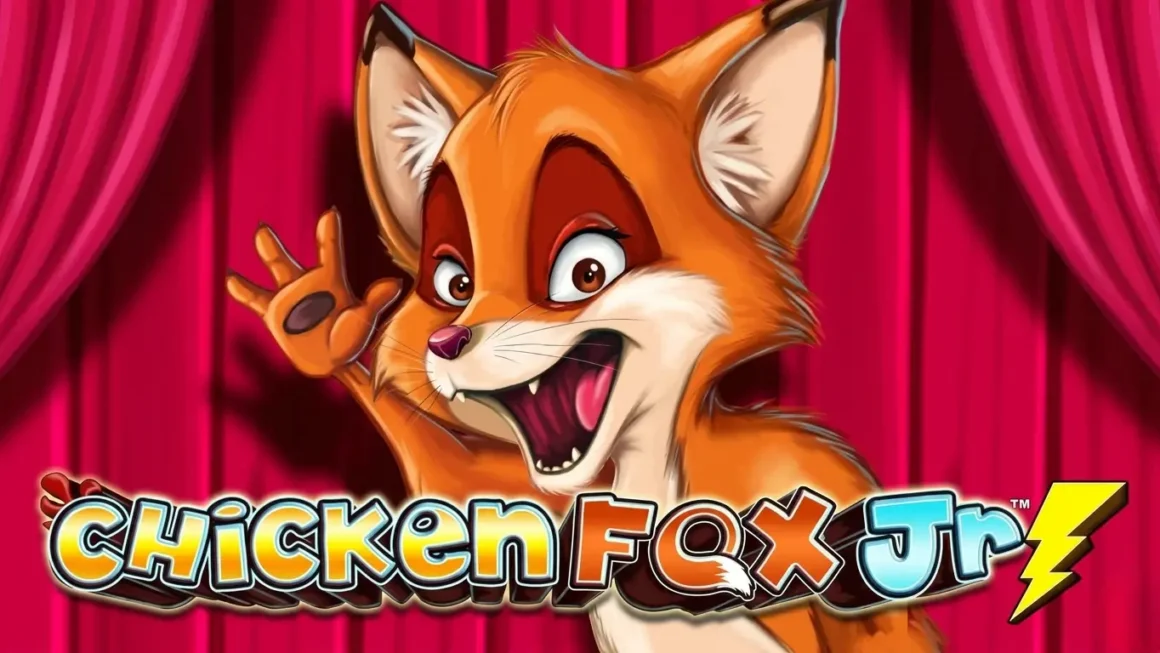
RTP: 95.5% | Volatility: Low | Max Win: 2,733x | Paylines: 20 | Bet Range: $0.20–$90
Let’s get something out of the way first. A fox sneaking into a henhouse is the oldest farmyard disaster story in the book — the chickens panic, feathers fly, and the farmer is left counting the damage. Lightning Box Games looked at that classic setup and decided to flip the whole thing on its head. In Chicken Fox Jr, the fox isn’t here for lunch. He’s here to steal the chickens’ cash prizes. And honestly? That’s a better story.
Launched in May 2022, Chicken Fox Jr is the prequel to Lightning Box’s earlier Chicken Fox — a high-volatility banger with a 13,500x max win that still has its fans. The Jr version takes the same barnyard cast, strips out the high-tension maths model, and rebuilds the whole thing around a much friendlier low-volatility engine. Different game, different audience, different purpose. Whether that trade-off works for you depends entirely on what you want from a spin session.
After logging real time on the reels in early 2026, here’s the full breakdown.
First Look: The Farm in All Its Cartoon Glory
Boot up Chicken Fox Jr and you’re immediately dropped into a chicken coop. Not a gritty, realistic farmyard — a cartoon version of one, the kind where all the animals have big round eyes and nothing bad can actually happen to them. The 5×3 grid sits in the middle of a cosy-looking barn interior, and everything is coloured in those warm, saturated tones that scream “animated children’s show” without actually going all the way there. One review described it as a game that “stays just the right side of being too cute,” which is accurate. The art direction knows where the line is and doesn’t cross it.
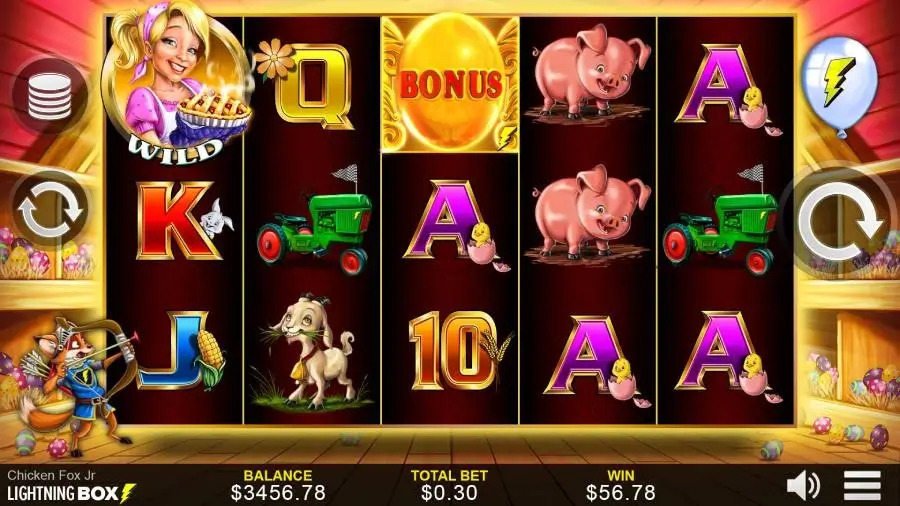
The symbols are what you’d expect from a farmyard theme done properly: low-paying playing card royals (10 through Ace) at the bottom of the ladder, then a progression through goats, pigs, tractors, and chickens on the way up to the top-tier payouts. The chicken symbols come in four distinct varieties — chick, chicken, hen, and fully-grown rooster — and they pay out in any combination. That means if you land two chicks, a hen, and two roosters on the same payline, it counts as five chicken symbols. It’s a small but welcome mechanical touch that makes the midrange of the paytable feel less rigid than it would be with single-symbol requirements.
The top-paying icon is the Wild: a cheerful woman holding a freshly baked cherry pie. She appears in the base game only, substitutes for any standard symbol to help build paylines, and is also the single biggest-paying symbol in the entire paytable. Five of her on a payline nets you 2,500x your stake. Four pays 500x, three pays 200x. She’s doing the heavy lifting at the top end of the base game paytable, which means the Lady with the pie is always a welcome guest on the reels.
The soundtrack is where Lightning Box earns a particular mention. A banjo-driven loop runs throughout every spin, peppered with occasional clucks, oinks, and other barnyard sound effects that really shouldn’t work as well as they do. Some slot soundtracks feel like they were attached to the game as an afterthought. This one feels commissioned for it. It’s goofy. It fits the screen perfectly. Turn it up, at least for the first session.
Lightning Box: Quick Studio Note
Lightning Box is an Australian developer — a fact that almost never gets mentioned in English-language reviews, despite being part of what makes the studio modestly interesting. They’re not a top-tier household name, but they’ve built a recognisable catalogue with consistent thematic identity. Jackaroo Jack, Stunt Stars, and both Chicken Fox titles share a visual language: cartoon-adjacent art, clear paytables, mechanics that are unusual enough to be worth explaining but not so complex that they need a tutorial. The original Chicken Fox remains their most played title in most markets. Jr is the more accessible companion piece, which is presumably what Lightning Box intended when they positioned it as a prequel.
The Numbers: What You’re Actually Working With
Before getting into the features, let’s talk maths — because the math model is where some players will decide this game isn’t for them.
RTP sits at 95.5%. That’s the published figure, and across the major review databases it holds steady between 95.50% and 95.53% depending on rounding. Industry average for online slots is typically closer to 96% or above at reputable operators, so Chicken Fox Jr is already starting with a slight handicap in the return column. Worth knowing before you commit a serious session to it.
Volatility is low. This is the most important number for understanding what playing the game actually feels like day-to-day. Low volatility means more frequent wins, shorter losing streaks, and smaller swings in your balance. You won’t be sitting through 200 dead spins waiting for the bonus to hit. You also won’t be walking away with a life-changing payout.
Max win is 2,733x your bet. For context: that’s a respectable number, but if you play at $1 per spin, the ceiling is $2,733. At $0.20, you’re looking at $546.60 as the absolute maximum. The original Chicken Fox goes up to 13,500x. That gap matters. If you’re chasing big-score potential, Jr is not your game.
Bet range runs from $0.20 to $90 across 20 always-active paylines. The minimum is accessible, the maximum is reasonable for mid-stakes players, and there’s no way to adjust the number of paylines — all 20 are always in play, which keeps things simple.
No Buy Bonus. No Progressive Jackpot. Two things that are increasingly expected in 2026 and both absent here. The game was built in 2022 before Buy Bonus became standard-issue, which explains it — but it’s still a gap worth flagging for players who like skipping straight to the good part.
Base Game: Keeping Things Alive Between Bonuses
Here’s the thing about low-volatility games: the base game experience carries more weight than it does in a high-vol slot, where you’re essentially just waiting for the bonus to arrive. In high-volatility titles, the base game is a fee you pay for the privilege of eventually hitting the feature. You endure it. In Chicken Fox Jr, the base game is genuinely decent — and the reason is the Lucky Fox Transform feature.
At random during any base game spin, the Fox Archer shows up uninvited. He pulls back his bow, takes aim at one of the low-paying card symbols on the reels, and fires. That symbol type — all copies of it currently showing — transforms into a higher-paying icon. So if you’ve got a reel full of Queen symbols that just missed every payline, the Fox can sweep in, upgrade the lot to goats or pigs, and suddenly you’ve got something working.
It doesn’t trigger constantly. It’s not the kind of mechanic that fires every five spins like clockwork. But it hits often enough to break the monotony of dead base game spins, and when it upgrades the right symbol at the right moment, it can genuinely flip a nothing spin into a solid win. The transformation isn’t arbitrary either — the Fox always targets card royals, always upgrades them to theme symbols, which means whenever the feature fires, you’ve removed some of the board’s weakest occupants and replaced them with something that can actually contribute to a payline. Low-volatility players will appreciate this more than they probably expect to — it’s the mechanic that stops the base game from feeling like a holding pattern between bonus triggers.
There’s also a sneaky edge case worth understanding properly. If you land exactly two Golden Egg scatter symbols — not three, which would normally trigger free spins — the Fox Archer gets a consolation assignment. He fires an arrow at a balloon on the right side of the screen. Hit it, and a third Golden Egg is revealed, and the free spins round triggers.
Think about what that means: a two-scatter near-miss is not a dead outcome in this game. It’s an active second chance. Most slot reviews mention the Balloon Bonus in passing, if at all. But understanding it changes how you experience those almost-there moments. Instead of watching two Golden Eggs land and feeling the immediate sting of a near-miss, you’re watching an arrow fly toward a balloon with a free spins trigger potentially riding on it. That’s a meaningfully different emotional experience, and it’s a small design decision that makes the base game feel slightly less cruel.
How often the Fox actually hits the balloon is not publicly disclosed — Lightning Box hasn’t published that probability. But it fires on a portion of two-scatter occurrences, and when it does, the payoff is full bonus entry from a spin that looked dead.
The Wild Situation
There are two types of Wild in Chicken Fox Jr, and they operate in completely different contexts.
In the base game: The Lady with the cherry pie is your Wild. She substitutes for any standard symbol to help build paylines, and she’s also the top-paying symbol in the paytable — 5x Lady = 2,500x your stake, 4x = 500x, 3x = 200x. Standard stuff, executed cleanly.
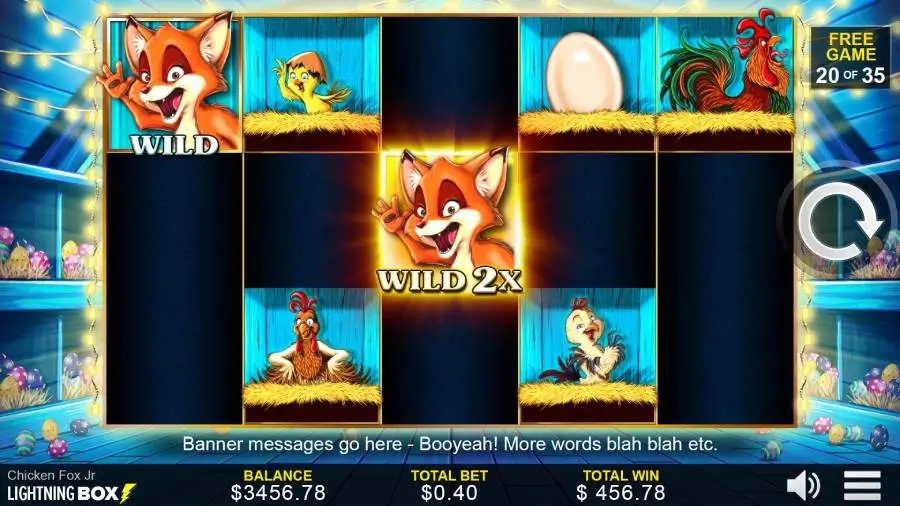
In the bonus round: The Lady steps aside and the Fox takes over. Two Fox variants appear: a standard Wild that substitutes normally, and a x2 Multiplier Wild that doubles wins when it contributes to a line. The mechanic here gets more interesting than it first appears, which we’ll get into in the bonus breakdown below.
Free Spins: Where the Actual Money Lives
Three or more Golden Egg scatters anywhere on the reels triggers the Chicken Catch free spins round. The trigger pays out:
- 3 scatters = 8 free spins
- 4 scatters = 15 free spins
- 5 scatters = 30 free spins
Retriggers are possible during the bonus — landing scatters again awards 8 more free spins on top of whatever you have remaining. In a good run with multiple retriggers, you can find yourself well into the 40–50 free spin territory, which is where the bonus starts feeling genuinely substantial.
The free spins play out on an alternate reel set. Here’s the key detail that separates Chicken Fox Jr’s bonus from a dozen generic “spin on a different grid” features: the standard reel symbols are mostly gone. What’s left is blanks, Chicken symbols, White Egg symbols, and Fox symbols. That’s the whole universe of the bonus round. Four symbol types, each with a specific job to do.
Every Chicken symbol on the bonus reels carries an attached cash prize. The smallest chickens — chicks — come with prizes of 20x or 40x per symbol. At the other end of the pecking order, Roosters carry prizes up to 900x. The intermediate chicken types (hens, regular chickens) sit between those values. When several Chickens land simultaneously, their individual prizes stack, and the total can build quickly across a board that’s dense with poultry. White Egg symbols aren’t there for decoration either — each one contains between 1 and 5 additional free spins, essentially acting as a fuel reserve that can extend a good run significantly.
But here’s the mechanic that makes or breaks each free spin: those prizes don’t pay out automatically just because a Chicken or Egg lands on the reels. They sit there, attached to their symbols, visible, waiting. Nothing is collected until a Fox arrives.
When a Fox symbol lands on the bonus reels, it sweeps up every Chicken cash prize currently visible on the board and every batch of additional spins contained in any Egg symbols in view. Everything in one motion. The Fox is the trigger, the Chickens and Eggs are the inventory, and the bonus round is essentially a game of “get the Fox and the Chickens on screen at the same time.”
That’s a legitimate mechanic with genuine strategic texture to it, even if the outcome is determined by RNG. A reel full of Roosters without a Fox is 900x per symbol sitting dormant and uncollected. A Fox landing on an empty board gives you a consolation prize — one additional free spin — which is Lightning Box acknowledging that an empty Fox appearance is genuinely frustrating and deserves compensation. A Fox landing into a dense field of Roosters and Eggs is the sequence that puts real numbers on the screen.
The x2 Multiplier Fox Wild adds another layer. When the x2 Fox appears and contributes to a collection, it doubles the haul — meaningful when multiple high-value Roosters are in view simultaneously, and the difference between a good bonus and a great one when it appears at the right moment.
For those wondering about the actual math ceiling: getting to 2,733x requires multiple Rooster-dense collections with Fox Wilds contributing multipliers, ideally across an extended retrigger chain. It’s rare, but it’s achievable through the mechanics as designed. The structure is coherent — the max win number isn’t arbitrary, it comes from the bonus mechanic actually functioning at its best across a favorable sequence.
Volatility in Practice: What Sessions Actually Feel Like
Low volatility gets described in clinical terms in most reviews — “more frequent wins,” “lower variance,” “suitable for recreational players.” Here’s what it actually means sitting at the reels.
You will not go 150 spins without a win. You will not lose half your balance in 10 minutes without hitting a single paying combination. The base game feeds you regular small-to-medium wins, the Lucky Fox Transform appears often enough to keep engagement up, and the free spins round triggers at a frequency that feels reasonable rather than punishing. During a 200-spin session, you’ll likely see the bonus multiple times. Whether those bonuses pay anything meaningful is still RNG-dependent, but you’ll see them.
What you won’t get: a 500-spin session where the bonus hits once but pays 800x your stake and puts you firmly ahead. That’s a high-vol experience. In Chicken Fox Jr, sessions tend to be flatter — more consistent, less dramatic. Bankroll erosion during a cold run is slower than it would be on a medium or high-vol game at the same stake. The downside is that the ceiling on any individual spin or bonus round is hard-capped at 2,733x, and getting anywhere near that requires a particular alignment of the Fox and Rooster symbols in the bonus that isn’t going to happen every session.
This makes Chicken Fox Jr genuinely well-suited to a specific use case: playing with a fixed session budget and wanting that budget to last while still having something happening on screen. If you sit down with 50 units and want to still be spinning 45 minutes later, low volatility is your friend. If you sit down with 50 units hoping to turn them into 500, you need a different game.
The low volatility also means Chicken Fox Jr is a reasonable choice for players newer to the hobby who are still working out what kind of slot experience they actually enjoy. Throwing a first-timer into a 200-spin high-vol drought and watching them rage-quit the entire genre is a bad outcome for everyone. A game that pays something back regularly while the mechanics are still being understood is a better teaching tool. That’s not an insult to Chicken Fox Jr — it’s one of the legitimate use cases for this volatility tier.
For the bankroll mathematicians in the audience: playing at minimum stake ($0.20) with a session budget of $20 gives you 100 buy-ins. On a low-vol game with a reasonable hit frequency, that’s a long session. Playing at $1 stake with a $20 budget gives you 20 buy-ins — significantly tighter, but the wins when they come are more meaningful in absolute terms. The volatility tier doesn’t change the house edge, but it does change the shape of how that edge manifests across a session.
Mobile: No Complaints
Built on HTML5, Chicken Fox Jr runs on everything. The cartoon art style was practically designed for touchscreens — large symbols, clear colour differentiation, no tiny text you need to squint at. The bonus round is tactile enough that it doesn’t feel diminished on a phone screen.
The UI is clean: coin button to set your bet, spin button to go, autoplay in the menu for those who want to set it and leave it. The sound toggle is easy to find, which matters more than people admit since banjo music, however charming, is not always appropriate for a lunch break spin session.
How Jr Compares to the Original Chicken Fox
Since Lightning Box explicitly positions Chicken Fox Jr as a prequel, the comparison is unavoidable.
| Chicken Fox Jr | Chicken Fox (Original) | |
|---|---|---|
| RTP | ~95.5% | ~95.5% |
| Volatility | Low | High |
| Max Win | 2,733x | 13,500x |
| Paylines | 20 | 25 |
| Release | 2022 | Earlier |
The RTPs are essentially identical. Everything else is a different game. The original is a high-tension, bigger-potential, longer-losing-streak experience. Jr is the approachable younger sibling who doesn’t give you heart palpitations but also doesn’t make you rich.
Neither is objectively better. They’re built for different situations and different player types. If you’ve played the original and loved the tension, Jr might feel a bit tame. If you’ve played the original and found the variance frustrating, Jr is the fix.
The Honest Verdict
What works: The Lucky Fox Transform keeps the base game from being a dead-spin grind — it’s genuinely the best thing about the first 50 spins of any session, and it does the mechanical job of bridging the gap between wins in a way that feels active rather than passive. The Chicken Catch bonus has real mechanical depth: it’s not just “spin on a different reel set and hope,” it’s a collection system where the interaction between Fox, Chicken, and Egg symbols creates a coherent cause-and-effect structure. The art and audio are coherent, charming, and don’t wear out their welcome. The Balloon Bonus second-chance mechanic on two-scatter near-misses is a small but meaningful quality-of-life feature that a surprising number of competitors never bother implementing.
What doesn’t work: The RTP at 95.5% is below where it should be in 2026. There are low-volatility alternatives running at 96% or above, and the difference compounds across any serious volume of play. If you’re playing for leisure and relatively short sessions, the gap won’t register. If you’re playing regularly or at meaningful stake, you’ll feel it over time. The max win at 2,733x is honest and achievable within the game’s mechanics, but it’s modest — particularly when the original Chicken Fox sits at 13,500x with comparable RTP. The absence of a Buy Bonus is an increasingly significant drawback as the feature becomes industry standard; players who prefer direct bonus access have to earn it through base game play here, which at low volatility means more base game time before getting to the part most players came for. The feature set, while executed cleanly, is thin — one bonus mechanic with a base game random feature attached doesn’t give you much variety over an extended session.
The RTP conversation specifically: 95.5% is the published figure. What this review cannot confirm — and what almost no competitor review addresses — is whether individual operators configure a different RTP variant. Some Lightning Box games support multiple RTP configurations, which means the game you play at Casino A might not return at the same theoretical rate as the same game at Casino B. If you care about this, check the game info panel at your specific casino, which should display the RTP in use. If it doesn’t, that’s worth knowing about the operator.
Bottom line: Chicken Fox Jr is a well-constructed low-volatility slot with a bonus mechanic that’s genuinely more interesting than the cute art style would lead you to expect. It’s not a max-win hunting vehicle, it’s not a high-tension session game, and it’s not going to replace the original Chicken Fox in the affections of players who came specifically for big-number potential. What it is: a consistent, pleasant, mechanically sound game that does its job without cutting corners on the features it does have. For the right player in the right context, that’s enough.