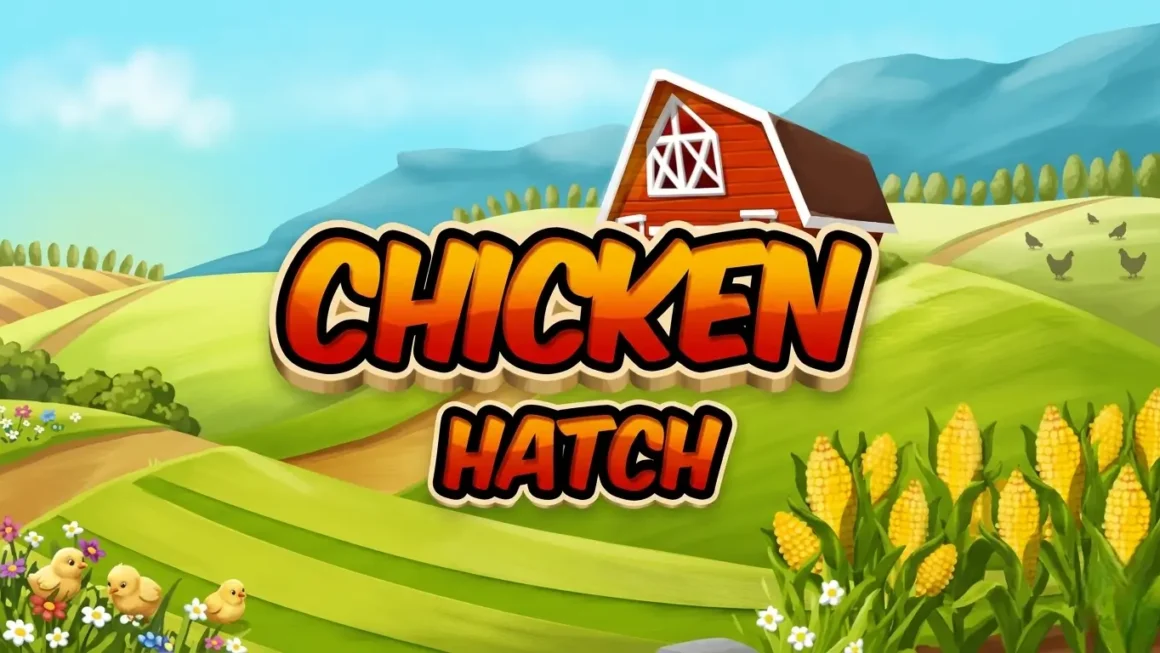
There’s a question older than online gambling, older than Las Vegas, arguably older than money itself: which came first, the chicken or the egg? Capecod Gaming decided not to answer it. Instead, they built a slot around it, handed you a cannon, and told you to figure it out yourself.
Chicken Hatch is a farmyard-themed video slot from Capecod, an Italian studio that most players outside of Italy probably haven’t heard of — and that’s actually part of the story. This is not a Pragmatic Play title with a hundred clones and a marketing budget the size of a small nation. It’s a quieter, more personality-driven release from a developer that’s been operating since 1987, long before “gamification” was a word that grown adults said in meetings with straight faces.
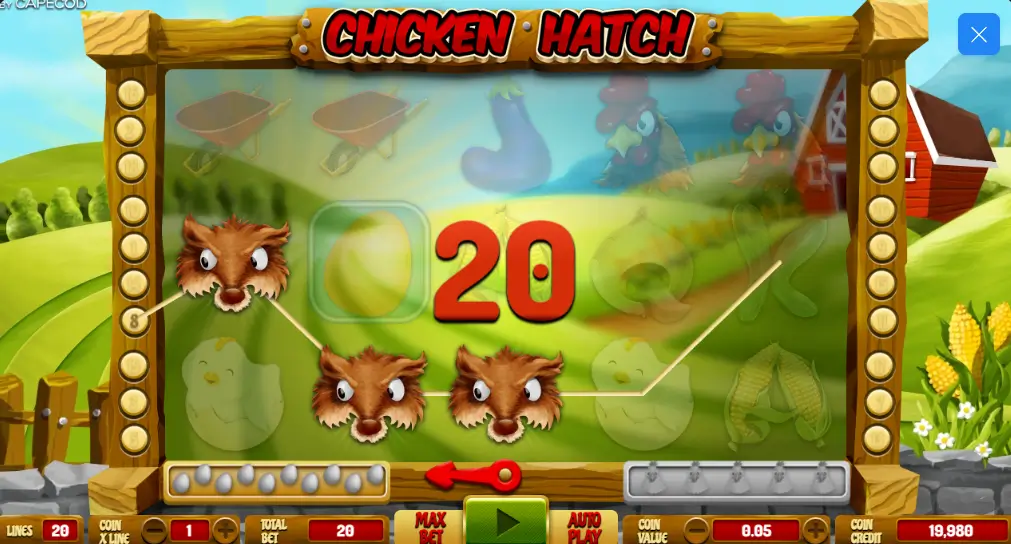
The game runs on a standard 5×3 grid with 20 fixed paylines, medium volatility, and a trio of bonus features that, taken together, make Chicken Hatch more mechanically interesting than its cheerful barnyard exterior suggests. Whether that’s enough to make it worth your time in 2026 is what we’re here to find out.
Who Made This Game? A Quick Word on Capecod Gaming
Before getting into the reels, it’s worth knowing who you’re dealing with, because Capecod is one of those providers that gets one-line treatment in most reviews (“a reputable Italian studio”) and then nothing else. They deserve slightly more than that.
Capecod was founded in 1987 in Castel Bolognese — a town in the Emilia-Romagna region of Italy, which is essentially the part of Italy where good things come from: Lamborghini, Ducati, Parmigiano-Reggiano, and now, apparently, slot machines about chickens. The company ran as a software house for decades before pivoting into casino game development, launching its iGaming Platform in 2008 and then its own original slot titles in 2013.
In 2017, Novomatic acquired them. Later, Greentube — Novomatic’s interactive division — completed a full takeover, partly with the stated goal of pushing Capecod’s content beyond the Italian market, where the studio had been heavily concentrated. As of 2026, the distribution is still weighted toward Italy, but you’ll find their games at LeoVegas, NordicBet, Unibet, and Videoslots, among others.
Their tagline is “100% Made in Italy,” which they say with the same quiet pride that Italian chefs reserve for fresh pasta. The portfolio now sits at 130+ titles across multiple currencies and languages. Most games run on HTML5, play fine on mobile, and tend to land in the medium-volatility zone with interactive bonus structures.
One consistent criticism: Capecod are not particularly forthcoming about max-win figures and volatility disclosures. You often have to piece that information together from third-party sources. Keep that in mind.
First Look: The Farm That Doesn’t Take Itself Seriously
Load up Chicken Hatch and the vibe is immediately clear. This is a cartoon farm where nobody is stressed about harvest yields or agricultural commodity prices. The reels sit inside a wooden frame — a nice rustic touch — against a backdrop of rolling green hills, a big blue sky, and a classic red barn that looks like it was painted by someone who had only ever seen barns in children’s books.
The color palette is warm and saturated. Greens are very green. Blues are very blue. The whole thing looks like someone turned the brightness up to about 110% and decided that was fine, actually. For the theme, it works.
The symbol animations deserve credit. When you land a winning combination, the symbols don’t just sit there — they move. The rooster crows. The fox looks shifty. The baby chick does whatever baby chicks do when they’re animated. It’s not technically demanding stuff, but the internal consistency of the art is genuinely good. Every element looks like it belongs to the same world, which sounds like a low bar but is something a surprising number of slots fail to clear.
Audio is farmyard folk music — cheerful, looping, the kind of thing you’d hear at a county fair or a particularly wholesome mobile game. It’s pleasant for the first few sessions. After a few hours of it, you might find yourself reaching for the mute button. That’s not a Chicken Hatch-specific problem; that’s just what loop-based slot audio does.
The Symbols: Who’s Who on the Farm
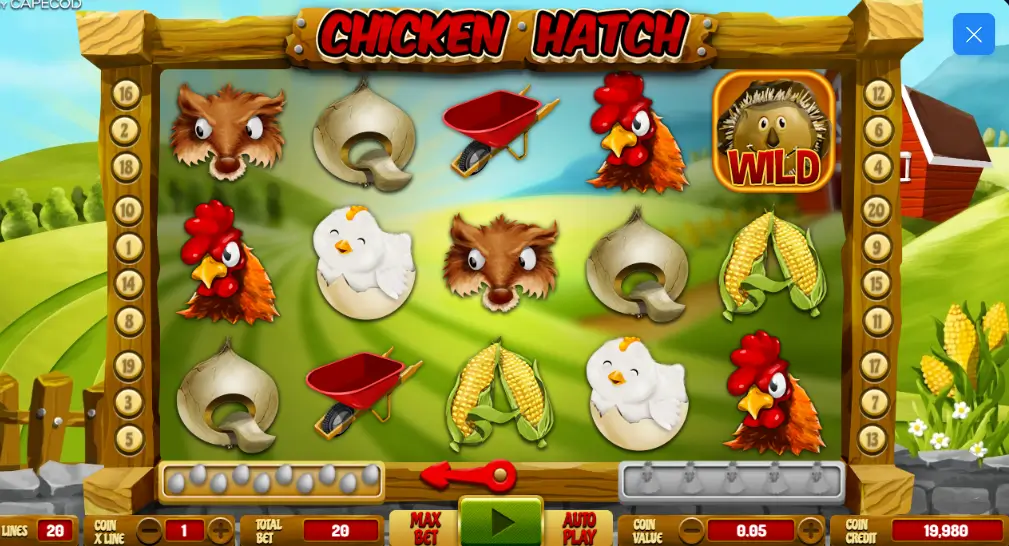
Starting with the premium end of the paytable: the Hedgehog is the wild symbol, substituting for all standard symbols. Five Hedgehogs in a line pays 4,000 coins — the top return in the base game. If you’re wondering what a hedgehog is doing on a farm themed around chickens and eggs, you’re asking better questions than the game’s design brief apparently did. He’s there. He’s wild. We accept him.
The Rooster sits just below the wild as the most valuable non-wild symbol, paying 1,000× your line bet for five in a row. Below the Rooster, you’ve got the Fox (a classic villain in this genre), the Wheelbarrow, the Mother Hen, and the Baby Chick rounding out the premium symbols.
The low-value symbols take a slightly different approach to the usual J-Q-K-A playing card lineup. Instead of card faces, Capecod went with farmyard produce: sweetcorn, garlic, courgette, aubergine, and onion. It’s a coherent choice — the vegetables contribute to the farm aesthetic instead of breaking it — and the art on these is good enough that you don’t mind seeing them.
The special symbol is the Magic Egg, which acts as the scatter and triggers the Magicspins free spins feature when three or more land anywhere on the reels.
One note on the wild situation, because multiple reviews get this wrong: a few sources name the Baby Chick as the wild symbol while others credit the Hedgehog. Based on the most reliable sources — GamblersPick and VegasSlotsOnline among them — the Hedgehog is the base-game wild. The Baby Chick appears prominently in the bonus rounds. They’re different symbols doing different jobs. Conflating them is a common error in English-language coverage of this game.
The Bet Range: This Is Not a High Roller’s Machine
Let’s talk numbers before we get to the features, because the bet range tells you a lot about what kind of game this is and who it’s built for.
Bets run from 0.01 to 0.50 per payline. With 20 fixed lines, that puts your per-spin range at 0.20 to 10.00. The minimum stake is low enough to be genuinely accessible for budget play. The maximum stake of 10.00 per spin, however, is quite modest by the standards of most slots released in the last few years, where 100.00 per spin or higher has become fairly standard for anything targeting mid-to-high-volume players.
This isn’t a criticism of the game’s quality — it’s simply an accurate description of its target audience. Chicken Hatch is designed for casual to mid-range play. If you’re the kind of player who sits down with a comfortable stake and wants to spin for a while without burning through your bankroll in twelve minutes, the bet structure suits you. If you’re looking for a slot that lets you put meaningful money through in pursuit of large multipliers, this probably isn’t the one.
The autoplay function is present, which is useful for lower-stakes players who want to set a session and step back.
The Dual-Meter System: The Part Most Reviews Skip Over
Here’s where Chicken Hatch actually earns its keep as a distinct game, and where most existing reviews fail to do it justice.
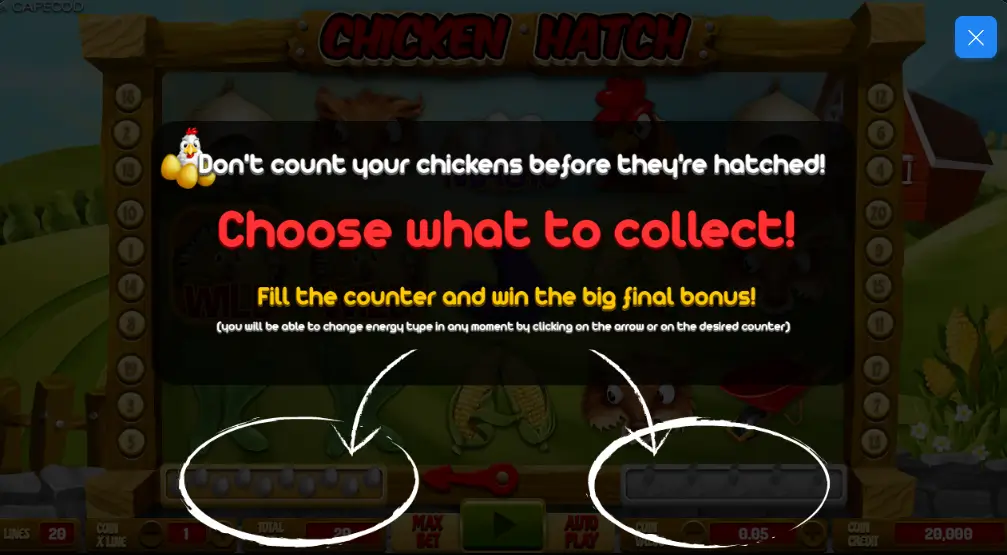
Before your session begins — or at the point where you’re ready to engage the bonus system — you choose between two meters: the Egg Meter and the Hen Meter. This is an active choice on the player’s part, not something that happens automatically. The meter you select determines which bonus symbols accumulate as you spin through the base game, and consequently, which of the two bonus games you’ll trigger when the meter fills.
Choose the Egg Meter, and you’ll be collecting egg symbols during play. Fill it up, and you get the Bonus Eggs game. Choose the Hen Meter, and you collect hen symbols instead, building toward the Bonus Hens game.
This is a genuinely interesting mechanic because it gives players a sense of agency — even if the underlying outcomes are still random, the decision about which path to pursue feels deliberate. It’s a light strategic layer that most slots of this format simply don’t have.
The fact that nearly every English-language review of Chicken Hatch describes the two bonus games without properly explaining that the dual-meter selection happens first is, frankly, a gap in the existing coverage. The meter system is the game’s actual structural differentiator. A player who doesn’t understand that upfront misses the whole point.
Bonus Feature 1: Bonus Eggs
Trigger the Egg Meter and you’ll find yourself in the Bonus Eggs round, which is the more visually dramatic of the two pick-em games.
Five eggs are loaded into a cannon and launched one by one. Each egg can land in one of two ways. Either it survives the journey and hatches into a chick, earning you a random cash prize, or it hits the ground as raw yolk and contributes nothing but disappointment.
The structure plays out like a cross between a pick-em game and a shooting gallery. You don’t control the cannon — the outcomes are determined by the RNG — but the presentation gives the round genuine momentum. Each launch has a result, and you’re watching the scoreboard fill up or fail to fill up in real time.
How much you walk away with depends entirely on which eggs hatch. The prizes for successful hatches are random within a range, so variance within the bonus is part of the experience. If all five eggs crack open successfully, the round is a good one. If three of the five splat, less so.
What makes this more engaging than a standard pick-em is the sequential reveal structure. You’re not selecting from a static grid — you’re watching each result play out before the next one launches. That pacing gives you something to react to, something to root for, rather than clicking five boxes and getting a total slapped on screen. It’s a small design decision that makes a noticeable difference in how the round actually feels from the player’s side. Whether you’re up or down at the end of five launches, you were genuinely along for the ride. That counts for more than it might seem.
Bonus Feature 2: Bonus Hens
Fill the Hen Meter instead and you get the Bonus Hens round, which is a more traditional pick-em format.
A row of hens is presented to you, each sitting on a nest. You pick hens one at a time, and each selection reveals either a golden egg — meaning a cash prize — or an empty nest, which ends the round.
It’s simpler than the Bonus Eggs experience, structurally speaking. The drama comes from the reveal moment rather than from a multi-stage launch sequence. Players who prefer a clean, decisive pick-em will probably prefer this one. Players who want more spectacle will likely lean toward the Egg Meter.
The Bonus Hens round works well precisely because it doesn’t overcomplicate itself. You’re picking hens, you’re hoping for golden eggs, and the farm aesthetic carries the moment. It’s not trying to reinvent the pick-em genre — it’s executing a familiar structure with enough visual personality that the repetition doesn’t feel stale. The hens animate, the golden egg reveal has a satisfying little beat to it, and the whole thing resolves quickly without overstaying its welcome.
Neither bonus game has a disclosed cap on what it can pay out, which is consistent with Capecod’s generally limited approach to publishing max-win data. The prizes are random within what the game’s math allows, and the game doesn’t tell you exactly what that ceiling is. That’s a transparency gap worth flagging. Other providers have moved toward publishing clear max-win figures on their game pages; Capecod hasn’t fully followed suit, and players looking for that kind of upfront disclosure won’t find it here.
Bonus Feature 3: Magicspins (Free Spins)
Land three or more Magic Egg scatters anywhere on the reels and you’ll trigger the Magicspins bonus — the game’s free spins feature.
Three scatters get you 3 free spins. Four get you 4. Five get you 5. The maximum multiplier during the free spins is 3×.
There’s no easy way to say this, so let’s just say it: this is a weak free spins feature by the standards of any year, but particularly by 2026 standards. Three free spins is a very short run. Even five free spins — the maximum — is on the low end for a free spins round in a modern slot. The 3× multiplier cap doesn’t move the needle much either.
Virtually no existing English-language review of Chicken Hatch calls this out directly. Most either describe the feature neutrally or fold it into a list of “exciting” bonus elements without noting the discrepancy between what’s on offer and what players have come to expect from free spins rounds. The Magicspins feature is not a reason to load up Chicken Hatch. The two pick-em bonus games are.
RTP and Volatility: Read This Part Twice
The RTP figure for Chicken Hatch is where things get interesting, and where you’ll find a meaningful gap between what most reviews state and what’s actually happening.
The default RTP is 95.12%, which is what you’ll see cited on SlotCatalog and most aggregator sites. Some sources put it marginally higher at 95.18% — a rounding or sourcing discrepancy small enough not to matter in practice.
However, at least one UK-oriented site (LadyLucks) lists the RTP for Chicken Hatch at 98.06%. That’s not a typo or an error on LadyLucks’ part — it almost certainly reflects an operator-configured RTP variant. Many slot games are built with multiple RTP settings, and the version that gets deployed on any given platform depends on what the operator has selected. A player at a casino running the 95.12% configuration and a player at a casino running the 98.06% configuration are playing what looks like the same game but with meaningfully different long-run return profiles.
The practical takeaway is this: check which version is running at whatever casino you’re actually using. The game information panel or help screen in the live game should state the configured RTP. If it doesn’t, that’s your first red flag about the casino’s transparency, not the game’s.
As for the industry context: 95.12% is below the current market average of roughly 96% that most mainstream slots hit. That’s not a dealbreaker for the right type of player — medium volatility, frequent small wins, plenty of base-game activity — but it’s worth knowing before you sit down.
The volatility is confirmed as medium across multiple independent sources. In practice, this means the game delivers small-to-mid wins at a reasonable frequency without going long cold stretches. For a low-to-mid-stakes player who wants a game that responds, medium volatility is often the sweet spot. Chicken Hatch is built for the kind of person who spins at 0.20–2.00 per round and wants to be entertained for an hour without watching their balance crater in fifteen minutes.
Mobile Performance
HTML5 build, solid performance on mobile. Capecod has made mobile optimization a core part of their recent development approach — their “vertical revolution” product line is specifically designed for portrait mode on smartphones, and the broader portfolio benefits from the same technical focus.
Chicken Hatch doesn’t have any features that create problems on smaller screens. The grid is clean, the buttons are readable, the bonus games present without layout issues. The cannon mechanic in the Bonus Eggs round translates well — each launch reads clearly on a phone screen, and the pick-em structure of the Bonus Hens round doesn’t require precision tapping to navigate. If you’re a mobile-first player, this isn’t a game where you’ll be squinting at UI elements or accidentally hitting the wrong button.
No download required. No registration needed to try the demo at most sites that carry it. Load times are short, performance doesn’t stutter, and the animation quality holds on both mid-range and higher-end devices.
One practical consideration worth mentioning: because Capecod’s international distribution remains narrower than the big studios, this game may simply not be in your casino’s mobile lobby. Before you spend time trying to find it, check whether your platform actually carries Capecod titles. A quick search within the game provider filter of your casino app will tell you immediately.
What’s Actually Good About Chicken Hatch
Let’s give it its credit. The dual-meter system — the core mechanic that lets you pick your bonus path before spinning — is a genuinely smart design. It creates investment in the session. You’re not just spinning and waiting for something to happen to you; you’re building toward a specific outcome that you chose. That engagement structure holds up well, and it’s more sophisticated than most games of this size and scope.
The art direction is coherent and well-executed. It doesn’t look like a slot built by committee in three weeks. The farm theme has personality. The animations work. The hedgehog wild landing mid-spin genuinely feels like a small event rather than just another symbol doing a thing.
Three distinct bonus features is meaningful variety for a game at this bet scale. You get pick-em action, you get a cannon mini-game, and there’s a free spins round available as a third path. The fact that the free spins feature is modest doesn’t negate the variety.
For players who aren’t chasing thousand-times-stake multipliers, Chicken Hatch delivers a relaxed session with consistent activity. It’s a game that respects your time at lower stakes.
What’s Actually Weak About Chicken Hatch
The free spins feature. Three to five spins at a 3× multiplier maximum is a thin offering. If the Magicspins trigger is the highlight of a session, that session wasn’t particularly rewarding. The game’s strength is in the two pick-em bonus modes, and the free spins round feels like it was added to complete a checklist rather than because the design called for it.
The RTP at its default configuration — 95.12% — is a below-average figure in 2026. The market has moved, and players now routinely have access to slots in the 96–97% range. For extended sessions, that percentage gap is felt.
The bet ceiling of 10.00 per spin is a genuine limitation for anyone who wants to do meaningful volume at higher stakes. It’s not a flaw for the intended audience, but it does narrow the game’s appeal.
Capecod’s limited international distribution means you may simply not be able to find this game at your preferred casino. That’s a practical problem that has nothing to do with the game’s quality, but it’s real. If you’re not at a Novomatic-adjacent platform or a Capecod distribution partner, Chicken Hatch might not be in your lobby at all.
And the music will, eventually, become background noise you no longer consciously hear — the audio equivalent of the slot’s personality disappearing into routine. Mute button exists for a reason.
Quick-Reference Specs
Provider: Capecod Gaming (Greentube / Novomatic Group) Grid: 5×3 Paylines: 20 fixed Volatility: Medium Default RTP: 95.12% (operator-configured variants exist, including 98.06% at some casinos) Bet range: 0.20–10.00 per spin (0.01–0.50 per line) Wild symbol: Hedgehog (base game) Scatter symbol: Magic Egg Top base-game payout: 1,000× line bet (Rooster) Top wild payout: 4,000 coins (5× Hedgehog) Bonus features: Bonus Eggs, Bonus Hens, Magicspins (free spins) Free spins: 3–5 spins, 3× maximum multiplier Progressive jackpot: No Autoplay: Yes Technology: HTML5, mobile-compatible
Verdict
Chicken Hatch is not the kind of game you load up because it’s going to make you rich. It’s the kind of game you load up because you want to spend some time on a cartoon farm, pick your bonus path, watch some eggs get fired from a cannon, and walk away having had a better time than the RTP number on paper suggests you should have.
The dual-meter mechanic is the game’s real selling point, and most reviews don’t explain it properly. That choice you make before the bonus triggers — Egg Meter or Hen Meter — is the closest thing to actual strategy this slot offers, and it creates a session structure that feels more engaging than a passive spin-and-wait format.
The weaknesses are real. The free spins feature is thin, the default RTP sits below market average, and the bet cap rules out high-stakes play entirely. If any of those factors are important to you, there are better options in 2026. But if you’re a mid-stakes casual player looking for an interactive farmyard slot with three distinct bonus modes and some genuine charm — and if your casino happens to carry it — Chicken Hatch earns a spin.
Just maybe mute it after the first hour.