Lucky Rooster has been sitting in casino lobbies since late 2018 — nearly eight years at the time of writing. That alone raises a question worth answering before anything else: does it still earn its place, or is it coasting on a flock of Asian-themed nostalgia while more competitive games eat its lunch?
The numbers that frame that question: 95% RTP, low volatility, and a maximum win cited by most sources at 4,000 credits via the Scatter Bucks feature. No sequel. No Power Reels variant. No buy-bonus option. In a 2026 lobby where PG Soft’s Fortune Ox runs at 96.75% RTP and Habanero’s Bounding Luck offers 5,440× max wins at high volatility, those numbers need a closer look before you commit a meaningful session to them.
This review works through the math model, the two features that carry all the weight, and a direct comparison with what the Chinese New Year slot category looks like in 2026. The conclusion is specific — not “it depends.”
The math model and what it means at the table
RTP: one figure, no variants
Every major source — SlotCatalog, Casino Guru, VegasSlotsonline — cites the same 95% RTP for Lucky Rooster. Unusually, no operator-configurable range has been documented for this title, which stands in contrast to games from providers like Pragmatic Play or NetEnt where operators routinely choose between 94%, 96%, and 96.5% configurations.
What that means practically: at 95%, the house edge is 5%. Over a theoretical 1,000 spins at £1 per spin, that’s an expected £50 in house profit. Compare that to Fortune Ox by PG Soft (96.75% RTP) — the same session produces an expected £32.50 in house profit. The gap is £17.50 per £1,000 wagered. That’s not catastrophic over a short recreational session, but it’s a real and sustained disadvantage over any extended play.
There’s a further compounding issue. High 5 Games has not published a buy-bonus option for Lucky Rooster, which means every session requires working through base game to reach the free games. At 95% RTP, those base game spins are the most expensive part of the session. Competitors that offer buy-bonus (paying a fixed multiple of stake to enter the feature directly) let players skip the baseline grinding at whatever RTP applies to base game spins. Lucky Rooster has no such shortcut — you earn the feature the old-fashioned way, on the clock, at 95%.
One note on sourcing: two review sites reference the “average payouts” of the game at 2×–200× without independently verifying this against the pay table. The pay table figures I could confirm from multiple sources: lucky cat (highest symbol) pays 200 credits for five-of-a-kind, gold ingot pays 150 credits, gold coin pays 120 credits, with card symbols paying between 2× and 30×. The 200× figure refers to the maximum regular symbol payout at a bet of 1 credit per way — not a standalone multiplier applied to total stake.
Volatility: low, and genuinely low
High 5 Games does not publish volatility data publicly for Lucky Rooster. The consensus among reviewers who have played it extensively is low variance. That assessment holds up when you look at the mechanics: a 1,024-betway grid means winning combinations form frequently by construction. The wild symbol carries attached Scatter Bucks values (more on this below), which adds small cash injections on most spins where it lands. The result is a steady, shallow session rhythm — modest wins arriving at a reasonable clip, with the big theoretical ceiling sitting well above what you’ll realistically hit on any given day.
This matters for bankroll management. Low volatility at 95% RTP means the math will grind you gently but persistently. You won’t lose your stack in 20 spins — but you won’t be running it up to anything dramatic either, unless the Scatter Bucks align unusually well during the free games.
Grid and betway logic
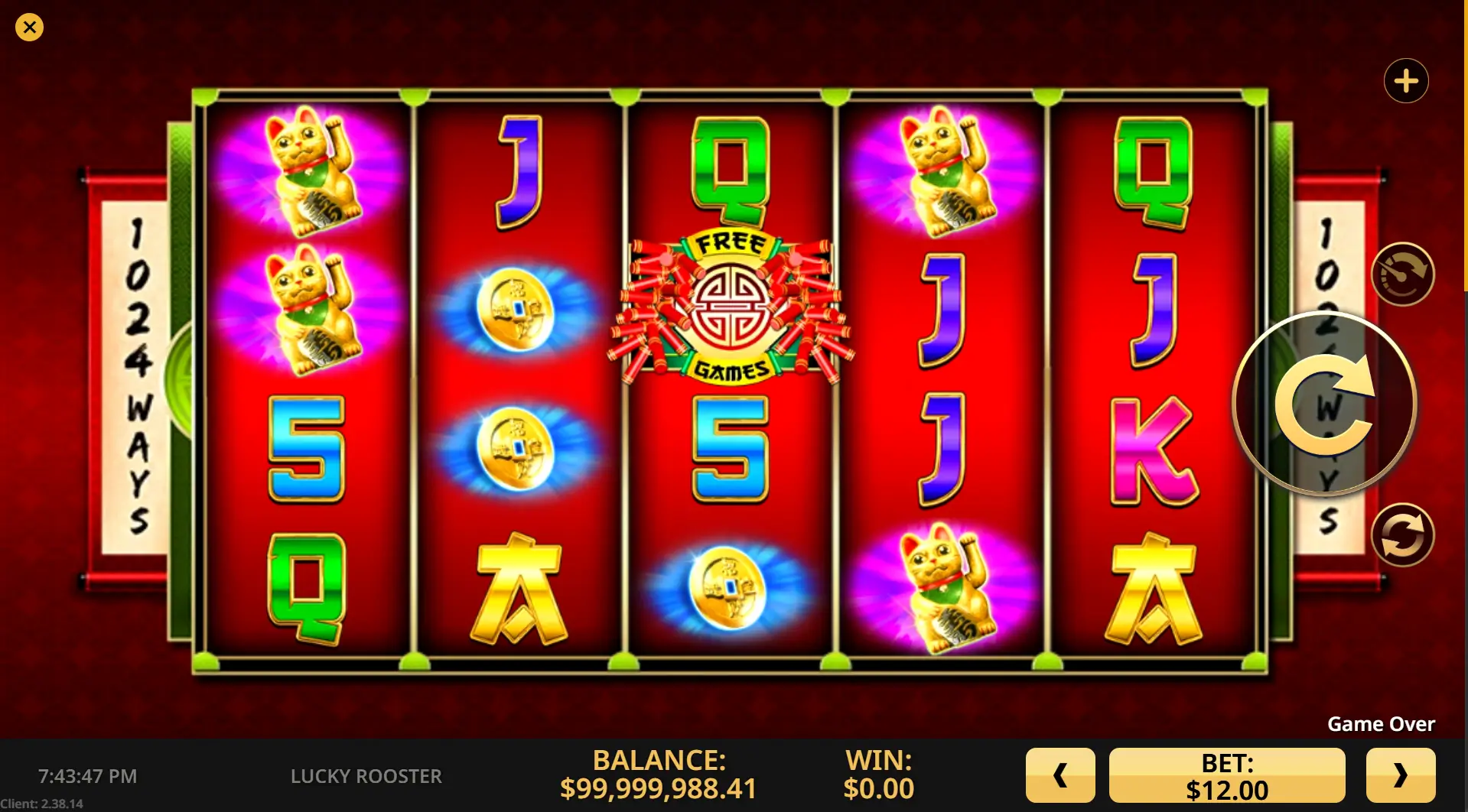
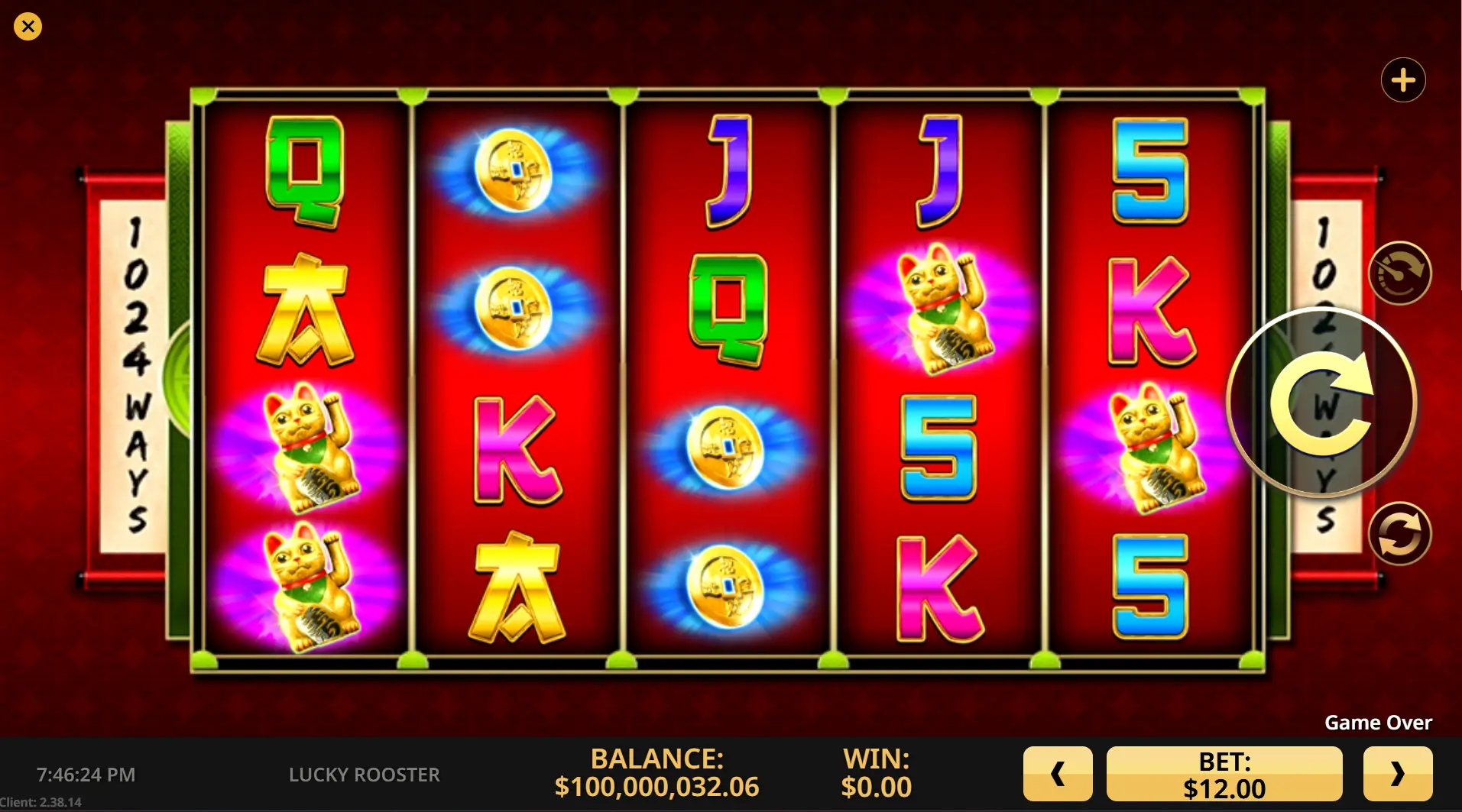
Five reels, four rows, 1,024 ways to win. No traditional paylines — wins form when matching symbols land on adjacent reels from left to right, in any position on those reels. This is left-to-right only; no bidirectional evaluation, no Pay Anywhere mechanic. Three or more matching symbols on consecutive reels from reel 1 constitutes a win.
The bet range is where the sourcing gets messy. PlayUSA and VegasSlotsonline cite a minimum of $0.80 (which corresponds to 1 credit per betway at the minimum denomination) up to $2,000 per spin. Onlinecasinos.com and SlotCatalog cite a $5,000 maximum. Both sets of figures have appeared in multiple independent reviews without resolution. The discrepancy likely reflects different market configurations or currency denomination settings. If you’re playing at a US-licensed operator, the $2,000 maximum is the more commonly reported figure — confirm in the game’s own paytable before high-roller sessions.
Max win: what 4,000 credits actually means
The headline max win is 4,000 credits via the Scatter Bucks feature. At the minimum bet of $0.80 (80 credits), a single 4,000-credit award equals 50× your stake. At $1 per spin (100 credits), it’s 40×. The theoretical ceiling often cited loosely as “4,000×” is therefore a credit figure, not a stake multiplier.
The actual max win in stake multipliers depends on four roosters each landing with a 4,000-credit Scatter Bucks award simultaneously. PlayUSA calculates this as 200× total bet on top of any payline wins. A full screen of lucky cats at all 1,024 ways would theoretically pay 2,560× total bet — but that requires every position across all five reels to show the same symbol, which is mathematically remote.
In practice, 4,000× stake is not achievable from this game. The realistic ceiling on a strong bonus session is more like 100×–300× stake. That matters. In 2026, 4,000× max win as a stake multiplier would already be considered below par. As a credits figure that translates to 50×–200× stake depending on your bet, it’s a genuinely modest ceiling.
Feature breakdown
Scatter Bucks: the engine that runs everything
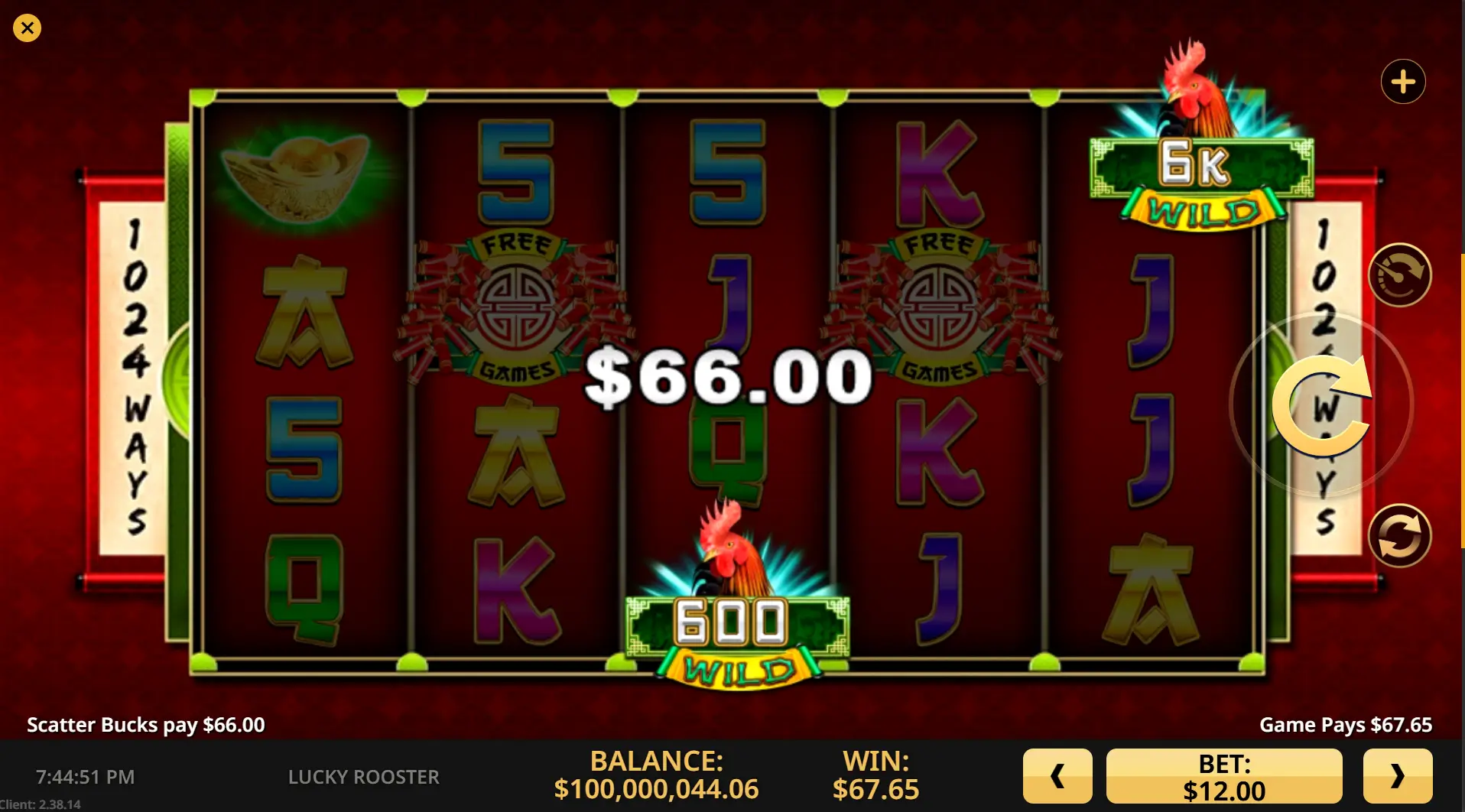
Trigger: The rooster wild symbol, which appears on reels 2, 3, and 4 in the base game (reels 2, 3, and 4 during free games — one review states reels 2–5 in the base game, but multiple independent sources place the base game wild on reels 2, 3, and 4 only; treat the reel 5 wild claim with caution until confirmed in-game).
Mechanic: Every rooster wild that lands on the reels arrives with an attached credit value. In the base game, this credit value ranges from 40 to 4,000 credits. During free games, the floor rises to 80 credits, with the same 4,000-credit ceiling. All credit values from roosters visible on the reels at the end of a spin are summed and paid in addition to any standard payline wins.
Multiplier range: There are no multipliers in the traditional sense. The Scatter Bucks award is a fixed credit amount attached to each wild, not a multiplier applied to a base win. This distinction matters: you cannot multiply a large payline win through Scatter Bucks. The two pay independently.
Maximum activation: Multiple roosters can land on a single spin — theoretically three in the base game (one on each of reels 2, 3, and 4). If three roosters each land with 4,000-credit awards simultaneously, the combined Scatter Bucks payout is 12,000 credits before payline wins are added.
Honest limitation: The Scatter Bucks range of 40–4,000 credits has no documented weighting data. From play observations reported by reviewers, the lower end of that range (sub-100 credits) appears far more frequently than the ceiling. The 4,000-credit award functions more as a jackpot moment than a regular contributor to session value. In extended sessions, a realistic expectation is Scatter Bucks delivering 0.5×–5× stake per trigger, with the occasional spike into the 20×–50× range.
There is also an important mechanical subtlety that several reviews gloss over. The Scatter Bucks credit values are fixed amounts (40 to 4,000 credits), not amounts scaled to your bet. At the minimum bet of $0.80 (80 credits per spin), a 100-credit Scatter Bucks win equals 1.25× your stake. At a $5 spin (500 credits), that same 100-credit award is worth only 0.2× your stake. This means the Scatter Bucks feature is mathematically most rewarding at the minimum bet — the fixed credit payouts represent a higher stake multiple at low bets than at high ones. For high rollers spinning at $50+ per round, the Scatter Bucks awards become largely cosmetic unless the 4,000-credit ceiling hits. That’s an unusual and somewhat punitive design characteristic that gets very little attention in existing reviews.
Free Games feature: useful but constrained
Trigger: Three or more firecracker scatter symbols landing anywhere in view simultaneously. Three scatters award 7 free games. Four scatters award 15 free games. Five scatters award 30 free games.
What it does: Free spins are played on the same 5×4 grid. The Scatter Bucks mechanic remains active throughout, with the credit floor raised from 40 to 80 per rooster wild.
Honest limitation — two of them: First, free games cannot be retriggered. Once you’re in the feature, the scatter symbols do not trigger additional rounds if they land during it. For a game whose only real value delivery mechanism is Scatter Bucks, capping the feature at a fixed count with no retrigger significantly limits upside. Second — and this is peculiar — the rooster wild appears on fewer reels during free games than in the base game according to some sources (specifically, one source places the wild on reels 2, 3, and 4 only during free games, while the same wild appears on reels 2–5 in the base game). If accurate, this means the free games feature actually reduces wild frequency while raising the Scatter Bucks floor. The practical effect is that the feature is nice to trigger but often underwhelming to experience — a quiet 20–100× session where the math does its work without much drama.
The absence of retriggering is the single most frustrating design choice here. It’s 2026, and most competitors in this volatility range offer at least one retrigger mechanism. Gate of Olympus it is not, but even a straightforward “3 scatters = 5 extra games” during the feature would meaningfully extend sessions and lift the excitement ceiling.
A practical note on free games frequency: with 1,024 betways on a five-reel grid, scatter symbols appear with reasonable regularity. Three scatters across any position on the reels trigger the feature — the “anywhere” evaluation means no frustrating near-miss where two scatters appear on reels 1 and 2 but not the third consecutive reel. The feature triggers roughly once every 150–200 base game spins by anecdotal reviewer accounts, though no official hit frequency data has been published by High 5 Games.
When the feature triggers with five scatters (30 free games), the session can deliver genuinely meaningful returns if the rooster wilds cooperate. Thirty games with Scatter Bucks active and the credit floor raised to 80 is the best Lucky Rooster can offer. It arrives rarely enough that when it does, it carries some weight — even if the mathematical ceiling still limits what “weight” can actually mean here.
Lucky Rooster in 2026: where it fits and where it falls short
No sequel, no enhanced variant
High 5 Games has expanded its Lucky animal series (Lucky Horse: 96% RTP, medium volatility, 6-reel grid with 466 betways; Lucky Pug: 96.5% RTP, medium volatility, 15-reel Clusterbucks mechanic), but Lucky Rooster has received no Power Reels treatment, no Megaways conversion, and no updated variant. In the same period, the studio has developed more feature-rich mechanics — Loot & Link jackpots, Power Bet features on Da Vinci variants, Mega Pixel Pays — none of which have reached the Lucky Rooster title.
Within the High 5 Games Lucky Animal series itself, Lucky Rooster is now the weakest entry by RTP. Lucky Horse runs at 96% with medium volatility and an expanding symbol mechanic during free spins. Lucky Pug runs at 96.5% with the Clusterbucks evaluation system. Lucky Rooster at 95% with low volatility and no mechanical evolution sits at the bottom of its own franchise.
Head-to-head with the category
Three direct competitors worth comparing in detail:
PG Soft Fortune Ox — 96.75% RTP, medium volatility, unique 3-reel layout with a 3-4-3 row configuration across 10 fixed paylines, max win 2,000× stake, win-guarantee respins with multipliers reaching 10×. The RTP advantage over Lucky Rooster is 1.75 percentage points — over a 1,000-spin session at £1, that’s the difference between an expected £50 and £32.50 in theoretical house take. The max win (2,000× stake) is substantially higher than what Lucky Rooster’s Scatter Bucks realistically delivers. The respins mechanic provides a structured path to mid-range wins rather than relying on random credit attachments. No buy bonus either, but the session feel is more modern. Release year: 2021, so it’s younger, better-tuned, and already has a track record.
The honest counterpoint: Fortune Ox is a three-reel game with a very different feel — less casual-flowing, more deliberate. If the appeal of Lucky Rooster is specifically its five-reel 1,024-betway structure, Fortune Ox satisfies the same theme hunger but not the same mechanical preference.
Bounding Luck — 96.28% RTP, high volatility, 1,024 ways to win on a five-reel grid, max win 5,440× stake. This is the more direct structural comparison: same grid architecture as Lucky Rooster, same zodiac theme lineage, but 1.28 RTP percentage points higher and a max win ceiling that is actually a stake multiplier rather than a credits figure. High volatility means it plays very differently — longer dry stretches, real upside when it hits. That’s a different session profile, and not everyone wants it. But for players who pick Lucky Rooster hoping for meaningful upside, Bounding Luck is the mathematically correct upgrade. The only caveat: verify availability at your operator, as it’s not universally stocked.
High 5 Games Lucky Pug — 96.5% RTP, medium volatility, 15 independent reels using the Clusterbucks evaluation (groups of five or more matching symbols, horizontally or vertically adjacent, constitute wins). This is from Lucky Rooster’s own stable, which makes the comparison pointed. High 5 Games built a more sophisticated product in the same Chinese zodiac series — 1.5% higher RTP, more complex win mechanic, better-rated by the studio’s own catalogue. Lucky Pug was released in 2018 as well, meaning both games launched in the same year. That makes it stranger, not better: why did High 5 design two Chinese zodiac slots simultaneously, one at 95% RTP and one at 96.5%, with fundamentally different mechanics?
The answer is probably that the two games serve different audience intents. Lucky Rooster plays simply; Clusterbucks requires understanding a non-standard evaluation. For markets and player profiles where simplicity matters, Lucky Rooster’s straightforward 1,024-betway structure is less intimidating. That context doesn’t fix the RTP, but it explains why the game exists alongside its better-compensated sibling.
What the category looks like in 2026
The Chinese New Year and Chinese zodiac slot category has grown aggressively since Lucky Rooster launched. PG Soft alone has produced Fortune Ox, Fortune Tiger, Fortune Mouse, and Fortune Dragon — a full zodiac suite, all running at 96%+ RTP, all with modern feature sets including win-guarantee mechanics. Pragmatic Play added Year of the Snake in early 2025 at 96.71% RTP with a 5,000× max win. The category floor for competitive new releases in this theme is approximately 96% RTP with a 2,000× minimum stake-multiplier ceiling.
Lucky Rooster at 95% RTP and a realistic win ceiling south of 300× stake now sits meaningfully below the category standard. It’s not broken. It’s not unplayable. It is simply a product that was designed to a different benchmark — the benchmark that existed in 2018 — and has not been updated to meet what the market expects eight years later.
Buy bonus and progressive jackpot: both absent
No buy bonus available. In 2026, this is a genuine differentiator — not because buy bonus is mandatory, but because its absence limits Lucky Rooster’s appeal to high-rollers and bonus-seekers who specifically want to target the feature on a schedule rather than spinning through base game to reach it. For a low-volatility game where the base game is actually quite playable on its own, the absence of buy bonus is less damaging than it would be for a high-volatility game — but it remains a missing feature competitors offer.
No progressive jackpot. No fixed jackpot. No link mechanic. The ceiling is fully contained within the Scatter Bucks credit math described above.
Availability
SlotCatalog reports Lucky Rooster is available in 43 countries across 56 scanned markets, present at a small number of licensed online casinos. It’s most commonly found in markets including Canada, New Zealand, Norway, and Finland. Availability is notably limited compared to newer High 5 Games titles that benefit from the studio’s expanded B2B distribution. If you’re specifically looking to play it at your preferred operator, confirm availability before reading any further — it’s not universally distributed.
High 5 Games as a provider: context worth having
High 5 Games launched its first video slot in 2002 and spent the following two decades building a reputation around Da Vinci Diamonds, Secrets of the Forest, and a broad catalogue of land-based-adjacent titles. The studio has operated in regulated US markets since 1995 and runs its own social casino (High 5 Casino) alongside B2B distribution to online operators. That legacy brings reliability — games load cleanly, RNG certification is in order, and the studio’s longevity in regulated markets means payouts are processed through proper infrastructure.
What it doesn’t bring is the aggressive feature innovation that newer studios — Hacksaw Gaming, Nolimit City, Push Gaming — have normalised since approximately 2019. High 5 Games’ more recent titles (Loot & Link, Mega Pixel Pays, Power Bet) show the studio adapting, but Lucky Rooster predates that adaptation. It’s a product of a different era of High 5’s design philosophy: straightforward betways, simple feature set, a single mechanical hook (Scatter Bucks) carrying all the weight.
Mobile performance is smooth. The game is HTML5, playable on iOS and Android without download. For a 2018 title, it has aged well technically — no loading issues, clean interface, quick to open. The audio (rooster crow on wild, Chinese drums on wins) is recognisable enough to be engaging without becoming grating in the first ten minutes. That’s about as much credit as it’s owed on the presentation side.
Verdict
Lucky Rooster (original, 2018)
Skip it as a serious session. The 95% RTP is a drag that compounds over time, and the low volatility with a modest credit-based win ceiling means you’re not getting compensated for that house edge with meaningful upside potential. The Scatter Bucks mechanic is clever and genuinely fun for short recreational sessions — spinning through and collecting rooster wilds is an enjoyable loop, and the game has a clean interface that loads fast on mobile without drama.
The player profile for whom Lucky Rooster makes sense: casual recreational players who want a low-stress, steady-rhythm session with no ambition to chase large wins. If your idea of a good slot session is keeping your balance relatively stable while enjoying a theme you like, the low volatility and frequent small Scatter Bucks awards serve that purpose. Minimum bet of $0.80 stretches a modest budget.
The player for whom it does not make sense: anyone who cares about long-term RTP, anyone who wants a real max win ceiling, anyone who plays bonus features for meaningful upside, and anyone already playing in a lobby that stocks Fortune Ox, Bounding Luck, or Lucky Horse. All three of those offer the same theme family at better maths and with more evolved mechanics.
The one number that limits this game most severely is not the max win — it’s the 95% RTP. Every other decision you make about this game sits downstream of that figure.
The Lucky series comparison
If you’re drawn to High 5 Games’ Chinese zodiac series specifically, play Lucky Pug first (96.5% RTP, Clusterbucks mechanic), then Lucky Horse (96% RTP, medium volatility, expanding symbols). Lucky Rooster is the series entry for players who have exhausted both of those and want to work their way through the catalogue — not the starting point.
A note on demo play
Lucky Rooster is available in demo mode at High 5 Casino’s own social casino platform and at a number of review sites. Given the low volatility, demo play gives a reasonably accurate picture of what real-money sessions feel like — the variance is low enough that a few hundred demo spins will show you the Scatter Bucks cadence and give you a realistic sense of the free games feature. Use it. The game’s loop is the kind that either resonates with your session style or doesn’t, and you’ll know within 100 spins.
Responsible gambling
Slots are negative-expectation games. Lucky Rooster’s 95% RTP means the house retains 5% of every pound or dollar wagered over the long run. Low volatility does not reduce long-run losses — it reduces short-run variance while the math does the same work more quietly. Set a session budget before loading the game and treat it as the cost of entertainment, not as an investment.
If gambling is affecting your finances, relationships, or mental health, support is available. GamCare (gamcare.org.uk) offers free, confidential support and counselling. BeGambleAware (begambleaware.org) provides tools to set limits and self-exclude across multiple operators. Gambling Therapy (gamblingtherapy.org) offers international support in multiple languages. Deposit limits and self-exclusion tools are available at any licensed operator — use them if you need them. There is no shame in it.