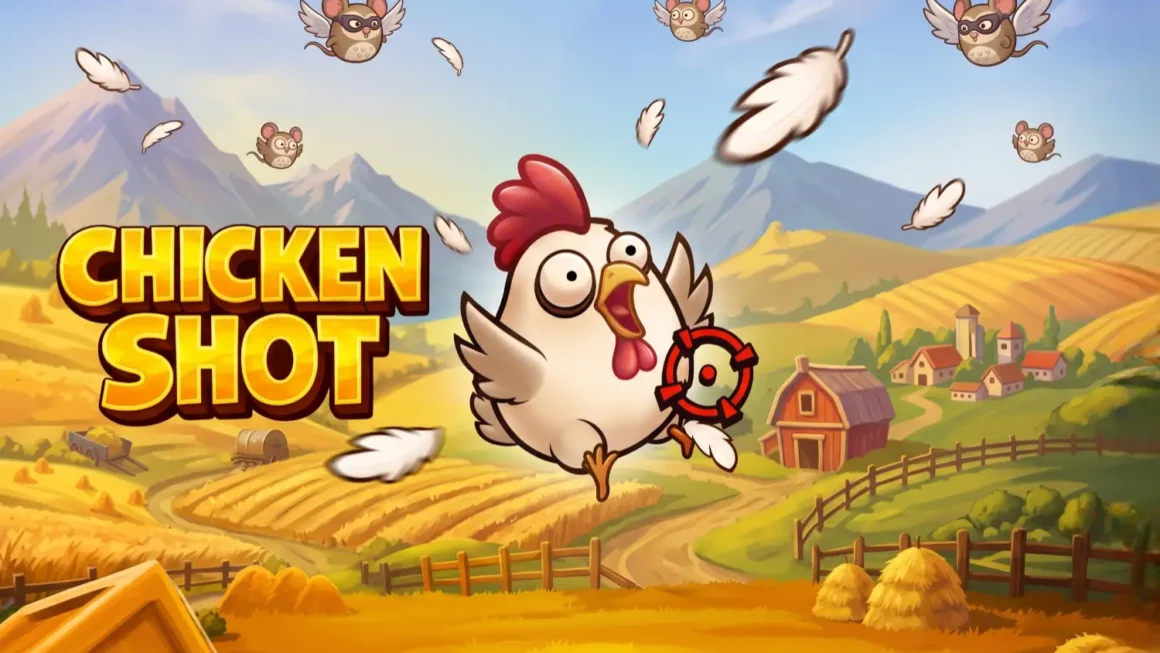
Chicken Shot landed in May 2026 — barely a month ago as this review goes live — and it arrived into a casual game category that BGaming has been quietly building into one of the more interesting corners of their portfolio. This is not a slot. No reels, no scatter triggers, no bonus round that takes three minutes to resolve. You tap chickens. They burst. You collect a multiplier or you don’t. That’s it.
The game sits in BGaming’s growing “casual” catalogue alongside Kicker Mania (penalty kick theme), Balloon Mania (pop-the-balloon theme), and Open It! (gift box theme) — all running variations of the same core mechanic: pick a target from a set of visible options, each carrying a displayed multiplier and an associated win probability, and either collect or miss. It’s an instant-win format with a thin layer of choice and decision-making layered on top. BGaming has been iterating on this template at pace in 2026, releasing multiple titles in the casual category within months of each other.
The question worth asking before we go further: is the ×64 max win ceiling a problem? In 2026, when Hacksaw Gaming routinely posts five-digit multiplier ceilings and even medium-variance video slots regularly advertise 10,000× or higher, a game that tops out at 64× looks like it belongs in a different decade. The answer is more interesting than a straight yes or no — and it depends entirely on why you’re playing Chicken Shot in the first place.
The honest framing is this: Chicken Shot is a session-pacing tool in the guise of a gambling game. It’s not built to deliver the kind of win that changes your day. It’s built to resolve quickly, show you the odds before you commit, and let you walk away without waiting for a feature that may or may not arrive. Whether that’s enough to justify its place in a casino lobby alongside games with genuinely aggressive upside depends on what you’re looking for when you load it.
Math model and mechanics
RTP
BGaming confirms 97% RTP on the official product page. That’s the single published figure — there is no operator-configurable range disclosed publicly, and the BigWinBoard review does not flag a secondary RTP profile. For context, 97% is above the category average for online casino games (typically 95–96%), and it places Chicken Shot comfortably in the high-return segment.
What does that mean at the table? On a £1 stake, the theoretical house edge is 3p per round. Play 100 rounds in a session, wager £100, and the model returns £97 on average over millions of rounds. In a short casual session of 50 spins, the swing around that average is wide — low volatility smooths it, but it doesn’t eliminate variance. The 97% is meaningful over long-term play, not over twenty clicks.
Note: BGaming does allow operators to configure alternative RTP profiles on their traditional slot titles. I found no public confirmation that this applies to Chicken Shot’s casual format. Check the in-game information panel at your specific casino to confirm the figure before playing.
Volatility
Low volatility. BGaming classifies Chicken Shot in its low-volatility tier on the casual games page, which is accurate to the mechanic. Because every round resolves with a win or a loss and low-multiplier options carry hit rates above 80%, sessions feel steady rather than swingy. The x1.1 chicken carries an 88.18% chance to burst on the first tap. Land it consistently and your bankroll barely moves — you’re essentially returning your stake with a 10% margin.
The catch is that low volatility here means low ceiling, not high floor. You’re not grinding toward a feature that might deliver a 200× hit. Every round is its own independent event. The multiplier is what it is when you shoot it.
Grid structure and bet mechanics
There is no grid in the traditional sense. Chicken Shot displays multiple chickens on screen simultaneously, each carrying a visible multiplier. You choose one target and click until it bursts — bigger chickens require more taps and carry higher multipliers. The available multipliers are:
×1.1 / ×1.5 / ×2 / ×4 / ×8 / ×16 / ×32 / ×64
Each chicken displays its “Chance to Win” before you shoot, so you’re never making a blind decision. This is the most distinctive design choice in the game — full transparency on probability before commitment. Most casino products obscure the real odds behind paytable mathematics. Chicken Shot shows you the chance percentage in plain sight.
Bet range is not published on the official BGaming page, though the maximum win is confirmed at €256,000 with a ×64 max multiplier. Working backwards: €256,000 ÷ 64 = a maximum stake of €4,000 per round. Minimum bet is not publicly confirmed — standard BGaming casual titles typically start from €0.10.
Max win ceiling
64× your stake. At £1 per round, that’s a maximum return of £64. At £10, it’s £640. At the top-end implied stake, £256,000 — but that’s a theoretical figure at a stake level accessible to very few players and irrelevant to casual play.
How does 64× compare in 2026? Against video slots, it doesn’t. Against casual and instant-win games in the same tier — BGaming’s own Kicker Mania (97% RTP, ×64) and Balloon Mania (97% RTP, ×64) share the same ceiling, and the InOut Games Chicken Shoot (different product, same month, 94% RTP) tops out at much higher stake-adjusted amounts but with a 94% RTP. The ceiling is consistent within BGaming’s casual range and honest about its category.
The point is: Chicken Shot doesn’t pretend to be a high-win-potential product. It knows what it is.
Feature breakdown
Chicken targeting and the Chance To Win display
Trigger: Player selects a target chicken from those visible on screen. The Chance To Win percentage is displayed on-hover before any commitment.
What it does: You click the chosen chicken repeatedly until it either bursts (win) or fails to burst (loss). The game doesn’t clarify publicly whether a miss is an instant end or requires multiple failures — the BigWinBoard review describes losses as “instant,” which aligns with the general casual format.
Multiplier range: ×1.1 through ×64, in eight tiers: ×1.1, ×1.5, ×2, ×4, ×8, ×16, ×32, ×64.
Hit rates: Only the extreme figures are confirmed from official sources. The ×1.1 chicken carries an 88.18% hit rate, the ×64 drops to 1.52%. The intermediate figures (for ×2, ×4, ×8, ×16, ×32) are not publicly disclosed by BGaming. You can, however, reverse-engineer rough estimates from the RTP. At 97% RTP, each chicken tier must satisfy: (hit probability × multiplier) ≈ 0.97. For ×1.1 that gives 88.18% × 1.1 = 0.97. For ×64, the confirmation is 1.52% × 64 = 0.97. The same logic should hold across all tiers, meaning:
- ×1.5 chicken: approximately 65% hit rate
- ×2 chicken: approximately 48–49% hit rate
- ×4 chicken: approximately 24% hit rate
- ×8 chicken: approximately 12% hit rate
- ×16 chicken: approximately 6% hit rate
- ×32 chicken: approximately 3% hit rate
- ×64 chicken: 1.52% (confirmed)
These mid-tier figures are derived estimates, not published data — treat them as directional, not precise. The key takeaway is that the odds decline steeply and consistently. There is no “sweet spot” where a mid-tier chicken outperforms its neighbours on expected value. Every tier targets the same 97% return; the only variable is how much session swing you’re taking on.
Honest limitation: The 1.52% hit rate on ×64 means you’ll miss roughly 98 times in 100 attempts at the max multiplier. At £1 per round, that’s 98 lost stakes — £98 in losses — before the expected hit. The ×64 return covers that with change (£64 return on a £1 stake), but only over many cycles. In a session of 50 rounds, hitting ×64 even once is statistically unlikely. The math works over thousands of rounds, not dozens.
Bigger chicken / multi-tap mechanic
Trigger: Selecting a high-multiplier chicken.
What it does: Larger chickens on screen require more taps before they burst — the official page confirms this explicitly. Bigger chickens take “more shots but carry the highest multipliers.” This is the closest thing Chicken Shot has to a feature layer: the act of tapping repeatedly builds a small amount of engagement tension that a single-click resolution wouldn’t.
Honest limitation: The multi-tap requirement on large chickens doesn’t change the underlying probability. It’s presentation, not mechanics. A ×64 chicken that takes five taps still has a 1.52% resolution chance — the taps don’t build toward anything; they just delay the outcome.
Autoplay
Trigger: Player configures preferred targets, stop conditions, and number of rounds.
What it does: Autoplay fires successive rounds without manual input, applying the configured targeting logic. Stop conditions presumably allow loss limits and win targets.
Honest limitation: Autoplay on a fast-resolution casual game is a meaningful risk escalation tool. Rounds in Chicken Shot resolve in seconds. Autoplay removes the natural pause between decisions. On a 97% RTP game with low volatility, the mathematics are relatively gentle — but £200 in stakes disappears very quickly at 10 auto-rounds per minute. The stop conditions are the only safeguard, and players who set them loosely will lose faster than they expect.
There’s an important point about how fast resolution interacts with your actual bankroll management. In a video slot with bonus features, the rhythm of dead spins, near-triggers, and eventual bonus activations naturally paces a session. You’re occupied for several minutes per bonus cycle. Chicken Shot has no equivalent pause. Each click-and-resolve takes roughly three to five seconds at most. A player burning through £0.50 stakes with autoplay set to 200 rounds just committed £100 to a two-to-three minute session. That’s not inherently bad at 97% RTP, but it’s dramatically faster than most slot players realise before they start.
If you’re using autoplay, the sensible approach is to set a hard session loss limit before you start — not a rounds limit, a money limit — and treat every stop-condition trigger as a genuine pause to reassess rather than a prompt to reconfigure and continue.
Hiding chickens (crate mechanic)
The official BGaming description mentions chickens “peeking from behind crates” as a gameplay element. The review sources describe encounters as feeling “spontaneous, with different chicken types offering varying multiplier potential.” This suggests the game’s chicken positions shift dynamically — new birds appear, some partially obscured, creating a live-action feel rather than a static menu of options.
This mechanic appears to be presentational rather than probability-affecting. The Chance To Win percentage is the operative figure; the visual drama of a chicken ducking behind a crate is animation, not math.
2026 perspective
The sibling game comparison
Chicken Shot and Chicken Rush are both BGaming productions with chickens in the name and 97% RTP, and that’s roughly where the similarities end.
Chicken Rush (released May 2024) is a traditional 5×5 video slot with 3,125 ways to win, medium-high volatility, a max win of 5,000×, and three tiers of buy-bonus options (Bronze, Silver, Gold at 50×, 100×, 300× the stake respectively). It has a dedicated free spins feature, sticky symbols, and wild multipliers of ×2, ×3, ×5, and ×10. Chicken Rush is a full-session slot built for players who want to grind toward a bonus feature. The connection to Chicken Shot is thematic and branding, not mechanical.
There is also Chicken Fire, another BGaming title visible in their current catalogue, built around a Hold and Win format with four potential jackpots and a Chance ×2 modifier — yet another mechanical departure that simply shares the barnyard aesthetic. BGaming has effectively turned the chicken theme into a product line spanning at least three distinct game formats.
Chicken Shot is none of the above. No buy bonus, no free spins, no progressive feature, no paylines, no grid. The 97% RTP matches Chicken Rush, but the experience is categorically different: shorter rounds, lower ceiling, transparent per-round odds, and no waiting for anything to trigger.
Which is better? That’s the wrong question. A player who wants to chase the ×5,000 ceiling should play Chicken Rush. A player who wants fast resolution with no dead spins and full odds transparency should play Chicken Shot. The 2026 question is whether 64× justifies the session when higher-ceiling casual games exist elsewhere in the BGaming lineup.
BGaming’s casual bet in 2026
The release velocity in BGaming’s casual category tells a story. Kicker Mania, Chicken Shot, Balloon Mania, and Open It! have all appeared in quick succession — all running the same fundamental mechanic with different themes. This is deliberate product strategy, not coincidence. BGaming is building a recognisable format that operators can deploy quickly, players can learn once and apply across multiple skins, and that satisfies mobile-first players who want shorter sessions.
The template has obvious advantages: low development overhead per title once the engine exists, broad theming flexibility, and a consistent RTP that makes it easy for operators to manage their portfolio math. The risk is brand saturation. If the third or fourth title in the BGaming casual series feels mechanically identical to the first (because it is), player novelty fades quickly. Chicken Shot has enough visual distinction and a farm-specific energy that differentiates it from Balloon Mania aesthetically, but anyone who has played one has played the core decision loop of all of them.
What this means for players: if you enjoy Chicken Shot, you will likely enjoy Kicker Mania. If you find the format shallow after twenty rounds, no BGaming casual title will solve that problem — they’re all built on the same loop. The format either clicks for you or it doesn’t.
Casual game category context
BGaming’s casual catalogue in mid-2026 includes Kicker Mania (97% RTP, low volatility, ×64 max win, football theme) and Balloon Mania (97% RTP, low volatility, ×64 max win, balloon theme) — both running the same core mechanic with a reskinned presentation. Penalty Duel (96.14% RTP, medium-low volatility) runs a related mechanic but with a higher ceiling of ×4,860 via the bonus buy mode. Lucky Birds is a BGaming crash game with multipliers up to ×12,000, also from the casual range.
This context matters: Chicken Shot sits at the lower-ceiling end of BGaming’s own casual portfolio. If max win potential is your priority, Penalty Duel’s buy bonus or Lucky Birds’ crash mechanic offer substantially more headroom at comparable or lower RTP. If you prefer the controlled simplicity of Chicken Shot’s pick-and-shoot format over crash-style timing decisions, then the ×64 ceiling is the honest price of admission.
Comparing to outside BGaming: InOut Games’ Chicken Shoot (March 2026, different product, confusingly similar name) targets flying chickens in a shooting mechanic with a maximum win of $20,000, but at 94% RTP — nearly a full 3-percentage-point disadvantage to BGaming’s version. On raw return efficiency, Chicken Shot wins that comparison without question.
Buy-bonus and jackpot availability
No buy bonus. No progressive jackpot. No fixed jackpot. None of these are present in Chicken Shot, and given the game’s design philosophy — instant resolution, pure pick-and-win — their absence is structurally coherent rather than a missing feature. Buy-bonus mechanics require a bonus structure to buy into. Chicken Shot has no bonus structure. The transparency of the Chance To Win display is effectively a substitute for the probability disclosure that buy-bonus pricing attempts to convey.
If the absence of a buy bonus is a dealbreaker, the product is simply not the right fit.
Who is this game for in 2026?
Chicken Shot isn’t a high-roller game. The ×64 ceiling at any reasonable stake doesn’t produce life-changing figures. It isn’t a grinding game — there’s no long-form progression system, no tier to reach, no bonus to unlock. It is a break game: five minutes between poker sessions, a casual wind-down, a mobile play while waiting for something.
The 97% RTP makes it among the more efficient time-fillers in this category. The Chance To Win display is genuinely useful — it’s one of the few casual games that makes you feel like an informed participant rather than a passive spinner. The multi-tap mechanic on larger chickens introduces just enough engagement to stop the game feeling purely mechanical.
The concern — and BigWinBoard raises it directly — is pace. Fast resolution plus autoplay plus low stakes-per-round equals a game that is deceptively easy to lose track of. The rounds themselves are cheap. The session total is not.
How to approach Chicken Shot without getting burned
The odds transparency in Chicken Shot is worth actually using, not just glancing at. Here’s what the Chance To Win display tells you in practical terms:
The ×1.1 and ×1.5 chickens are essentially breakeven machines. At 88% and ~65% hit rates respectively, they keep your bankroll close to flat with small drips in either direction. These are useful if you’re testing the game or burning down a bonus wagering requirement — the high hit rate keeps you in action, and the low multiplier means you’re not making meaningful wins.
The ×2 and ×4 chickens are where most recreational players should probably spend most of their time. At approximately 48% and 24% hit rates, they have real loss exposure on individual rounds but are nowhere near as punishing as the upper tiers when they miss. A ×4 hit covers four missed rounds at the same stake. In practice, this means at £0.50 per round, a ×4 hit covers the four £0.50 losses it took to get there — you’re roughly even, with a streak of misses and a single recovery.
The ×8 through ×64 tier is where discipline becomes the operative factor. The expected value is the same 97% as every other tier — the RTP model is consistent. But the swing is dramatically wider. Chasing ×64 at £1 per round means accepting the realistic possibility of running 50+ consecutive misses before a hit. That’s £50 in losses before the £64 return. Most players will quit before the cycle completes. That’s when the RTP stops being academic and starts being painful.
The most rational approach for recreational play: pick a tier in the ×2 to ×4 range, set a session budget, and use autoplay with a strict loss limit. The transparency of the Chance To Win figures is an unusually honest design decision; it deserves to be used as an actual decision tool, not ignored in favour of chasing the ×64 chicken because it looks bigger on screen.
Verdict
Chicken Shot (BGaming, 2026)
97% RTP is the best number in this review, and it should carry meaningful weight. In a casual game category where 94–95% is common, BGaming is returning materially more over time. Combined with full odds transparency per round and low volatility, this is about the most player-friendly version of an instant-win game you’ll find from any major provider.
The Chance To Win display deserves recognition as a genuinely unusual piece of design. Most casino products of this type — scratch cards, click-to-reveal instant wins, pick-and-win mini-games — keep the underlying probabilities entirely invisible to the player. BGaming shows them on-screen, in plain numbers, before you commit a stake. That’s not a gimmick; it’s actual information that allows an informed decision. Whether players use it or ignore it is another matter, but the option being there is a real differentiator.
The ×64 ceiling is the honest trade-off. You’re not playing this for life-altering returns. You’re playing it because it resolves quickly, the odds are visible, and there’s no feature drought to endure while waiting for a bonus trigger that may or may not deliver. If a session of Chicken Rush has left you frustrated after 200 dead spins pre-bonus, a switch to Chicken Shot offers an immediate antidote: clear odds, fast resolution, no waiting.
The concern, repeated throughout this review because it’s genuinely significant: pace. A BGaming casual game at low stakes autoplay can consume a meaningful bankroll in minutes. The 97% RTP is a long-term figure. In a five-minute session, the theoretical return is irrelevant; only the stop conditions you set before starting are.
Recommended for: recreational players who want fast rounds with no dead spins, mobile players who prefer click-based mechanics over spinning reels, and anyone who finds the per-round odds transparency a genuinely useful decision tool. Also worth considering for anyone burning bonus wagering requirements — the high hit rate on low-tier chickens keeps the round count moving efficiently. Bet within what you’d spend on entertainment, not within what you’d expect back as a return.
Not recommended for: players chasing high multipliers, anyone who autoplay-runs without set loss limits, or high-volatility grinders who measure sessions in bonus trigger counts. For those players, Chicken Rush (5,000×, buy bonus, 97% RTP) or Lucky Birds (×12,000, crash mechanic, BGaming) are the same provider’s better-suited alternatives in 2026