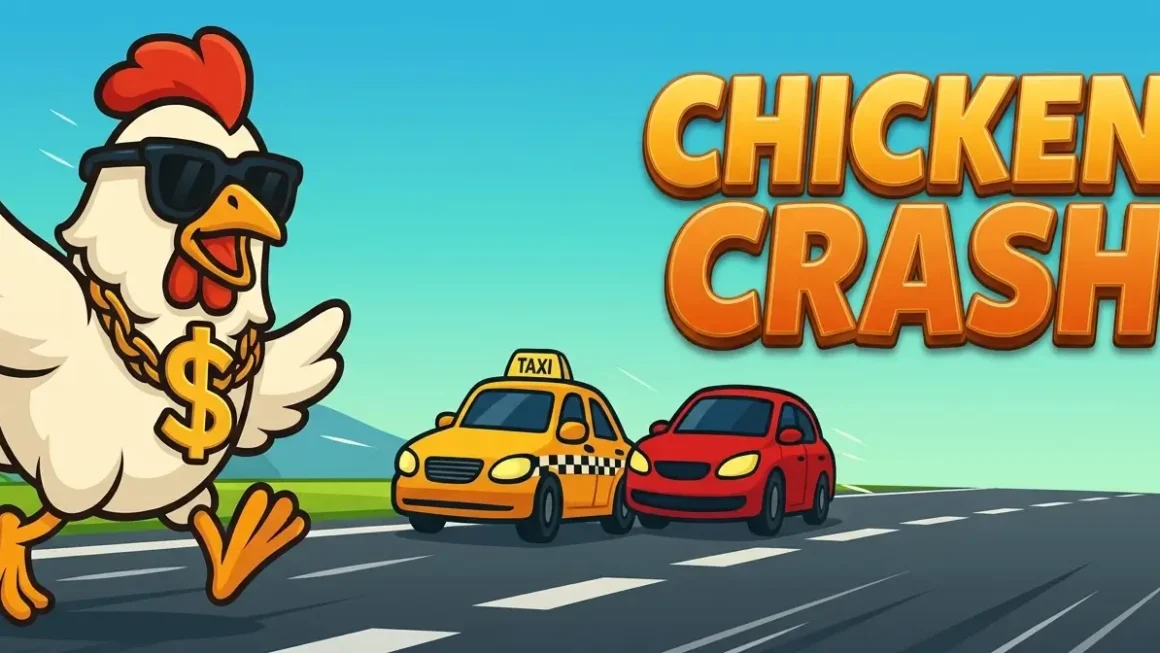
Astriona Games is one of the youngest studios in the crash game space, founded in 2025. That is not a long track record. What they launched, almost immediately, was Chicken Crash — a step-multiplier game with a cartoon chicken, 49 lanes of traffic, Provably Fair verification, and an adjustable risk system. The headline number is 67,065×, which is enough to turn heads in any lobby. The RTP figure is where things get complicated: depending on which source you trust, it sits anywhere between 96.1% and 98%. That discrepancy is not a typo problem — it reflects the operator-configurable nature of crash game math models, and it matters more than most players realise before they deposit.
By mid-2026, Chicken Crash has a sequel on the market (Chicken Crash Snowstorm) and the broader chicken-on-the-road genre has become legitimately crowded. This review examines whether the original still earns its place in a 2026 lobby, what the RTP spread actually means for your session, and where the step-multiplier mechanic genuinely delivers versus where it flatters to deceive.
The math model
RTP — what the conflict actually means
Three distinct RTP figures are circulating for Chicken Crash: 98% (per SlotCatalog and LiveBet, both of which attribute it to the official game data), 96.5% (per multiple affiliate aggregators), and 96.1% (per SlotsLaunch). This is not a case where one source is wrong and the others are right. Crash games from newer studios are routinely deployed across operators at different RTP configurations, and Astriona has not published a single definitive figure in a way that resolves the conflict.
Why does 1.5 percentage points matter? At 98% RTP, the house edge is 2%. At 96.5%, it’s 3.5%. Those sound like marginal differences. Over 200 rounds at £1 per round — a realistic session for a crash game player — the expected loss is £4 at 98% and £7 at 96.5%. Still manageable. But crash games compress time: 200 rounds can happen in under 30 minutes. Scale that to an evening and the difference between a 2% and 3.5% house edge is £16 versus £28 in expected losses.
The practical instruction: always check the RTP displayed in the game’s own information panel before playing for real money. The number displayed there is the rate your operator is running. Do not assume the 98% figure applies to your session — it may not.
A further complication: the RTP figures cited across sources are all theoretical long-run averages, not per-session guarantees. Crash games — especially step-multiplier titles with adjustable risk — compress variance significantly. On Hard difficulty, rounds can terminate at the first or second lane repeatedly. A 20-round run of single-lane crashes at £1 each costs £20 while the theoretical maximum for that sequence (had the chicken survived all 49 lanes) exceeds £67,000. The gap between expected value and session experience is enormous. That is not a design flaw — it is the nature of high-volatility crash mechanics — but players approaching Chicken Crash expecting the 98% RTP to produce recoverable sessions should understand that variance, not RTP, determines individual session outcomes.
Volatility and the adjustable risk system
Volatility in Chicken Crash is not a fixed parameter — it is player-selected. Three settings are available: Low, Medium, and Hard. The Low setting reduces vehicle density in the lanes, which increases the chicken’s survival probability per step but compresses the multiplier increments. The Hard setting introduces significantly more traffic, which means more frequent crashes but a steeper multiplier curve reaching toward the 67,065× ceiling.
This is genuinely useful design. Most crash games present a single volatility profile and ask you to manage risk purely through your cash-out timing. Astriona has built a dial that adjusts the underlying probability distribution. Choosing Hard is not just accepting worse odds — it restructures the math so that low-multiplier crashes are more common but the rare long runs reach much higher peaks. For high-bankroll players who can absorb losing runs, that is a meaningful option. For players depositing £20 and looking for controlled sessions, the Hard setting will drain a stack before delivering any meaningful peaks.
The 49-lane structure
Unlike standard crash games that run a single ascending multiplier curve, Chicken Crash operates on a step-multiplier mechanic across 49 lanes. Each lane represents one step. Each successful crossing adds to the current multiplier. The chicken can be stopped at any lane (by cashing out) or struck by a vehicle at any point. This is the CrossyRun mechanic — a structural innovation that SlotCatalog identifies as a genuine evolution over the standard crash format because it gives players visual spatial information (the lanes ahead) rather than an abstract curve.
There is no grid structure in the traditional slot sense. No reels, no paylines, no payway count. The entire game is one chicken, one road, and a decision point at each of 49 potential steps.
Rounds are fast — 5 to 10 seconds for typical play. This pace matters more than most players account for. At 10 seconds per round including the brief reset, a session with 60 active minutes of play produces around 360 rounds. At £1 per round and the 98% RTP, expected loss across that session is £7.20. At 96.5%, it becomes £12.60. Neither figure is catastrophic in isolation. But the round count accelerates considerably compared to slot play — where bonus rounds, animations, and loading time collectively slow the pace — and the psychological effect of rapid successive losses on the crash mechanic is well-documented in player community discussions. The visual of repeated early crashes compresses badly. After ten £1 bets lost in the first lane, the rational response is to continue with your strategy unchanged; the emotional response is to extend hold times on the next round to “recover.” That is the specific mindset the auto-cashout feature is designed to interrupt.
Bet range: £0.10 to £100 per round. No confirmation of a minimum bet below £0.10 from any source checked.
Feature breakdown
Adjustable risk level
Trigger: Player-selected before each round. Not activated during play — set in advance.
The three settings (Low, Medium, Hard) restructure the underlying probability distribution, not just the presentation. On Hard, vehicles appear with higher frequency in each lane, which increases the probability of early crashes while preserving access to the upper multiplier range up to 67,065×. On Low, the chicken crosses lanes more easily but the multiplier ceiling is compressed — the payout curve rises more slowly.
The honest limitation: Astriona does not publish the exact probability tables for each difficulty tier. You cannot independently verify whether Hard doubles the crash probability or triples it. The player experience on Hard is noticeably more volatile in practice, but without published hit-frequency data per tier, you are relying on subjective session observation. That is a transparency gap that established competitors like Spribe (which publishes round statistics in-game) do not have.
Auto-cashout
Trigger: Player sets a target multiplier before the round begins.
This is standard functionality across all major crash titles. Set a target (e.g., 2×, 5×, 15×), and if the chicken survives to that multiplier, the game cashes out automatically. If the chicken crashes before reaching the target, the bet is lost.
Auto-cashout is the single most important tool for disciplined play on a step-multiplier game. Without it, the visual of the chicken still alive in the lanes creates genuine psychological pressure to hold longer than your pre-session plan intended. Every extra lane feels survivable right up until it isn’t. Setting a pre-commitment target before the round removes that in-round decision entirely. Use it. Not optionally — consistently.
The maximum configurable auto-cashout level is not published in available sources. Based on the 67,065× maximum win, a target above that figure is presumably either unavailable or irrelevant.
Bet sizing and session structure
Chicken Crash has no internal session limits or responsible gambling controls beyond the standard deposit limit tools at casino level. There is no panic button inside the game, no session time display, and no round count tracker. On Fast difficulty especially, this matters because the absence of any temporal anchor inside the game makes sessions feel shorter than they are.
A starting point for disciplined session play: decide a target multiplier and a stop-loss before opening the game. On Low difficulty, a 2× auto-cashout target produces a hit rate that sustains sessions across many rounds — though the accumulated gains are modest. On Hard difficulty, a 5× to 10× target captures a meaningful proportion of the higher-multiplier rounds while cutting losses on the frequent early crashes. The exact optimal target depends on your probability assumptions per tier, which Astriona has not published — so these are directional frameworks, not mathematically proven optima.
The dual-bet feature available in Aviator — placing two independent bets with different auto-cashout targets in the same round — is not available in Chicken Crash. You stake a single amount per round. That limits the hedging strategies available to players who use Aviator’s split-bet approach (one conservative auto-cashout for session stability, one high-multiplier bet for upside).
Provably Fair verification
Trigger: Available post-round for any completed game.
Provably Fair is a cryptographic system — common in blockchain-adjacent gaming — that allows a player to verify the outcome of each completed round. The seed for the result is generated and committed before the round begins; the player receives the hash and can independently compute whether the crash point matches what was predetermined. Chicken Crash uses Provably Fair technology as confirmed by both LiveBet and SlotCatalog.
The practical limitation: most players never use it. The value of Provably Fair is theoretical assurance rather than session-by-session verification. What it does is give auditors, researchers, and analytically minded players the tools to confirm that outcomes are not manipulated post-hoc. For casual players, it is a trust signal rather than an active tool.
One comparison worth making: Pragmatic Play’s Spaceman uses certified RNG auditing instead of Provably Fair — independently verified, but not player-verifiable round by round. Aviator by Spribe and Chicken Crash both offer the stronger standard. That is a genuine differentiator in Astriona’s favour.
No bonus buy, no free rounds, no jackpot
There is no bonus buy option in Chicken Crash. There are no free spins, no scatter triggers, and no progressive jackpot. The game is deliberately stripped to its core mechanic: bet, cross lanes, cash out or crash.
In 2026, the absence of a buy-bonus feature is worth flagging specifically. The feature has become standard in slot gameplay and is increasingly available in crash titles. Chicken Crash Snowstorm, Astriona’s own sequel, also does not appear to offer a bonus buy based on available information. If buy-bonus matters to you — and for many time-limited sessions it does — neither Astriona title currently delivers it.
Chicken Crash in 2026: the competitive picture
Against Chicken Crash Snowstorm
Astriona’s own follow-up, Chicken Crash Snowstorm, was released in late 2025. It runs on the same 49-lane step-multiplier framework with the same adjustable difficulty tiers. The key differences:
- Max win: Snowstorm reaches 836,785× versus the original’s 67,065× — a 12× increase in theoretical ceiling
- RTP: Snowstorm also runs at 98% per confirmed sources
- Bet range: Snowstorm accepts €1–€200, which sets a higher minimum than the original’s £0.10
The Snowstorm sequel’s theoretical ceiling is genuinely interesting. 836,785× is an absurd number in any crash game context — for reference, Aviator’s all-time record multiplier across all rounds ever played is 2,586,812×, so Snowstorm’s ceiling is theoretically achievable in a single session. The probability of reaching that level on Hard difficulty is vanishingly small, but the mathematical upper bound exists.
The honest assessment of Snowstorm versus the original: the sequel is numerically superior on ceiling and is the more relevant title for players who optimise for maximum theoretical upside. The original remains valid for players with smaller budgets because the £0.10 minimum entry is lower than Snowstorm’s €1 floor.
Against Aviator (Spribe)
Aviator is the category reference point. 97% RTP, dual bet spots per round, an uncapped theoretical multiplier (practical cap around 10,000×), live statistics, in-game chat, and distribution across thousands of casinos. It is also not the best mathematical option in the category.
Chicken Crash at 98% (if your operator runs that configuration) is 1 percentage point better than Aviator’s standard 97%. At £1 per round and 80 rounds per hour, that is £0.80 per hour kept in your stack rather than lost to the house. Small, but real over sessions. The trade-off is that Aviator’s casino availability is dramatically broader, the live stats feature genuinely useful for pattern-testing, and the brand recognition means more content, more community, and more documented strategy.
One complication: Aviator’s operator-configurable RTP is a known issue in 2026. Spribe allows casinos to run the title at 97%, 96%, or 94%. The 94% configuration exists and is deployed by some operators. Chicken Crash has the same operator-configuration problem, but a possible ceiling of 96.5% versus Aviator’s 94% floor means that in the worst-case scenario, Chicken Crash still outperforms Aviator’s most aggressive operator configuration. This is a narrow edge and depends entirely on which deployments you encounter.
Aviator also retained the record for the highest multiplier ever recorded in a live crash round: 2,586,812×. That is an outlier from years of accumulated play across millions of sessions worldwide — not a representative outcome — but it illustrates the uncapped upside of Aviator’s format compared to Chicken Crash’s 67,065× hard ceiling on Hard difficulty.
Against JetX (SmartSoft)
JetX runs at 97% RTP with a theoretical max win reported around 25,000× and allows three simultaneous bets per round — the widest multi-bet option in the category. It also carries a progressive jackpot component. Chicken Crash has neither multi-bet nor jackpot. Against JetX on features, Chicken Crash loses. Against JetX on ceiling (67,065× versus 25,000×), Chicken Crash wins. Against JetX on RTP, Chicken Crash wins if running at 98%.
The three-bet system in JetX is worth understanding because it enables a genuinely different strategic posture. A player can place a small auto-cashout bet at 1.5× for session stability, a medium bet at 5× for regular mid-multiplier gains, and a speculative long-hold bet at 50×+ for the occasional large win — all in the same round. If the jet crashes at 3×, the 1.5× bet is profitable, the 5× bet is lost, and the 50× bet is lost. The overall round loss is smaller than if the full stake had been on the single 50× target. Chicken Crash’s single-bet structure cannot replicate this hedging. If you are a player who uses multi-bet risk management as a primary strategy, JetX is the better title regardless of the RTP comparison.
Against BGaming Crash
BGaming Crash runs at 99% RTP — the highest verifiable rate in standard crash games — with a theoretical max of 1,000,000×. Chicken Crash at 98% is mathematically second-best among verified Provably Fair titles by RTP, and its 67,065× ceiling sits well below BGaming’s theoretical million. For pure RTP optimisation, BGaming Crash is the stronger choice. Chicken Crash offers the step-multiplier visual differentiation and the adjustable difficulty system that BGaming’s title does not have.
Astriona as a provider: what 2025-founded means
Astriona Games launched in 2025 and has approximately 20 titles in its catalogue as of mid-2026, based on SlotCatalog’s provider listing. For context, Spribe — which released Aviator and built the crash game category — has been operating since 2018. SmartSoft (JetX) has a similarly established track record. BGaming has been active since 2012.
None of this means Astriona’s games are poor quality. Chicken Crash works as designed, and the Provably Fair implementation is a genuine commitment. But a 12-month-old provider with 20 titles has a shorter track record of dispute resolution, withdrawal processing, and long-term API stability than incumbents with 5–8 years in the market. If you are playing through an unlicensed or crypto-native operator, the provider’s age amplifies that risk slightly. If you are playing through a licensed casino with a dispute resolution track record, the provider’s age is mostly irrelevant.
The practical implication: Chicken Crash’s availability in casino lobbies is narrower than Aviator’s. Check that your operator actually hosts it before trying to find it.
Who should actually play this
The step-multiplier mechanic is genuinely different from the standard crash curve. Watching a chicken cross lanes gives you spatial information — you can see how many lanes remain — which affects decision-making in a way that an abstract ascending curve does not. Whether that spatial feedback improves your decisions or creates more psychological pressure to hold is debatable, but it is a structurally distinct experience.
The adjustable risk system is the most interesting design choice in the game. It means a single title can serve as a low-variance warm-up session on Low difficulty or a high-stakes variance machine on Hard. No other title in the chicken-road genre offers that in the same way. Chicken Road 2.0 by InOut Games has four difficulty tiers and was released in April 2025, but its RTP is 95.5% — materially worse than Chicken Crash’s best-case 98% — and its max win reaches 361,000× at the cost of a lower theoretical return per session.
The RTP transparency gap is the biggest frustration. Chicken Crash’s 98% figure is genuinely competitive — better than Aviator, better than JetX, better than Spaceman. But you cannot confirm which RTP your operator is running without checking the in-game information panel. Some deployments may run 96.5% or lower. That is the same problem Aviator has (operators can configure Spribe’s title down to 94%), but Aviator has been in the market long enough that its operator network is better documented.
The absence of in-game statistics is a genuine gap. Aviator displays live round history, multiplier trends, and what other active players cashed out at. Chicken Crash shows you the road ahead and your current multiplier. That is it. For players who use round statistics to calibrate cash-out decisions — even understanding that each round is independent and past results do not predict future crashes — the absence of live data is a functional limitation compared to the market leader.
Mobile performance is confirmed across sources. The HTML5 build runs on phone and tablet without a dedicated app. Given that the step-multiplier mechanic works on a single vertical screen without the complex multi-column layouts of slot games, mobile is arguably the format Chicken Crash suits best.
Verdict
Chicken Crash (original):
The step-multiplier mechanic works. The adjustable risk system adds tactical depth that most crash competitors lack. The 98% RTP, where it applies, is competitive with the best in the category. But the max win ceiling of 67,065× on Hard difficulty — while headline-worthy — is not the dominant number in the crash game space. BGaming Crash reaches 1,000,000×. JetX’s theoretical ceiling is higher. Aviator’s community and casino availability are broader. The original’s main argument is the £0.10 minimum bet, the step-lane visual format, and the Provably Fair verification.
Play if: you want a visually distinct crash mechanic, you are comfortable verifying your operator’s RTP before play, and you are managing a modest bankroll (the low minimum entry is the specific edge case where this title makes the most sense). The Low difficulty setting also makes Chicken Crash one of the more approachable crash titles for players transitioning from slots who find Aviator’s abstract multiplier curve disorienting.
Skip if: you prioritise multi-bet functionality, a progressive jackpot, in-game live statistics, or the social features that Aviator’s live chat provides. Also skip if your casino is running a sub-97% RTP configuration on this title — at that point you are better served by BGaming Crash or a verified 97% Aviator deployment.
Chicken Crash Snowstorm:
The sequel is numerically stronger in almost every regard — a 836,785× ceiling versus 67,065×, the same 98% RTP, and the same core mechanic. The catch is the higher minimum bet of €1 versus the original’s £0.10. For players with a session budget above £20, Snowstorm is the version to choose. The winter aesthetic is a cosmetic change; the underlying math improvement is real. The 836,785× ceiling places Snowstorm in the upper tier of crash games by theoretical maximum — above JetX (25,000×), above the effective cap in Aviator (~10,000×), and in the same bracket as BGaming Crash (1,000,000×) and High Flyer (1,000,000×, though that one hard-caps wins at €250,000). Whether you will ever see a fraction of that number is a different question — but the math model behind it is not fabricated.
The one-sentence recommendation for both: at the right operator RTP, these are among the better-value crash titles in a 2026 lobby — but check the in-game info panel before your first bet, because the figure you assume and the figure you are actually playing on may not be the same.
A note on responsible play: Chicken Crash is a fast-format game designed to produce decisions in under 10 seconds. The speed compresses session time in a way that is not always obvious until the session is over. Set a round limit or time limit before you start, not after. If crash games are causing financial stress or disrupting daily routine, GamCare (gamcare.org.uk) and Gambling Therapy (gamblingtherapy.org) both offer free support and are accessible without needing to identify yourself to a regulator or a casino.