The “New Wave” of Instant Games: Why 100HP Gaming Is Rewriting the Format
The crash game market spent the better part of 2022–2024 running on a single template: rocket launches, ascending curves, and a cash-out button that everyone pressed either too early or not at all. Aviator by Spribe codified the genre. JetX gave it a faster skin. Then the clones arrived — dozens of them, all sharing the same underlying math model, the same live-bet feed on the left panel, the same dopamine lever dressed up in different liveries.
100HP Gaming, a Limassol-registered studio founded in 2022, didn’t attempt to dethrone Aviator by copying it. Their portfolio strategy has been lateral: take the core crash premise, strip the continuous-curve mechanic, and reframe it as a discrete, turn-based decision tree. The result is a distinct behavioral loop — one where the player isn’t passively watching a line climb and deciding when to tap out, but is instead actively selecting a path at each node, with the crash event encoded into a hidden terminal state rather than a freely moving probability function.
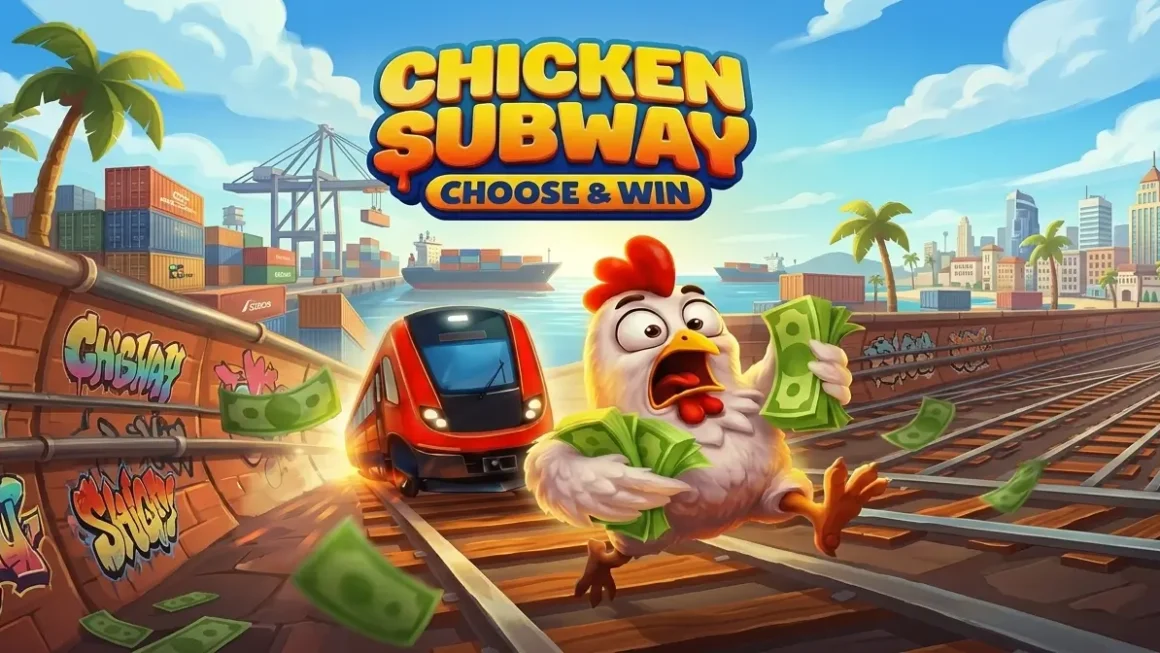
Chicken Subway, released on December 25, 2025, is the most commercially visible execution of that design philosophy. Within weeks of launch, it was appearing in the instant-game lobbies of MGA and Curaçao-licensed operators, distributed through aggregators including SOFTSWISS and Hub88. By May 2026, it has accumulated enough session data and third-party coverage to warrant a serious technical audit — which is exactly what this article delivers.
The game’s surface aesthetics are deliberately arcade-coded: a runner format visually reminiscent of mobile games, color-saturated track environments, a protagonist that communicates risk through animation states. None of that is why experienced players should care about it. What matters is the probability architecture underneath — specifically, how the turn-based lane-selection model interacts with a cash cap structure, where the per-round payout ceiling sits at $10,000 regardless of the theoretical multiplier ceiling, and what that means for high-stakes session management.
Crash/Mine Mechanics Breakdown: How the Turn-Based Model Actually Works
Standard crash games operate on a continuous multiplier curve. The round begins, a multiplier starts at 1.00x and climbs at an accelerating rate, and the house has pre-seeded a crash point using a provably fair RNG before the round starts. The player’s only variable is the cash-out threshold — pick a number and either hit it manually or set an auto-exit. The entire session volatility is encoded in how the crash distribution is weighted toward low multipliers.
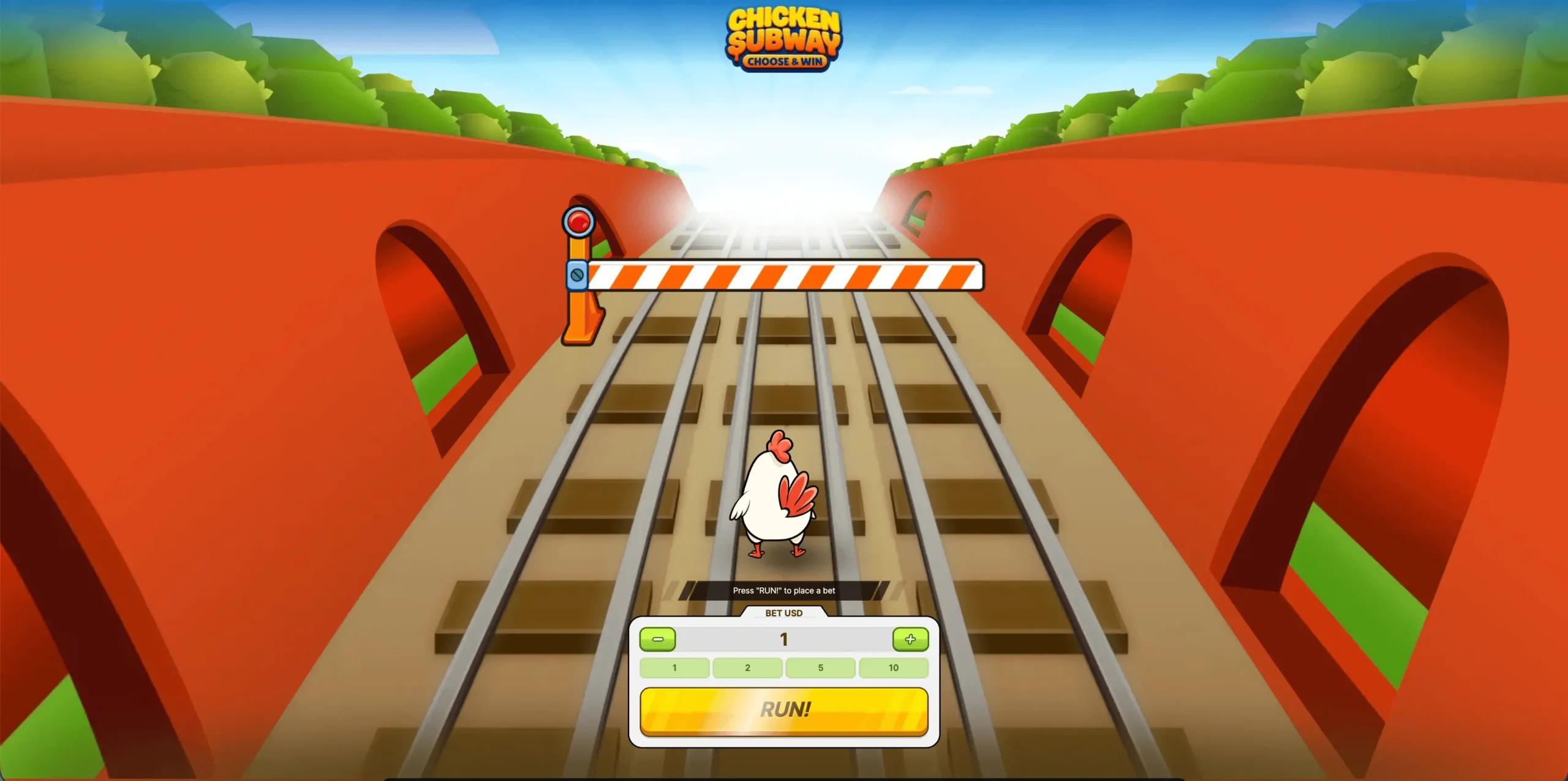
Chicken Subway diverges from this in a structurally significant way. The game presents three lanes — left, center, right — each with a distinct multiplier value attached. The player selects one lane per “step.” A correct selection advances the round and compounds the multiplier. An incorrect selection terminates the round immediately, forfeiting the entire stake. At any step boundary, before committing to a lane, the player can cash out and collect the accumulated multiplier.
This is closer to a Mines-style probability model than a traditional crash curve. In Mines-format games (Stake’s Mines being the canonical reference), the player selects tiles on a grid, each revealing either a gem (safe) or a mine (bust), with the probability of a safe reveal decreasing as more tiles are selected. The expected value of continuing is calculable at each step because the remaining unsafe tiles are a known quantity.
In Chicken Subway, the probability structure per step is nominally 1-in-3 — three lanes, one of which contains the termination event. However, 100HP Gaming has not published the exact per-step crash probability distribution, which is the critical disclosure gap in the game’s current documentation. Several third-party sources suggest the multiplier values per lane aren’t uniform, meaning the “safe” lanes may carry different return weights and the crash probability may not be a flat 33.3% at every step. This is an important distinction: if lane multiplier values differ and the crash is disproportionately concentrated in lower-value lanes, the effective probability structure is tilted against players who optimize for maximum gain.
What is publicly confirmed:
- RTP: The figure varies across sources. The game’s own promotional material and one operator-facing source cite 97%. The SlotCatalog listing indicates 97%. A separate third-party guide claims 96%, while at least two affiliate sources cite figures between 97–99%, with the upper end apparently contingent on conservative cash-out behavior rather than being a certified mathematical constant. For analytical purposes, 97% should be treated as the baseline certified figure. The variable RTP claim — where player behavior shifts effective return — is mathematically coherent but suggests the house edge expands as players push deeper into the multiplier tree, which is the intended behavioral dynamic.
- Bet range: $0.10 minimum / $150 maximum per round, consistent across all verified sources.
- Per-round cash cap: $10,000, regardless of multiplier depth achieved.
- Theoretical multiplier ceiling: Sources conflict significantly. SlotCatalog lists the max win at x1,000. Operator-affiliated sources claim x55,000. This is an unresolved discrepancy that materially affects how the game should be evaluated for high-stakes play. At a $150 maximum bet, a x1,000 multiplier produces $150,000 — well above the $10,000 cash cap. A x55,000 multiplier is mathematically irrelevant if a $10,000 ceiling is enforced. The per-round cash cap, not the multiplier ceiling, is the operative constraint.
- Provably Fair system: Confirmed. The game uses SHA-256 cryptographic hashing. Before each round, the server generates a hidden terminal crash point, encrypts it, and provides the hash to the player. Post-round, the original value is revealed, allowing hash verification. This is the same architecture used across 100HP Gaming’s full portfolio — Astronaut, Crime Empire, Air Jet, MetaCrash — and has been independently confirmed as functional by multiple audit reviews.
The turn-based discrete model has one analytical advantage over continuous curves: at any cash-out boundary, a player theoretically knows the depth they’re at and can calculate implied probability of survival to the next step. In practice, this calculation is complicated by the undisclosed per-step probability and variable lane multipliers. The provably fair system proves the crash point wasn’t manipulated, but it doesn’t publish the crash probability distribution — which means session volatility is not fully auditable without large-sample statistical analysis.
Risk vs. Reward Psychology: How the Interface Manufactures Commitment
The behavioral design of Chicken Subway exploits a specific cognitive pattern that distinguishes it from passive crash formats: the illusion of agency at each decision node.
In a standard crash game, the player’s only input is the cash-out moment. The experience is explicitly passive — you watch a number climb and decide when to leave. There is limited felt agency because the only variable under player control is exit timing. Chicken Subway inserts a lane selection between each multiplier step. The player is not merely watching; they are choosing. This shifts the felt experience from passive observation to active participation, even though the underlying outcome — which lane contains the crash event — is governed by the same pre-seeded RNG that determines crash points in any other provably fair game.
This matters for retention dynamics. When a player cashes out early in Aviator, the subsequent experience of watching the multiplier continue to climb produces regret — a recognized behavioral driver that increases bet sizing in subsequent rounds. In Chicken Subway, the equivalent experience is selecting a lane that turns out to be safe while watching the multiplier gates you didn’t select also appear to be viable. The game doesn’t show you that you could have survived — it shows you that you survived because you chose correctly. This attribution pattern, where outcomes are credited to player skill rather than RNG, produces higher confidence in continued play.
The interface accelerates this dynamic through several specific design choices:
High-speed UI with minimal latency between steps. Rounds are designed to resolve quickly. The animation sequences are short. The interval between “select lane” and “result revealed” is measured in fractions of a second. This compression of the decision-feedback loop reduces deliberation time and increases the emotional velocity of sessions — a well-documented driver of compulsive play behavior in EGMs (electronic gaming machines).
The cash-out option is always visible but never promoted. The UI displays the cash-out button throughout active play, but the primary visual weight at each step goes to the lane selection mechanic. Players who process the interface visually are anchored to the next lane choice, not the exit option. This is not accidental — it mirrors the design logic of slot machines that display the spin button larger than the “bet one less” controls.
Multiplier accumulation is shown in real-time and accelerates. As players advance through steps, the multiplier grows, but — critically — the rate of growth increases at deeper steps. This is the same psychological mechanism that makes sunk cost fallacy particularly powerful: the potential gain from one additional step becomes increasingly large as the total accumulated multiplier grows, while the probability of survival may be simultaneously declining. The felt ratio of “I’m so close to a major win” to “the crash probability right now” is distorted by the recency and magnitude of the accumulated gain.
No explicit display of crash probability. Unlike some Mines implementations that show remaining safe tiles versus total tiles, Chicken Subway does not display the per-step crash probability at any point in the round. The player is making a 1-in-3 (or differently weighted) selection without feedback on how the odds are shifting. This is the interface design choice with the largest negative expected-value impact for undisciplined players.
Volatility & Payout Patterns: The Math Model vs. Aviator and JetX
Crash games are characterized by their bust distribution — specifically, the proportion of rounds that terminate at low multipliers versus the long tail of high-multiplier outcomes. In Aviator (Spribe), the median crash point hovers around 2x–3x, with the distribution heavily weighted toward early exits. Roughly 33% of rounds in Aviator are estimated to crash below 1.5x, meaning a player with an auto-exit at 2x will successfully cash out in fewer than half of rounds on a long-run basis.
Chicken Subway’s volatility profile is structurally different because the crash point is not a continuous distribution — it’s a discrete termination event at one of several defined step boundaries. This means “session volatility” in the traditional crash sense is replaced by step-depth volatility: the probability that a given round terminates at step 1, step 2, step 3, and so on.
100HP Gaming has not published the step-depth crash distribution. Based on the per-step lane selection model and a 97% RTP with a $10,000 cash cap, the following can be inferred:
- Shallow-exit behavior (cash out at step 1–2) effectively produces a near-flat-odds bet with a mild house edge. The multiplier at these depths is low, the probability of survival to reach them is high, and the RTP approaches the certified maximum.
- Deep-exit behavior (continuing past step 4–5+) concentrates variance. The multiplier grows, but the compounded probability of surviving each 1-in-3 selection degrades exponentially. Surviving five consecutive steps at a flat 1-in-3 crash probability per step carries a survival probability of approximately (2/3)^5 = 13.2%. At seven steps, that drops to (2/3)^7 = 5.9%.
- The $10,000 per-round cap imposes a hard ceiling on the deep-play strategy. For a player betting $150 (maximum), reaching x67 (approximately 5–6 steps at plausible multiplier increments) would theoretically yield the cap. Any multiplier above that produces no additional return. This creates a counterintuitive scenario where deep play above the cap threshold has negative EV regardless of survival probability, because the upside is bounded while the crash risk is not.
Comparison with Aviator (Spribe): Aviator’s RTP is operator-configurable between 97% and 99%. Its bust distribution is a standard crash curve with a documented concentration of early busts. The game has no per-round cash cap in its standard implementation. For skilled session managers using fixed auto-exit thresholds, Aviator’s continuous curve offers more precise risk management than Chicken Subway’s discrete lane model, because exit timing is fully under player control and the math is more transparent.
Comparison with JetX (SmartSoft Gaming): JetX runs a 97% RTP with a max multiplier ceiling of x25,000. Its crash distribution resembles Aviator’s. JetX does not employ per-round cash caps and has more granular auto-cashout controls. For high-stakes players, JetX offers better ceiling access than Chicken Subway’s $10,000 hard cap.
Where Chicken Subway has a structural edge over both: The turn-based model allows a different kind of session discipline. Because there is a mandatory pause between each step (the lane selection moment), the game cannot accelerate past a player’s deliberate decision. This is distinct from continuous crash games where the curve climbs regardless of player input — in Chicken Subway, the multiplier does not move until the player acts. For players prone to freezing during rapid multiplier climbs, the step-gated format may produce better cash-out discipline. This is the only mechanical argument for preferring Chicken Subway over continuous-curve formats from an expected-value standpoint.
2026 Technical Audit: Mobile Performance, Server Stability, and Distribution
100HP Gaming’s technical stack has been consistently described as genuinely lightweight relative to the category. Game builds are reportedly as small as 1.6 MB, and the HTML5 implementation requires no client-side download, running via browser on any modern mobile device. This is a material advantage in mobile-first emerging markets where data costs and device memory constraints are real operational variables.
The HTML5 / no-download architecture means Chicken Subway loads via casino PWA or in-browser without app store distribution. This is both a reach advantage (no installation friction) and a regulatory-neutral position — the game is not subject to app store content policies, which have progressively restricted real-money gaming applications in several jurisdictions.
Server-side performance in instant crash formats is critical because the cash-out request must be processed and confirmed before the round terminates server-side. In a high-latency environment, a player who taps cash out during a valid window may lose the bet because the server processes the crash event before the cash-out message arrives. This is a known problem in the crash game category and has been documented across multiple providers.
100HP Gaming’s distributed server architecture, designed for their MGA and Curaçao-regulated deployments, has been described by early testers as stable under normal mobile conditions. The step-gated format of Chicken Subway actually provides a latency buffer that continuous curve games lack — because the round is paused at each lane selection, the window for cash-out confirmation is wider than in a fast-climbing Aviator-style curve. The cash-out request competes only with the player’s active lane selection, not with a continuously advancing multiplier. This is a meaningful technical advantage for players on slower mobile connections (3G/4G with variable signal).
Mobile optimization details:
- Runs on iOS Safari and Android Chrome without dedicated app installation
- Push notification support for tournament events is available through casino PWA wrappers
- Biometric login integration where supported by casino platform
- Auto-bet and auto-cashout features are present in the desktop version; mobile parity has been confirmed by multiple third-party testers
- Demo mode is available without account registration on supported platforms
Distribution footprint as of May 2026: Chicken Subway remains a relatively limited release. SlotCatalog data confirms the game is available across a small number of operators, concentrated in markets with active 100HP Gaming integrations. The studio distributes through SOFTSWISS, Hub88, and EvenBet aggregators — all of which provide instant single-API integration for licensed operators. Broader rollout is anticipated throughout 2026 as the title is included in new operator agreements.
Regulatory framework: The game operates under Curaçao eGaming licensing and has been confirmed in MGA-licensed environments. iTech Labs has been cited as a certification body for 100HP Gaming’s RNG audits in the Astronaut title, and the same RNG architecture underlies Chicken Subway. The SHA-256 Provably Fair implementation is verifiable client-side using publicly available hash verification tools.
Chicken Subway in Context: 100HP Gaming’s Portfolio and the Studio’s Trajectory
Evaluating Chicken Subway in isolation misrepresents its position in the market. It is part of a deliberate portfolio strategy by 100HP Gaming, and understanding where it sits relative to the studio’s other titles clarifies both its design intent and its target player segment.
Astronaut is 100HP’s flagship title — the one that established the studio’s presence in the crash genre. It’s a continuous curve game, thematically closer to Aviator than Chicken Subway is, with a 97–98% RTP (operator-configured) and a x10,000 max multiplier. It features dual-bet panels, auto-withdrawal, in-game statistics, a round history feed, and an in-game chat. It is the studio’s most feature-complete product and the most direct Aviator competitor. For players who want the standard crash format with better RTP than the market average, Astronaut is the more complete product.
Crime Empire (September 2024) is 100HP’s highest-volatility release. At 98% RTP and a maximum payout of €259,200 — achieved via a x12,960x multiplier with a €20 maximum bet — it offers the most favorable ceiling for high-stakes players in the portfolio. The crash event is visualized as a “robber escaping” rather than a climbing curve, but the underlying model is a standard crash distribution. For bankroll-heavy players, Crime Empire’s uncapped (or effectively uncapped) ceiling makes it a more rational high-stakes vehicle than Chicken Subway’s $10,000 hard cap.
Air Jet / StarX (2024) are dual-bet sky race formats with 98% RTP and a max multiplier of x12,960. These titles introduced promo code activation and skin customization, features that 100HP has used to build operator-level CRM integration.
MetaCrash is the studio’s crypto-native product — a crash game with a x50,000 max win and token-based wagering mechanics. It targets the DeFi-adjacent gambling segment that prioritizes on-chain verifiability and cryptocurrency staking.
Gods of Plinko (2025–2026) represents 100HP’s expansion beyond pure crash mechanics into physics-simulated instant games. It’s a directional indicator: the studio is broadening its format range while maintaining the lightweight mobile-first architecture.
Chicken Subway’s position in this portfolio is as a format-differentiator aimed at players who find continuous curve games passive or who have already habituated to Aviator-style mechanics. The turn-based lane selection mechanic is novel enough to generate new acquisition without cannibalizing Astronaut’s player base — they appeal to different behavioral preferences. The game’s lower max win (relative to Crime Empire) and simpler feature set make it accessible to casual crash players while its high-volatility depth play attracts action-seekers looking for a structurally different risk architecture.
The social features present in other 100HP titles — leaderboards, in-game chat, tournament activations — are either limited or absent in Chicken Subway’s current implementation. The 100HP operator documentation confirms that 70% of new users engage with daily leaderboards or promo codes in their first four weeks across the portfolio. If these features are added to Chicken Subway, expect measurable uplift in retention metrics.
Minimum-Risk Strategy Analysis: The Only Approach That Makes Mathematical Sense
No strategy eliminates the house edge. The 97% RTP means the studio collects $3 per $100 wagered in aggregate, regardless of how individual players sequence their bets. What strategy does is redistribute that edge across a session — concentrating risk in fewer rounds, extending session duration, or trading frequency for magnitude.
For Chicken Subway specifically, the following approaches have clear mathematical grounding:
Single-step exit discipline. Committing to cash out after a fixed number of steps — typically one or two — produces the most predictable variance profile. At step one, you’re accepting a low multiplier with a high survival probability. The RTP impact is minimal, but the per-round risk is contained. This approach maximizes session duration per bankroll unit and keeps effective RTP closest to the certified 97%.
Fixed-depth targeting with hard stops. Set a target step depth before the round begins and execute cash-out automatically. Do not override the target mid-round. The primary failure mode in Chicken Subway is commitment drift — players who intended to exit at step three who continue to step five after a string of successful survivals. The step-gated interface creates natural pause points that can be used for discipline, but only if the exit depth is pre-committed.
Stake sizing relative to the cash cap. At $150 maximum bet, reaching x67 yields the $10,000 cap. This is achievable at moderate step depth. Betting $15 at the same depth yields $1,000 — leaving a full order of magnitude of ceiling headroom with a lower bust cost on any given round. Stake calibration relative to cap constraints is the most underutilized lever in high-volatility instant game play.
Avoid progressive bet escalation after losses. The Martingale adaptation — doubling stake after a bust to recover the previous round’s loss — is mathematically destructive in high-bust-probability environments. In a game where shallow exits (step 1) have roughly a 33% crash probability and deeper play compounds that risk, a losing streak of three consecutive first-step busts (probability approximately 3.7% per three rounds) produces a 8x stake obligation on the Martingale fourth bet. Combined with the $150 bet ceiling, the strategy hits its hard limit quickly.
Professional Strategy Verdict
Game type: Turn-based instant win / lane-selection crash hybrid
Certified RTP: 97% (baseline; sources conflict between 96% and variable 97–99%)
Bet range: $0.10 – $150
Per-round cash cap: $10,000
Theoretical multiplier ceiling: Disputed (x1,000 per SlotCatalog vs. x55,000 per operator sources)
Provably Fair: Confirmed (SHA-256)
Regulation: Curaçao eGaming / MGA environments
Max win vs. Crime Empire: Significantly lower ceiling for high-stakes play
Technical performance: Strong — 1.6 MB build, HTML5, latency buffer from step-gated format
Who should play Chicken Subway: Players who have habituated to Aviator-style passive curve games and want a structurally different risk format. The turn-based decision mechanic provides genuine behavioral novelty, and the step-gated architecture is technically superior for low-latency mobile play. Players who prioritize session discipline will find the mandatory decision pauses useful if they pre-commit to exit depths.
Who should look elsewhere: High-stakes players targeting large single-round payouts. The $10,000 per-round cash cap is a hard constraint that makes Chicken Subway inefficient for maximum-bet sessions targeting large multipliers. Crime Empire (€259,200 ceiling) or Astronaut (x10,000–x50,000 ceiling, no published per-round cap) are better suited for that player profile. Similarly, players who require a fully transparent per-step probability disclosure should note that 100HP has not published the lane crash distribution — a gap that makes precise expected-value calculation impossible without independent statistical sampling.
The honest technical assessment: Chicken Subway is a well-engineered product from a studio with a proven mobile-first architecture. The format differentiation is real — this is not another Aviator clone. The behavioral mechanics are effective, arguably too effective in the ways that matter for player protection. The $10,000 cash cap is the most important fact in the game’s math model and is consistently underreported in affiliate coverage. Until 100HP publishes the per-step crash probability distribution and resolves the RTP discrepancy across its documentation, the game carries an audit gap that players should factor into session planning. Play with pre-committed exit depths, defined session bankrolls, and no Martingale escalation. The RTP is competitive for the category — the risk architecture is not uniquely predatory — but the interface is designed to keep you one step deeper than your original plan.