
Frenzy Clusters landed on June 23, 2026, which makes it one of the newest cluster-pays titles in any lobby right now. Three weeks old is not enough time for a track record, but it is enough time to pull apart the math model, the four bonus routes, and the number that actually matters here: a 97.11% RTP sitting on top of a high-volatility 7×7 grid.
That RTP is the hook. Most 2026 releases from the big studios settle into the 96.0–96.5% band and call it a day. BGaming pushed this one half a point higher while keeping the volatility rating at the aggressive end and the max win at 10,000× the stake. The question worth answering before you load a demo: does the extra return actually change how the game plays, or is it a marketing number that gets eaten by the bonus-buy pricing anyway?
The math model and what the numbers mean at the table
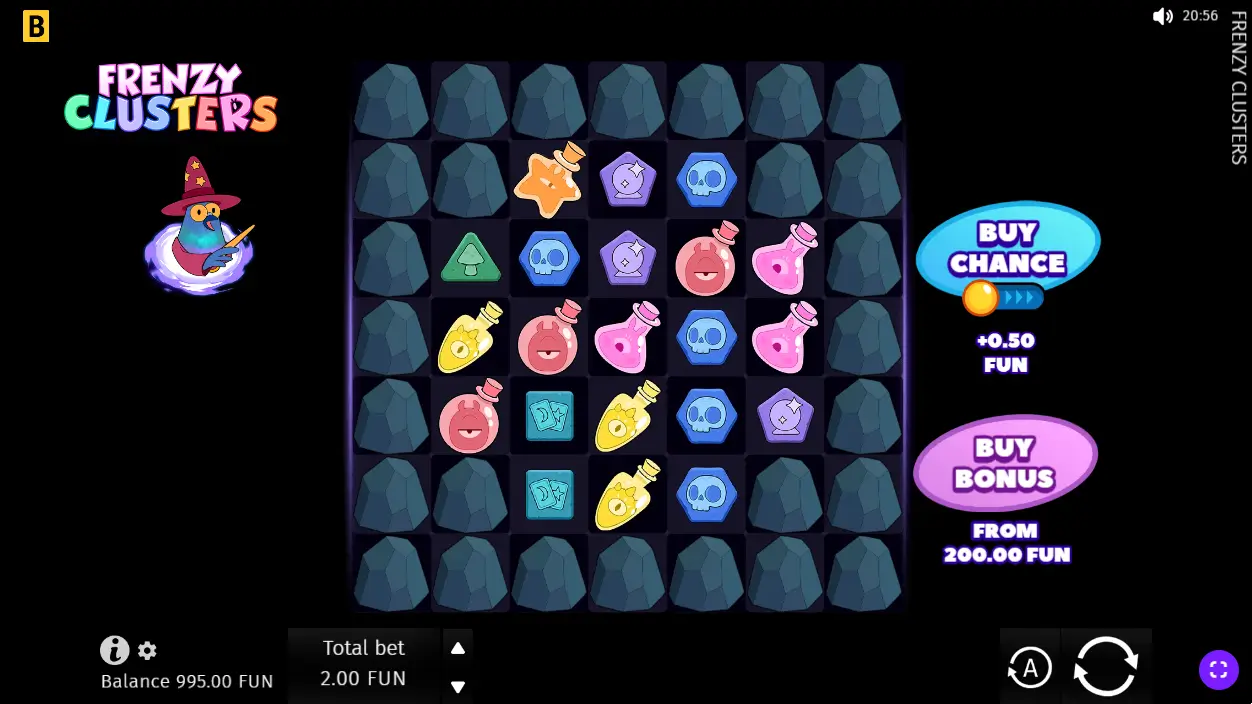
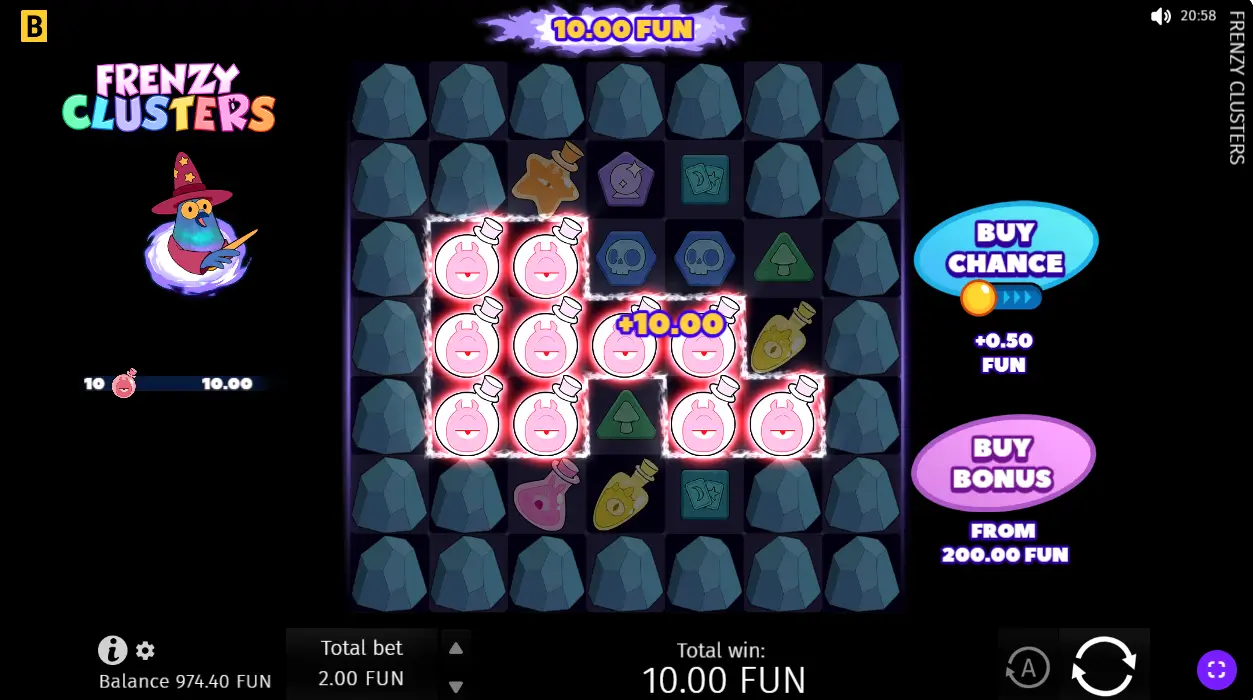
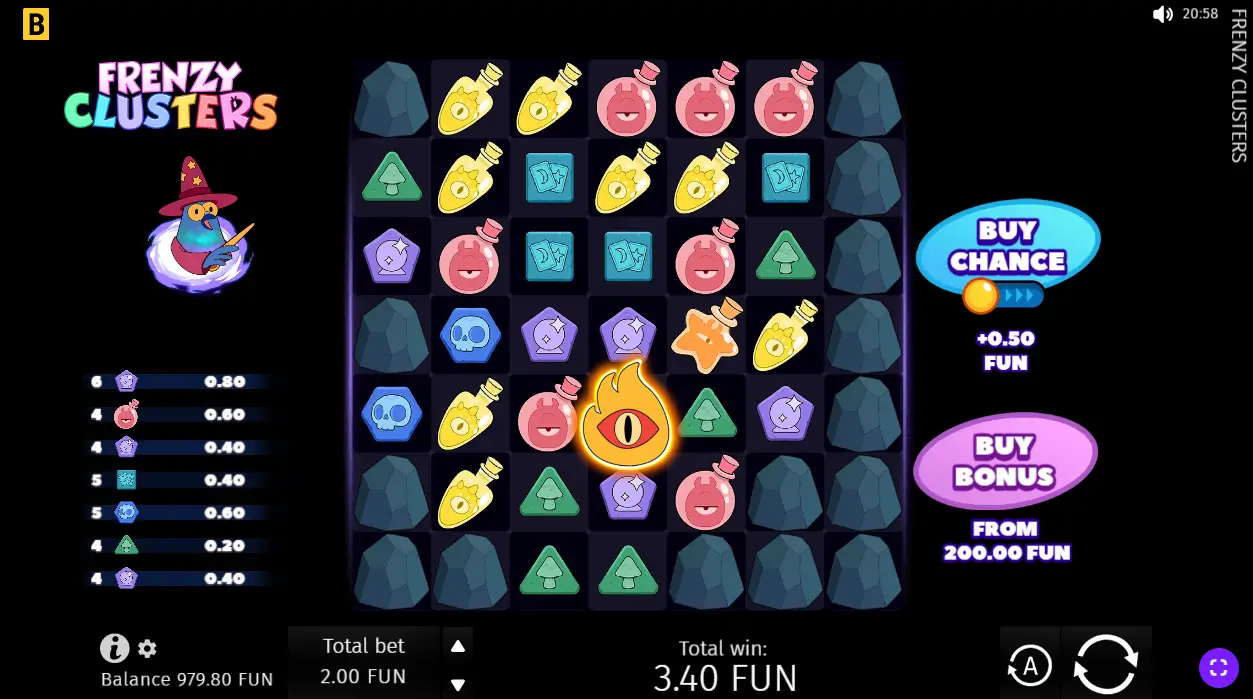
Frenzy Clusters runs on a 7×7 grid — 49 positions — with no paylines. Wins form when four or more matching symbols connect horizontally or vertically, and the grid pays with a cluster mechanic rather than a ways-to-win or fixed-line structure. There’s no fixed reel count to memorise; the whole board is live on every spin, and connected clusters burst and cascade the way most modern Pragmatic Play or Hacksaw cluster titles do.
The RTP is confirmed at 97.11%, and BGaming lists it as the single published figure rather than an adjustable range split across multiple operator versions. That matters because a lot of high-volatility cluster games — Sugar Rush among them — ship with several RTP configurations that casinos can select from, and the number quoted in a review isn’t always the one live on the felt. Frenzy Clusters appears to run one configuration. Still, check the in-game paytable before you stake anything real, because casino-side RTP can shift by jurisdiction even when the developer only publishes one number.
What does 97.11% actually buy you over the 96% average? Over a modelled 1,000-spin session at a €1 base bet, a 97.11% RTP theoretically returns around €971 against €1,000 wagered, compared with roughly €960 at a flat 96%. An extra €11 per thousand spins isn’t going to change your bankroll management, but across the volume a slot like this sees in a single streaming session or a weekend of casual play, it’s a real edge — assuming the operator hasn’t reconfigured it downward, which is always the caveat with any online slot RTP claim.
Volatility is confirmed high, and BGaming’s own listing backs that up with a hit rate of 2.64 — meaning winning clusters land, on average, roughly once every 2.64 spins. That’s a relatively active hit frequency for a slot carrying a 10,000× ceiling, and it tracks with what you’d expect from a 49-cell cluster grid: there’s simply more surface area for four-symbol clusters to form than on a standard 5×3 reel set. The catch is that most of those hits are small. The bulk of the theoretical return sits in the Free Spins and Mega Free Spins rounds, not the base game — which is the standard shape for a high-volatility cluster slot in 2026.
The feature-trigger rate is listed separately at 269.4, which is BGaming’s figure for how often the natural Scatter trigger fires without buying in. Roughly one base-game spin in 269 lands the three Scatters needed for Free Spins unassisted. That’s a long wait if you’re playing base-only, and it’s the exact reason the Buy Bonus menu exists — more on the pricing for that below.
Put the two figures next to each other and the shape of a session becomes clearer. A 2.64 hit rate means something pays roughly every third spin, which keeps the balance ticking over and stops the game feeling dead between rounds. A 269.4 feature rate means the bonus you’re actually here for — the one carrying most of the theoretical return — is a genuine rarity without paying for it. That gap between “frequent small activity” and “rare big structure” is the defining shape of this math model, and it’s worth internalising before staking anything, because the base game alone will not tell you whether Frenzy Clusters is a good or bad slot. The bonus rounds will.
Run the numbers on a realistic session. At €1 a spin with roughly 600 spins an hour on a fast-click setting, you’d expect just over two natural Scatter triggers in that hour, going purely off the 269.4 figure — assuming no Chance feature is active. That’s an unreliable basis for judging the game inside a single sitting, high volatility or not, which is exactly why the Buy Bonus and Chance options exist as a way to control pacing rather than leave it entirely to the natural trigger rate.
One area where the public data doesn’t agree: the bet range. BGaming’s own page and a slot-review aggregator both cite 0.20 to 25 per spin, while a second independent review lists 0.20 to 8.00. There’s a way to sanity-check this: the confirmed max win cap is €250,000 at a 10,000× multiplier, and 250,000 ÷ 10,000 = 25. That math lines up cleanly with the 0.20–25 range and not with the 8.00 ceiling, which suggests the wider range is the accurate one — but casino-side bet limits vary by operator and currency, so treat the active game panel as the final word before you size a stake.
Feature breakdown: what each mechanic actually does
The rock grid and locked cells
Frenzy Clusters doesn’t start with the full 49 positions in play. The grid opens with blocked cells framed in rock around the edges, and the playable area only expands when a winning cluster forms adjacent to a locked section. Landing a win next to a rock cell shatters it and opens that position for the rest of the spin sequence. In the base game, an expansion lasts for a single spin before the grid resets to its starting size. Inside either bonus round, expansions persist for the entire duration of the round, so the field tends to open up and stay open as a Free Spins or Mega Free Spins session progresses.
The practical effect: base-game spins early in a sequence are working with a smaller grid than the number 7×7 suggests, and the real cluster potential only shows up once you’re inside a bonus or you get a lucky run of adjacent wins. This is the mechanic that makes the base game feel slower than the headline grid size implies — you’re not actually playing a full 49-cell board most of the time.
Special symbols: Rocket, Book, Sphere
After a winning cluster of four or more matching symbols disappears, there’s a chance one of three special symbols appears in its place. Rocket clears every symbol along a full horizontal or vertical line. Book clears a 3×3 block centred on its position. Sphere removes every visible copy of one randomly selected symbol type from the entire grid. None of these three pay out directly — clearing symbols this way doesn’t add to your win on its own. What they do is set up longer cascade chains and, more importantly, they can trigger further rock-cell breaks if the cleared area sits next to a locked position, which is how a single spin can spiral into several consecutive avalanches.
The catch worth stating plainly: because the special symbols destroy value rather than award it, a spin that looks visually busy — rockets firing, spheres wiping the board — can still land you nothing if none of the resulting cascades form a new cluster. Don’t read activity as payout.
In terms of realistic contribution, the three special symbols aren’t a standalone payout source and were never designed to be one — their job is structural. A Sphere that clears every copy of a common low-paying symbol can open up space for a higher-value cluster to cascade in behind it, and a Rocket or Book that breaks a rock cell early in a spin sequence can extend how long that sequence runs. The honest limitation is that none of this is guaranteed to matter. On a base-game spin with a small, closed-off grid, a special symbol can fire and simply clear an area that never gets reused before the spin ends. The mechanic earns its keep almost entirely inside the bonus rounds, where the expanded, persistent grid gives every cleared position a real chance to be refilled and re-triggered.
Free Spins (3+ Scatters)
Landing three or more Scatter symbols anywhere on the grid triggers the standard Free Spins round. The exact spin count scales with the number of Scatters landed, and each Scatter collected during the base-game trigger adds +1× to a progressive multiplier that sits above the reels and applies to every win for the rest of the round. There’s no confirmed upper limit stated on how high that multiplier can climb — it’s driven by how many Scatters land and how the round plays out, not a fixed cap.
Three hidden multiplier values, obscured behind rock cells at the start of the round, get revealed as the grid expands during play and add directly to the above-reel total. This is the round most players will see naturally, since the 1-in-269 base trigger rate means it’s the more common of the two bonus outcomes if you’re not buying in.
In a typical session, standard Free Spins is the round that delivers the bulk of mid-sized wins — the ones that don’t hit the theoretical ceiling but comfortably beat base-game returns. Its realistic ceiling is capped by how much of the grid actually opens up during the round, since it starts with the same locked rock cells as the base game and depends on clusters landing next to them to expand. The honest limitation: if the three hidden multipliers stay buried behind rock that never gets broken, the round can finish having paid out closer to base-game levels than to anything resembling the 10,000× headline. It’s a genuinely strong round when the grid opens early. It’s a forgettable one when it doesn’t.
Mega Free Spins
The upgraded bonus mode opens with the entire 7×7 grid unlocked from the first spin — no rock cells to break through — and starts with a higher baseline multiplier than the standard round. Three random multiplier values are added to the above-reel total automatically at the start, before a single spin has been played, and Scatters landed during the round still add +1× each on top. This is the round with the real ceiling potential, and it’s accessible either through a rare natural trigger or, far more commonly, through the dedicated Buy Bonus option.
This is where the 10,000× number actually lives. With the full 49-cell grid active from spin one and no rock cells slowing down cascades, Mega Free Spins is built to stack the above-reel multiplier fast and apply it across a wide, unobstructed board. Realistically, most sessions of this round will land somewhere well below the max — a genuinely huge multiplier requires several consecutive cascades to chain cleanly, and that’s still a random outcome rather than something the fully unlocked grid guarantees. The honest limitation is cost, not mechanics: at 250× the stake to buy in directly, Mega Free Spins is the single most expensive decision on the game’s menu, and a player relying on the natural trigger will see it far less often than the standard Free Spins round.
Mystery Bonus and the Buy Bonus menu
Three purchase options sit behind the Buy Bonus button, and BGaming states the exact price adjusts to the current bet size. Independent review sources list the reference pricing as: Free Spins Buy at 100× the current bet, Mystery Bonus Buy at 137.5×, and Mega Free Spins Buy at 250×. Mystery Bonus is the middle-cost option and the most interesting mechanically — instead of choosing a round directly, you pick one of five portals, and the portal randomly resolves into either the standard Free Spins or the Mega Free Spins mode. You’re paying a premium over the guaranteed Free Spins buy for a chance — not a guarantee — at the better round.
There’s also a Chance feature, sold separately from the three Buy Bonus options, which doubles the probability of naturally landing three Scatters on a given spin without skipping straight to the bonus. It’s the cheapest way to lean into bonus frequency without committing to a full buy-in, and it’s worth understanding the difference: Chance improves your odds on organic spins, Buy Bonus skips the wait entirely at a fixed cost.
Read that pricing again: a Mega Free Spins buy at 250× stake means a €1 bettor is committing €250 to a single decision. That’s not a rounding error — it’s more than double the cost of the guaranteed Free Spins entry, and it concentrates a meaningful chunk of a session’s bankroll into one spin of the wheel, math-wise. Buy Bonus availability is subject to local regulation and casino configuration, so don’t assume the button will be live everywhere this game is offered.
Worth thinking through the Mystery Bonus pricing specifically, because it sits in an odd spot between the other two. At 137.5× stake, it costs more than a guaranteed standard Free Spins entry (100×) but less than a guaranteed Mega Free Spins entry (250×) — and what you’re actually buying is a coin flip-adjusted shot at either outcome through one of five portals. If the portal odds land anywhere close to even, paying 137.5× for a roughly 50/50 shot at the 250×-priced round is a mathematically defensible middle ground, not a trap. Where it stops making sense is for a player who specifically wants the standard Free Spins round and nothing else — for that player, the direct 100× buy is the cheaper and more predictable route, and Mystery Bonus is just added variance on top of variance.
Hero selection
Before the first spin, players choose one of five characters — Golub, Hugo, Olaf, Bloke, and Aussie — and can switch at any point mid-session via the character panel. BGaming is explicit that this is a presentation layer only: it changes which animations play on a win and which visual cues appear alongside special symbol triggers, but it has no effect on RTP, hit frequency, or which symbols land. Worth knowing before you spend time agonising over which hero “feels luckier.” None of them are.
Frenzy Clusters in the 2026 lobby
There’s no sequel, Power Reels edition, or Megaways variant of Frenzy Clusters at the time of writing — the game is three weeks old, and BGaming’s full catalogue listing shows no follow-up title using the name. That’s a non-comparison worth stating clearly rather than inventing a variant that doesn’t exist: this is a standalone release, and any “which version should I play” question doesn’t apply here yet.
What does apply is how it stacks up against other high-volatility cluster titles currently live. Sugar Rush by Pragmatic Play runs the same 7×7 cluster structure but caps its adjustable RTP at 96.50% and its max win at 5,000× — half of Frenzy Clusters’ ceiling, with a lower theoretical return on top. Arcanum by ELK Studios uses a 6×7 cluster grid, matches Frenzy Clusters’ 10,000× max win, but runs at a 94% RTP — a full three points below what BGaming is offering here. Twilight Princess, also Pragmatic Play, uses a smaller 5×5 cluster format, a 96.08% RTP, and a 7,500× ceiling. Against all three, Frenzy Clusters wins on RTP outright and either matches or beats every one of them on max win multiplier. On paper, this is one of the stronger math models currently sitting in a cluster-pays lobby.
The Arcanum comparison is the more instructive one of the three. Matching a 10,000× ceiling is easy to do on paper — plenty of studios print that number — but doing it at 97.11% RTP instead of 94% is the harder trick, and it’s the gap that actually separates a well-priced high-volatility slot from a punishing one. A three-point RTP difference compounds fast over volume: on a €10,000 turnover session, that’s a theoretical €300 difference in expected return between the two games, before any bonus-buy spend is factored in. Sugar Rush, for its part, wins on brand recognition and distribution — it’s in more lobbies than Frenzy Clusters will be for a while yet — but it simply isn’t built for the same ceiling-chasing player. Anyone choosing between the two purely on math should be choosing Frenzy Clusters.
None of this means Frenzy Clusters is the best cluster-pays release of 2026 outright — Nolimit City and Hacksaw both have titles carrying max wins several multiples higher, and neither of those studios is playing in the same RTP-versus-ceiling trade-off that BGaming is making here. What Frenzy Clusters does is occupy a specific, well-defined niche: high enough volatility and ceiling to satisfy players chasing real upside, paired with an RTP that’s genuinely above average rather than merely competitive. That’s a narrower target than “biggest max win on the market,” but it’s a target BGaming hits cleanly.
Where it doesn’t lead the category: there’s no progressive jackpot on Frenzy Clusters, and no evidence of one in any of the published game data. If you’re specifically hunting a pooled jackpot on top of the bonus structure, this isn’t that game — the 10,000× ceiling is fixed, not progressive, and the €250,000 cap applies regardless of how the multiplier math plays out. Buy-bonus availability is the other qualifier: where it’s live, it matters. In 2026, a high-volatility slot without a bonus-buy route is increasingly the exception rather than the rule, and players who’ve gotten used to skipping the 269-spin average wait on comparable titles will expect the option here too. It’s present, priced clearly, and subject to the usual jurisdiction restrictions.
Is this a high roller’s game, a recreational spin-for-fun title, or dead weight in a crowded 2026 lobby? It sits closer to the first category than the other two. The 97.11% RTP and matched 10,000× ceiling against Arcanum put real mathematical weight behind it, but the hit-rate-versus-bonus-cost gap is real: a 2.64 base hit rate keeps the reels moving, while a 250× buy-in for the best round assumes a bankroll built for that kind of variance. A casual player dropping in small stakes will see plenty of base-game activity and comparatively modest returns; the game’s actual identity — the multiplier stacking, the fully unlocked grid, the above-reel value climbing — only shows up once you’re inside Mega Free Spins, whether you got there naturally or paid for the door.
Verdict
Frenzy Clusters earns its place through the math model, not the fantasy theming. A 97.11% RTP beats the category average by a full percentage point, and a 10,000× max win holds its own against Arcanum while comfortably beating Sugar Rush and Twilight Princess — that’s the number that should drive the decision here, not the five interchangeable heroes on the side panel.
The one figure that limits it: a 250× Mega Free Spins buy-in on a game where the natural trigger only fires once every 269.4 spins on average. That combination means the “real” version of this game — the fully unlocked grid, the stacked above-reel multiplier — is expensive to reach on demand and rare to reach by accident. Budget for that gap before you decide how you want to play it.
Play this if you’re an experienced high-volatility player who tracks RTP and max-win figures before choosing a title, and who’s comfortable sizing a bankroll around occasional 100–250× decisions rather than steady small wins. The 2.64 hit rate means the base game won’t feel dead while you wait for a bonus, which softens the usual high-volatility grind somewhat — but don’t mistake that base-game activity for the game’s real ceiling. Skip it if you want a low-variance, frequent-small-win session, or if a locked bet range topping out somewhere between 8 and 25 per spin (confirm on your casino’s panel) doesn’t suit your stake size.
For everyone in between, the demo is the right starting point — the rock-cell expansion and special-symbol chains are worth seeing play out before any real money goes in, and it’s the only way to get a feel for how often your specific casino’s configuration actually opens up the grid. Three weeks into its release cycle, Frenzy Clusters hasn’t built the track record that older titles like Sugar Rush have, but the published math already gives it a clear identity: a genuinely above-average RTP wrapped around a ceiling that competes with the category’s stronger names, sold at a bonus-buy price that assumes you know exactly what you’re paying for.