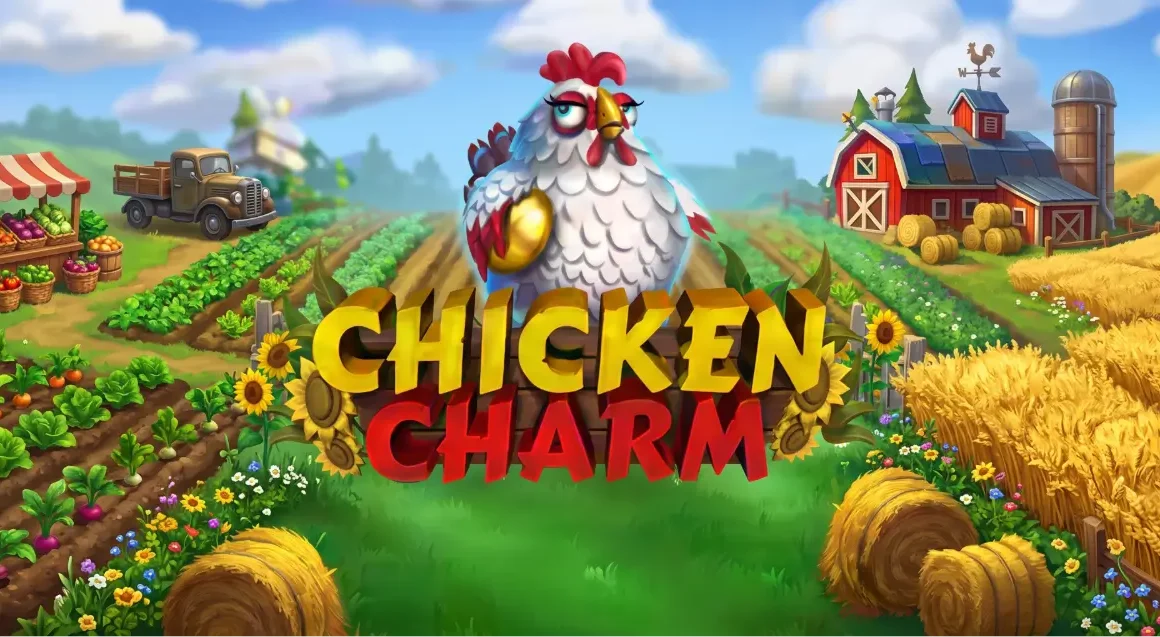
Chicken Charm landed in September 2024, which makes it a veteran by the standards of a niche that turns over new “chicken” titles every few months. It comes from Seven ABC, a studio that only started making slots in 2023 and has built its early reputation on speed and range rather than one signature mechanic. The number that frames everything else here is the RTP: 95.9%, sitting a shade under the 96% benchmark that most players use as a rough dividing line between “fine” and “why bother.” Medium-high volatility on top of that sub-average return is the combination worth interrogating before you load a single credit.
The math model: what 95.9% and medium-high volatility actually buy you
Start with the return figure, because it’s the one number every operator publishes and every player skims past. Chicken Charm carries a fixed RTP of 95.9%. There’s no evidence in circulation of Seven ABC running the operator-configurable RTP bands that have become standard practice at studios like Pragmatic Play, where a single title might ship in three or four RTP tiers and each casino picks which one goes live. That’s not necessarily a mark against Chicken Charm — a single, fixed RTP is at least honest in its simplicity — but it does mean there’s no lower-RTP trap version circulating that you need to watch out for at a specific casino. What you see quoted is, as far as the available listings show, what you get.
95.9% is below the 96%–96.5% range that a lot of 2026 releases are landing in, and meaningfully below the 97% that titles like Chicken Rush from BGaming advertise. Over a modest session — say, 300 spins at £1 — the difference between 95.9% and 97% works out to roughly £3.30 in theoretical return, which won’t ruin anyone’s night. Over thousands of spins across a year of regular play, though, that gap compounds. It’s a small tax, not a scandal, but it’s the first thing to log mentally before the theme and animations do their job of distracting you from it.
Volatility is rated medium-high, listed at a 4 on the scale used by the aggregator that currently hosts the most detailed spec sheet for this game. In practice, that band means you should expect longer runs without a meaningful win, punctuated by payouts that outweigh what a low-volatility farm slot would offer. Medium-high volatility with a sub-96% RTP is a demanding pairing — you’re accepting more variance in exchange for a return rate that isn’t compensating you particularly generously for the privilege. Compare that to Chicken Drop, which pairs high volatility with a 96.5% default RTP: the risk profile is similar, but the underlying return is stronger.
Here’s where I have to be straight with you: the published record on Chicken Charm doesn’t include a confirmed hit frequency, and no max win multiplier has surfaced across the major aggregators I’d normally check for this — SlotCatalog, Casino Guru, BigWinBoard, AboutSlots. That’s unusual. Most farm and animal-themed slots in this segment, even from smaller studios, have their ceiling figure documented within weeks of release because affiliates chase that number for headlines. Chicken Charm launched in September 2024 and, more than a year on, that figure still isn’t circulating in any source I can verify. I’m not going to invent one. If a max win number matters to your decision — and for a medium-high volatility game, it should — you’ll need to check it directly against the paytable at whichever casino lobby you’re using, because I can’t hand you a reliable figure here.
The grid itself is conventional: five reels, with a fixed number of paylines rather than a ways-to-win or cluster system. Fixed paylines mean the game rewards consistency in structure — you know exactly what you’re covering with every spin, unlike Chicken Drop’s 7×7 tumbling cluster grid, where the playing field itself changes shape as symbols cascade away. That structural choice puts Chicken Charm closer to traditional slot mechanics than to the newer cluster-pay wave that’s dominated the “chicken slot” micro-genre since Pragmatic Play’s release popularised it.
The exact payline count isn’t published in the listings I can verify — only that the structure is fixed rather than adjustable. That’s a smaller gap than the missing max win, since fixed-payline five-reel slots in this bracket typically run somewhere between 20 and 25 lines, but I’d rather flag the absence than guess at a specific figure and present it as fact. Check the paytable in-client before you commit real stakes if the exact number matters to how you plan your bet sizing.
Bet range runs from $0.10 to $25 per spin, which is a reasonably wide band. It covers cautious low-stake play comfortably and stretches far enough to interest a moderate-stakes player, though it falls short of the $50–$100 ceilings you’ll find on titles like Chicken Man, which tops out at €100 per spin. If you’re the kind of player who likes to push volatility with size, Chicken Charm’s ceiling will feel restrictive before your bankroll does.
It’s worth spelling out what medium-high volatility actually feels like across a real session, because the label alone undersells the experience. At this band, you should expect stretches of twenty, thirty, even fifty spins with nothing but small return hits or dead spins, followed by a cluster of activity where the free spins round lands and does most of the session’s heavy lifting. That’s a fundamentally different rhythm to a low-volatility farm slot, where wins arrive often but rarely amount to much. Players who bring a small bankroll and expect steady top-ups will find Chicken Charm frustrating. Players who accept the dry stretches as the cost of entry for a bigger swing when the bonus finally triggers will find it more tolerable — assuming that swing is actually worth waiting for, which is precisely the part the missing max win data leaves unanswered.
Hit frequency — how often a spin returns any win at all, big or small — isn’t published for Chicken Charm either. For context, Chicken Rush’s documented 22.73% hit rate means a win lands roughly once every 4.4 spins on average. Without an equivalent figure for Chicken Charm, you’re left estimating from the volatility label alone, which is a blunter instrument. Medium-high volatility slots typically sit somewhere in the high teens to low twenties for hit frequency, but that’s a genre-level generalisation, not a confirmed number for this specific title.
Feature breakdown: wilds, scatters, and free spins — with an honest gap
Every published listing for Chicken Charm agrees on the shape of its feature set: wild symbols, scatter symbols, and a free spins round, with multipliers mentioned as part of the free spins experience. That’s the extent of what’s confirmed. What I can’t give you — because it isn’t published anywhere I can verify — are the specifics that actually determine whether those features are worth chasing: the scatter count needed to trigger free spins, how many free spins you’re awarded, whether the round can retrigger, and what range the multipliers actually cover.
That gap matters more here than it would on a title with three years of community play-throughs and streamer VODs behind it. Wilds and scatters are the two most generic words in the slot lexicon — they tell you almost nothing about how a game actually plays until you know the trigger conditions and the payout ceiling attached to them. A wild that only substitutes on a single reel is a different feature entirely from one that expands, walks, or stacks. A scatter-triggered free spins round that awards five spins with a 2x multiplier plays nothing like one that awards fifteen spins with escalating multipliers up to 10x. Right now, Chicken Charm’s public-facing material doesn’t distinguish between these possibilities.
Wild symbol
Described consistently as a standard substitute across the sources that mention it — it stands in for regular paying symbols to help complete winning combinations. No source confirms whether it’s a static, expanding, stacked, or walking wild, and no source confirms whether it appears in the base game only or also during free spins.
Scatter symbol
Confirmed as the trigger for the free spins round, in line with the vast majority of slots at this stake level and complexity. The exact number of scatters required, and whether it needs to land in a single spin or accumulate, isn’t documented in any source I can check.
Free spins with multipliers
The one feature block Chicken Charm’s own marketing material actively promotes, describing the animated chicken symbols as capable of triggering “unexpected bonus features” during play. Multipliers are attached to this round according to the same source, but no multiplier range, no spin count, and no retrigger condition is specified.
You might reasonably ask: why include a feature section at all if this much of it is unconfirmed? Because the honest answer — that this is a mid-tier, medium-high volatility slot whose feature depth simply hasn’t been documented in the usual places — is itself useful information. A game with this little third-party scrutiny after fifteen-plus months on the market usually means one of two things: low player volume, or limited casino distribution. Either reading should factor into your decision more than a guessed-at multiplier range would.
What I can say with more confidence, because it’s consistent with how five-reel, fixed-payline, wild-and-scatter slots at this volatility band typically behave: expect the base game to deliver small, frequent wins to keep the balance moving, with the free spins round doing the heavy lifting on anything resembling a big payout. That’s the standard shape of the genre, not a Chicken Charm-specific claim.
Compare that to how thoroughly Chicken Man’s feature set is documented by contrast. Independent reviews break down its two separate scatter types — one Safe-themed, one Bank-themed — the exact trigger count for each, and the stacking behaviour of its wilds during the final bonus spin, down to the detail that its multiplier wilds add together rather than multiply against each other. That level of granularity is what a properly reviewed feature section looks like, and it’s the standard Chicken Charm hasn’t met yet. The contrast isn’t a criticism of the game’s design — it may well play just as well as Chicken Man on the reels — it’s a criticism of how little independent verification exists to confirm or deny that.
There’s also no mention anywhere of a bonus symbol distinct from the scatter, no pick-and-click mini-game of the kind Seven ABC has used in other titles like Gems of Fortune, and no cascading or re-spin mechanic layered onto the base game. On the evidence available, Chicken Charm is a straightforward three-feature slot: wild, scatter, free spins with multipliers. If that sounds thin next to some of 2026’s more mechanically stacked releases, that’s because it is — plenty of studios are now shipping four or five interacting systems in a single title, and Chicken Charm reads as a release from an earlier, simpler design philosophy despite being barely two years old.
The 2026 perspective: no sequel, thin distribution, and a crowded field of chicken slots
Chicken Charm has no sequel, no Power Reels edition, no Megaways conversion, and no bonus-buy variant that I can find evidence of. For a studio like Seven ABC — which markets itself partly on the ability to customise and reskin games quickly for operators — the absence of a follow-up more than a year after launch is itself a data point. Compare that to Pragmatic Play’s approach with Chicken Drop, where a strong-performing base game routinely spawns spin-offs, seasonal reskins, or feature upgrades within twelve to eighteen months. Chicken Charm hasn’t had that treatment. It reads as a game that shipped, filled out a portfolio, and hasn’t generated enough traction to justify further investment — which is a fair outcome for plenty of slots, but worth knowing going in.
The provider context is worth a moment too. Seven ABC was founded in 2023 and has leaned into thematic range rather than a signature mechanic — its catalogue spans mythology, crime, and animal themes, and the studio positions itself to operators as a source of customisable, quickly-deployed titles rather than as a big-swing, headline-grabbing developer in the Nolimit City or Hacksaw mould. That business model produces perfectly playable games, but it doesn’t typically produce the kind of mechanically distinctive release that earns detailed third-party breakdowns from the major review sites. Chicken Charm fits that pattern exactly: a competent, generic-featured slot from a young studio, without the marketing push or player volume to generate the kind of documentation that titles from more established houses get as a matter of course.
That’s not automatically a red flag on the safety side. Seven ABC’s own site foregrounds responsible gambling messaging as part of its foundation, which is a reasonable baseline signal for a studio still building its reputation. But it does mean this is a developer better judged by its distribution and catalogue depth than by any single flagship release, and Chicken Charm — a mid-catalogue farm title rather than a marquee launch — isn’t the game to use as evidence of what the studio is capable of at its best. Titles like Gems of Fortune, also from Seven ABC, show a more layered feature set with expanding symbols and a pick-and-click bonus game, suggesting the studio’s more ambitious design work has gone elsewhere.
Distribution is the other half of the picture that’s hard to pin down. Aggregator listings confirm Chicken Charm sits within a Seven ABC portfolio of 30-plus slots, but none of the sources I can check break out casino-by-casino availability figures the way they do for higher-profile releases from Pragmatic Play or BGaming. That absence of granular distribution data, on top of everything else that’s missing, reinforces the same picture: this is a game that exists, functions, and gets listed — without having built the kind of visible footprint that generates detailed scrutiny.
Buy-bonus availability isn’t confirmed anywhere for Chicken Charm, and given how thin the rest of the published record is, I’d treat its absence from every source as meaningful rather than incidental — if it had a bonus buy, that’s usually one of the first things an operator or affiliate site flags, because it drives higher-stake play. No progressive jackpot is mentioned in any listing either. Both of these are common inclusions on 2026-era releases chasing high-roller attention, and Chicken Charm’s absence from that conversation places it firmly in the “casual, low-to-mid-stake” bracket rather than competing for whale traffic.
Now put it next to the competitors that actually dominate search traffic for chicken-themed slots. Chicken Drop by Pragmatic Play is the benchmark: a 7×7 tumbling cluster grid, default RTP of 96.5% (with lower-RTP operator configurations also in circulation, so always check the in-game panel), high volatility, and a confirmed 5,000x max win. It has no traditional wild symbol, leaning instead on upgrade mechanics and outsized “Golden Egg” symbols that can cover large sections of the grid. Chicken Rush by BGaming runs on a 5-reel, 3,125-ways structure with a 97% RTP — genuinely strong for the category — medium-high volatility, and a 5,000x max win ceiling; one aggregator lists its hit frequency at roughly 22.73%, or one win in every 4.4 spins, which is unusually well-documented for this niche. Chicken Man by Backseat Gaming takes the genre in a different direction entirely, with a 5×5 grid, 19 paylines, two distinct scatter types feeding two separate bonus features, and a bet ceiling that stretches to €100 per spin for players who want to push stakes harder than Chicken Charm’s $25 cap allows.
Against that field, Chicken Charm’s 95.9% RTP is the weakest of the four, and its lack of a confirmed max win figure means it can’t even be benchmarked against the 5,000x ceilings that Chicken Drop and Chicken Rush both offer. You might ask whether that makes Chicken Charm simply a worse game. Not automatically — RTP and max win aren’t the only things that matter, and plenty of players value a straightforward five-reel structure without cascading grids or dual bonus systems. But on the numbers that are actually available to compare, Chicken Charm is competing from behind, not from strength.
Worth noting: RTP itself isn’t always a fixed, single-source figure across the industry. Chicken Drop is a useful cautionary example here — Pragmatic Play ships it with multiple RTP profiles, commonly cited around 96.5%, 95.5%, and 94.5%, with the exact version live at any given casino determined by that operator’s configuration. That’s the industry-standard practice worth understanding regardless of which chicken slot you end up choosing: the RTP printed in a review isn’t always the RTP running at your casino of choice, and the in-game information panel is the only reliable source once you’ve picked a specific operator. Chicken Charm, as far as the record shows, doesn’t ship in multiple RTP configurations — one further point in favour of it being straightforward, even if the single figure it does offer isn’t a strong one.
The theme itself deserves a brief word too, since farm and chicken imagery has become one of the most oversaturated micro-genres in the entire slot market. Between Chicken Drop, Chicken Rush, Chicken Man, Chicken Gems, Chicken Cross, Chicken Road, Chicken Crossy, and now Chicken Charm, the reel space is crowded enough that theme alone won’t differentiate a release — mechanics and math have to do that work instead. On that measure, Chicken Charm’s fixed-payline, wild-and-scatter approach is the most conservative of the group, closer in spirit to a mid-2010s slot template than to the tumbling, multi-feature designs that dominate 2026’s new releases.
Is this a high roller’s game, a recreational game, or dead weight in a 2026 lobby? It’s recreational, and only within a fairly narrow band. The $25 bet ceiling rules out serious high-stake play from the outset. The medium-high volatility asks for patience that a below-average RTP doesn’t reward particularly well. And the absence of any documented max win, bonus buy, or jackpot means it can’t compete for the attention of players chasing a specific number. It occupies the space of a low-stakes farm-themed filler title — the kind of game a casual player might land on while browsing a lobby, rather than one that gets sought out by name.
Verdict: play it for what it is, not for what it might be
Chicken Charm is a competent, unremarkable five-reel slot with a below-average 95.9% RTP and medium-high volatility that isn’t matched by any standout feature depth in the public record. The number that limits it most isn’t the RTP on its own — plenty of players tolerate sub-96% titles for the right theme or mechanic — it’s the total absence of a confirmed max win figure after more than a year on the market. When a slot’s ceiling isn’t documented anywhere, you’re being asked to gamble on volatility without knowing what the reward side of that trade actually looks like.
If you’re a casual, low-stake player who likes farm and animal themes and wants something undemanding to spin at $0.10–$1 a go without chasing a specific jackpot number, Chicken Charm does the job. The bet range accommodates that kind of play comfortably, and a fixed RTP at least means you’re not gambling on which configuration your casino happens to run. Treat it as a filler title, not a session centrepiece.
If you’re chasing genuine upside — a confirmed five-figure multiplier, a documented hit rate, a bonus buy to control your own volatility, or a provider with the track record to back a sequel — go to Chicken Drop or Chicken Rush instead. Both offer stronger, better-documented RTPs, confirmed 5,000x ceilings, and enough third-party scrutiny that you know exactly what you’re signing up for before the reels start turning. Chicken Charm hasn’t earned that same level of confidence, and until Seven ABC or an aggregator publishes the numbers that are currently missing, that’s the honest place to leave it.