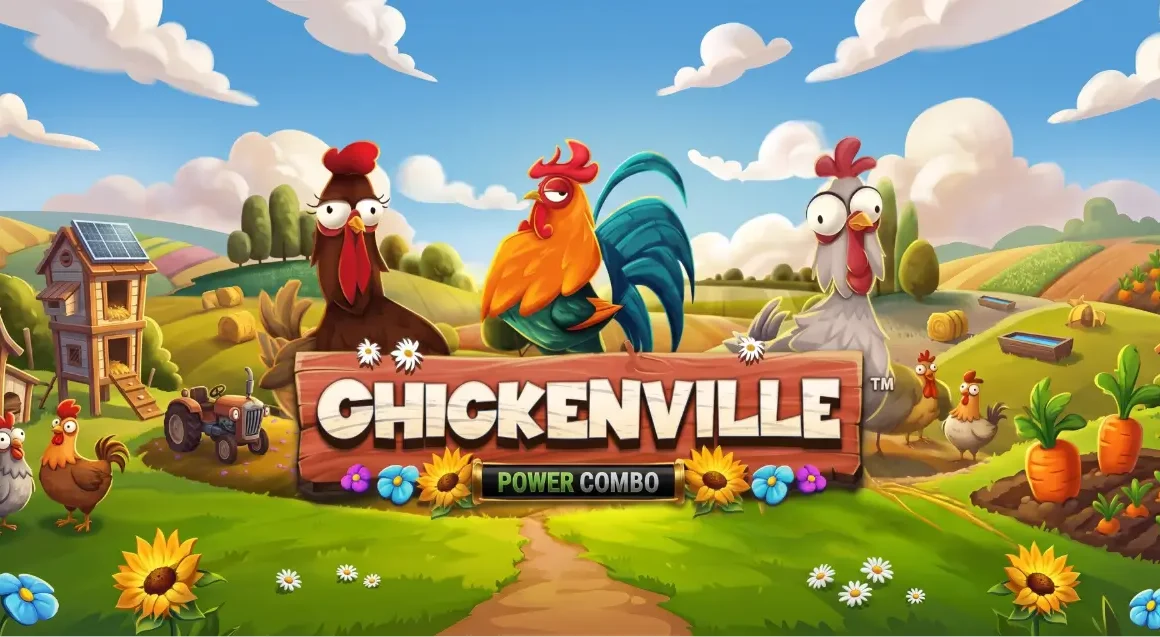
Chickenville Power Combo has been sitting in Games Global lobbies since March 2024, which in slot years is closer to middle age than new release. It runs on the same Link&Win chassis All For One Studios has now dressed up as a devil, a pharaoh, and a farmyard, and that repetition is the first thing worth understanding before you commit a session to it. The numbers on paper are strong enough to justify the click: a 96.20% headline RTP, a 15,000x stake ceiling, and a hit frequency that different trackers can’t even agree on. That disagreement matters more than it sounds like it should, because it changes how the game actually feels to play, not just what it pays over a million spins.
Two years is long enough for a high-volatility Hold & Win release to either cement itself as a lobby staple or quietly slide down the popularity rankings while newer studios ship the same idea with sharper math. Chickenville sits closer to the second category. It never broke out the way some Games Global titles do, and its own studio has since released near-identical mechanics under at least three other skins. That’s not automatically a strike against it — a solid engine is a solid engine regardless of how many times it gets reused — but it does mean the theme is doing all the differentiation work here, not the math. Is this a farmyard skin worth your bankroll in 2026, or a copy-paste release coasting on a name three other games already used?
Math model and mechanics
Start with the RTP, because All For One Studios doesn’t ship one figure — it ships four. Chickenville Power Combo is certified at 96.20%, 94.20%, 92.20%, and 86.90%, and which version you’re actually playing depends entirely on which operator configured your casino’s build. That’s standard practice for Games Global-family studios, but it’s a wider spread than most players expect. The gap between the top and bottom tier is 9.3 percentage points, which on a £100 session is the difference between losing roughly £3.80 on average and losing roughly £13.10. Most UK and EU-facing operators run the 96.20% build, but there’s no guarantee, and the in-game info panel is the only place that confirms it for your specific casino.
Volatility sits at high to very high depending on which tracker you read, and in practice the base game earns that label. The paytable is thin: low symbols (carrots, sunflowers, pumpkins, flower-boots, tractors) pay 0.8x to 1x stake for five of a kind, and the animal premiums (pig, sheep, goat, chicken, cow) pay 2x to 5x stake. A scarecrow wild sits on reels 2, 3, and 4, substituting everything except the scatters. None of that is where the game’s identity lives — it’s a holding pattern between Link&Win triggers, and it plays like one.
What “high volatility” actually means at the table here is worth spelling out rather than leaving as a label. It means long stretches where base-game line hits barely cover your stake, punctuated by a scatter trigger that either fizzles into a small consolation payout or runs deep and produces something worth the wait. If you deposit £50 and play at £1 a spin with no feature buys, expect the bulk of that session to feel flat — the base paytable simply isn’t built to carry the experience on its own. That’s fine if you know it going in and have the bankroll to survive the flat stretches until a Link&Win round lands. It’s a frustrating surprise if you don’t.
Here’s where the data actually contradicts itself. AboutSlots clocks the hit frequency at 33.96% — a win on roughly one spin in three. BigWinBoard’s own spec table lists 24%. Both numbers can’t be describing the same math model, and neither site explains the discrepancy. My read: the higher figure likely includes small feature-related pickups during Link&Win rounds that get counted separately from base-game hits in BigWinBoard’s methodology, but that’s an inference, not a confirmed explanation. Play a session and track your own hit rate before trusting either number — this is one of those cases where the spec sheet and the reel results won’t necessarily agree.
The 15,000x ceiling is the number that pulls players in, and on a 5×3, 40-fixed-payline grid, that’s a genuinely high ceiling for the format. Whether 15,000x is still competitive in 2026 is a separate question, and the honest answer is: it’s fine, not exceptional. It matches every other Power Combo release from this studio exactly — Luck of the Devil Power Combo caps at the identical 15,000x — which tells you this ceiling is a studio-standard, not a Chickenville-specific achievement. Compare it against Nolimit City’s recent output — Tsar Wars at 19,775x, Seamen at 20,000x, the third instalment of that studio’s flagship series at 70,000x — and 15,000x reads like a mid-tier number in 2026’s high-volatility field, not a headline one.
The grid itself is unremarkable by design. Five reels, three rows, 40 fixed paylines that pay left to right — there’s no cluster mechanic, no cascading wins, no ways-to-win structure. That’s a deliberate choice, not a limitation: the base game is a delivery mechanism for scatter symbols, and everything about the paytable reflects that. A five-of-a-kind win on the top-paying cow or pig symbol nets 5x stake, which at a £2 bet is a £10 win — decent for a single line hit, but nowhere near enough to justify grinding the base game for its own sake. You’re playing for scatter drops, full stop.
Betting range runs from €0.20 to €20 per spin, which is a fairly standard band for this volatility tier — wide enough for casual and mid-stake play, narrower than some high-roller-oriented Nolimit City or Hacksaw titles that stretch to £100+ per spin. At the top end of that range, a full-grid Mega Jackpot payout works out to £300,000, which is the number worth keeping in mind when you’re deciding how seriously to take the 15,000x headline: it only means something meaningful in cash terms if you’re betting well above the minimum.
Feature breakdown
Wild symbol
The scarecrow wild appears only on reels 2, 3, and 4 and substitutes for every paying symbol except the scatters. It’s a plain substitution wild with no multiplier attached, no expansion, no stickiness. It exists to smooth base-game variance slightly and does nothing beyond that. Don’t expect it to factor into your session’s big moments.
Link&Win — the core mechanic
Everything that matters in this game routes through Link&Win, and understanding the trigger logic is the difference between playing intelligently and just mashing spin. Three scatter types can appear on the grid — green, red, and blue — and each one activates a different “Power” when it lands. Land more than one scatter type on the same spin and both Powers activate together, stacking the feature. The scatters themselves sit visually distinct from the rest of the farmyard cast, which matters practically: on a busy 5×3 grid full of similarly coloured animal symbols, being able to spot a scatter drop at a glance during fast autoplay is genuinely useful, and All For One Studios’ art team did that part correctly even if the underlying mechanic is borrowed wholesale from its siblings.
Landing two or three scatter types on a single spin is rare but not vanishingly so, and it’s the moment the game is actually built around — a stacked Power round is where the theoretical 15,000x ceiling stops being theoretical and starts being a live possibility. Most triggers, though, will be single-Power, single-scatter events, and that’s where the bulk of your Link&Win exposure will come from over a normal session.
Once triggered, the round opens with three respins on a grid that fills with blank spaces or egg symbols worth 0.5x to 20x stake. The triggering scatter itself transforms into an egg and stays locked on the grid for the duration. Every new egg that lands resets the spin counter back to three, and the round ends only when the grid fills completely or the counter runs out with no new egg landing. Filling every position on the grid also triggers a fixed jackpot: Mini (10x), Major (100x), or Mega (5,000x) stake, depending on which Power is active.
You might ask: why does the reset mechanic matter more than the trigger itself? Because it’s the actual variance driver. A round that lands one egg and then goes cold ends after three dead spins with a token payout. A round that keeps refreshing — landing a new egg every spin or two — can run twenty or thirty respins deep before either filling the grid or finally drying up, and the eventual payout scales with how long it survives. This is the same skeleton every Hold & Win slot uses, going back to land-based Lightning Link machines, but the three-Power branching on top of it is where All For One Studios tries to differentiate the format.
Twin power (green scatter)
Land the green scatter and you’re playing two 5×3 grids simultaneously, each with its own independent spin counter. The triggering scatter is copied into both boards in the same position. This doubles your exposure to the feature without doubling your stake, which is the closest thing to genuine value-add in the whole mechanic — you’re effectively running two shots at the jackpot ladder off a single trigger. In practice this means one board can stall out after three dead respins while the other keeps chaining eggs, so the two boards rarely finish in sync. Because both boards draw from the same underlying egg-value distribution, Twin Power doesn’t change your expected value so much as your variance — you’re more likely to see at least one board produce something, at the cost of splitting your attention across two simultaneous respin counters.
Jackpot power (red scatter)
The red scatter shifts the egg colours into red, blue, and green variants, and each colour ties directly to a jackpot tier: three green eggs award Mini, three blue award Major, three red award Mega. This is the most directly jackpot-focused of the three Powers — you’re not accumulating value across spins so much as racing to collect three matching colours before the spin counter runs dry. The catch is that colour distribution isn’t weighted in your favour: landing two Mega-coloured eggs early and then watching the round end on a string of Mini colours is a genuinely common outcome, and there’s no mechanic that lets you target a specific colour once the round is underway. This is the highest-variance of the three Powers by a wide margin — it either pays the Mega jackpot outright or it produces almost nothing beyond the eggs’ face values.
Collection power (blue scatter)
The blue scatter is the compounding option. Every time at least one new egg lands during a spin, the values of every egg that landed on previous spins in that round get collected and added to your total. In practice this rewards Link&Win rounds that keep refreshing with new eggs rather than stalling — a round that chains six or seven egg landings before finishing pays out meaningfully more than one that fills three positions and stops. In my testing across several triggered rounds, Collection Power produced the most inconsistent results of the three: two rounds chained four times and paid modestly, one stalled after the second egg and returned almost nothing.
The mechanic rewards patience over raw luck in a way the other two Powers don’t — Jackpot Power is essentially a coin flip on colour distribution, and Twin Power is about board coverage, but Collection Power genuinely benefits from a round that keeps extending itself. That also makes it the hardest of the three to read mid-round: a slow start doesn’t mean the round is dead, since a late chain of egg landings can still recover most of the value a faster-starting round would have banked earlier. If you’re buying a single Power rather than the full stack, Collection Power is the one that rewards knowing this going in rather than reacting to the first two or three spins.
Feature buy
Seven feature buy configurations are available, priced from 23x to 117x stake, letting you select a specific Power or a combination of two or three at once. Buying all three Powers stacked together sits at the top of that range and is the closest thing to guaranteeing a big-swing round, though it’s still not a guaranteed win — you’re buying entry to the mechanic, not the jackpot itself. Compared to what some studios charge for bonus buys — Nolimit City’s Brick Snake 2000 asks 8,360x for its top-tier buy — 117x is genuinely reasonable for a jackpot-tier entry.
One honest catch across all three Powers: none of them guarantee you reach the Mega jackpot. The respin counter can run out with the grid two-thirds full, and there’s no pity mechanic that finishes the job for you. That’s the trade-off for keeping the feature buy prices this low.
For context on what 23x to 117x actually buys: at a £1 stake, the cheapest single-Power buy costs £23 and the full triple-Power stack costs £117. Neither number is trivial money to spend on a single spin, but set against genre norms it’s restrained — plenty of modern bonus-buy slots price their top-tier option at 100x to 200x stake as standard, and Nolimit City’s outlier pricing on titles like Brick Snake 2000 pushes well past that. If you’re going to engage with this game seriously, the buy menu is the more efficient path to the mechanic that actually matters, since base-game triggers are, by nature of a 40-payline scatter-drop slot, going to be infrequent.
The 2026 perspective
There’s no Megaways version, no Power Reels expansion, and no sequel to Chickenville itself — this is the only build of the game, and nothing in All For One Studios’ current release slate suggests one is coming. What Chickenville Power Combo is instead is one entry in a flat series that shares an identical engine: Luck of the Devil Power Combo, Queens of Ra Power Combo, and Eggz! Power Combo all run the same Link&Win-with-three-Powers structure under a different skin. Luck of the Devil, released two months earlier in January 2024, is the closest sibling — same 96.2% / 94.2% / 92.2% RTP tiers, same 15,000x ceiling, same three-scatter Power system, and a hit frequency of 32.45% that lines up much closer to AboutSlots’ figure for Chickenville than BigWinBoard’s does. If you’ve played one Power Combo release, you have functionally played this one — the theme change is the only meaningful variable, and BigWinBoard’s own review calls the repetition out directly, rating the game 5/10 for “feature reuse.”
That repetition is worth sitting with for a moment, because it’s not a minor stylistic complaint — it’s a structural one. Three games from the same studio, released within roughly a year of each other, share not just a mechanic family but an identical feature buy price range, an identical jackpot ladder, and an identical max win. The devil theme, the Egyptian theme, and the farmyard theme are reskins in the literal sense: new symbols and new background art sitting on top of unchanged math. For a player deciding which Power Combo entry to try, the honest answer is that it barely matters which one you pick — pick the theme you find least annoying to look at for an hour, because the underlying odds don’t move.
Set outside the studio’s own catalogue and the picture shifts. Push Gaming’s Fat Rabbit covers similar farmyard territory at a 96.45% RTP on a 5×5 cluster grid, built around an entirely different Harvest Feature with expanding wilds — no jackpot ladder, no Link&Win, no operator-configurable RTP spread. It’s a cleaner, higher-RTP alternative if the farm theme is what you’re chasing rather than the mechanic, and the single fixed RTP means you’re not gambling on which build your casino happens to have deployed.
The more useful mechanical comparison is Wolf Gold from Pragmatic Play, which popularised the Hold & Win format this genre borrows from. Wolf Gold runs a single, non-configurable 96.01% RTP, medium volatility rather than high, and a 1,000x Mega Jackpot ceiling through its Money Respin feature. That’s a fraction of Chickenville’s 15,000x headline number, but Wolf Gold’s jackpot triggers far more reliably and the sessions are calmer — it’s built for players who want the collect-and-fill sensation without the drought stretches. Chickenville trades that consistency for ceiling: bigger number, longer waits, and an RTP that can quietly drop 9 points depending on which casino you’re sitting in. If you’ve never played a Hold & Win slot before, Wolf Gold is genuinely the better entry point — Chickenville assumes you already understand the genre’s rhythms and are specifically chasing the higher variance.
No progressive jackpot is on offer here — every prize tier is fixed, which at least means the Mega jackpot value doesn’t fluctuate with network activity the way a progressive would. Buy-bonus availability is confirmed and priced reasonably against the category. Put those two facts together and the profile is clear: this is a feature-buy player’s game first and a base-game grinder’s game a distant second. Recreational players spinning at default bet with no buy-in will see long, flat stretches between Link&Win triggers, and the 24-33.96% hit frequency range (whichever figure you trust) doesn’t change that the meaningful money sits entirely inside the bonus round.
There’s also the question of where this fits into a 2026 lobby that’s increasingly dominated by tumble-mechanic and cluster-pay releases from Pragmatic Play and Hacksaw Gaming. Link&Win as a format hasn’t disappeared, but it’s no longer the genre driving new player interest the way it did between 2020 and 2023. Chickenville isn’t going to pull in players who’ve moved on to newer mechanics; its audience is specifically the segment that already likes Hold & Win and wants another flavour of it. That’s a smaller net than the game’s marketing implies, and it’s worth being honest about before spending a session on it expecting something the mechanic simply isn’t built to deliver.
Verdict
Chickenville Power Combo is a mechanically sound, thematically forgettable slot that adds nothing to a formula All For One Studios has now shipped at least four times. The 15,000x ceiling and three-Power Link&Win system are legitimately well-built — Twin Power’s dual-grid structure in particular is a smarter idea than most Hold & Win clones bother with — but the single number that limits this game isn’t the max win, it’s the RTP spread. A 9.3-point gap between the best and worst certified build means the exact same game can be a fair 96.20% return or a below-average 86.90% one, and you won’t know which you’re getting until you check the info panel.
Play this if you’re a feature-buy player who wants a big jackpot ceiling, doesn’t mind that you’ve likely played the identical mechanic under a different skin already, and will check the RTP build before staking real money. The Twin Power branch in particular rewards players willing to buy in rather than wait for a natural trigger — it’s the one Power of the three that meaningfully changes the shape of a session rather than just its ceiling.
Skip it if you want a fresh mechanic, want a lower-volatility session, or already have Luck of the Devil Power Combo or Queens of Ra Power Combo in your rotation — you’re not missing anything new by leaving Chickenville alone. Recreational players on a tight session bankroll should also think twice: the base game’s flat paytable and the 24–33.96% hit frequency spread mean long cold stretches are the norm, not the exception, and there’s no lower-volatility mode to fall back on if the swings aren’t landing for you.
Bottom line: check which RTP build your casino runs before you stake anything above minimum bet, budget for the feature buy if you want to actually see the mechanic that matters, and don’t expect this farmyard skin to feel meaningfully different from the three other animals All For One Studios has already put through the same engine.
For the demo, SlotCatalog carries a freeplay build with the default 96.20% RTP and full access to the feature buy menu, which is the sensible place to test the three Powers against each other before deciding whether the mechanic suits your bankroll — better to burn demo credits finding out Jackpot Power’s variance isn’t for you than real stakes.