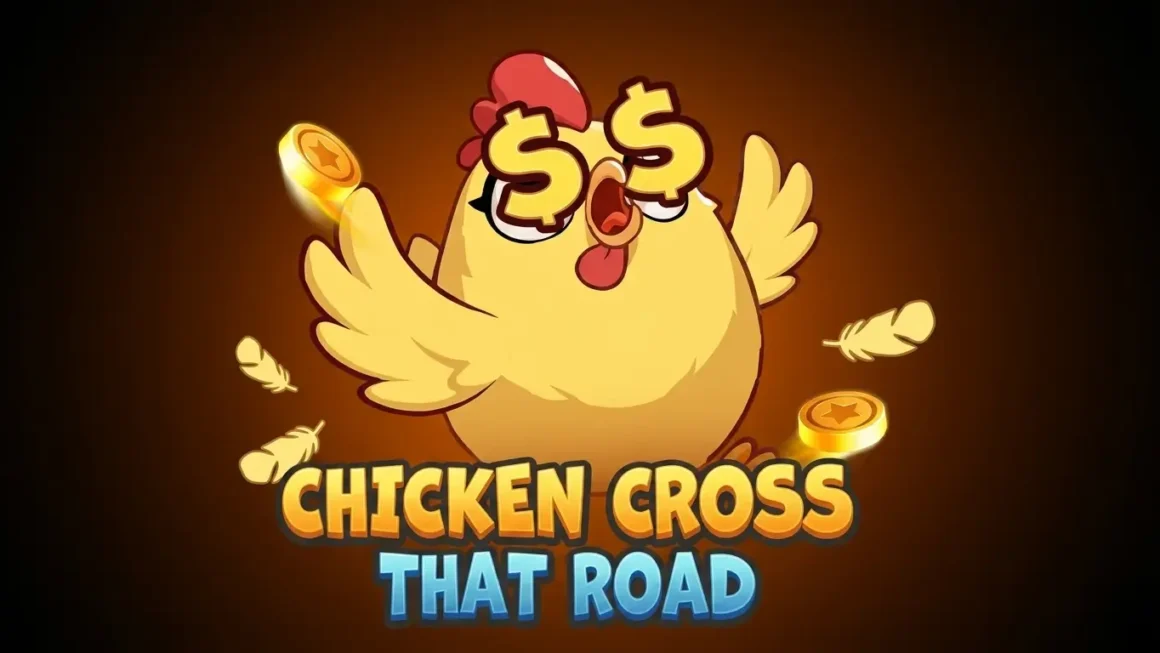
There is an old joke — possibly the oldest joke in human history — about why a chicken crosses the road. The punchline, as everyone knows, is “to get to the other side.” What nobody told us back then is that by 2025, getting to the other side could be worth a few hundred times your original bet, and that tens of thousands of casino players would be sitting at their phones at two in the morning, white-knuckling every lane, screaming internally at a cartoon bird.
Welcome to Chicken Cross That Road by Ideal Gaming — one of the latest entries in the road-crossing crash game genre that has quietly eaten a significant chunk of the online casino market over the past couple of years.
Is it worth your time and your bankroll? That is exactly what we are here to figure out. No fabricated numbers, no made-up RTP claims lifted from thin air, no fictional “I won $10,000 on my third spin” anecdotes. Just an honest, ground-level look at what Ideal Gaming has built, how it stacks up against its feathered competition, and whether you should actually be playing it.
A Bit of Background: The Genre That Came Out of Nowhere
Before we get into the game itself, let us spend thirty seconds on why chicken road-crossing games even exist as a casino category in 2026.
The blueprint goes back to Frogger — the 1981 arcade classic where you guided a frog across a highway and a river without getting flattened. Fast-forward to 2014, and Crossy Road turned that concept into a mobile smash with 200 million downloads by 2018. Somebody in the iGaming industry looked at those numbers and thought: what if we added a cash-out button?
That somebody — or several somebodies working independently — cracked open a genre. InOut Games dropped Chicken Road and it went viral, partly because it plays well but mainly because it looks incredible on a streaming clip: multiplier creeping up, tense music, one more step, feathers everywhere. Upgaming followed with Chicken Cross. Roobet built Mission Uncrossable. Evoplay licensed SlotCatalog’s CrossyRun mechanic for Uncrossable Rush. The genre exploded.
Ideal Gaming entered this space with Chicken Cross That Road — a title that is about as on-the-nose as it gets, which is actually a smart SEO move and a sign the developer knows exactly which audience it is after.
What Kind of Game Is This, Exactly?
Let’s get the taxonomy right, because it matters.
Chicken Cross That Road is not a slot. There are no reels, no paylines, no symbol combinations, no bonus spins triggered by landing three scatter chickens. If you are here expecting Gates of Olympus with a poultry makeover, wrong door.
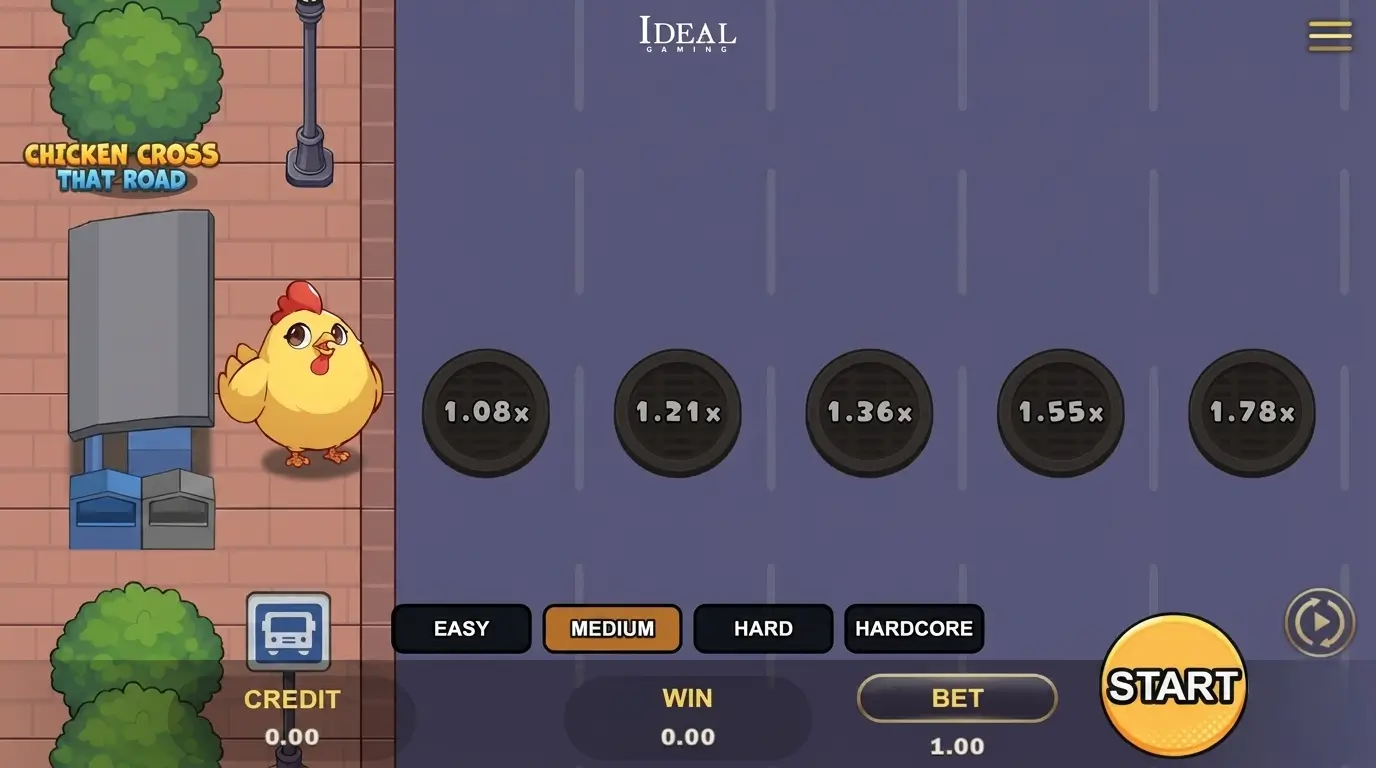
This is a step-multiplier game, sometimes called a crash-adjacent game, sometimes just “a road-crossing game” by players who have moved past caring about genre labels. The core loop works like this:
- You place a bet.
- Your chicken appears at the start of the road.
- You send the chicken forward, one lane at a time.
- Each successful crossing increases the multiplier on your stake.
- At any point, you can hit Cash Out and pocket the current multiplier applied to your bet.
- If a vehicle hits the chicken before you cash out, the round ends and your bet is gone.
That is the whole game. It is not complicated. It is also surprisingly hard to walk away from, which is either a testament to good game design or a warning sign, depending on how you look at it.
The tension comes from a very human psychological trap: the multiplier keeps climbing, each step feels “probably safe,” and stopping at, say, 4x when 8x is right there feels like leaving money on the table. This is the same mechanism that makes crash games like Aviator work. The difference here is visual and interactive — you are guiding a character through physical space, not watching a graph go up. That added layer of narrative makes the risk feel more personal, which makes the cashout decision feel harder.
Difficulty Levels: Choose Your Own Adventure (Into Ruin)
Like virtually every game in this genre, Chicken Cross That Road offers multiple difficulty settings. This is the feature that makes the genre genuinely flexible for different player profiles rather than being a one-size-fits-all proposition.
The exact names of Ideal Gaming’s difficulty tiers and the precise probabilities per step have not been independently published in verified third-party databases at the time of writing — which is worth saying plainly rather than copying numbers from a competitor’s game and slapping them on this one. What the genre convention tells us is how these tiers work structurally:
Lower difficulty levels give the chicken more safe paths through each lane. The chicken is more likely to survive, the multipliers climb more slowly, and the ceiling before you reach the “golden egg” equivalent is lower. These modes are designed for players who want to grind modest, steadier returns — or for anyone new to the genre who is still figuring out when to cash out.
Higher difficulty levels reduce the safe paths dramatically. The chicken is in genuine danger at almost every step. Multipliers escalate much faster, the theoretical ceiling can reach astronomical figures, and your bankroll can evaporate in three rounds if you are not careful. These modes are for players who genuinely enjoy variance and have bankroll management sorted before they sit down.
The important thing to understand — and something many reviews of this game type gloss over — is that the RTP figure you will see cited for these games is typically calculated at a specific difficulty level, usually the easiest one. Play at Hardcore equivalent difficulty, and the effective house edge behaves differently. That is not necessarily bad, but it is information you need before choosing your mode.
If and when Ideal Gaming publishes a full math sheet or a certified paytable breaking down probabilities per step per difficulty, that is the source to trust. Until then, the sensible move is to use the demo mode at each difficulty level to get a feel for how quickly the chicken tends to die before committing real money at higher settings.
Reading the Road: How Each Lane Works Against You
Here is something most genre overviews skip over because it requires actual math rather than vibes-based commentary.
In a road-crossing step-multiplier game, each lane you cross is an independent probability event. The game is not tracking your history and deciding to kill your chicken at step seven because it feels you have had a good run. The RNG runs fresh for every single step. This matters because it changes how you should think about the decision to continue.
At each step, the game is rolling dice invisibly. In Easy mode, those dice are heavily weighted in your favour — the lane is almost certainly safe. In Hardcore mode, those same dice are brutally balanced: the chicken has a meaningful chance of dying at every single crossing, which is why the multipliers at that level become so large in theory. The math has to compensate for the survival probability.
What this means practically: the multiplier you see on screen is not just a reward for having survived, it is a mathematical expression of how likely it was that you would survive to that point. The 52,000x multiplier sitting at step 20 of Hard mode exists because surviving 20 consecutive Hard-mode crossings is genuinely unlikely. Most attempts will not get there. The ones that do collect a number that reflects that rarity.
Understanding this does not change the game, but it does change your relationship to the cashout button. You are not “giving up” when you cash out at 5x in Hard mode. You are banking a return that reflects real risk successfully navigated. That is a legitimate win. The chicken that gets to 50x in Hard mode deserves a statue, not a template for your average session expectation.
Playing in Demo Mode: Actually Do This
Nearly every serious casino game in this genre offers a free-play demo version, and Chicken Cross That Road is no exception to that standard. Use it.
The demo does everything the real-money game does except involve actual money. Same mechanics, same difficulty levels, same cashout decisions, same chicken dying at step four when you were sure it was going to make it. The only difference is that the multiplier at the end of a successful run does not translate into a withdrawal.
Why does this matter beyond the obvious “practice before you spend” advice? Because the specific feel of a cashout moment is something you cannot learn from reading a review. You genuinely cannot know whether you will instinctively cash out at 3x or let it ride to 10x until you have run through thirty or forty demo rounds and watched your actual decision-making pattern emerge. Some players discover they are chronic over-holders who never cash out early enough. Others find out they panic-cash at the first sign of a rising multiplier and leave most of the value on the table.
Demo mode is where you learn which player you are, for free, before that information costs you anything. The demo also lets you test each difficulty level to understand the survival rhythm before picking one for real-money play. Easy mode will feel almost boring at first — the chicken just keeps walking. Hardcore will feel like a lottery that occasionally remembers you exist. The middle tiers are where most players end up.
One other use for demo mode: testing the auto cashout feature. If Chicken Cross That Road offers the ability to set a target multiplier and have the game exit automatically when it hits, practice setting and trusting that feature in demo mode first. The hardest part of auto cashout is not configuring it — it is not manually overriding it when the multiplier blows past your target and the screen is screaming at you to stay in.
The Cashout Mechanic: Where All the Drama Lives
Every step in Chicken Cross That Road ends with a binary decision: go forward or cash out. That is it. That is the whole strategic layer of the game.
It sounds trivial. It is not.
The game is essentially a live stress test of your relationship with risk. You will absolutely know players — maybe you are one of them — who set a target of 3x, reach 3x, think “one more lane won’t hurt,” push to 4x, think “one more,” and then watch the chicken become roadkill at 6x, walking away with nothing when they could have locked in six times their stake three steps ago.
You will also know players who cash out at 1.5x every single time and never experience the high end of the multiplier range at all. Mathematically safer, but not exactly the experience you came for.
The sweet spot — if there is one — is having a cashout target decided before each round starts and sticking to it regardless of what the screen is showing you. That requires actual discipline, which is harder than it sounds when the multiplier is sitting at 7x and climbing.
Useful features to look for in Ideal Gaming’s implementation: auto cashout (set a multiplier target and the game cashes out automatically when it hits) and autoplay (repeat rounds automatically with preset parameters). Both of these are standard in the genre and are genuinely helpful for keeping emotional decisions out of the equation. If Chicken Cross That Road offers these tools, use them.
The “Provably Fair” Question
In the broader chicken road-crossing genre, provably fair certification — where players can independently verify the outcome of each round using cryptographic hashes — has become something of a selling point. Games like Chicken Road by InOut Games and Mission Uncrossable by Roobet lean heavily on this.
Whether Ideal Gaming’s Chicken Cross That Road operates on a provably fair system or a standard certified RNG is a question worth asking your casino platform directly. The presence or absence of provably fair mechanics does not make the game rigged either way — regulated RNG certification is a legitimate and widely used alternative — but it does affect how much independent verification you can do on any given round’s outcome.
If your casino displays Ideal Gaming’s certification information in the game info panel, that is the document to check. Licensing body, RNG certification, and audit records are the three things worth knowing.
Visuals and Sound: Keeping It Honest
One thing that characterises almost every game in this genre is a deliberate commitment to simple, arcade-style visuals. This is not an accident.
Road-crossing games are built for fast decisions and repeat play. You are not meant to be admiring the background art — you are meant to be watching the chicken and the multiplier. Overloading the screen with visual complexity would work against the gameplay loop. The genre’s aesthetic is therefore functional by design: clear lanes, visible multiplier counter, obvious cash-out button, cartoon chicken protagonist.
Whether Chicken Cross That Road has warmer, more characterful art than competitors, or whether it goes colder and more minimal, affects the vibe of long sessions. The genre leaders — particularly InOut Games with its wild-eyed, tongue-out chicken character — have found that giving the bird a bit of personality makes players more emotionally invested in its survival, which makes each close call land harder. If Ideal Gaming has done similar character work on their chicken, that is a genuine plus.
Audio is typically kept simple in these games: a short looping track, some squelchy sound effects when the chicken moves, a crash effect when the round ends. Nothing you would call a sophisticated soundscape, but then nobody is playing this game for the soundtrack.
The real visual test is mobile performance. The genre is heavily mobile-played, and the best implementations translate the tap-to-advance mechanic perfectly — one tap moves the chicken, the cash-out button is thumb-reachable, and the multiplier display is readable on a small screen without squinting. HTML5 delivery is standard across the genre, meaning no downloads and smooth cross-device play.
How Does It Compare to the Competition?
The road-crossing genre has several established players, and any new entry from a provider like Ideal Gaming is going into a market where players already have opinions about what good looks like.
Chicken Road by InOut Games is currently the genre benchmark. Its 98% RTP, four difficulty modes, €0.01–€200 betting range, and Provably Fair certification have made it the most widely distributed title in the category. The visual design — the anarchic-looking cartoon chicken, the flaming manhole covers — has become the genre’s face. It is also the game most non-player reviewers accidentally describe when they mean to review something else, which is a backhanded compliment to how dominant it is.
Chicken Cross by Upgaming goes a different direction with a 99% RTP — the highest theoretical rate in the genre — and a four-level system peaking at a “Daredevil” mode with up to 1,000x multipliers. Its distribution is currently limited to a small number of markets, which makes it somewhat of a specialist choice.
Mission Uncrossable by Roobet is the crypto-casino native version — provably fair, crypto-first, and positioned at a more adventurous audience. Estimated RTP sits in the 94–98% range depending on the source.
Uncrossable Rush by Evoplay launched under SlotCatalog’s CrossyRun licensed mechanic in June 2025, with up to 10,000x maximum payout. It is the newest genre entrant from an established provider and is already showing up in broad casino networks.
Where does Ideal Gaming’s Chicken Cross That Road fit in this lineup? That depends on the specifics — RTP, betting range, max win cap, and distribution — that require direct verification from the provider. A game with a 98%+ RTP, solid mobile implementation, and broad casino network integration would compete comfortably with the genre leaders. A game with a lower RTP and limited availability would be a more niche proposition.
What Ideal Gaming can bring that smaller genre players often cannot is operator trust, integration stability, and potentially better casino placement — if the company has existing relationships with major casino aggregators. Whether those relationships translate into Chicken Cross That Road being prominently featured at well-regarded casinos is something worth checking before you go searching for the game at random.
Bankroll Reality: A Few Things Worth Saying Plainly
Every review of a chicken road-crossing game is required, by unwritten law, to include the phrase “the 98% RTP means the house edge is razor-thin.” Let us unpack that statement instead of just repeating it.
RTP is a long-run theoretical figure. It means that over millions of rounds, the game returns approximately X% of total money wagered to players as winnings. It says absolutely nothing about what happens in your session tonight, which might consist of forty rounds and therefore has no statistical relationship to the long-run average whatsoever.
A 98% RTP game still has a 2% house edge. That 2% will get you in a short session — or rather, the variance will, because short sessions swing wildly above and below the theoretical return. The advantage of a high RTP is that you are getting eaten slower, on average, than you would be at a 95% RTP game. That is real, and it matters for session length. But it is not a guarantee of returns, and it is not a substitute for having a loss limit before you sit down.
The other number worth understanding is the maximum win cap. Theoretical multipliers in this genre can reach comically large numbers — we are talking millions of times the stake in some difficulty configurations. In practice, casinos and/or developers impose a maximum win ceiling (typically expressed as a cash amount rather than a multiplier). InOut Games caps Chicken Road at €20,000 per round regardless of the theoretical multiplier, for example. If Chicken Cross That Road has a similar cap — and most implementations do — then chasing a 50,000x multiplier at Hardcore difficulty is a mathematical exercise, not a realistic objective. Know the cap before you play.
Who Actually Enjoys This Game?
Let us be direct about the player profile, because “suitable for everyone” is not a real answer.
Chicken Cross That Road works well for:
Players who find traditional slots too passive. If staring at spinning reels feels like watching someone else make decisions, the active cashout mechanic here puts you back in the driving seat — or rather, in the chicken’s lane.
Players who prefer short, discrete sessions. Rounds last seconds. You can play ten rounds in five minutes and walk away. This is not a game that traps you in an hour-long bonus round.
Mobile-first players. The tap-based mechanic translates perfectly to phones. It is built for thumb play.
Players who like to experiment with risk profiles. Four difficulty settings is a meaningful range. The game genuinely plays differently at Easy versus Hardcore, not cosmetically differently.
Chicken Cross That Road is probably not for:
Players seeking progressive jackpots or large guaranteed prize structures. There is no jackpot here, no free spins, no bonus game triggered by symbols. The payout ceiling exists, and it is set by the platform.
Players who want cinematic production values. This genre is not competing with high-production slots on visual spectacle. It is competing on tension and decision-making.
Players with poor bankroll discipline. The “one more lane” mechanism is genuinely dangerous for anyone who struggles to walk away. The speed of the game makes it easy to blow through a session budget faster than you expect.
The TikTok Effect: Why This Genre Blew Up
It would be intellectually dishonest to write about chicken road-crossing games in 2026 without acknowledging the role social media played in turning a niche arcade format into a mainstream casino category.
This genre is extraordinarily clip-friendly. A round of Chicken Cross That Road where the multiplier climbs to 80x before the chicken gets flattened takes under two minutes and produces a complete emotional arc — anticipation, escalation, disaster — that fits perfectly into short-form video content. Streamers figured this out early. Watching someone else play the game, particularly watching the moment they decide whether to cash out or push another lane, is genuinely compelling viewing in a way that a slot spin is not. A slot spin has a result but not a decision. The road-crossing format has both.
The result is that a significant portion of players arriving at games like Chicken Cross That Road have already watched it being played dozens of times before they have ever placed a bet themselves. They know the feel of the multiplier climb, they have seen the spectacular crashes and the enormous cashouts, and they arrive with a pre-formed idea of what the game experience should feel like. This is both an advantage (no learning curve) and a potential trap (they are often chasing a highlight-reel version of the game rather than the statistical average version).
If you are coming to Chicken Cross That Road via streaming content, worth remembering: streamers play on camera with high stakes specifically to produce dramatic moments. Your session at moderate stakes will feel different. Both experiences are valid. Just do not mistake the streamer’s 200x Hardcore run for a representative outcome.
Strategy Notes That Are Actually Useful
Most “strategy guides” for crash and road-crossing games are dressed-up bankroll management advice with multiplier targets attached. There is nothing wrong with that — bankroll management is the strategy — but let us frame it usefully rather than dressing it up as insider knowledge.
Set the cashout target before the round, not during it. The time to decide when you are leaving is before you see the multiplier climbing. Once the number is moving and the chicken is hopping, your brain is in a different mode — one that is bad at rational calculation and good at telling you that 8x is so close, just one more step. Pre-commitment is the only reliable defence against in-round decision drift.
Keep individual bet size proportional to your session budget. The conventional framing is somewhere in the 1–5% of session bankroll per bet range, which sounds conservative but allows you to run enough rounds that the game’s statistical properties have a chance to express themselves rather than going bankrupt in a five-round cold streak. At Hardcore difficulty specifically, losing five consecutive rounds is not unusual and needs to be survivable.
Difficulty and target multiplier should match. If you are playing Easy mode with a cashout target of 100x, you are likely to be waiting a very long time between successful runs while grinding minimal returns most of the time. The mode should align with the multiplier range you are actually targeting. Easy mode is appropriate for lower targets (2x–10x range, roughly); Hardcore is where the big theoretical numbers live, at correspondingly high risk.
Do not chase. This sounds obvious and is nevertheless the most commonly broken rule in the genre. If you lose five rounds in a row on Hard mode, the correct response is not to increase your stake to recover losses. The next round has exactly the same probabilities as the first round. The streak has no memory, and neither does the RNG.
Use auto cashout when you have a specific target. Human reaction time and emotional state are unreliable. If your plan is to exit at 4x, configure the auto cashout at 4x and let it handle the execution. You can always manually override downward if the chicken dies before reaching your target, but you cannot manually override your own tendency to say “just one more lane” if you are watching the multiplier live.
The Genre in 2026: Crowded but Growing
The road-crossing format went from novelty to established casino category faster than almost any other format in recent iGaming history. In early 2026, you can find chicken-themed step-multiplier games at the majority of mid-to-large online casino platforms, with the number of new releases from providers big and small showing no sign of slowing.
This creates a specific challenge for any new entry: differentiation. The core mechanic is identical across every title in the category. You cannot patent the concept of a cartoon animal crossing a road while accumulating multipliers — the format is too generic, the genre already too crowded. What a new game needs to compete is either a meaningful difference in the math (RTP, max win, difficulty probabilities), a genuinely better user interface, superior casino distribution, or some visual or mechanical hook that makes it more fun to play or watch than the alternatives.
Ideal Gaming entering this space with Chicken Cross That Road is a reasonable business decision. The audience is proven, the format is understood, and the development costs for a game this mechanically simple are not prohibitive. Whether the execution matches the opportunity depends on the specifics — the ones worth verifying before playing for real money.
What the genre’s growth does mean for players is broadly positive: more competition typically drives better player terms. Higher RTPs, wider betting ranges, sharper cashout features, broader casino availability. If Chicken Cross That Road is going up against InOut Games and Upgaming for the same audience, Ideal Gaming has a real incentive to match or beat those games on the metrics that actually matter.
Final Verdict
Chicken Cross That Road by Ideal Gaming drops into a genre that has already proven it can hold player attention and generate genuine excitement without reels, paylines, or elaborate bonus structures. The road-crossing step-multiplier format works — the psychological hook of incrementally increasing stakes under time pressure is real, and the visual metaphor of guiding a character through physical danger makes it feel more personal than a rising multiplier graph.
Whether this specific implementation is worth your time and money over the genre leaders depends on details that require direct verification: RTP at each difficulty level, difficulty mode parameters, max win cap, certification body, and casino availability. Those are the facts to establish before committing real money. The genre itself is solid. The concept is proven. The joke about why a chicken crosses the road has survived for well over a century and shows no signs of losing its punchline.
In this version of the answer, the chicken crosses the road because your cashout target is sitting right on the other side. Whether you actually hit that button before one more lane is between you and your impulse control.
Try the demo first. Set your target before you start. And for the love of the golden egg, do not play Hardcore on your first session.