Chicken Fire landed on 22 July 2026, which makes it one of the newest entries in BGaming’s #Classic range rather than an established title with years of player data behind it. That matters, because everything below is first-impression math, not five years of aggregated spin history. It arrives into a Hold and Win category that’s one of the most saturated corners of the slot market right now — every studio from Playson to Hacksaw Gaming has its own 3×3 fruit-and-jackpot machine, and most of them share a near-identical skeleton.
What separates Chicken Fire on paper is a 95.90% RTP sitting below the 96–97% band most of its direct rivals occupy, paired with a 5,000x max win and a genuinely unusual Chicken Multiplier mechanic that stacks additively rather than multiplicatively. Built by BGaming in partnership with mobile specialist LudexPlay, this is also one of the first titles in the studio’s catalogue designed vertical-first rather than adapted down from a desktop layout. Whether that mobile-native build compensates for a below-par payback figure is the question this review actually needs to answer.
Math model and mechanics
Start with the number that should give any experienced player pause: 95.90% RTP. That’s not a rounding-error gap from the 96–97% most modern Hold and Win releases target — it’s a genuine half-to-full-point deficit, and BGaming has not published an alternative operator-configurable RTP band for Chicken Fire the way some studios do for their bigger releases. On the figures currently available, 95.90% is the number, full stop. Over a 1,000-spin session at a $1 base bet, that half-point gap versus a 96.5% title works out to roughly $5 more retained by the house across the session — not dramatic, but it compounds over volume, and it’s the kind of gap that shows up in long-run bankroll tracking even when it’s invisible spin to spin.
Volatility is classified as medium to medium-high depending on the source, which in practice means this isn’t a game built around constant small hits. Hit frequency sits at 1 in 9, so roughly one spin in nine returns something — a Coin-and-Collect combination in the base game, a straight paying combo, or entry into the Bonus Game itself. That’s a reasonably active hit rate for a Hold and Win title; plenty of comparable 3×3 machines run closer to 1 in 12 or worse before the bonus round even enters the picture.
There’s a genuine conflict in the source data worth flagging rather than papering over: one review lists the betting range as 0.20 to 100 per spin, while another states spins start at 1.00. BGaming hasn’t published an official paytable confirming which is accurate at time of writing, and operator-level bet configuration for Coin Value slots frequently varies by casino regardless. Treat the lower bound as unconfirmed and check the in-game bet selector before you commit real money — this is exactly the kind of detail that differs between a $0.20 minimum session and a five-times-higher $1.00 floor.
The grid itself is compact: 3 reels, 3 rows, 5 fixed paylines, all paying left to right. There’s no ways-to-win engine and no cascading mechanic here — Chicken Fire is a classic-format machine wearing a modern bonus system, not a modern math engine wearing a retro skin. That distinction matters for anyone expecting the volatility of a Megaways or cluster-pays title; the base game itself plays tight and simple, with essentially all of the game’s variance loaded into the Bonus Game.
Five paylines on a 3×3 grid is a genuinely narrow win structure compared to the category’s higher-coverage entries — Chicken Rush, from the same studio, runs 3,125 ways to win on its own 5×5 layout. That’s not a fair apples-to-apples comparison given the different grid sizes, but it illustrates the design philosophy at work here: Chicken Fire isn’t trying to win on base-game win frequency or coverage. It’s a two-act structure — a deliberately tight base game whose only real job is to deliver you into the Bonus Game, where all of the interesting math actually lives. If you play this expecting steady, well-distributed base-game returns the way you’d get from a ways-based slot, the session will feel dry between hits. That’s by design, not a flaw, but it’s worth knowing before you sit down with a small bankroll and a 1-in-9 hit rate standing between you and any meaningful action.
On the max win: 5,000x stake is the headline figure, though one source describes payouts scaling up to 1,000x within the Bonus Game itself before the top jackpot tier is layered on top. Read that as two separate numbers doing two separate jobs — 1,000x is roughly what a strong but non-jackpot Bonus Game run delivers, and 5,000x is the ceiling once you factor in landing the Grand Jackpot on top of accumulated Coin values. Neither figure is confirmed against an official BGaming paytable at review time, so both should be treated as the studio’s own marketing figures rather than independently verified math.
Put 5,000x into cash terms at a $1 base bet and you’re looking at a $5,000 ceiling on a single round — respectable for the Hold and Win category, but a full order of magnitude below what Hacksaw Gaming’s higher-end catalogue routinely publishes (10,000x-plus on several titles), and well short of the 91,000x extremes some 2026-era cluster-pays releases have pushed toward. Chicken Fire isn’t competing in that bracket, and it shouldn’t be judged against it. Within its actual peer group — compact 3×3 Hold and Win machines with fixed paylines — 5,000x sits comfortably mid-to-upper pack, ahead of Playson’s Pink Joker at 1,000x and roughly double Hacksaw’s Tres Pinatas at 2,500x.
Feature breakdown
Wild symbol
The Wild substitutes for every regular paying symbol and pays out on its own line like any standard symbol, but it does not substitute for Coin or Collect symbols — those run on a separate trigger logic entirely. This is a base-game-only symbol with no attached multiplier of its own, which is a meaningfully more conservative design than competitors that load their Wilds with x2–x10 multiplier ranges. The realistic contribution here is incremental line wins, not a standalone win driver. The catch: because the Wild carries no multiplier, it does less heavy lifting for your session RTP than the equivalent symbol in, say, BGaming’s own Chicken Rush, where Wilds carry x2 to x10 multipliers as standard.
That’s worth dwelling on for a moment, because it’s the single clearest mechanical explanation for why Chicken Fire’s RTP sits half a point below its studio sibling. A flat, non-multiplying Wild on a 5-payline classic grid simply contributes less expected value per hit than a Wild that can occasionally deliver a 10x line win on its own. None of the sources reviewed break down BGaming’s internal RTP contribution model by symbol, so this is analytical inference rather than confirmed math — but the design choice is consistent with the overall payback gap, and it’s the kind of detail a specs table alone won’t tell you.
Coin and Collect symbols
Coins land exclusively on reels 1 and 3, carrying values of 1x, 2x, 3x, 5x, 7x, 10x, or 15x the stake. The Collect symbol appears only on reel 2. When a Collect lands alongside one or more Coins on the same spin, every visible Coin value is summed and paid instantly as part of that spin’s win. This is the base game’s primary win engine, and it’s also the trigger condition for the Bonus Game — a bigger, more loaded version of the same Coin-and-Collect logic.
The mechanical limitation worth stating plainly: with Coins restricted to just two reels and Collect restricted to one, the base-game version of this combo is a low-frequency, low-ceiling event. It pays instantly and it pays reliably relative to a full jackpot chase, but don’t expect it to be the mechanism that delivers your session’s headline win. That’s what the Bonus Game exists for.
Do the arithmetic on a base-game Coin-and-Collect hit and the ceiling becomes obvious fast: with two Coin positions available and a maximum individual value of 15x each, the absolute best-case single-spin outcome outside the Bonus Game is 30x stake — two maxed Coins summed by a Collect. Most hits will land well below that, since 1x, 2x and 3x values are the more commonly weighted outcomes on any Coin Value slot of this type. That 30x ceiling on base-game Coin wins is precisely why the 5,000x headline figure only makes sense once you understand it belongs almost entirely to the Bonus Game and its stacked Chicken Multipliers, not to anything achievable in ordinary spin-by-spin play.
Bonus Game (Hold and Win)
Landing Coins with a Collect shifts play into the Bonus Game proper, still on the same 3×3 grid, now running as a respin-based Hold and Win round. Collect symbols become sticky the moment they land inside the feature, locking their position for the remainder of the round, while fresh Coin values continue to populate the grid on each respin. The round ends when the respin counter runs out without a new qualifying symbol landing — standard Hold and Win logic, no deviation from the genre norm here.
Chicken Multipliers
This is the one genuinely distinctive mechanic in Chicken Fire, and it’s worth pausing on why it works differently to almost every rival Hold and Win multiplier system. When the wild-eyed chicken symbol lands during the Bonus Game, it leaves a 2x multiplier on every grid position it touches. If a second chicken later lands across any of those same cells, the existing multiplier there increases by one — not by doubling again. Land three chickens across a single position over the course of the round and you’re looking at a 4x multiplier on that cell, not an 8x.
That additive-not-multiplicative structure is a genuine departure from Playson’s Pink Joker, which multiplies its Joker symbol value by up to 10x in one shot, or Hacksaw’s approach of stacking multipliers geometrically through symbol collisions. Chicken Fire’s version is slower to build and considerably harder to break the bank with — which is either a refreshing bit of honesty in a genre full of inflated multiplier claims, or a genuine ceiling problem depending on how you value big-swing potential. Realistic contribution: most Bonus Game runs will see one or two chickens land, pushing a handful of cells to 2x or 3x. Stacking a single cell to 5x or beyond across a single round is the outlier case, not the expectation.
Jackpot tiers
Four fixed jackpots — Mini, Minor, Major, and Grand — sit above the grid and stay visible throughout play, giving the Bonus Game a secondary prize structure independent of the Coin-and-multiplier accumulation. BGaming hasn’t published the individual payout multiplier for each tier at time of writing, which is a genuine gap in the available data rather than an oversight on this review’s part — competitor titles in the same category, like Hacksaw’s Tres Pinatas, publish exact tier values (25x, 50x, 250x, 2,500x). Chicken Fire’s tier values remain unconfirmed, so treat the Grand Jackpot as broadly synonymous with the game’s 5,000x ceiling rather than a separately stacking prize until BGaming’s paytable confirms otherwise.
The four-tier naming convention itself — Mini, Minor, Major, Grand — is standard across the Hold and Win genre going back to the format’s IGT slot-machine origins, and BGaming isn’t doing anything structurally novel by using it here. What would actually differentiate Chicken Fire’s jackpot system is transparency on the exact multipliers, and that’s the one area where a brand-new release should be measured against its more established rivals and found wanting. Compare that to Hacksaw’s Tres Pinatas, where a player can calculate expected jackpot value before ever loading the demo. Until BGaming publishes the equivalent table for Chicken Fire, the honest advice is to treat the jackpot layer as a bonus on top of your Coin winnings rather than a number you can factor into a session bankroll plan.
Pile of Gold
A random-trigger feature that can fire the Bonus Game directly from base-game play, independent of landing a qualifying Coin-and-Collect combination. Details on its trigger probability aren’t published, which is typical for this style of “random feature” across the industry — studios rarely disclose the underlying trigger rate, and BGaming is no exception here. What can be said with reasonable confidence, based on how equivalent random-trigger features behave across BGaming’s #Classic range, is that Pile of Gold functions as a low-probability bonus on top of the standard Coin-and-Collect trigger route rather than a replacement for it — don’t expect it to meaningfully shift your session’s overall Bonus Game frequency away from what the 1-in-9 base hit rate already implies.
Buy Bonus and Chance x2
Three purchase routes exist: buying straight into the standard Bonus Game, buying a higher-volatility version of the same round, or buying entry with three Collect symbols already placed on the grid before the round starts. That third option is the most interesting of the set — pre-loading Collect positions functions less like a volatility booster and more like a guaranteed-strong-start purchase, which is a genuinely different value proposition to the blunt “pay more, get a spicier bonus” option most competitors offer. Alongside Buy Bonus sits a Chance x2 booster, which raises the base-game probability of triggering the Bonus Game organically at an increased cost per spin — a middle-ground option for players who want better odds without committing to a full bonus purchase. The catch across all of it: none of the three Buy Bonus prices or the Chance x2 cost multiplier are confirmed in the sources available, and — as with any Buy Bonus feature — availability depends entirely on your operator’s jurisdiction. UK-licensed operators, among others, don’t offer bonus buy features at all.
The 2026 perspective
Chicken Fire has no sequel, Power Reels, or Megaways variant at time of writing — it only launched on 22 July 2026, and BGaming hasn’t announced an expanded version. For context: BGaming released Chicken Rush 2 just eight days later, on 30 July 2026, but that’s a separate street-crossing game built on an entirely different risk-ladder mechanic, not a variant of Chicken Fire’s Hold and Win structure. The two share a mascot species and a release window, nothing more. If you’re looking for an evolved or expanded version of this specific title, one doesn’t exist yet.
What does exist for comparison is BGaming’s own back catalogue. Chicken Rush, released May 2024, runs a 97% RTP against Chicken Fire’s 95.90% — a meaningful gap in the same studio’s portfolio, and one worth sitting with. Chicken Rush also carries genuinely conflicting max win figures across sources (5,000x on the official BGaming page and slot aggregators, 6,000x on at least one third-party listing), which is its own reminder that published max win figures deserve scepticism industry-wide, not just for the newest release. Either way, Chicken Rush’s Wilds carry x2–x10 multipliers standard, versus Chicken Fire’s flat, non-multiplying Wild. On pure math, Chicken Rush is the stronger BGaming release — Chicken Fire trades that payback edge for a tighter, faster, more mobile-native session format.
Outside the studio, the closest direct competitor is Playson’s Pink Joker: Hold and Win — same 3×3 grid, same 5 fixed paylines, same Collect-on-reel-2 trigger logic, and a near-identical 95.87% RTP. The two games are close enough in structure that the meaningful difference comes down to ceiling: Pink Joker caps out at 1,000x, a fifth of Chicken Fire’s published 5,000x. If raw ceiling is what you’re chasing, Chicken Fire wins that comparison outright, even accounting for its own payback deficit.
Hacksaw Gaming’s Tres Pinatas Hold & Win sits in a different bracket entirely — a 3-lives respin structure rather than a fixed respin count, published jackpot tiers at 25x, 50x, 250x, and 2,500x, and a track record from a studio whose portfolio typically runs 5,000x to 10,500x max win across its catalogue. Tres Pinatas’ transparency on jackpot values is the standard Chicken Fire hasn’t yet matched — BGaming’s four-tier system remains a black box on individual payouts at time of writing. Structurally the two games also diverge on how the respin counter resets: Tres Pinatas resets lives to 3 every time a qualifying symbol lands, which tends to extend rounds and increase variance within the bonus itself, while Chicken Fire’s respin logic (standard Hold and Win — the counter resets only on a fresh qualifying landing, not stated to differ from genre norm) is comparatively more conservative and likely to produce shorter, more predictable Bonus Game durations.
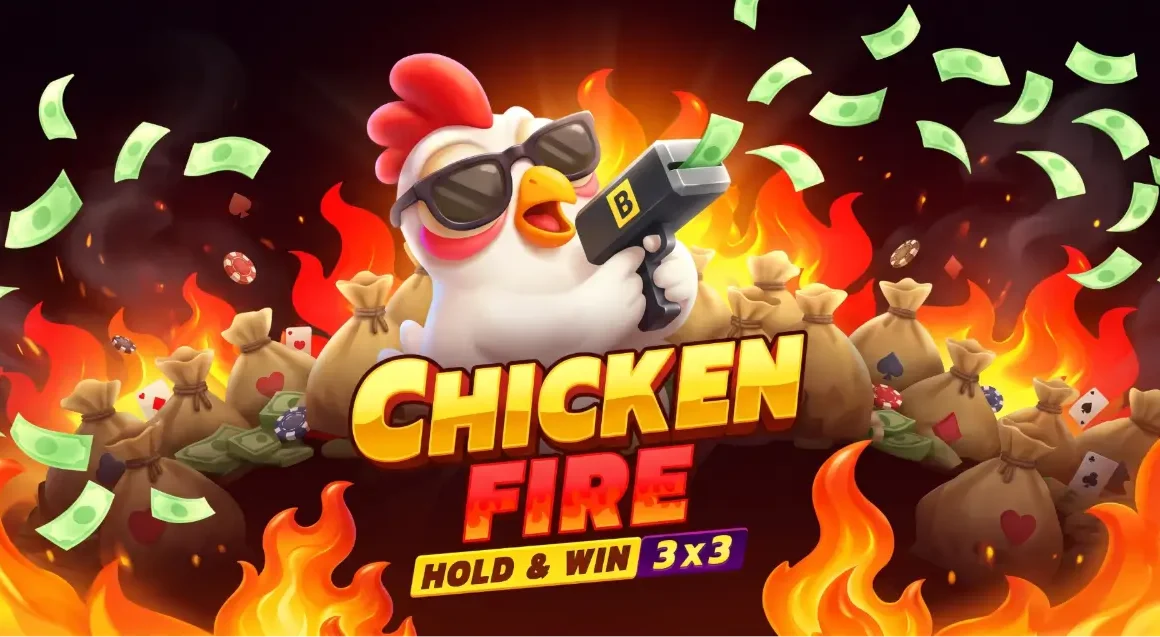
Worth flagging one more theme-level inconsistency in the source material: one outlet describes Chicken Fire’s setting as a farmyard scene with a deep blue backdrop, while another — reporting directly on the BGaming/LudexPlay partnership announcement — describes a sunny beach backdrop with a sunglasses-wearing chicken. Both can’t be the primary visual identity simultaneously, and neither claim comes from BGaming’s own game page directly. It’s a cosmetic discrepancy rather than a mechanical one, but it’s the kind of detail worth confirming in the demo before you form expectations about tone — this reads more like inconsistent third-party coverage of a newly launched title than a meaningful split in the actual game.
There’s no progressive jackpot here — all four tiers (Mini, Minor, Major, Grand) are fixed multipliers of stake, not a pooled, growing prize. That’s consistent with the rest of BGaming’s #Classic range; the studio generally reserves progressive mechanics for a small number of dedicated titles rather than spreading them across every Hold and Win release. And there’s no buy-bonus restriction unique to this title beyond the standard jurisdictional limits every Buy Bonus feature runs into; UK players in particular should expect the purchase options to be unavailable regardless of what the demo shows, since UKGC-licensed operators are barred from offering bonus buy features altogether.
So who is this actually built for? Given the mobile-first vertical layout, the tight 5-payline base game, and a Bonus Game that rewards patience over one single explosive combination, Chicken Fire reads as a recreational, phone-first session game rather than a high-roller’s title. The 15x per-Coin ceiling and additive (not multiplicative) Chicken Multiplier both cap how fast a single round can escalate — this isn’t a game built to deliver a shock five-figure multiplier off one lucky symbol collision, and anyone chasing that specific thrill should look elsewhere in BGaming’s catalogue, or toward Hacksaw’s higher-ceiling output.
Verdict
Chicken Fire is a competent, mobile-native addition to an already crowded Hold and Win category, held back by a below-average 95.90% RTP and a level of published-data opacity — unconfirmed jackpot tier values, conflicting bet minimums, undisclosed Buy Bonus pricing — that’s genuinely more common at launch than most players realise, but still worth naming directly.
Play it if: you’re a mobile-first casual or medium-volatility player who wants a fast, vertically-optimised session with a real shot at a 5,000x ceiling, and you don’t need every number on the paytable confirmed before you spin. The Chance x2 and pre-loaded Collect buy option are genuinely useful middle-ground tools that most competitors don’t offer in that exact form.
Skip it if: payback percentage is your primary filter, or you specifically want a Wild that carries its own multiplier rather than a flat substitute. At 95.90% RTP, BGaming’s own Chicken Rush — same publisher, same species of mascot, 97% RTP, multiplier-carrying Wilds — is the stronger mathematical choice sitting one click away in the same catalogue. The number that limits Chicken Fire most isn’t the max win. It’s the 95.90%, and no amount of Chicken Multiplier design cleverness changes that figure.
For context on where this actually sits in the broader 2026 field: it’s a stronger max-win proposition than Playson’s Pink Joker, a weaker RTP proposition than its own studio’s Chicken Rush, and a more conservative, lower-ceiling machine than anything in Hacksaw Gaming’s upper catalogue. That’s not a damning verdict — it’s a mid-pack Hold and Win release with one standout mechanical idea in the additive Chicken Multiplier and one clear weak point in its payback figure. Judge it on those terms rather than on the marketing copy, and it’s a reasonable way to spend a mobile session. Judge it purely on RTP, and better options exist one tab away.