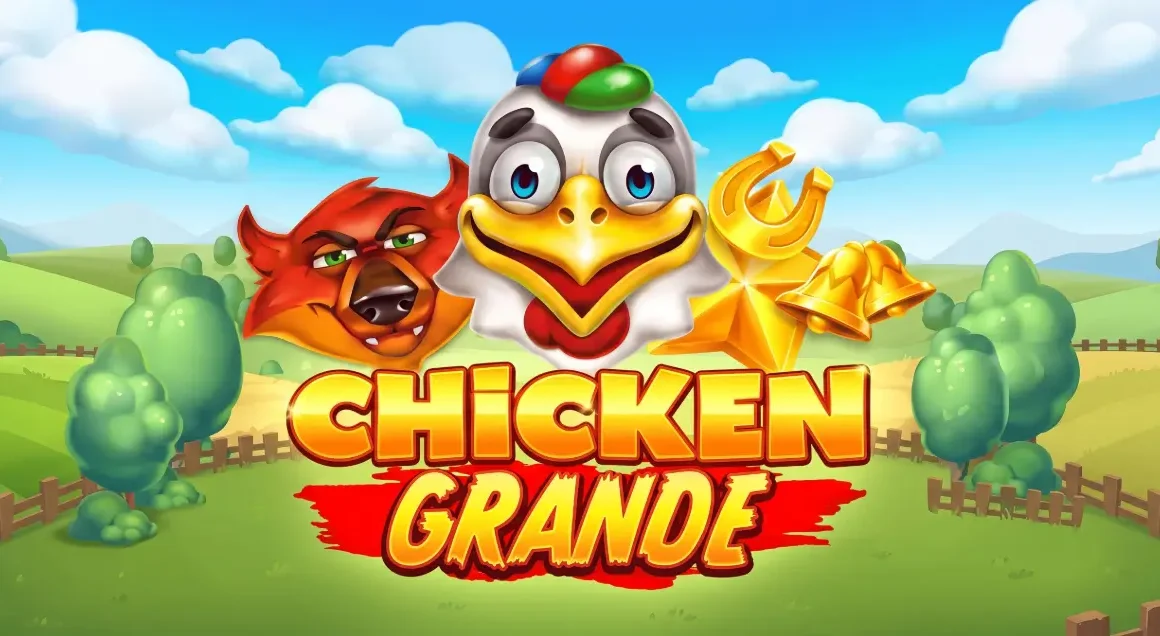
Skywind has been running the same basic trick since 2020: fill a tower, watch a wolf, decide whether to be greedy. Chicken Grande, live since 9 July 2026, is the latest coat of paint on that trick, and the first version of it that actually plays like a modern slot rather than a single-reel novelty. RTP is listed at 97.00%, volatility is rated high, and the ceiling sits at 10,000x stake — a genuine step up from where this format started. The question worth asking isn’t whether Chicken Grande works. It’s whether five paylines and a Partial Collect button are enough to justify calling this a new game rather than a re-skin.
Skywind isn’t a studio that chases trends — it’s a UKGC- and MGA-licensed provider that’s spent over a decade building a reputation on high-RTP, mechanically simple titles rather than feature-stacked spectacle. Chicken Grande fits that house style precisely. It arrives into a 2026 chicken-slot market already crowded with Pragmatic Play’s Chicken Drop, BGaming’s Chicken Rush, and Skywind’s own Nunchucks Chicken, all fighting over the same farmyard theme with wildly different mechanics underneath. Where those games lean on cluster pays, respins, and multiplier chains, Chicken Grande leans on the one thing Skywind has always leaned on: a simple accumulate-or-lose-it loop, dressed up just enough to feel current.
Math model and mechanics
Chicken Grande runs on a 97.00% RTP, according to the only detailed technical breakdown currently available for this title. That figure comes from a single third-party review published shortly after launch, not from SlotCatalog, Casino Guru, or Skywind’s own game page — none of which have indexed this release yet. Worth saying plainly: for a game barely six weeks old at the time of writing, that’s normal. It also means there’s no second source to check the number against, and no confirmation of whether operators can configure a lower version, which is standard practice across most of Skywind’s back catalogue. Until SlotCatalog or Casino Guru publish their own audits, treat 97.00% as the headline figure rather than gospel.
Put that RTP in context: it sits above the 96% industry norm and matches the top-tier figure Skywind quoted for the original Vinci la Gallina back in 2020. On a £1 spin over a 500-spin session, a 97.00% RTP theoretically returns £485 against £500 wagered — a £15 gap, before volatility decides whether that plays out as a slow bleed or a spiky rollercoaster. Given the rating here is high, expect the latter.
Volatility is rated high, and the mechanic explains why. This isn’t a standard win-per-spin slot. It’s a tower-fill format: matching Golden Symbols land on active paylines, each hit nudges the relevant tower up a step, and every step adds to a running Cashpot. Nothing pays out meaningfully until a tower is either filled or abandoned — so the session rhythm is long stretches of small top-ups punctuated by decision points, not the flat drip of a standard cluster-pays release. Hit frequency in the conventional sense (wins per 100 spins) isn’t the right lens here; what matters is tower-fill frequency, and that’s not something the current source set has broken down.
Grid and paylines: five active paylines carry the winning combinations. That’s a meaningful jump from the original Vinci la Gallina’s single reel and single payline — more on that comparison below. Betting runs from €0.10 to €300 per round, a wide enough spread to suit cautious testers and high-stakes players on the same paytable, which is standard Skywind practice across its catalogue.
That bet range also determines the value attached to every tower step, since Skywind’s tower games scale prize values directly off the current stake rather than running fixed cash amounts. Drop from €1 to €0.10 and every step in every tower becomes worth a tenth as much — the Cashpot mechanic itself doesn’t change, but the practical stakes of a Wolf reset shrink or grow with it. This is worth internalising before choosing a bet size: raising your stake on a tower-format game raises not just your win potential but the emotional cost of every reset, in a way flatter-paying slots don’t replicate quite as sharply.
Mobile compatibility isn’t detailed in the material currently published for Chicken Grande specifically, though Skywind’s wider catalogue — including its other Gallina-family titles — has consistently supported both desktop and mobile play. Given the studio’s track record, there’s no specific reason to expect Chicken Grande to break from that pattern, but it isn’t independently confirmed for this exact release at the time of writing.
Max win: 10,000x stake, translating to a £2,000 or €3,000 ceiling depending on where the max bet sits at a given operator. Is 10,000x competitive in 2026? Middling, not embarrassing. Nunchucks Chicken hits the same 10,000x from the same studio. Chicken Drop from Pragmatic Play caps at 5,000x. Chicken Rush from BGaming tops out around 5,000x as well. None of these come close to the seven-figure multipliers modern cluster or Megaways titles routinely advertise — but Chicken Grande was never built to compete on that axis. Its ceiling is a function of a fully-stacked Cashpot, not a cascading multiplier chain, and that changes what “competitive” means for this specific format.
Run the numbers on a realistic session: a player betting £1 a spin across 200 spins puts £200 into the machine. At 97.00% RTP, the theoretical return sits around £194 — a £6 shortfall, tighter than most standard slots would produce, on paper. What that figure hides is how the money comes back. In a flat-paying slot, that £194 arrives in dribs and drabs across most spins. Here, it’s concentrated: long runs of tower-building spins that pay nothing directly to balance, interrupted by cash-out decisions and the occasional Wolf wiping the accumulated total. Read that again: the RTP number is real, but it tells you almost nothing about what a single session will actually feel like.
Because the format pays through tower fills rather than per-spin combinations, standard “hit frequency” figures (the percentage of spins that produce any win at all) don’t map cleanly onto Chicken Grande the way they would onto a five-reel cluster slot. A tower-step hit isn’t a cash win in the traditional sense — it’s progress toward one. No source currently breaks down what percentage of spins land a Golden Symbol versus a blank versus the Wolf, which is a genuine gap in the public data at this stage of the game’s life. Until that breakdown exists, players should treat the high-volatility label as the operative guidance rather than expecting granular hit-rate numbers.
Feature breakdown
Golden Symbols and the colour towers
Three Golden Symbols — green, red, and blue — each feed a dedicated tower displayed above the reels. Landing a matching-coloured symbol on an active payline nudges that tower up by one step and adds the corresponding value to the Cashpot. This is the entire engine of the game: there’s no separate free-spins trigger described in the available material, no scatter-activated bonus round, no multiplier ladder bolted on top. The tower fill is the feature.
One honest limitation here: the source material references a “Freispiele” (free-spin) mode in passing — stating that the Cashpot accumulates across both free spins and base game — but doesn’t detail how free spins are triggered or how they differ mechanically from the base round. Until a fuller technical breakdown is published, that’s a gap in the public record, not a gap in the game. Treat it as unconfirmed rather than assume it doesn’t exist.
Compare that to Skywind’s own Vinci La Gallina Deluxe, where each Golden Symbol can land as a single, double, or triple element — meaning one spin can advance a tower by up to three steps at once rather than the flat one-step-per-hit pace of the original single-reel version. Whether Chicken Grande inherited that stacked-symbol mechanic from its Deluxe sibling isn’t confirmed in the material currently available, and the single published review doesn’t mention it either way. Worth knowing: if it did carry that mechanic forward, tower-fill speed could vary more than the base description suggests — another reason to treat the current picture as incomplete rather than final.
Realistic payout contribution: because towers pay in fixed steps rather than escalating multipliers, the bulk of a session’s return sits in small, frequent top-ups to the Cashpot rather than one dramatic hit. The 10,000x ceiling is only reachable if all three towers fill without a Wolf appearing — a low-probability outcome in any high-volatility tower format, and one no available source has quantified for this specific title.
The Cashpot and the Partial Collect Option
Every tower step adds to a single running Cashpot, which the player can bank at any point — this is the core risk decision of the game. Cash out early and lock in a modest return; keep spinning and the pot grows, but so does exposure to the reset symbol.
Partial Collect softens that binary. Once at least two steps are banked on a given tower, the player can secure a portion of the Cashpot: the tower drops back by one step, and the value difference pays out immediately to balance. This is a genuine mechanical addition over the 2020 original, which offered no partial cash-out — in Vinci la Gallina, it was full send or full reset, nothing in between. Chicken Grande’s Partial Collect gives risk-averse players a lever the earlier game never had.
The catch: Partial Collect only activates from two steps onward, so the very first fill on any tower carries the same all-or-nothing exposure the original game always had. You might ask: why not let players bank from step one? Most likely because the early steps carry the smallest values — the mechanic exists to protect meaningful accumulated wins, not to eliminate risk from the format entirely.
Wolf Symbol and the reset mechanic
The Wolf is the single most important symbol on the reels, and it’s a blunt instrument. It appears as a large 3×3 block, and when it lands, every tower — plus the entire Cashpot — resets to zero. There’s no partial mercy built into a Wolf hit itself; Partial Collect has to be used before the Wolf appears, not after.
There’s a second layer to it that makes the Wolf genuinely nasty rather than just a reset trigger: before the reset fires, it can randomly boost one tower by up to 20 steps. That looks like a gift until the boosted tower resets along with everything else a moment later. It’s a tease built into the punishment symbol — a brief flash of “you nearly had it” immediately preceding the wipe. In practice, this is the mechanic most likely to frustrate players who don’t understand it going in: the Wolf isn’t just bad luck, it’s designed to make the loss feel closer to a win than it was.
One honest limitation: no source currently available breaks down Wolf hit frequency, so there’s no way to state with confidence how often a typical session will see a reset relative to a successful tower fill. Given the high volatility rating and the game’s own single published review — which described the reset mechanics as capable of making “the flow feel frustrating” — expect resets to be a regular occurrence rather than a rare event, but treat that as directional rather than quantified.
Picture a realistic sequence: a player has built the Green Tower to four of five steps and the Cashpot sits at £40 from a £1 base bet. The Wolf lands, and instead of a flat reset it first grants the Blue Tower a random 15-step boost — flashing a huge notional value on screen — before wiping every tower and the full £40 Cashpot back to zero a beat later. Nothing is banked from that boost; it existed for less than a second. This is the exact design tension every tower-and-reset format from this studio has relied on since 2020: the near-miss and the loss arrive in the same symbol, back to back, rather than as two separate events. Players who don’t use Partial Collect before that point lose the lot regardless of how close any tower was to completion.
The 2026 perspective
Chicken Grande doesn’t have a sequel or a Power Reels variant — it’s the newest entry in an existing Skywind lineage rather than a title that’s since been expanded. The direct family tree runs: Vinci la Gallina (2020, single reel, single payline, 97.61% RTP, high volatility, three towers tied to bell/star/horseshoe symbols, chicken wild, wolf reset), Vinci la Gallina Deluxe (2021, three-reel expansion of the same mechanic, RTP reported inconsistently across sources — 97%, 96%, and 95.51% all appear depending on the operator and market), plus smaller regional entries like Punta La Gallina and Gallina Pazza. Chicken Grande is best read as the next generation of that family rather than a standalone release: same colour-tower-and-wolf DNA, restructured onto five paylines instead of one, with the Partial Collect Option as the headline mechanical upgrade.
What changed, concretely: paylines went from one to five, meaningfully increasing the rate at which towers can fill per spin. Max win climbed from Vinci la Gallina’s bet-scaled ceiling (reported between 500x and roughly 150,000x flat cash depending on stake, across different sources — worth flagging as a discrepancy in the public record rather than a clean upgrade path) to a stated 10,000x multiplier, which is at least unambiguous. And Partial Collect is new to the format entirely — the 2020 and 2021 versions offered no mid-tower cash-out.
It’s also worth noting the family has splintered regionally rather than iterating in a straight line. Vinci la Gallina and its Deluxe follow-up lean heavily into Italian-facing casinos, where “Gallina” branding has real cultural recognition — the games are marketed there as a recognisable nostalgia product, not just another farmyard slot. Punta La Gallina and Gallina Pazza extend that same regional footprint further without ever crossing over into English-language markets in a major way. Chicken Grande, by contrast, launches under an English title from day one, which reads as a deliberate move to widen the format’s reach beyond the Italian audience that made the earlier entries successful. Whether that rebrand pays off depends on whether English-speaking players take to a mechanic that’s spent five years building its reputation almost entirely in one regional market.
What didn’t change: the core tension. Fill or lose it all. No free-spins ladder with escalating multipliers, no buy-bonus option confirmed in current material, no progressive jackpot. If those are must-haves for a 2026 lobby regular, Chicken Grande won’t scratch that itch — it’s playing the same restrained, mechanic-first game its ancestors did five years ago, just with more moving parts.
Named competitors sit close by on theme and studio. Nunchucks Chicken, also from Skywind, runs 96.5% RTP on medium-high volatility with a 10,000x ceiling — matching Chicken Grande’s max win almost exactly, but through Ninja Respin and Shuriken Showdown features rather than a tower-and-reset structure. Nunchucks Chicken’s RTP has also been reported as configurable down to 89.5% at some operators — a reminder that Skywind’s default figures aren’t always what’s live on a given platform. Chicken Drop from Pragmatic Play trades the tower mechanic for cluster pays on a 7×7 grid, running 96.5% RTP at high volatility with a 5,000x cap — lower ceiling, but a fundamentally different, faster-paced structure with a Tumble feature most tower-format fans won’t recognise. Chicken Rush from BGaming sits at 97% RTP on medium-high volatility with roughly 5,000x max win across 3,125 paylines and a three-tier Buy Bonus option — the buy-bonus availability is the clearest gap between it and Chicken Grande, which currently has no confirmed purchase route into its feature set.
Buy-bonus availability: not confirmed for Chicken Grande in any source reviewed. That matters in 2026, where a growing share of high-volatility slot players expect the option to skip the grind and pay directly for a shot at the feature. Its absence here — whether by design or simply because the game predates that expectation for this studio’s tower format — is a real limitation for players who dislike long dry spells between meaningful spins. Chicken Rush’s three-tier Buy Bonus (Bronze, Silver, Gold, each priced differently and each guaranteeing entry into its respective feature at a different starting strength) is the clearest illustration of what Chicken Grande currently doesn’t offer: a way to pay for certainty instead of grinding for it.
There’s also a design philosophy worth naming directly. Nunchucks Chicken and Chicken Drop both build toward a single climactic bonus round — Shuriken Showdown or the Free Spins tumble sequence respectively — that the player works toward across the base game. Chicken Grande has no equivalent climax. The Cashpot is the bonus round, running continuously rather than being gated behind a trigger. That’s either the game’s most distinctive feature or its biggest missed opportunity, depending on whether a player wants a slow-build payoff or prefers the option to cash out on their own terms at any moment. It’s a legitimate design choice, not an oversight — but it does mean Chicken Grande will feel thinner than its feature-stacked rivals to anyone expecting a discrete bonus game to chase.
Progressive jackpot: also not confirmed. The Cashpot functions as the game’s payout ceiling, but it resets to zero rather than accumulating across the player base, so it isn’t a jackpot in the conventional sense.
Is this a high roller’s game, a recreational spin, or dead weight in a 2026 lobby? It sits closest to recreational-with-teeth: the €0.10 floor keeps it accessible, but the Wolf’s reset mechanic punishes anyone chasing the 10,000x ceiling on a small bankroll. High rollers looking for headline multipliers will find better ceilings elsewhere. Players who enjoyed the original Gallina format’s push-your-luck rhythm and wanted more paylines and a partial cash-out option finally have exactly that.
Verdict
Chicken Grande is a competent, faithful update to a five-year-old Skywind format rather than a reinvention of it. The one number that limits it most is the 10,000x ceiling — solid for this specific tower-and-reset sub-genre, unremarkable against the wider 2026 high-volatility field, where seven-figure multipliers are increasingly the entry bar for headline status.
Play it if you liked Vinci la Gallina’s original push-your-luck loop and wanted more paylines and a genuine partial cash-out option — Chicken Grande delivers both without breaking the format that made the original popular. The Partial Collect Option in particular makes this a better fit for players who want some control over their exposure rather than an all-or-nothing swing on every session. It also suits players with tight or flexible bankrolls equally well: the €0.10 floor means a cautious session can run for hours without serious risk, while the €300 ceiling gives high-stakes players the same tower mechanic with proportionally larger numbers on the board.
Skip it if you’re chasing buy-bonus convenience, a progressive jackpot, or a max win that competes with 2026’s biggest cluster and Megaways releases — none of those are here, and there’s no confirmed roadmap suggesting they’re coming. It’s also worth a note of caution given the current state of the public record: with RTP confirmed by only one third-party source and no SlotCatalog or Casino Guru audit yet published, players who want independently verified numbers before committing real stakes may want to wait for broader coverage to catch up with the release.
Two player profiles this suits well: the patient grinder who enjoys watching a Cashpot climb and trusts Partial Collect to lock in progress before the Wolf appears, and the nostalgia player who’s spun the original Vinci la Gallina at an Italian-facing casino and wants the same tension with a modern coat of paint. Two it doesn’t suit: the feature-hunter who wants a discrete bonus round to build toward, and the high-roller specifically shopping for a max win north of 50,000x, who’ll find better odds of a headline hit on Chicken Drop’s Free Spins tumble sequence or on almost any current Megaways release instead.
For everyone else — bankroll-conscious players who want a straightforward, high-volatility session without feature-hunting complexity — Chicken Grande does what its five-year lineage has always done, just with one more lever to pull before the Wolf shows up.