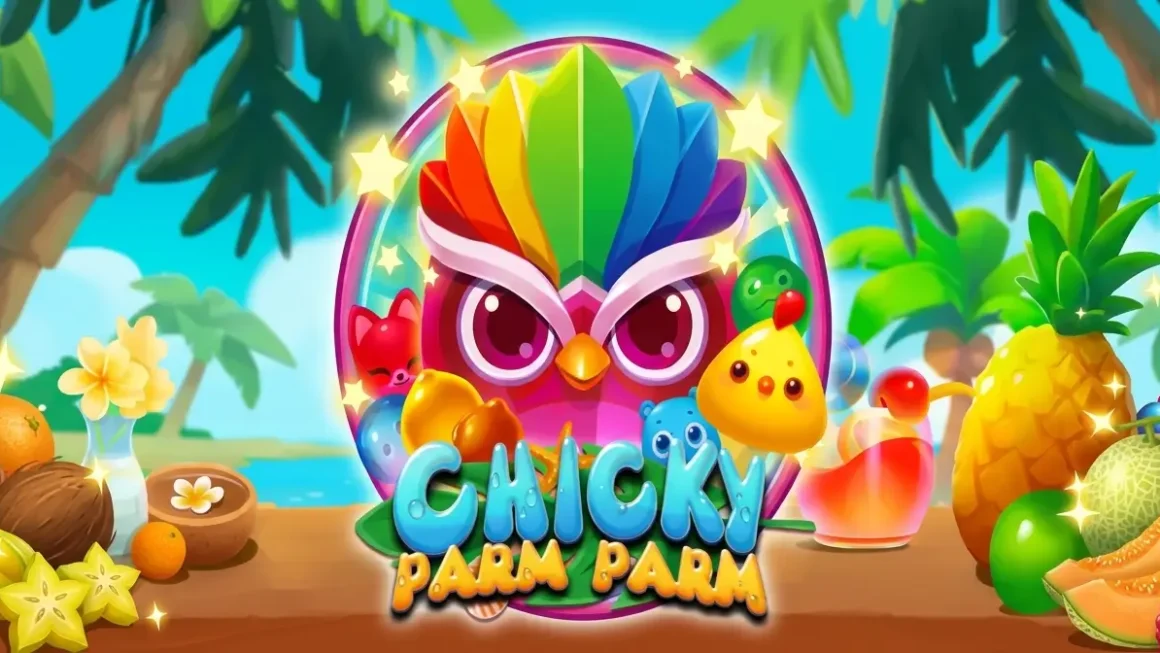
Chicky Parm Parm has been on the market since early 2024. It launched during a moment when cluster pays slots were already crowded — Jammin’ Jars had been running for six years, Reactoonz had its sequel, and every major studio was shipping grids with escalating multipliers. CQ9 came in with something different: a three-level progression mechanic borrowed more from mobile puzzle games than from traditional slot design. It’s the closest thing to Candy Crush that a casino lobby has produced, and that’s not an insult. It’s a description of what makes the game structurally interesting.
The headline number is 10,000x. That’s legitimately competitive — it matches CQ9’s own Move N Jump and trails only the most ambitious titles in the cluster pays category. Whether the math model actually delivers on that ceiling in a way that feels reasonable is a different question. The 97.5% RTP figure that appears in one source is either genuinely exceptional for a low-to-medium volatility game or an unverified estimate wearing the clothes of a confirmed spec. That conflict matters and deserves a proper look before you spin a penny.
CQ9 itself, founded in 2016 and headquartered in Taiwan, is GLI-certified and holds Malta Gaming Authority licensing. Their catalogue runs to over 150 HTML5 titles, available on more than 5,000 platforms worldwide. They’re a legitimate studio. The documentation gaps on individual titles — including this one — don’t reflect bad faith, just a different disclosure culture to the European-headquartered publishers. That context matters when interpreting the data situation here.
Math model and mechanics
RTP — a data conflict worth knowing about
One affiliate source (Esball) cites 97.5% RTP with low-to-medium variance. Slotstemple, by contrast, notes explicitly that CQ9 has not officially released RTP or volatility data for this title. No confirmation appears on SlotCatalog, Casino Guru, or BigWinBoard.
CONFLICT: Esball states 97.5% RTP / low-to-medium volatility. Slotstemple and SlotCatalog list RTP and volatility as unconfirmed from CQ9. Neither the official CQ9 developer page nor independent certification sources publish a verified figure as of June 2026.
If the 97.5% figure is correct, it places Chicky Parm Parm in a genuinely strong bracket. For context, CQ9’s wider portfolio typically sits between 95.3% and 96% RTP, with outliers like Good Fortune estimated around 97%. A 97.5% reading at low-to-medium volatility would be unusual for a title with a 10,000x ceiling — those numbers don’t usually coexist. The casino you play at will determine which RTP variant you’re actually running. Check the game’s paytable before you commit.
Volatility and hit frequency
The low-to-medium classification, if accurate, means this plays differently to most cluster slots at the 10,000x ceiling mark. You won’t be sitting through 200-spin dry spells waiting for a single big hit. The cascade mechanic — symbols fall from above rather than spinning, winning clusters disappear and new ones drop in — generates frequent smaller wins across all three levels. This is a grind-friendly game, not a bomb-and-burn one.
That said, cascade mechanics create an illusion of activity that isn’t always reflected in the net result. Lots of small wins adding up to less than your stake per spin is a very common experience in low-to-medium volatility cluster games. You’ll see numbers appear in the win counter regularly. What matters is whether those numbers add up to more than what you put in. At low volatility, they often don’t — the game is giving back small amounts frequently rather than returning larger amounts infrequently. Know the difference between “hits” and “profitable hits,” because the two aren’t the same thing.
The practical session experience at Level 1 (4×4 grid) is likely the thinnest part of the game. On a small grid, clusters are inherently limited in size. You’re building toward the 6×6 layout, not enjoying your best math in the opening phase. Budget for the progression. Players who run out of bankroll before reaching Level 3 have effectively played the demo version of the game — they’ve seen the concept but not the ceiling.
Grid structure — three progressive levels
The core innovation here is the Level Up system. Chicky Parm Parm doesn’t have a fixed grid:
- Level 1: 4×4 (16 positions)
- Level 2: 5×5 (25 positions)
- Level 3: 6×6 (36 positions)
Each level uses a Cluster Pays mechanic rather than fixed paylines. There are no payline numbers to quote — wins are awarded when a cluster of identical symbols forms a connected group, horizontally and/or vertically, anywhere on the grid. The symbols fall from above rather than spinning on traditional reels.
Progression from one level to the next happens by meeting an undisclosed cluster requirement — the specific threshold isn’t published in any source reviewed. In practice this means you’re working blind on advancement timing, which adds an element of patience that some players enjoy and others find frustrating.
The expanding grid is the game’s most meaningful structural feature. A 4×4 grid gives you 16 positions to form clusters. A 6×6 grid gives you 36 — more than double the surface area, which directly increases the probability of landing substantial clusters. By the time you’re playing on the 6×6 layout, the max win ceiling becomes genuinely approachable (even if still unlikely).
The symbol design reinforces the level-up concept thematically. At Level 1, the symbols are colourful balls — almost abstract, hard to form an attachment to. At Level 2, the balls develop eyes and expressions. At Level 3, they’ve evolved into cartoon animal characters: a fox, a frog, a chicken (CQ9 has an obvious fondness for the chicken — it shows up in multiple games). This isn’t just cosmetic. The visual transformation gives players a tangible sense of reward for advancing. You’re not just moving to a bigger grid; you’re unlocking a better-looking version of the game. Small design detail, but it works.
The question nobody can currently answer from external research is the advancement trigger. If Level Up requires a certain number of cluster wins in sequence, that creates a skill-adjacent variable — bigger bets, which generate bigger cluster wins, might accelerate progression. If it’s based on a points threshold, bet size almost certainly matters. This needs direct verification from the official CQ9 documentation or in-game paytable, neither of which publicly discloses the mechanic in the sources reviewed for this article.
Max win — 10,000x in context
10,000x is a strong number. To frame it: a £1 spin producing 10,000x returns £10,000. At the £0.10 minimum, that’s £1,000. That’s useful context for anyone playing this at low stakes expecting a life-changing outcome.
In the 2026 cluster pays category:
| Game | Provider | RTP | Max win | Grid |
|---|---|---|---|---|
| Chicky Parm Parm | CQ9 | 97.5%* (unverified) | 10,000x | 4×4 → 6×6 |
| Jammin’ Jars | Push Gaming | 96.83% | 20,000x | 8×8 |
| Reactoonz | Play’n GO | 96.51% | 4,570x | 7×7 |
| Sweet Pop | CQ9 | Not published | 5,000x | 6×5 |
*Cited by one affiliate source; not confirmed by CQ9 or independent certification bodies.
Chicky Parm Parm’s max win sits neatly between Reactoonz (low ceiling, high-volatility math) and Jammin’ Jars (massive ceiling, genuinely high variance). If the RTP figure holds, it has a more player-friendly math model than either of its main competitors on paper — but that caveat about verification matters.
Feature breakdown
Level Up mechanic
Level Up is the structural backbone of the game, not a traditional bonus feature. The three grid sizes — 4×4, 5×5, 6×6 — are navigated sequentially within a session rather than randomly triggered. Each level introduces new symbol designs: at Level 1, the symbols are colourful balls with appendages; by Level 3, they’ve become fully formed cartoon animals including a fox, frog, and the studio’s recurring chicken mascot.
The practical implication: you start every session at the smallest grid and must earn your way to the more favourable 6×6 layout. This creates a genuine sense of progression — you’re not just watching a static board, you’re working toward a more volatile situation. The limitation is the reverse: if a session doesn’t get you to Level 3, you’ve been playing the least powerful version of the game the entire time.
No specific activation threshold — number of clusters required, coins scored, or time-based condition — is publicly documented. That’s a design transparency issue, and it’s one worth flagging.
Cluster Pays and Cascading (Avalanche)
Every win triggers an Avalanche: winning symbols are removed from the grid, and new ones fall from above to fill the gaps. If those new symbols form another cluster, the cascade continues, adding to your win total for that spin. Multiple consecutive cascades from a single spin are possible and do occur.
There’s no win multiplier attached to consecutive cascades in the base game — this is the sharpest point of differentiation from Jammin’ Jars, where the Jam Jar Wilds carry rising multipliers through cascades. Every cascade in Chicky Parm Parm pays at face value. A cascade that wins 5x and is followed by another that wins 5x gives you 10x total — not 5x + 10x, not 5x + 25x. The compounding multiplier dynamic that turns good cascade sequences into exceptional ones simply doesn’t exist in the base game here.
The cluster pays minimum — how many identical connected symbols constitute a winning cluster — isn’t specified in any externally reviewed source. Most cluster slots require 5+ symbols; Chicky Parm Parm’s game instructions and official documentation don’t specify this publicly. On a 4×4 grid, the minimum cluster size likely needs to be small (perhaps 3 or 4) to generate meaningful win frequency; on a 6×6 grid, the same minimum produces relatively smaller wins proportionally. This is another area where the CQ9 paytable in-game is the authoritative source — check it before you decide on a session stake.
The absence of a base-game multiplier is the largest functional gap versus the leading cluster pays titles. In Jammin’ Jars and Reactoonz, cascades carry escalating multipliers or charge meters that compound into large wins. Here, you’re accumulating flat-value wins. Larger clusters on the 6×6 grid compensate to some extent — a 20-symbol cluster pays significantly more than a 5-symbol one — but the math model lacks the compounding potential of the category leaders. If you prefer a mechanical simplicity over compounding complexity, that’s actually a point in the game’s favour. Not everyone wants to track meters and multiplier stacks.
Free Spins — the Rainbow Bird trigger
Free Spins are activated when the Rainbow Bird head symbol lands on the grid. This triggers 10 free spins played on a different reel configuration, with a random multiplier applied to all wins during the bonus round.
The trigger is rare — multiple play reports note that the Rainbow Bird appears infrequently, with no published frequency figure available from CQ9 or any independent certification source. The multiplier range for the bonus round is not specified in any reviewed source. “Random multiplier” as a description covers anything from 2x to several hundred times the normal value — without a published range, there’s no way to assess the realistic bonus round EV.
The good news: even without a confirmed multiplier ceiling, the free spins take place on a separate grid configuration (the game’s visual description suggests it’s a modified version of the standard layout, with atmospheric effects added), and base cluster wins during those 10 spins are amplified by whatever multiplier has been applied. The multiplier is fixed at the point of trigger — it doesn’t escalate across the bonus round, which distinguishes it from games like Jammin’ Jars, where Jam Jar Wild multipliers compound through every cascade.
The honest catch: the Free Spins feature is the sole avenue to the game’s theoretical max win. Without knowing the multiplier ceiling and trigger frequency, the 10,000x figure is difficult to contextualise as realistic or merely theoretical. At low-to-medium variance with a rare trigger, the median bonus round outcome is likely modest. The extreme ceiling exists but requires an exceptional multiplier draw, an active 6×6 grid, and a well-positioned cluster — several variables lining up simultaneously. It can happen. How often it happens in practice is the question that requires certified data to answer properly.
What I’d want to know from CQ9 directly: the free spins trigger frequency (1-in-N spins), the multiplier range (minimum to maximum), and whether re-triggers are possible. None of that is currently in the public domain. Until it is, treat the 10,000x number as a ceiling, not a likelihood.
No buy-bonus
There is no bonus buy option in Chicky Parm Parm. In 2026, this is a meaningful absence. The ability to purchase direct access to the free spins round has become standard in competitive cluster slots — Jammin’ Jars added it in 2021, and it features across most major Push Gaming and Play’n GO titles. Players who want to concentrate their session time on bonus rounds can’t do that here. You wait for the Rainbow Bird, and you wait.
For casual recreational players, this is irrelevant. For anyone playing with a defined budget and a preference for efficient bonus exposure, it’s a limitation that affects how you’d approach the session.
No progressive jackpot
No jackpot mechanic exists. This is consistent with most of CQ9’s cluster titles and not a surprise. Noted for completeness.
How to approach a session
Chicky Parm Parm rewards patience over aggression. The Level Up progression means the first phase of any session is the weakest phase mathematically — smaller grid, smaller clusters, smaller wins. A few practical notes from what the mechanics tell us:
Bet sizing and progression. If the Level Up trigger is connected to win value (which is likely but unconfirmed), higher bets will produce higher cluster values and potentially accelerate advancement. If the trigger is based purely on winning a certain number of clusters, bet size is irrelevant. Without confirmed mechanics, the safer assumption is to keep bets at a sustainable level for your bankroll — enough to reach Level 3 before running out.
Session length. This isn’t a quick-session game. You need time to progress through three levels, reach Level 3, and give the Rainbow Bird trigger a realistic number of spins to land. If you’re depositing £20 and spinning at £2 per spin, you have roughly 10 spins before half your bankroll is gone and you haven’t left Level 1. The game rewards players who have the bankroll depth to reach its best configuration.
Demo mode. The game is widely available in demo mode across most CQ9-partnered casinos. Playing demo first serves a specific purpose here: it lets you understand how quickly you advance through levels, what the cluster wins look like at each level, and approximately how rare the Rainbow Bird trigger is in practice. That session-feel data matters more in this game than in a standard 5-reel slot with a fixed grid.
Bet range. The specific bet range for this title isn’t confirmed in any reviewed source, but CQ9’s broader portfolio accepts bets from as low as £0.10 per spin across their HTML5 framework. Verify at whichever casino you use — minimum and maximum stakes can be restricted by individual operators.
2026 perspective
The cluster pays category was effectively defined by Jammin’ Jars in 2018. Everything that came after has had to answer the question: what does this do that Jammin’ Jars doesn’t?
Chicky Parm Parm’s answer is the Level Up system — a mobile-game-inspired progression that changes the physical grid size rather than layering new features on a static board. It’s a genuinely different structural approach, and it works. The sense of moving through levels gives sessions a narrative that flat-grid cluster games don’t have. Reactoonz has the Quantum Leap meter building toward the Gargantoon wild; Chicky Parm Parm has the literal expansion of the playing field. Both achieve the same effect — a sense of momentum — but through very different mechanical paths.
That’s the good part. The bad part is everything surrounding it.
The multiplier question doesn’t go away. Cascading symbols with no compounding multiplier in the base game means your standard session payouts are capped by cluster size alone. At 4×4, clusters are small by definition. At 6×6, they’re meaningfully larger — but you still need a well-timed Rainbow Bird landing with a favourable multiplier draw to approach the game’s upper win potential. Jammin’ Jars produces outsized base-game wins with any Jam Jar Wild in a large cascade. Reactoonz builds toward the Gargantoon 3×3 wild which can single-handedly reshape a spin. Chicky Parm Parm concentrates nearly all its variance in a single bonus trigger of uncertain frequency and unknown multiplier ceiling.
CQ9’s own Sweet Pop does the cluster thing differently — a fixed 6×5 grid with a scatter pays mechanic (any eight matching symbols win, not connected clusters) and a 5,000x ceiling. It’s less imaginative than Chicky Parm Parm on structure but arguably more consistent in session experience, because you’re always on the largest grid from the first spin. No progression tax. You’re in the best configuration immediately. That trade-off is worth understanding when you’re choosing between CQ9’s cluster titles.
For the Tier 1 European and UK market, the buy-bonus absence is probably the biggest commercial drag on Chicky Parm Parm’s uptake. Players who like to allocate a specific portion of their session budget directly to bonus rounds can’t do that here. UK players are exempt from that consideration — UKGC regulations prohibit bonus buy — but everywhere else the absence of that feature puts the game at a practical disadvantage versus competitors who give players the choice.
The transparency issue is the one I keep returning to. We’re in 2026. The game launched in early 2024. CQ9 is a legitimate, GLI-certified studio with MGA licensing and a catalogue of over 150 games. The fact that basic specs — RTP, volatility, free spins trigger frequency, multiplier range — aren’t publicly confirmed for this title more than two years after release is unusual. It’s not a dealbreaker. Many CQ9 titles have the same documentation gap. But it makes rigorous analysis difficult and keeps this game out of the “high-conviction recommendation” tier.
On RTP: if the 97.5% figure is real and verified, this game is being underrated. A confirmed 97.5% at 10,000x maximum win with low-to-medium volatility would be a genuinely unusual combination. Most publishers offering that kind of RTP pair it with sub-5,000x max wins and extremely predictable sessions. Getting both in one title would be notable enough to change the competitive ranking. The problem is we can’t confirm it. Until we can, we evaluate the game on its structure, and the structure is interesting — not exceptional.
Verdict
Chicky Parm Parm is a good slot if you like the puzzle-game feel of cluster plays and appreciate a genuine structural innovation. The three-level progression grid is the best thing about it — it gives sessions a shape that most grid slots don’t offer. The cartoon animal symbols are charming without being cloying. The Cascade mechanic works exactly as it should.
Play it if: you’re a recreational player who enjoys casual, lower-pressure slot sessions with a meaningful max win ceiling. You like watching a game evolve across a session. You’re not dependent on bonus buy to structure your play. You have enough bankroll depth to reach Level 3 in a realistic session length. The 10,000x max win gives you genuine upside that the low-to-medium variance framing might undersell — the ceiling is there, even if the path to it runs through an unquantified bonus trigger.
Don’t bother if: you’re a high-variance hunter who needs multiplier cascades through the base game, progressive jackpot potential, or bonus buy access. In that profile, Jammin’ Jars still holds more in its maths — 20,000x max win, rising Jam Jar multipliers through every cascade, confirmed 96.83% RTP across every review source on the market. That’s a stronger package for the experienced cluster player. If you want the 10,000x ceiling in a more mechanic-rich package, Move N Jump from CQ9 itself has confirmed specs and a different win structure worth comparing.
The unverified RTP is the single biggest question mark over this game. Check the paytable at whichever casino you use — that screen will show the configured RTP for your session. That number is the one that actually governs your session math, and it’s the only figure worth trusting.