
There’s a particular kind of slot that never makes headlines. No Megaways engine, no 100,000x max win, no Twitch streamers screaming into a microphone at 2 AM. Chicken Little by Rival Gaming is exactly that kind of slot — and yet, here I am writing about it in 2026, because it keeps popping up in casino lobbies, players keep coming back to it, and the question keeps coming up: is this old-school three-reel bird worth playing, or is it just nostalgia dressed up in pastel feathers?
Let me save you some time upfront. Chicken Little is a classic 3-reel, single-payline slot built around a centuries-old fairy tale. It has one wild symbol, a paytable that tops out at 4,000 coins, a published RTP of 95%, and absolutely zero free spins, bonus rounds, or scatter symbols. For some players, that sentence alone is enough to close the tab. For others — particularly those who grew up on Vegas-style fruit machines or who simply want a low-stakes game that doesn’t require reading a 40-page rulebook — this is precisely the appeal.
I’ve spent time with this game across multiple sessions, looked at how real players describe their experience with it, and cross-referenced what’s actually in the paytable. Here’s the full picture.
What Rival Gaming Actually Is (And Why It Matters)
Before talking about the game itself, it’s worth placing Rival in context, because the developer’s identity shapes what Chicken Little is.
Rival Gaming has been operating since 2006. That makes them one of the older independent studios in the online casino space — a market where developers come and go faster than slot themes. Over nearly two decades, they’ve built a catalogue of roughly 170 slot titles, ranging from their famous i-Slots (story-driven five-reel games with advancing plotlines) to stripped-down three-reel classics like this one.
Their three-reel library doesn’t try to compete with the high-volatility, feature-heavy output of studios like Pragmatic Play or Nolimit City. That would be a losing battle and Rival knows it. What they do instead is polish the fundamentals. Simple math, clean presentation, and RTPs that are often more honest than what you’ll find on shiny new releases buried in casino lobbies. Their three-reel portfolio includes titles like Milk the Cash Cow (98.70% RTP) and Gold Rush (98.02% RTP), which represent genuinely player-friendly mathematics for the format.
What Rival also understood early — and still applies — is that not every player wants an event-driven slot. The i-Slots get the press. The bonus-rich five-reel titles attract the streamers. But a sizable portion of the real-money player base simply wants to sit down, make a small wager, watch the reels turn, and not think too hard. That market exists, it’s loyal, and it keeps coming back to exactly these kinds of games. Rival has served that market consistently for nearly two decades, and Chicken Little is one of the cleaner examples of what that looks like in practice.
Chicken Little sits in the same family, though at the lower end of the RTP range. 95% isn’t bad — it’s close to the industry standard — but it does mean this game is not the most efficient Rival classic if your sole goal is bankroll preservation.
The Theme: A Fairy Tale That Actually Works for Slots
The game draws on the old folk tale of Chicken Little — or Henny Penny, as it’s known in much of the world — the story of a young chicken who becomes convinced the sky is falling after an acorn hits her on the head, and who then proceeds to panic everyone around her on the way to tell the king.
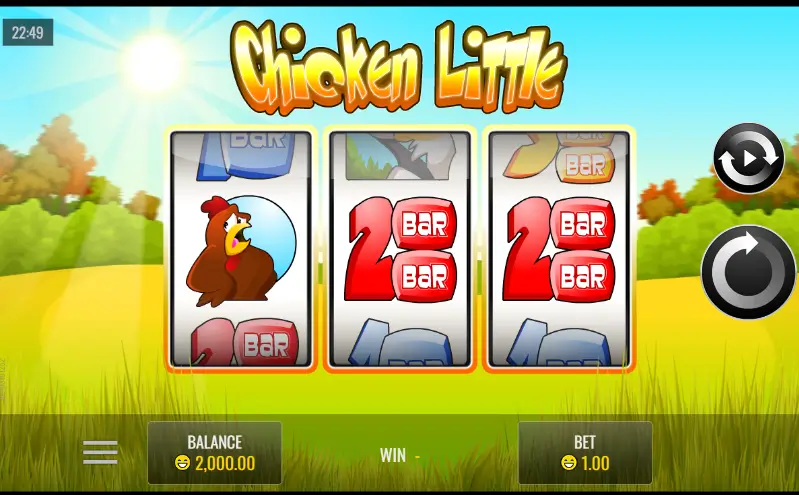
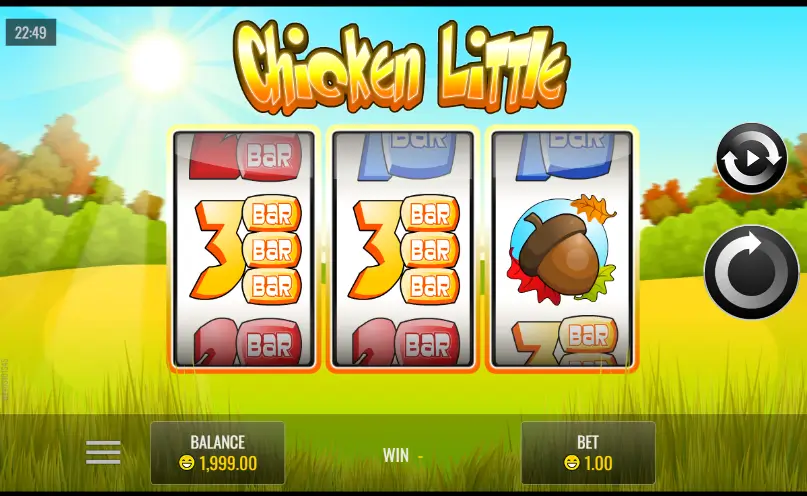
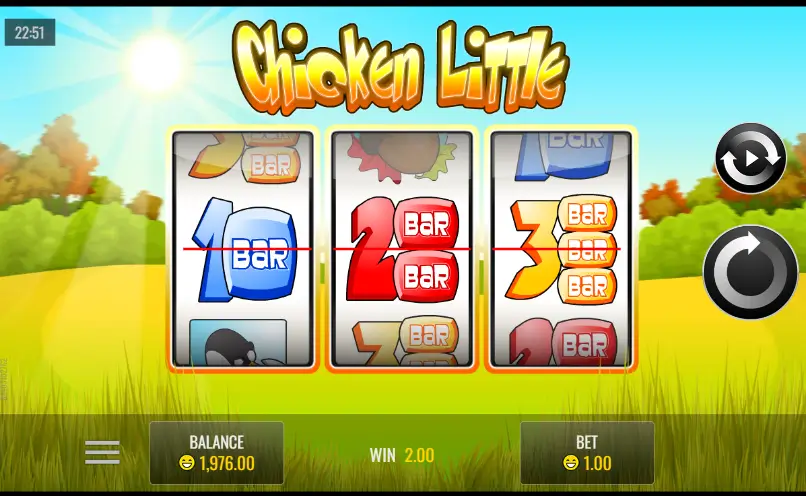
It’s charming material for a slot, and Rival’s visual team has done a decent job with it. The backdrop shows the characters in a woodland setting, presumably mid-panic. The pastel color palette is soft without being insipid. The bar symbols are color-coded — blue for single bars, red for double bars, yellow for triple — which makes the paytable easier to read at a glance. The characters themselves are well-rendered for a classic slot: round, expressive, with enough personality to tell them apart.
The sound design deserves a mention. The background music that kicks in when the reels spin has a 1920s jazz-bar quality to it — upbeat, slightly chaotic, strangely fitting for a bird who thinks the world is ending. There are squawking effects when a winning line hits. None of this is going to win any audio engineering awards, but for a game of this type and age, it’s genuinely more characterful than most.
The 2005 Disney animated film of the same name likely influenced how many players first encountered this story, and there’s a soft visual echo of that movie’s aesthetic. The game predates the modern era of licensed slot titles, so there’s no official Disney tie-in — but the thematic overlap is real enough that players who remember that film will feel immediately at home.
Mechanics: Everything You Need to Know in Two Minutes
Let me be direct about the structure, because there’s no point overcompleting a simple game.
Reels and paylines: 3 reels, 3 rows, 1 payline running through the center. That’s it. Every spin produces one possible winning combination or nothing. There are no diagonal lines, no cluster pays, no ways system. If you’ve played a classic fruit machine, you know exactly what to expect.
Bet range: Coin values run from 0.01 to 10.00. The game accepts between 1 and 3 coins per spin. This means minimum bet per spin is 0.01 (1 coin at minimum value) and maximum is 30.00 (3 coins at 10.00 each). That’s a reasonably wide range. Low-stakes players can grind at penny level for a long time. High rollers aren’t going to find this interesting, but they were never the target audience.
Max bet feature: Available, places the maximum 3-coin wager automatically.
Autoplay: Available for real-money play. Not usable in demo mode at most casinos. Useful for longer sessions where you want hands-off spinning without managing every individual bet.
Jackpot: 4,000 coins. At the maximum coin value of 10.00, that translates to 40,000.00 in cash. At minimum coin value, it’s 40.00 — respectable for a penny-stakes game. The jackpot is fixed, not progressive, which means it doesn’t grow over time and doesn’t require a separate side bet or network connection.
RTP: Published at 95%. This is a certified figure, not a marketing number. It means the game is designed to return 95 cents for every dollar wagered over a statistically significant number of spins. In practice, individual sessions will vary considerably in both directions.
The Paytable: Symbol by Symbol
The payout structure is worth walking through carefully, because the spread between low-end and top-end wins is part of what defines the playing experience.
Mixed bars (any combination of single, double, and triple bar symbols): 2 to 6 coins. The lowest-paying combination in the game. These hit with reasonable frequency, which is part of why the game doesn’t feel completely dead during cold streaks.
Single bars (three matching single-bar symbols): 8 to 24 coins. More valuable, noticeably less frequent.
Double bars (three matching double-bar symbols): 10 to 30 coins. Middle-tier symbol.
Triple bars (three matching triple-bar symbols): 15 to 45 coins. Still in bar territory, but a meaningful step up.
Acorns (three acorn symbols): 20 to 60 coins. The thematic anchor of the game — an acorn fell on Chicken Little’s head and started the whole panic. Here, they’re worth a decent mid-range payout.
Henny Penny (three matching Henny Penny symbols): 40 to 120 coins. One of the supporting characters from the story. A solid win when it lands.
Ducky Lucky (three matching Ducky Lucky / Goosey Loosey symbols, depending on version): 70 to 210 coins. The second-highest character symbol. Landing three of these on one spin on a max bet is a genuinely satisfying result.
Chicken Little (the titular character, and the game’s Wild): 1,000 to 4,000 coins. This is where the game lives or dies. Three Chicken Little symbols on the center payline at maximum coins is the 4,000-coin jackpot. Even at minimum coin value, it pays 1,000 coins — which at a 1-cent coin is still 10.00 in cash.
The wild function is worth explaining clearly. Chicken Little substitutes for all other symbols on the reels. Two Chicken Little wilds on the payline alongside any other symbol will complete a winning combination using the other symbol’s payout rules — but with a multiplier applied. The multiplier doubles the line win when one wild is involved in the combination. This is a meaningful mechanic for a single-payline game: it means any spin with a Chicken Little symbol on the center line has elevated potential, even if the jackpot combination doesn’t land.
What Actual Players Say About It
Across multiple player forums and review aggregators, the feedback on Chicken Little is remarkably consistent — which in itself is informative. Players aren’t divided on this game the way they are on high-volatility titles. The experience is predictable enough that people know what they’re getting.
The dominant use case described by real players is bankroll management during a downswing. The consensus is that this is a game you go to when your bankroll has taken a hit elsewhere and you want a low-risk way to recover, or at least survive, before moving back to bigger games. The reasoning is that small bets go a long way, small wins land often enough to keep the balance stable, and the 4,000-coin jackpot offers a meaningful upside without requiring high-stakes exposure.
Players note a specific behavioral pattern: the game performs relatively well at low stakes (1–2 cents per coin) but seems to tighten up considerably once you move to higher coin values. This is consistent with what you’d expect from the math on a low-to-medium volatility game — the distribution of wins shifts as bet size increases, and the jackpot becomes harder to hit relative to what you’re wagering to chase it.
The betting strategy question is genuinely interesting with this game. Because there’s only one payline and no mechanism to increase the number of active lines, the only lever you have is coin size and coin count. Playing 3 coins at a small coin value versus 1 coin at a larger value produces different effective bets but also changes the payout structure slightly, since some paytable prizes scale with coin count rather than just coin value. Worth experimenting with if you plan to spend real time with the game.
One common criticism is the absence of a bonus feature. For a game sitting in the Rival catalogue alongside i-Slots with full narrative sequences, the complete lack of free spins, multiplier rounds, or scatter pays is noticeable. The paytable compensates somewhat — a 4,000-coin fixed jackpot is genuinely competitive with what some video slot bonus rounds pay out — but the lack of variance injection means the game can go cold for extended periods with no mechanism to break the drought.
Another honest observation from regular players: this is a game that works well in short sessions. Sitting with it for hours chasing the jackpot is a losing strategy. It’s better treated as a pit stop than a destination.
Where It Stands in the Rival Classic Slots Lineup
Within Rival’s three-reel catalogue, Chicken Little occupies a specific position. It’s not the highest-RTP classic they offer — Milk the Cash Cow at 98.70% and Gold Rush at 98.02% both return more over time. It’s also not the most feature-rich, since some Rival classics include scatters or basic multiplier mechanics.
What Chicken Little has that many competing titles don’t is a genuinely high jackpot ceiling for the format and a theme with actual personality. The fairy-tale source material, the character-based symbol set, and the audiovisual presentation give it a distinct identity. Most 3-reel classics feel interchangeable — row after row of bars, sevens, and fruit. Chicken Little has characters you can name and a story that functions as a backdrop rather than wallpaper.
The game also benefits from the stability of Rival’s platform. Because Rival has been in the market for nearly two decades, their older titles are available at a wide range of casino operators and play reliably. There are no loading issues tied to cutting-edge technology, no server-side game logic that occasionally misfires. It loads fast, runs smoothly, and does what it says on the tin.
The Honest Case Against It
Let’s not pretend this game has no weaknesses. It has real ones, and players considering it deserve a straight account.
The RTP sits at the lower end for Rival classics. At 95%, you’re not getting a terrible deal, but you’re not getting the near-98% returns that Rival offers on some of their other three-reel titles. Over long sessions, that difference compounds. If return optimization matters to you, there are better choices within the same developer’s catalogue.
No free spins, no bonus round, no scatter pays. In 2026, with the modern slot landscape offering cascading wins, expanding wilds, buy-bonus features, and multi-level bonus games, a completely featureless three-reel slot requires the player to accept a fundamentally different value proposition. There is no jackpot-round mechanism to break the tension after a long losing run. What you see is what you get, every single spin, with no interruption to the base game rhythm.
Single-payline gameplay is polarizing. One line means every spin either wins or doesn’t. There’s no near-miss construction across multiple paylines, no “almost had it on line 4” that keeps some players engaged. Whether this is a feature or a flaw depends entirely on what you want from a slot session. But for players conditioned to 20-payline or Megaways-style games, the single line can feel limiting and cold.
Mobile experience is functional, not optimized. Chicken Little was designed before mobile-first development became industry standard. It plays on phones and tablets — the HTML5 version works across iOS and Android — but the UI wasn’t built with touchscreen interaction as the primary consideration. The game works. It just doesn’t feel purpose-built for a 6-inch screen.
Who Should Actually Play This Game
Given everything above, who is this slot actually for?
It suits players who specifically want a classic, no-frills slots experience without the cognitive overhead of modern feature-heavy games. If you’ve been grinding volatile bonus-buy slots all evening and want something that doesn’t require decisions, Chicken Little is genuinely restful in that regard. One payline. One wild. Spin.
It suits players on short bankrolls who want to extend their session time. At minimum coin values, the game can run for a long time without catastrophic losses. The mixed-bar combinations land often enough to keep small balances alive.
It suits players at Rival-powered casinos who want to clear a bonus with limited contribution to wagering requirements. Check the bonus terms — some operators exclude certain game types, and classic slots sometimes carry different wagering weights — but where they’re included, Chicken Little’s straightforward math makes tracking progress easy.
It’s a poor fit for players chasing massive wins relative to stake. The 4,000-coin jackpot is meaningful in absolute terms but modest as a multiplier of maximum bet: 4,000 coins at maximum bet means 4,000 × 10 = 40,000 in currency, but you’re betting up to 30.00 per spin to chase it. That’s a roughly 1,333x multiplier on maximum stake — better than many progressive jackpot slots offer in relative terms, but well below what high-volatility games with 10,000x+ potential can deliver.
It’s also a poor fit for players who need visual stimulation and engagement variety to stay interested. If you’re prone to boredom during quiet patches, a no-feature single-line slot will exhaust your patience quickly.
Final Verdict
Chicken Little by Rival Gaming is an honest slot. That’s both its strength and its limitation.
It doesn’t pretend to be something it isn’t. It’s a three-reel, one-payline, fairy-tale-themed classic with a 4,000-coin fixed jackpot, 95% RTP, and a wild symbol that can occasionally change the direction of a session. The visuals are cheerful, the audio is better than you’d expect, and the game runs without drama on any device.
The absence of bonus features is a real gap, and the RTP isn’t the best Rival offers in the three-reel format. But for what it sets out to do — provide a calm, low-stakes classic slot experience with a recognizable theme and genuine jackpot potential — it delivers competently.
Part of what makes it worth covering in 2026, when there are literally thousands of newer slots competing for attention, is exactly that staying power. Games don’t survive in active casino lobbies for years by accident. They survive because players return to them, and players return to Chicken Little because it behaves predictably, treats small bankrolls fairly, and occasionally pays out a jackpot that feels meaningful relative to what was staked.
If you’re the kind of player who opens a casino lobby looking for something to play for 20 minutes without wanting to decode a feature tree, Chicken Little is worth a few spins. Set a modest session limit, play at minimum coin value if you’re just testing it, and don’t go chasing the 4,000-coin jackpot on max bet with money you can’t afford to lose. That advice applies to every slot — but with this game, the math at least gives you a reasonable chance of making your session budget last.
In a market saturated with flashy mechanics and artificially inflated volatility, there’s something to be said for a slot that just plays straight. Chicken Little has been doing exactly that for years. In early 2026, it’s still worth a spin — just don’t expect the sky to fall in either direction.
Quick Reference: Chicken Little by Rival Gaming
| Spec | Detail |
|---|---|
| Developer | Rival Gaming |
| Reels / Rows | 3 / 3 |
| Paylines | 1 (fixed) |
| Min Bet | 0.01 per spin |
| Max Bet | 30.00 per spin |
| Coin Range | 0.01 – 10.00 |
| Wild Symbol | Yes (Chicken Little character) |
| Scatter Symbol | No |
| Free Spins | No |
| Bonus Round | No |
| Fixed Jackpot | 4,000 coins |
| Published RTP | 95% |
| Volatility | Low–Medium |
| Mobile Compatible | Yes (HTML5) |
Frequently Asked Questions
What is the RTP of Chicken Little by Rival Gaming? The published RTP is 95%. This is the theoretical long-term return across a large number of spins. Individual sessions will vary significantly above and below this figure.
Does Chicken Little have free spins or bonus rounds? No. Chicken Little has no free spins feature, no scatter symbols, and no bonus game. The only special symbol is the Wild (the Chicken Little character itself), which substitutes for all other symbols and applies a multiplier when contributing to a win.
What is the maximum win in Chicken Little? The fixed jackpot is 4,000 coins. At the maximum coin value of 10.00, that’s 40,000.00 in currency. Three Chicken Little wild symbols on the center payline with maximum coins bet triggers this jackpot.
Is Chicken Little available to play for free? Yes. Most Rival-powered casinos offer a demo or free-play mode. Some third-party slot aggregator sites also host the free version. Autoplay is typically not available in free-play mode.
What symbols are in the game? The symbol set includes: mixed bars, single bars, double bars, triple bars, acorns, Henny Penny, Ducky Lucky (or Goosey Loosey), and Chicken Little (wild). Payout values range from 2 coins for a mixed-bar combination up to 4,000 coins for three Chicken Little wilds.
Is Chicken Little suitable for mobile? The HTML5 version runs on iOS and Android devices. The game is functional on mobile, though it wasn’t originally designed as a mobile-first title and the interface reflects that.
How does the wild multiplier work? When one Chicken Little wild symbol appears in a winning combination on the center payline, it doubles the prize for that line. When two wilds appear in a winning combination, the prize is quadrupled.
What other Rival classic slots are comparable? Within Rival’s three-reel catalogue, comparable titles include Milk the Cash Cow (98.70% RTP), Gold Rush (98.02% RTP), Crazy Camel Cash, and Loco 7s. Milk the Cash Cow offers a considerably higher return rate for players prioritizing RTP over theme or jackpot size.