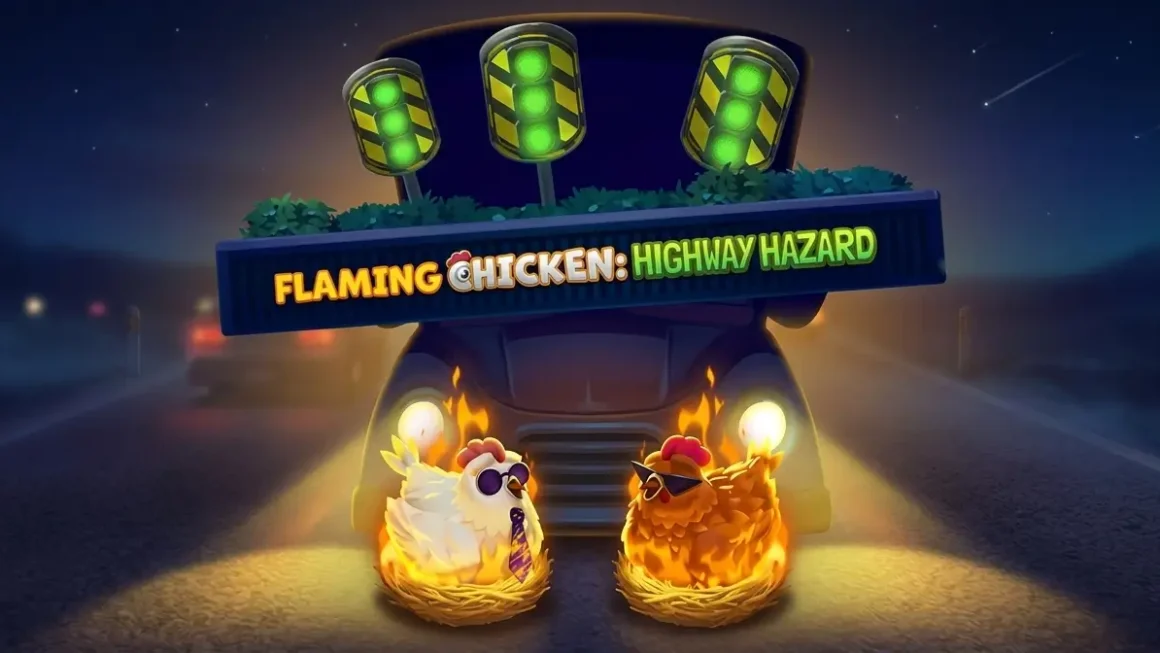
There are slots that announce themselves with a dramatic orchestral swell and a fog machine’s worth of visual gravitas. Then there’s Flaming Chicken: Highway Hazard from Octoplay’s Penguin King studio, which opens to the sight of chickens — feathered, clearly unhinged, and absolutely committed to crossing a very busy road — while your bankroll quietly considers what it’s got itself into.
Released in spring 2025 and picked up fast by operators including Stake.com, this is one of the more conceptually unhinged slots to land in the past year. And I mean that as a compliment. At a time when the slot market is drowning in generic mythology titles and the forty-seventh variation of a fortune-cat grid, something this committed to its own absurd premise deserves proper attention. The chicken-crossing-road theme has become its own genre category in 2024–2025, but most entries use it as a skin over conventional mechanics. Flaming Chicken: Highway Hazard actually builds its core bonus mechanic around the premise. That’s a different thing, and it’s why the title has held up in coverage and player discussion well past its launch window.
Let’s go through it properly.
Who Made This Thing?
Octoplay is a Malta-based provider founded in October 2022 by Carl Ejlertsson, a former executive from Evolution and Red Tiger — two operations that know their way around a game engine. That pedigree shows. In under three years, Octoplay built a portfolio of around 80 titles across multiple in-house studios: Penguin King, Super Hippo, Combat Royale, Twice As Nice, and Smash Games. The company holds licenses from the Malta Gaming Authority, the UK Gambling Commission, Sweden’s Spelinspektionen, and the Alcohol and Gaming Commission of Ontario, among others. In January 2026, they went live in Michigan with FanDuel, Rush Street Interactive, and BetMGM — a meaningful signal about how seriously the regulated US market is taking them.
Flaming Chicken: Highway Hazard comes from Penguin King, the Octoplay sub-studio that tends toward the irreverent end of the spectrum. Their other titles include Salmon King and Mr Piggles, so the chicken theme isn’t exactly coming out of nowhere. What Penguin King does consistently is take a throwaway premise and engineer something mechanically worth playing underneath it.
The Specs: What You’re Working With
Before getting into the experience, here’s the cold data:
Grid: 6 reels × 5 rows
Paylines: 21 (fixed)
RTP: 95.77%
Volatility: High (rated 5/5 on SlotsLaunch)
Max win: 20,000× your bet
Bet range: 0.10 to 50
Release date: May 2025
Features: Wild with multipliers (up to 3×), Bonus Game, Flaming Chickens, Super Bonus, Bonus Buy, Double Chance
The RTP of 95.77% lands below the generally cited industry benchmark of 96%. That’s worth noting upfront rather than burying — this game takes a slightly larger theoretical cut than average, and with high volatility layered on top, your base game sessions can be dry for extended stretches.
The 6×5 grid is large. What’s slightly odd is that Octoplay chose to pair it with only 21 fixed paylines. On a grid this size, that’s a fairly restrictive payline structure — you’d typically see either cluster pays, Megaways, or at minimum something north of 40 lines. The payline compression does create situations where you can watch the reels fill with chicken symbols and walk away with nothing meaningful, which is a design choice that’ll frustrate some players.
But that ceiling of 20,000× keeps things interesting. For context: on a €1 bet, that’s €20,000. On the max bet of €50, it’s €1,000,000. That theoretical top end is the hook that makes the volatility worth tolerating.
The Theme and Presentation
The setting is a rural highway cutting through what reviewers variously describe as woodland or countryside — think American truck-stop belt rather than motorway. The reels sit on the highway itself, flanked by trees, and the visual palette leans warm without going full neon. The symbol design is cartoon-adjacent but not condescendingly childish; these chickens have character. Some wear expressions of grim determination. Others look like they know exactly what they’ve signed up for.
The soundtrack runs guitar-led and relatively relaxed in the base game — one player on Strafe.com described it as “soothing guitar music that adds to the immersion.” Don’t let that fool you into thinking the game is calm. The audio shifts during the bonus round, and descriptions of the experience range from “Mad Max meets Looney Tunes” to “something out of a racing game.” The contrast is deliberate and works.
Visually, the game performs well on mobile — the 6×5 grid scales without losing legibility, and the highway backdrop renders cleanly on smaller screens. Octoplay’s optimization across devices is consistently noted as a studio strength, and this title holds up.
Base Game: What Actually Happens on Each Spin
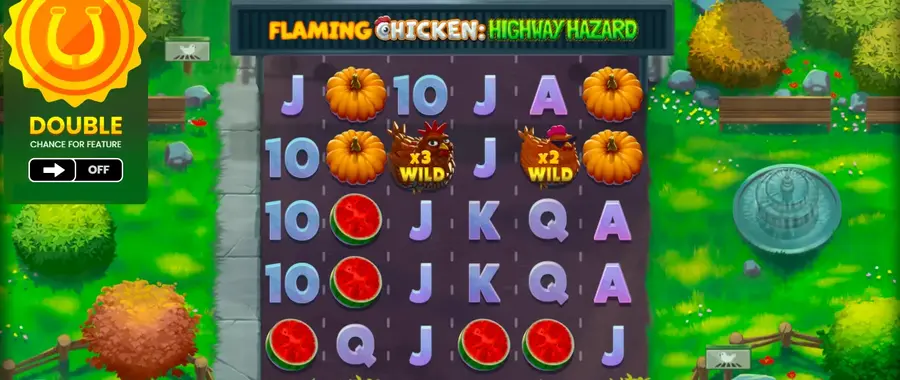
In the base game, you’re spinning a 6×5 grid across 21 fixed paylines looking for matching symbols. The symbol set runs a chicken-themed range — various poultry characters at different pay tiers, traffic-related icons, and card-rank low-pays. Nothing in the paytable is going to surprise you structurally; the base game reads like a conventional slot and plays like one too.
The standout mechanic here is the Wild symbol, which takes the form of a chicken. These Wild chickens come attached with multipliers — up to 3×. When a Wild lands as part of a winning combination, that multiplier applies to the win. So a Wild with a 2× multiplier doubles the line win it contributes to; a 3× multiplier triples it. The multiplier values appear visibly on the Wild symbol itself, so you always know what you’re working with before you’ve even calculated the outcome.
Having a 3× multiplier on a wild sounds modest until you consider that multiples can compound across a single win line if more than one multiplied Wild participates in the same combination. In practice, though, the base game is largely a holding pattern — it’s functional, readable, and occasionally produces a decent mid-sized hit, but the real architecture of this game is built around the bonus round. That’s a deliberate structural choice on Octoplay’s part, and it’s honest in the sense that the game doesn’t try to convince you the base game is where the money lives. Anyone who’s played a high-volatility bonus-hunter slot knows the rhythm: you spin, you manage bankroll, you wait for the scatter alignment that changes everything.
The Double Chance option deserves more attention than it usually gets in coverage of this game. It’s a toggleable per-spin buy-in — you pay an additional percentage on top of your base stake, and in return the scatter frequency increases. What matters beyond the obvious is that activating Double Chance also nudges the theoretical RTP upward from its base 95.77% figure. For anyone specifically hunting the bonus round, Double Chance is worth considering if your bankroll permits it. For players who are watching their stake size carefully and treating the base game as the primary experience, it’s optional. The mathematical case for using it over extended sessions is solid, but it accelerates your total stake exposure on a per-spin basis, which demands more bankroll to sustain through the inevitable dry patches.
The traffic light scatter symbols are your primary target throughout the base game. They can appear anywhere on the grid — no payline restriction — and three of them anywhere simultaneously triggers the bonus round. That “anywhere” qualifier is important: on a 6×5 grid, you have 30 positions available for scatters to land, which is why the Double Chance toggle makes a tangible difference to how frequently the bonus enters. Without it, you’re working against worse odds on each individual spin.
One thing the base game does well is maintain visual coherence with the bonus round. The highway setting is consistent across both modes, so the transition to the crossing mechanic feels like part of the same world rather than an arbitrary modal shift. Smaller detail, but it matters for whether a session feels cohesive or feels like two unrelated games glued together.
The Bonus Round: Where the Concept Actually Lands
This is the bit that sets Flaming Chicken: Highway Hazard apart from generic high-volatility slots, and it’s why the game has attracted coverage from reviewers who’d otherwise dismiss a chicken-themed slot without a second glance.
Trigger: 3 or more traffic light scatter symbols anywhere on the grid.
When you land the bonus, the slot transitions into a completely different screen. Chickens — each carrying an assigned multiplier value — appear and attempt to cross the highway. Vehicles are coming. The chickens try to make it to the other side. The ones that cross safely add their multiplier values to your total bonus win. The ones that get hit contribute nothing.
This mechanism is genuinely fresh. It takes the “chicken crossing the road” joke premise and builds it into a functional gambling mechanic that creates real tension. You’re watching individual chickens navigate traffic, and your payout depends directly on how many survive. It’s unpredictable in a way that pure reel spins aren’t — the randomness plays out visually and narratively, not just numerically. The result is that the bonus round actually makes you feel something, which is more than you can say for a free spins screen where three glowing orbs drop from the sky and spin nine times while you drink your coffee.
The audio environment during the bonus shifts noticeably from the base game’s lighter guitar soundtrack. Multiple reviewers have described it as high-energy, kinetic, and slightly ridiculous in the best possible sense. The screen fills with movement: chickens darting, cars swerving, multiplier numbers flaring. There’s a madcap visual energy to it that’s consistent with the game’s overall personality.
There are effectively two tiers of bonus:
Standard Bonus Game — Normal chickens attempt the crossing. Each carries a multiplier value visible on their character sprite. Survivors contribute their multiplier to the total bonus win. The total is then applied to your stake. This is the primary bonus trigger from scatter alignment.
Flaming Chickens — Within the bonus crossing, Flaming Chicken variants can appear. These ignite normal chickens when they interact, doubling the prize stacks for the affected birds. This is the compound multiplier mechanism that drives the game’s highest outcomes. When Flaming Chickens are active, a single surviving ignited chicken can generate significantly larger contributions to the total win than a standard chicken with the same face-value multiplier.
Super Bonus — The escalated version. All chickens enter the highway already on fire — no normal birds in this round. Every participant has the ignited/doubled stack effect applied from the start. The Super Bonus is the route to the game’s extreme outcome territory. It is available via Bonus Buy at a higher cost than the standard bonus purchase option.
Bonus Buy — Available where regulations permit. Two tiers: a standard Bonus Buy that drops you directly into the crossing mechanic, and a Super Bonus Buy that guarantees the all-fire variant. Bonus Buy access raises the effective RTP compared to spinning for the trigger naturally.
One reviewer who tested the game extensively reported a single bonus round producing 1,250× in one session, describing a sequence where burning chickens moved across the screen and compounding multipliers stacked before the outcome resolved. That’s an extreme data point — not a session average — but it’s within the confirmed possibility space of what the mechanic can deliver.
The BigWinBoard review noted that some players will find the bonus “too unpredictable or drawn out.” That’s an honest critique. The outcome depends on how many chickens survive the crossing, and there will be bonuses where most of your birds get hit and you come away with a negligible win relative to what the feature trigger cost you in spin investment. The crossing mechanic doesn’t guarantee meaningful output; it generates a distribution of outcomes, and the lower end of that distribution exists. For players who’ve internalized the structure of high-volatility bonus hunting, this is normal and expected. For players who assume a bonus trigger always means a worthwhile return, this game will teach them otherwise fairly quickly.
One structural note: the bonus round doesn’t include a retrigger mechanism, at least in the standard configuration. What you get from a single trigger is what you get. Compare this to free spins slots where additional scatters during the feature can extend play — the crossing mechanic is a one-shot execution. This makes session-to-session variance feel sharper than it might in a game with retrigger potential.
How It Compares
The chicken-crossing-road genre has gotten crowded since Roobet’s Mission Uncrossable made it a format worth copying. Octoplay’s approach here is distinctive because it’s a full 6×5 reel slot with a crossing mechanic bolted onto the bonus, rather than a pure crossing game. That distinction matters when you’re deciding what you actually want from a session.
Mission Uncrossable — Roobet’s original chicken-road title — runs at 96% RTP, medium volatility, and a maximum win of 8,000×. It’s a more approachable experience: more frequent outcomes, lower ceiling, less drama. Flaming Chicken inverts most of those parameters. Higher ceiling, more volatile bonus, lower RTP, less frequent wins overall. These aren’t objectively better or worse choices; they’re different risk profiles.
Against games like Money Train 4 or Wanted Dead or a Wild — which occupy roughly the same high-volatility, bonus-hunter positioning in the broader market — Flaming Chicken is described by at least one reviewer as “leaning harder into bonus volatility.” The base game is drier, the bonus ceiling is genuine, and the tonal register is considerably lighter. It’s less grimdark casino-Western and more Saturday morning cartoon chaos. Whether you find that refreshing or irritating probably says something about your preferred slot aesthetic.
The 21-payline structure puts Flaming Chicken at a specific disadvantage versus Megaways titles in the same volatility tier. Games like Dead or Alive 2 or Razor Shark offer thousands of ways to win, which generates more base-game texture and frequent smaller hits to maintain engagement between features. Flaming Chicken’s 21 lines across that 6×5 grid can produce visual confusion — the grid fills with symbols, nothing connects cleanly, the result is a loss — which is a friction point that Megaways architecture simply doesn’t have.
For players who specifically enjoy the crossing-game format but want the fuller structure of a traditional slot around it, this hits a useful niche. It’s not trying to be Mission Uncrossable or Stake’s own Chicken Original, both of which operate as pure crossing games with player agency. Flaming Chicken is a slot that uses the crossing format as its bonus engine rather than its entire mechanical identity. That’s a meaningful design distinction.
The game’s humor register also separates it from most of the high-volatility competition. It doesn’t take itself seriously. In a market full of apocalyptic mythology slots and Wild West death imagery, Flaming Chicken is playing a completely different game tonally, and that lightness has its own appeal — particularly for players who find the po-faced intensity of some bonus-hunter titles exhausting.
Practical Playing Notes
Bet sizing: With high volatility and a potentially long wait for the bonus, bet sizing matters more than in medium-volatility titles. Playing at the minimum 0.10 per spin gives you extended runway to absorb dry stretches. Reviewers who’ve tested the game in volume suggest keeping stakes conservative — relative to your bankroll — until you have a read on the bonus frequency at your particular casino. Different operators may configure RTP variants, so the 95.77% figure is the standard published number but may not represent every deployment.
Double Chance: Worth enabling if you’re specifically hunting the bonus and can sustain the increased per-spin cost. The scatter frequency benefit is real, and the marginal RTP improvement, while small, runs in your favour over volume. Turn it off if you’re under bankroll pressure and need to extend your session runway.
Bonus Buy: Available at casinos that permit it (excluded in some regulated markets for compliance reasons). Two tiers — standard Bonus Buy and Super Bonus Buy. The Super Bonus Buy costs more but delivers the all-fire variant of the crossing mechanic. If you’re playing Bonus Buy, the Super tier is the one that gives you the highest outcome ceiling. Standard Bonus Buy is cheaper but delivers the base crossing mechanic with normal/standard chicken populations.
Session expectations: Set them before you open the game. Dry stretches of 50–100+ spins without a meaningful bonus trigger are possible and normal for this volatility profile. The game is not broken when that happens. The flip side is that when the bonus lands well — particularly the Super Bonus with multiple flaming chickens surviving — the output can be substantial. Managing the gap between those events is the actual skill challenge with a game like this, and it’s mostly a bankroll management question rather than anything you can influence in-game.
Mobile performance: Plays cleanly across devices. The highway backdrop and the 6×5 grid scale appropriately on phone screens. The bonus round animation plays smoothly in mobile browsers without frame-rate issues that have been noted in some competing titles. Octoplay’s technical optimization is consistently highlighted in coverage of their wider portfolio, and this title represents that standard.
Bonus Buy geography: Not all markets allow Bonus Buy access. Where regulations restrict it — several European markets operate under restrictions on feature purchases — you’re playing the natural trigger version only. Factor this into your session planning if you’re primarily interested in the crossing mechanic without the base-game patience requirement.
The Honest Problems
It would be dishonest to wave these away. Three issues come up consistently in serious coverage:
The RTP. At 95.77%, it’s below average. On long sessions, that extra 0.23–0.5% versus typical industry titles compounds against you. Players with options should factor this in.
The payline restriction. Twenty-one paylines on a 6×5 grid is the design choice that generates the most criticism. It makes the base game feel underwhelming relative to the grid’s visual weight. You can fill that grid and still land no win simply because the match doesn’t fall on a payline. That’s intentional volatility amplification, but it can feel like the game is playing against itself visually.
Bonus variance. Getting into the bonus round doesn’t guarantee a meaningful win. If the chickens keep getting hit by cars — which happens — you can bonus out with a disappointingly small return. The Super Bonus is more reliable for bigger outcomes, but it costs more to access directly and isn’t guaranteed in the standard bonus trigger. This is the nature of the mechanic, but new players expecting a bonus to always deliver should know it doesn’t work that way.
Responsible Gambling
Flaming Chicken: Highway Hazard is a high-volatility slot with a below-average RTP. That combination is the right profile for players who understand exactly what they’re doing with their stakes — not for anyone chasing losses or playing on money they can’t afford to lose. The bonus mechanic is designed to produce excitement through unpredictability, which is precisely the quality that makes the game genuinely fun and also the quality that makes it unsuitable for sessions where you’re not fully in control of your decision-making. Set a session limit before you start. If the standard tools are available at your casino — deposit limits, cool-off periods, session timers — use them. They exist for exactly this reason.
Verdict
Flaming Chicken: Highway Hazard is the rare slot that does something actually novel with its bonus mechanic and earns the right to its chaos. The chicken-crossing-the-road premise isn’t just cosmetic — it’s load-bearing. The survival of your multiplier-carrying chickens is the actual randomness driver of the bonus round, which makes the visual drama functionally meaningful rather than decorative. That’s a harder thing to engineer than it looks, and Octoplay’s Penguin King studio has done it well.
The RTP is the sticking point. 95.77% is a real concession, and combined with maximum volatility and a restrictive payline structure, this is a game that will test your patience between features. If that sounds like a deal-breaker, go find a title with a better RTP and medium volatility. Plenty exist, and some of them are genuinely good games.
But if you’re the kind of player who can handle extended dry spells knowing that the bonus round has a legitimate shot at four-figure multipliers, and if you appreciate when a game commits fully to its own ridiculous concept — chickens on fire, traffic everywhere, multipliers stacking on top of each other as your feathered portfolio sprints across four lanes of cartoon highway — then this is worth your time and your patience.
Octoplay built something here that has a personality. Not a manufactured one, not a theme-park version of personality, but something that actually made reviewers want to write about a chicken slot at length. In a market full of slots that could have been made by anyone, Flaming Chicken: Highway Hazard could only have been exactly this. From the Penguin King studio that previously asked us to care about a Salmon King and a character called Mr Piggles, the chicken was always going to show up eventually. It was worth the wait.