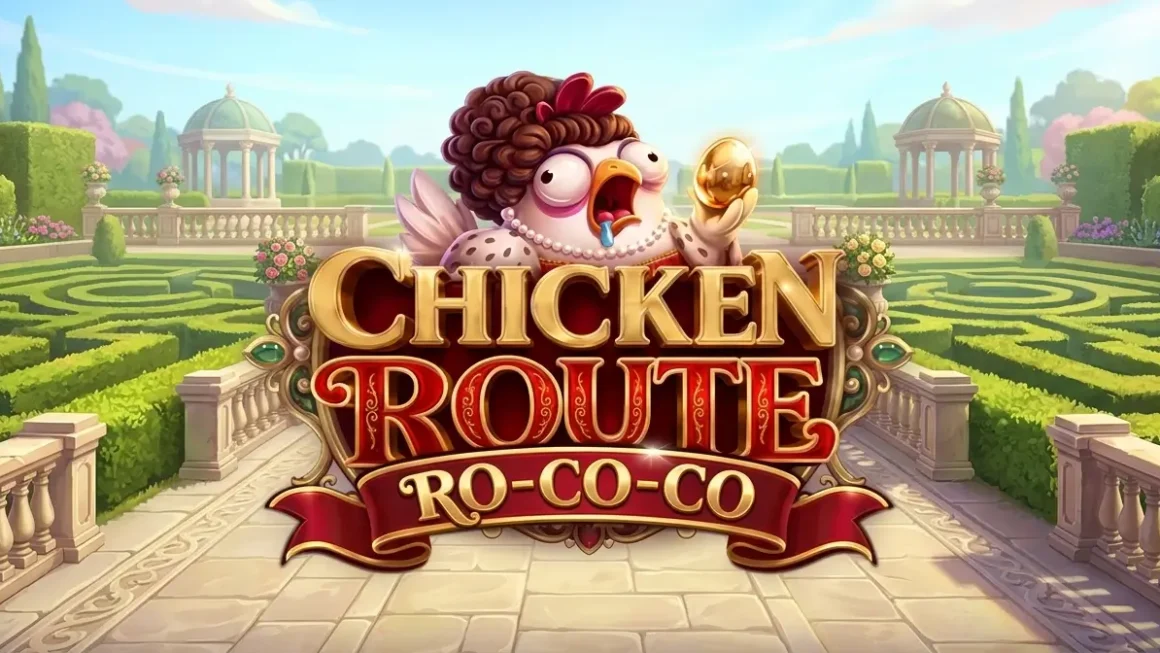
There are crash games. There are step-multiplier games. And then there is a cartoon chicken wearing 18th-century aristocratic attire, sipping tea in a velvet armchair, staring across a busy road with the quiet confidence of someone who has absolutely no business crossing it. That is Chicken Route: Ro-co-co by Turbo Games, the studio’s latest spin on its own breakout hit — and it is either the most absurd thing in iGaming right now, or the most cunningly designed one. Possibly both.
I have been covering casino games for long enough to recognise when a developer is coasting on a skin change versus when they have actually thought about what a themed variant does to the player’s emotional experience. This review breaks down exactly where Ro-co-co lands on that spectrum — and why the answer is less obvious than the ornate wallpaper in its background art might suggest.
Turbo Games: Who’s Behind the Feathers
Before getting into the game itself, it helps to understand the studio. Turbo Games was founded in 2020 and operates from Tallinn, Estonia. The company launched its first title, Crash X, in 2021, and has since built a catalogue of over 40 crash-style and instant-win games. The studio obtained RNG certification in 2022, and Chicken Route: Ro-co-co sits as one of its more recent releases — the base Chicken Route was listed as the studio’s 46th game.
What matters about Turbo Games from a player’s perspective is the Provably Fair architecture. Every round result is verifiable through cryptographic proof, meaning you are not simply taking the casino’s word for it. The studio publishes its math, allows brand customisation for operators, and wraps all of its titles in an ecosystem called Turbo Universe — more on that below.
The company is not a household name in the way that Pragmatic Play or Evoplay is, but within the crash and fast-game vertical, they have built a reputation for clean mechanics and high retention content. Chicken Route in its original form was already one of the better entries in the traffic-dodging sub-genre. The Ro-co-co variant adds a visual layer that, done right, can genuinely change the mood of play.
The Ro-co-co Concept: Baroque Absurdity as a Design Choice
Let’s spend a moment on what Ro-co-co actually is, because it is not simply a reskin in the lazy sense. The theme draws from 18th-century Rococo aesthetics — the ornate French decorative style that produced gilded furniture, elaborate plasterwork, pastel portraits, and enough curling flourishes to give a modern graphic designer a migraine. Turbo Games leaned into it hard.
The setting described in official materials is Victorian London — foggy streets, gentlemen in top hats, interiors so detailed that even a quill looks like a work of art. The chicken herself is positioned as a noblewoman: sitting in an armchair, sipping tea, dressed to survive high society rather than heavy traffic. The tagline from the official description puts it well: “Help the lady cross the road. Preferably alive.”
This matters beyond aesthetics. The juxtaposition of a stately, composed aristocratic character with the absolute chaos of a crash game creates a specific kind of ironic tension that actually feeds into the psychology of play. You feel the absurdity every time you tap GO. That slight ridiculousness lowers your guard, which is precisely when the game tightens its grip. It is a clever trick, and Turbo Games have clearly thought about it.
Core Mechanics: Crash Logic in a Road-Crossing Frame
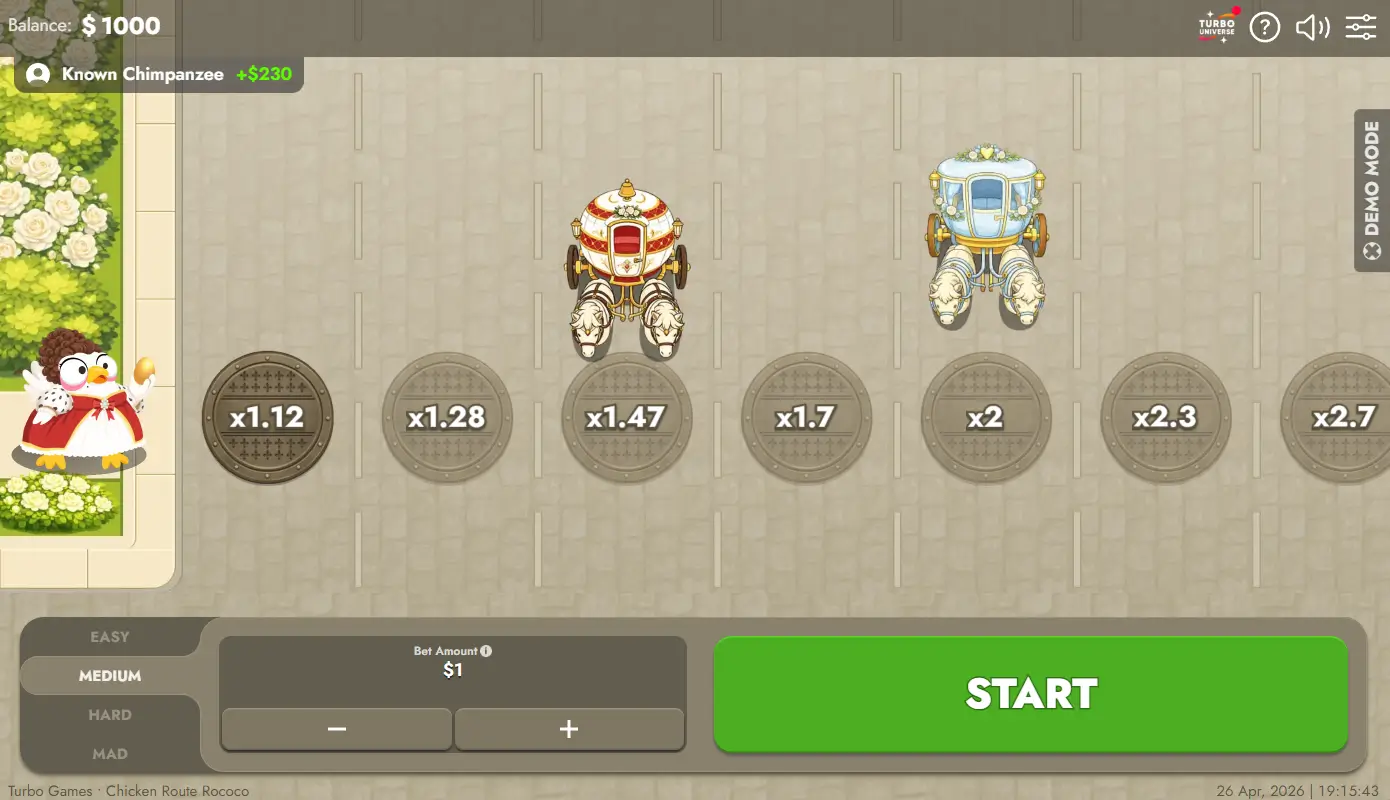
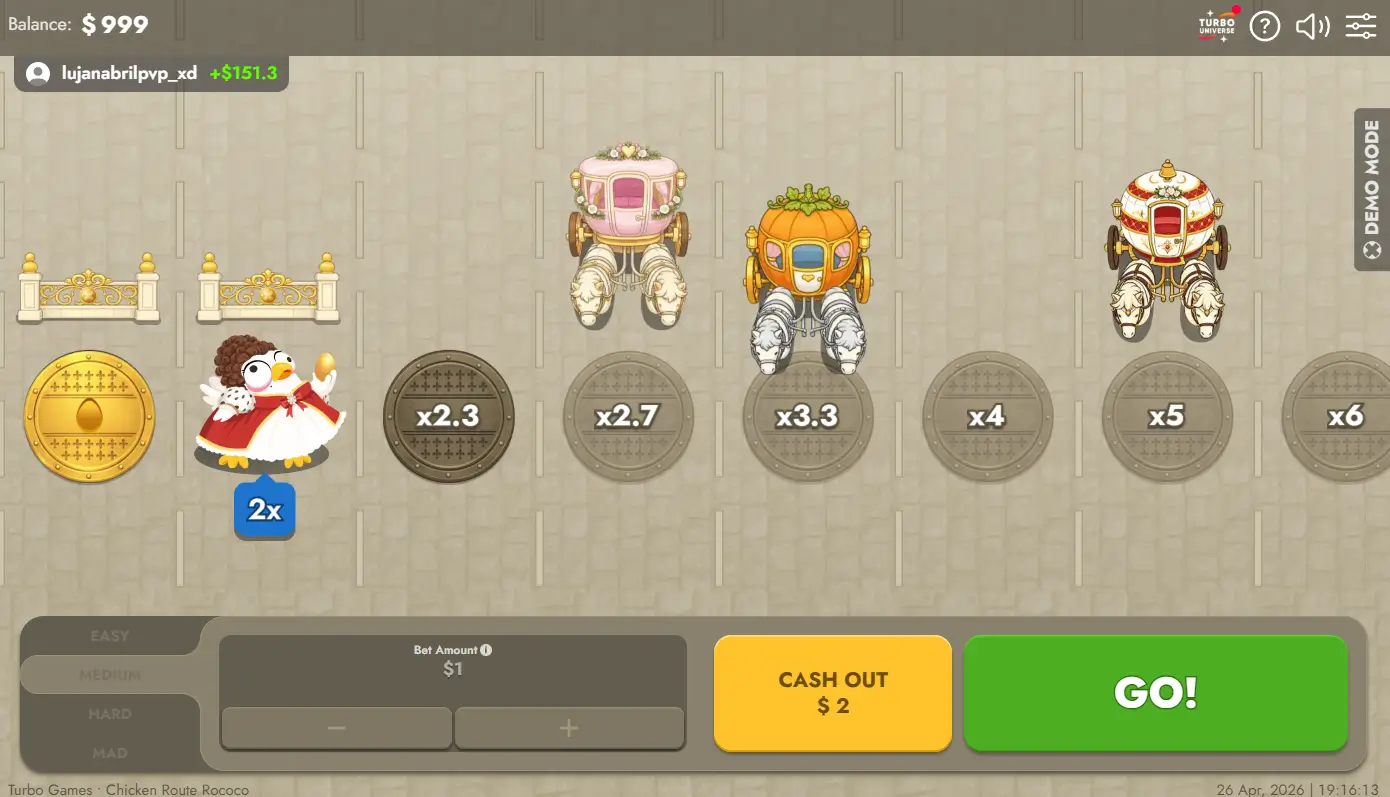
Strip away the powdered wig and the underlying engine is the same one powering the base Chicken Route. The mechanics work like this: you place a bet, select a difficulty level, press Start, and then guide your chicken across a multi-lane road one step at a time. Each successful step raises a multiplier displayed directly on the road. At any point you can press Cash Out to lock in your current multiplier multiplied by your stake. If a car hits the chicken before you cash out, the round ends and you lose your bet.
Unlike traditional crash games where a line climbs until it busts, here you have agency at each individual step. Every tap of the GO button is an independent RNG event. You are not watching a curve — you are making a decision, then making another one, and another. That distinction is what separates Chicken Route from something like Aviator, and it is why the game generates more active tension per second than a standard crash title does.
The minimum bet sits at $0.10, the maximum at $100. The minimum winning multiplier is 1.03x. The theoretical maximum is 1,000,000x your stake — but note that individual casino operators set their own payout caps, so the actual ceiling you encounter at your casino may be considerably lower than seven figures.
The RTP ranges from 95.68% to 96.27% depending on difficulty mode and session length. The upper end of that range sits comfortably above the iGaming industry average for slots. This is a genuine positive, not a marketing footnote.
Difficulty Modes: The Real Lever in This Game
Four modes. This is the core decision point that defines your entire session.
Easy gives you 24 steps to complete the crossing. Multipliers grow at a measured pace — minimum start around 1.03x — and risk per step is lowest. This is the mode for learning the game, grinding through bonus wagering requirements, or simply playing with smaller stakes over a longer session without blowing your balance on three bad rounds in a row.
Medium reduces steps to 22. The multiplier growth rate picks up marginally, the risk increases proportionally. Still a reasonable mode for mid-stakes play.
Hard cuts steps to 20. At this point the multiplier curve steepens noticeably. The distance between each step and a potential car strike is shorter, but the rewards per step start to look meaningfully different from Easy mode.
Mad is 18 steps between you and the Grand Prize. The highest risk, the steepest multiplier curve, and the shortest road. If the chicken reaches the finish line on Mad, the payout is at the extreme end of what the game’s math produces. The vast majority of rounds on Mad will not reach that point.
The adjustable volatility system is one of the genuinely intelligent design decisions in this game. Most crash games fix their volatility in the math. Turbo Games made it a user-facing control, which means a conservative bettor and a high-stakes player can both find a setting that fits their session. That is not common in this format, and it earns credit.
What Ro-co-co Changes (And What It Does Not)
The honest answer is that Ro-co-co is a themed variant of Chicken Route, not a mechanically distinct product. The RTP, difficulty structure, step counts, and cashout system are identical. The differences are visual and atmospheric.
What the visual overhaul does deliver is a distinct mood. Where the base Chicken Route is a cartoon street scene with blocky urban design — cheerful, borderline childish — the Ro-co-co version replaces that with a more richly rendered, period-specific environment. The aristocratic chicken protagonist carries a different kind of personality. The contrast between high-society composure and total road chaos is funnier and more memorable than the original’s straightforward chicken-versus-traffic premise.
For players who have already put significant time into the base game and know its rhythm well, Ro-co-co offers a fresh visual context without demanding relearning of any mechanics. For new players encountering this particular variant first, the theme actually works as a slightly better hook — it is more distinctive in a crowded field of traffic-dodging games.
What it does not change: there is still no Autoplay. Sound control is the only available setting. There are no traditional bonus rounds or free spins. The game is stripped to its mechanical core, which purists will appreciate and feature-hunters will find lacking.
Turbo Universe: The Gamification Layer
Turbo Universe is the studio’s built-in engagement system, accessible via the Turbo icon within the game. It includes personal statistics, leaderboards, achievements, and a “Plays of the Day” board displaying the biggest multipliers hit by other players. There is also a Turbo League structure that assigns players a rank based on activity.
From a design standpoint, Turbo Universe is a solid retention mechanism. The leaderboard element in particular adds a social competitive dimension that most instant-win games completely ignore. Watching someone post a 200x win on Hard mode while you are grinding through Easy creates aspiration — and aspiration keeps sessions going.
The practical benefit for players is the personal stats section. Being able to review your own session history and cashout patterns is useful data, particularly if you are trying to calibrate your cash-out discipline across different difficulty settings.
Free Bets are occasionally offered through Turbo Universe, though availability depends entirely on which casino and operator you are playing through. When they appear, they represent genuine zero-risk value — a chance to collect real winnings without putting your balance on the line. Worth looking for, but not something you can count on being present.
The Tension Loop: Why This Game Is Hard to Put Down
I want to be specific about what makes Chicken Route: Ro-co-co adhesive, because it goes beyond “it’s fun.” The game operates on a tension loop that standard slots do not replicate.
In a slot, you press spin and wait. The outcome is delivered to you. In Chicken Route, you press GO, the outcome is delivered, and then you immediately face a new decision with higher stakes — because your multiplier has just increased and you now have more to lose. The psychological load is cumulative. By step 8 on Hard mode, you are not playing casually anymore. You are invested. The aristocratic chicken waddling toward her next step while violins presumably play in the background is carrying your money, and you know exactly how many steps remain.
Average round duration is under 30 seconds according to available information about the game’s design. That is fast enough to replay immediately after a loss, and fast enough that a winning run builds up real money before you have fully processed the situation. The combination of short sessions and high decision frequency is what makes crash-adjacent games stick — and Chicken Route executes this format better than most of its direct competitors in the traffic-dodging niche.
Playing Ro-co-co: Practical Notes From the Session
After running through a significant number of demo and real-play rounds at different difficulty levels, a few patterns emerge that are worth documenting for anyone planning a serious session.
On Easy mode, the multipliers are modest but the run lengths are long. Reaching step 12 or 15 without incident is realistic, and at that point you are collecting between roughly 2x and 5x depending on how the specific round’s multiplier curve has developed. The practical approach on Easy for players managing bankroll is to set a consistent cashout target — say, after step 8 or 10 — and treat every round as a unit. The variance is low enough that this approach produces stable session results rather than wild swings.
On Hard and Mad, the conversation changes entirely. The multiplier curve climbs faster, but the penalty for staying too long is proportionally brutal. What the game does not tell you outright — but what becomes clear over multiple sessions — is that the tension of each individual step compounds psychologically. By step 12 on Mad mode, the multiplier may be sitting at 15x or higher. At $10 a bet, that is $150 on the line. The temptation to take one more step is enormous. This is exactly the spot where experienced crash players know to cash out, and where newer players consistently overextend.
One observation worth sharing: the game’s round-to-round feedback loop is faster than it feels during play. Because each session averages under 30 seconds, it is easy to reach 20 or 30 rounds in what feels like a brief sitting. Tracking how many rounds you have completed is genuinely useful — not in terms of predicting outcomes, since every step is an independent RNG event, but in terms of understanding how quickly stakes can accumulate when you are reloading bets at speed.
There is also a specific discipline around switching difficulty mid-session. If you have been running Easy and decide to move up to Hard after a few wins, your bankroll is in a different state than it was at the start. Hard mode losses are faster and steeper. The transition deserves a conscious decision, not an impulsive click on the mode selector because a few Easy wins made you feel invincible.
The Free Bets mechanic, when available through the operator, is worth paying attention to. A Free Bet on Hard or Mad mode is a legitimate opportunity to collect a meaningful multiplier without risking your own stake. If your casino has them active, check the Turbo Universe hub before defaulting to pure deposit play.
The Ro-co-co Theme vs. the Base Game: A Direct Comparison
Players who have time with the original Chicken Route will notice immediately that the Ro-co-co variant carries a different ambient weight. The base game is bright, fast, and urban — it does not ask you to feel anything particular about the chicken. She is an avatar, a vehicle for multiplier collection, cheerfully oblivious to her own peril.
The Ro-co-co protagonist is different. The aristocratic framing — the armchair, the tea, the elaborate period costume, the ornate background details — creates a character that has actual presence. You are not guiding a placeholder animal. You are escorting a dignified noblewoman across a road that is entirely beneath her social standing. The comedy is built in, and it reads clearly even on a small mobile screen.
Whether this constitutes a meaningful upgrade depends entirely on how much weight you place on atmosphere during a session. For players who play with the sound off and the game minimised between spins on other tabs, the Ro-co-co aesthetic is irrelevant. For players who actually sit with a game and absorb its environment, the difference is real. The Rococo design has more personality per square inch than most crash game environments, and in a genre where the visual template is almost always either generic urban street or abstract mathematical space, that distinction matters.
Turbo Games have also released seasonal skins for Chicken Route — a Christmas festive edition was confirmed in late 2025 alongside Vortex and Aero. The Ro-co-co variant fits into this pattern of using visual theming as a player retention tool, giving regular players a reason to return to a known game format with a fresh context. That strategy works if the underlying game is strong. In this case it is, so the approach is well-founded.
Honest Weaknesses
No review worth reading pretends a game has no problems. Here are the genuine ones:
Repetition is real. The game loop is narrow by design. After twenty to thirty rounds you have seen everything the game offers visually and mechanically. Long sessions will feel monotonous to players who need variety to stay engaged. The Ro-co-co theme adds texture compared to the base game, but it does not solve the fundamental repetition issue.
No Autoplay is a conscious choice that some players will hate. Every single step requires a manual tap or click. This is intentional — it maintains engagement and prevents the kind of passive losses that autoplay on high volatility can cause. But for players who like to set parameters and let a session run, the absence is noticeable.
The 1,000,000x headline is marketing math. The theoretical maximum exists. The probability of reaching it under any realistic conditions — particularly on a casino platform where the operator-set payout cap may be a fraction of that figure — is vanishingly small. The RTP and the practical max win are the numbers that actually matter to session planning, and they are solid but not extraordinary.
No traditional bonus features. If your ideal session includes free spins, expanding wilds, or a pick-and-click bonus round, this game will disappoint you. The cashout mechanic and Free Bets are the entirety of the feature set. For many players that minimalism is the point; for others it will feel thin.
Comparable Titles: Where It Sits in the Market
The traffic-dodging crash game niche has become genuinely competitive. Evoplay’s Uncrossable Rush offers similar gameplay with an RTP of 96% and four risk levels. TaDa Gaming’s Chicken Dash operates across three levels with an RTP of 97% and reported max wins above 20,000x. InOut Games’ Chicken Road, one of the genre’s founding titles, runs at 98% RTP. These are strong alternatives.
What Chicken Route: Ro-co-co has that most of them do not is the Turbo Universe ecosystem — the leaderboards, stats tracking, and achievement system provide a meta-layer that adds genuine value to regular play. The theme here is also more distinctive than most direct competitors; a baroque aristocratic chicken is a more memorable visual concept than a generic cartoon road.
Where it loses ground is on the RTP ceiling. A 96.27% upper bound is reasonable, but it does not match the 97-98% figures some alternatives offer. For mathematically-minded players who treat expected value seriously, that gap adds up over long-term volume.
Provably Fair: What It Actually Means Here
This point is worth addressing directly because “Provably Fair” gets thrown around as a buzzword without explanation. In Turbo Games’ implementation, each round result is generated using a cryptographic algorithm combining a server seed (known to the house before the round) and a client seed (generated from your session data). After the round, you can verify that the outcome was predetermined before you pressed GO and was not altered mid-game.
This is not the same as claiming the game favours you. The house edge still exists — it is baked into the RTP. What Provably Fair actually guarantees is that the casino cannot manipulate the outcome in real time, and that the published RTP reflects the genuine mathematical structure of the game. For a crash-style game where the cashout mechanic involves time pressure, that assurance is worth having.
Mobile Performance
Available data on the game consistently notes the HTML5 build is lightweight — reportedly under 2MB without music — and loads quickly even on slower connections. Full Android and iOS compatibility is confirmed. The tap-to-proceed control scheme is actually better suited to mobile play than mouse clicking, which makes the game feel more natural on a smartphone than it does on desktop. Session length under 30 seconds means it fits comfortably into short breaks without demanding the kind of concentration a long slot session requires.
Final Assessment
Chicken Route: Ro-co-co is a well-executed themed variant of a solid crash-adjacent game, dressed in a visual concept clever enough to earn genuine interest rather than just cosmetic differentiation. The Rococo/aristocratic chicken framing is more than a reskin — it creates a specific ironic mood that works in the game’s favour during play.
The underlying mechanics are honest and well-calibrated: a 95.68–96.27% RTP, four clearly differentiated difficulty modes that function as genuine volatility controls, Provably Fair verification, and a tension loop that short-session players will find genuinely difficult to walk away from. Turbo Universe adds value that most games in this format simply do not offer.
The weaknesses are real and consistent: narrow gameplay loop, no Autoplay, no traditional bonus features, and a theoretical max win that practical conditions will rarely let you approach. These are not dealbreakers, but they define who the game is and is not for.
If you are a crash game regular looking for something with more active decision-making than Aviator, a traffic-dodging game player who wants social/competitive features baked in, or someone who simply appreciates a developer with a sense of humour about what they are making — Chicken Route: Ro-co-co delivers. If you need variance in your feature set, a higher RTP ceiling, or Autoplay support, there are stronger alternatives.
The chicken crossed the road in a powdered wig. Whether she made it to the other side, and with how much of your money, is still entirely up to you.