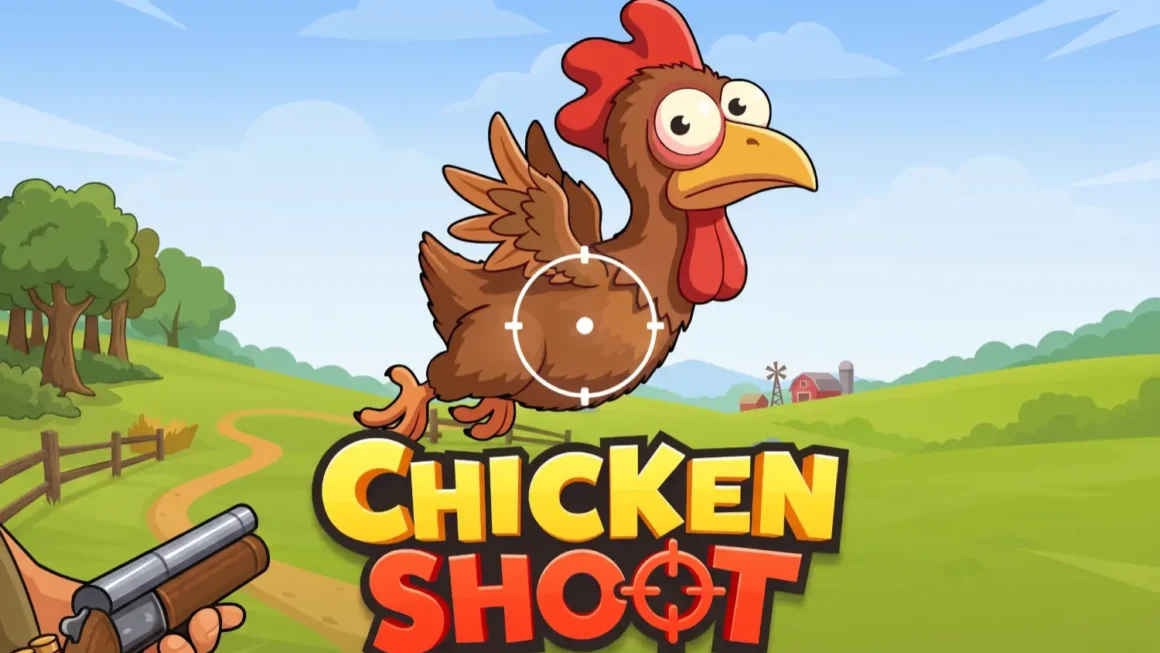
InOut Games released Chicken Shoot on 25 March 2026 — less than three months ago at the time of writing. That makes it one of the newest titles in the studio’s catalogue, and that catalogue already has a problem: Chicken Road sits right next to it in most casino lobbies, runs on a published RTP of 98%, and commands a three-million-times multiplier ceiling. Chicken Shoot walks in at 94% RTP and a 120× cap.
That gap matters. Whether InOut built something genuinely different — a game with its own reason to exist — or simply repackaged its farmyard theme into a format with worse math is the question this review answers directly.
The honest short version: Chicken Shoot is not trying to be Chicken Road. The mechanics are distinct, the pace is different, and the audience is different. Whether that distinction justifies the 4-percentage-point RTP penalty depends entirely on what you want from a session.
Math model and mechanics
RTP — and the operator configuration issue
The RTP published by InOut Games is 94%. That figure appears on the official game page, across the vast majority of casino affiliates, and in the game’s own Provably Fair documentation. The house edge is 6%.
One exception: BetFury’s lobby shows the game at 96%. This is not an error on BetFury’s part — it reflects an operator-configurable RTP, which InOut Games (like most instant game providers) makes available at a range. The base published figure is 94%; licensed operators can elect to host a higher-RTP version, and BetFury appears to have done so.
What this means practically: if you open Chicken Shoot at two different casinos, you may be playing at 94% at one and 96% at the other without any visual indication in the game itself. The difference on a £200-per-session player is £4 in theoretical loss at 94% versus roughly £3.20 at 96%. Not dramatic, but real. The correct approach is to check your casino’s game information page before playing — not rely on the figure listed on review sites, including this one.
At 94%, Chicken Shoot sits noticeably below the arithmetic centre of gravity for licensed instant games. The broader fish/shooting game category averages around 96%–96.5%. Fish Catch by RTG runs at 96.2%; TaDa Gaming’s flagship arcade shooter runs at 96.5%. InOut’s own Chicken Road is published at 98%. Against that field, 94% is a clear disadvantage and should influence how you manage your bankroll going in.
Volatility and hit frequency
InOut classifies Chicken Shoot as medium volatility. That classification is internally consistent with the mechanic: each round resolves in one shot, the multiplier range runs from x1.1 at the low end to x120 at the high end, and the distribution of chicken values is heavily weighted toward the lower bands. You will land the x1.5 and x2 chickens frequently enough to maintain momentum; the x24, x48, and x120 birds appear rarely and are priced accordingly in probability.
This is not high volatility disguised as medium — the hit structure genuinely delivers more frequent, smaller returns than a crash game or high-volatility slot. Sessions on low-multiplier Autoplay settings produce a relatively flat bankroll curve. Sessions hunting only the top-tier birds produce sharp variance. The player controls that dial almost entirely through target selection.
What medium volatility means in a session of 100 shots at £1: at the bottom of the multiplier distribution (targeting x1.1–x1.5), expect a lot of near-breakeven rounds with an occasional small net loss. At the top (targeting x24+), expect long stretches of losses punctuated by rare large returns. The 94% RTP applies across both strategies over volume; the distribution of how you experience those losses is what changes.
Grid structure and round logic
There is no reel grid. Chicken Shoot is an instant arcade game — the visual field is a farmyard backdrop through which chickens fly at varying speeds and directions, each displaying a multiplier value.
One round equals one shot. You place your bet, select a chicken, fire, and receive an immediate win or loss result. There is no cash-out decision, no timing element, no partial win for partial progress. You either destroy the target and receive bet × multiplier, or you miss and lose the stake for that round. It is faster-paced than any crash or stepping game because there is no waiting — the round resolves in under a second.
The minimum bet is $0.01 per shot; the maximum is $200 per shot. The maximum win is capped at $20,000, which becomes the binding constraint before the 120× multiplier at bet sizes above $167. A £200 shot at x120 would theoretically return £24,000 — but the cap cuts that to £20,000. Worth knowing if you play at high stakes.
The progressive multiplier system
This is the mechanic that distinguishes Chicken Shoot from a generic instant game. When you target a specific chicken and your shot fails to destroy it, that chicken’s multiplier increases by a fixed increment. It does not reset until someone (you or another player) successfully destroys it.
In practice this creates a secondary decision layer: do you continue targeting the same high-value chicken that has been resisting shots, knowing its multiplier is climbing, or switch to easier targets for consistent smaller wins? The patience play — repeatedly attempting a difficult high-multiplier target while it grows — is the mechanic that separates experienced players from newcomers.
The multiplier resets to its base value the moment the chicken is successfully destroyed and a payout is issued. This prevents infinite accumulation and keeps the math honest.
Feature breakdown
Autoplay target selection
Autoplay in Chicken Shoot is not the same as Autoplay in a slot. You are not simply pressing a button to spin reels automatically — you are programming the game to hunt specific multiplier tiers while you watch.
The configuration lets you specify which chicken types to target: x1.01–x1.15 for a conservative slow-burn session, x1.5–x3 for a balanced approach, x12 for veteran territory, and x24+ for outright jackpot hunting. The system then aims and fires on your behalf according to those preferences, up to a configurable maximum number of rounds (the published ceiling is 1,000 shots).
The honest limitation: Autoplay removes the human judgment element. The progressive multiplier mechanic — the interesting decision about whether to keep targeting an accumulating chicken — is essentially handed off to an algorithm when Autoplay is active. Players who use Autoplay in jackpot-hunt mode are, in effect, running high-variance shots on autopilot. That is a legitimate way to play, but it flattens the game’s most interesting strategic dimension.
Autoplay also makes it possible to blow through a session budget faster than you might expect. 1,000 shots at $1 per shot is $1,000 exposed capital. Set a loss limit before activating it.
The tiered chicken system
Chickens in Chicken Shoot are not all equal. Different birds carry different base multipliers, move at different speeds, and appear at different frequencies. The higher the multiplier, the faster and rarer the target.
Based on available information from the official InOut page and multiple operator descriptions, the multiplier distribution breaks down roughly as follows:
- Common chickens (x1.1–x3): Appear frequently, move at moderate speed. The session backbone — these are where most shots land in a typical session.
- Mid-tier birds (x4–x12): Less frequent, faster-moving. Represent the middle ground between sustainability and profit.
- Rare birds (x24–x48): Appear sporadically. Hitting one at even a moderate bet size produces meaningful returns.
- King Chicken (x48–x120): The rarest target in the game. The listed multiplier ceiling is x120. At a £100 bet, that returns £12,000 — still well below the £20,000 cap. At £200, the cap kicks in before the full multiplier is reached.
The exact multiplier values for each tier and their precise appearance frequencies are not published by InOut Games. The x1.1–x120 range is confirmed; the internal distribution probability is not. Treat any claimed frequency statistics from third-party sites with scepticism.
Manual mode
In contrast to Autoplay, manual mode gives the player direct targeting control every shot. You choose which chicken to aim at, you fire when ready, and you decide how to respond to the progressive multiplier accumulating on missed targets.
This is the more engaging way to play — and, in my view, the format Chicken Shoot is actually built around. The progressive multiplier mechanic only becomes meaningful when you are watching it, evaluating it, and deciding whether to commit another shot to a climbing target or walk away to something more achievable. Autoplay discards that entirely.
The limitation of manual mode: at fast session pace, it requires sustained concentration. The chickens move; you need to identify the target, account for movement, and fire. It is not genuinely skill-based in the sense that a steady hand or better aim actually improves your probability — the RNG determines hit or miss regardless of where you point the crosshair. But it creates the sensation of control, which is what keeps players in manual mode rather than switching to Autoplay.
It is also worth flagging how different the mobile and desktop experiences feel in manual mode. On desktop, moving the cursor to a specific chicken and clicking is fast and precise. On mobile, you are tapping a moving target on a smaller screen, and the touch controls are calibrated (by InOut’s own description) to prevent accidental misfires. That calibration introduces a very slight delay between tap and shot registration on some devices — not enough to affect the RNG outcome, since the result is pre-committed before you fire, but noticeable if you are used to desktop precision.
Approach and bankroll considerations
This section exists because Chicken Shoot’s mechanic encourages two very different session structures, and the bankroll implications of each are not obvious until you have experienced them.
The low-multiplier grinding approach uses Autoplay or careful manual selection to target x1.1–x1.5 chickens almost exclusively. The return per shot is modest — a £1 bet returning £1.10 to £1.50 — but hit frequency is high. Over 200 shots, this approach will produce something resembling the stated 94% RTP in practice, with relatively small swings. It is mathematically the most controlled way to play. It is also, bluntly, not very interesting after the first few dozen rounds. The game was not designed for this.
The jackpot-hunt approach targets x24, x48, and x120 birds exclusively. Between successful shots, you will experience long stretches of consecutive losses. At £1 per shot, hitting a dry run of 30 missed shots costs £30 — and dry runs of that length are common when targeting rare birds. A single x48 hit at £1 returns £48, covering the run and delivering a meaningful profit. But 30-shot losing streaks at higher bet sizes (say, £5 per shot) cost £150 before that recovery hit. The x120 King Chicken, when it finally lands, pays £600 on a £5 bet — but there is no guarantee on the session timeline for that hit.
The progressive multiplier play is what InOut Games appears to actually intend as the primary strategic dimension. The idea is to monitor the multiplier accumulating on a specific high-value chicken across failed shots, then commit a larger bet once the multiplier has climbed to a level that justifies the increased risk. A chicken that started at x12 and has accumulated through several missed attempts might now display x18 or x24. The question is whether the hit probability has changed. It has not — the RNG determines each shot independently, and the progressive multiplier accumulation does not increase your probability of hitting the target. What it increases is the reward if you do.
That distinction is important. The progressive system creates the feeling that a hard-to-hit chicken is “due” for a successful shot. It is not. Each shot is an independent event. The multiplier is climbing, but the hit probability is not. Playing the progressive mechanic well means sizing your bet appropriately when a high-value target has accumulated significant value — not chasing it with escalating stakes on the assumption that a hit is overdue.
Provably Fair verification
Every shot result in Chicken Shoot is generated using a Provably Fair SHA-256 cryptographic system. Before each round, the server commits to a seed hash; after the round resolves, the player can verify that the outcome matches the pre-committed hash, confirming no post-hoc manipulation.
This matters for the category. Chicken Shoot’s rapid growth attracted counterfeit versions almost immediately — unlicensed clones running on unregulated servers that do not respect the 94% RTP and may not pay out at all. The Provably Fair system gives players on licensed platforms a concrete verification mechanism the clones cannot replicate.
Practically: the verification requires a hash-matching process that most casual players will never use. But its existence signals that InOut Games is building to a standard that the grey-market copies are not. Always check that the InOut Games logo appears during the loading sequence. If it does not, you are not playing the official game.
Social and live features
Chicken Shoot ships with a live player counter that frequently shows over 20,000 concurrent users, and a live win feed that displays recent payouts from other players scrolling in real time.
The counter and feed are clearly engagement mechanics — watching a feed that shows “Player123 just won £840” creates social proof and FOMO. They are not interactive features in any meaningful sense; you cannot play against other players, and other players’ shots do not affect your targets or multipliers.
The 20,000+ concurrent user figure suggests the game has achieved genuine scale quickly. Whether that reflects genuine player satisfaction or heavy marketing spend is not something the player counter can answer.
2026 perspective
Chicken Shoot vs Chicken Road: same studio, very different math
This comparison is unavoidable. InOut Games built both titles, they share a farmyard theme, and they sit in the same casino lobby. The differences are significant:
Chicken Road is InOut’s flagship crash-style game: the player guides a chicken across dungeon pots (or road lanes, depending on the version), each crossing multiplying the bet, with a cash-out decision at each step. Published RTP: up to 98%. Maximum multiplier: exceeds 3,000,000×. Difficulty is player-adjustable from Easy to Hardcore, which modifies both the risk curve and the multiplier ceiling.
Chicken Shoot uses a fundamentally different mechanic — instant arcade shooting with one shot per round, no cash-out timing decision, and a fixed multiplier per target. Published RTP: 94%. Maximum multiplier: 120×.
The RTP gap is 4 percentage points. On a session of 100 rounds at £5 per shot (£500 total staked), that gap costs the Chicken Shoot player an additional £20 in theoretical loss compared to Chicken Road. The maximum multiplier comparison is not close — 120× versus 3,000,000× is a different category of game entirely.
Does Chicken Shoot offer anything Chicken Road does not? Yes, actually. The instant resolution mechanic — one shot, immediate result — is faster and cognitively lighter than the step-by-step tension of a crash game. Players who find crash-style timing stressful or who want a more arcade-reflex experience will find Chicken Shoot easier to engage with. The progressive multiplier accumulation on missed targets creates a different kind of tension than a crash game’s cash-out decision. These are genuine mechanical differences, not just cosmetic ones.
But the math cost of those differences is real. If your primary concern is long-run return, Chicken Road is the correct choice within InOut’s own catalogue.
Buy bonus and progressive jackpot
No buy bonus feature exists in Chicken Shoot. This is standard for instant games — the format does not have a traditional bonus round to purchase — but it means there is no shortcut to the highest-value targets. If you want to hunt the King Chicken, you hunt it from the base game, shot by shot.
No progressive jackpot. The $20,000 win cap is a hard ceiling, not a prize pool. There is no accumulating jackpot network connecting Chicken Shoot sessions across casinos.
Both absences are architectural rather than oversights. The game is built around per-round micro-decisions, not jackpot chasing or bonus-round pursuit.
Competitor context
Chicken Shoot sits in a loosely defined category that includes fish table games (JILI, KA Gaming, TaDa Gaming) and arcade instant games (Spribe’s Aviator, InOut’s own Chicken Road). Direct comparisons by mechanic are imperfect, but the RTP comparison is instructive:
| Game | Provider | RTP | Max win |
|---|---|---|---|
| Chicken Shoot | InOut Games | 94% (up to 96% operator-configured) | $20,000 (120×) |
| Chicken Road | InOut Games | Up to 98% | 3,000,000×+ |
| Fish Catch | RTG | 96.2% | Not fixed — variable |
| Mega Fishing | JILI | 96%+ | Boss-tier multipliers |
| TaDa Gaming flagship shooter | TaDa Gaming | 96.5% | Chain reaction multipliers |
At 94%, Chicken Shoot is the lowest-RTP title in this comparison by a meaningful margin. The competing fish/shooter titles cluster around 96%–96.5%. InOut’s own Chicken Road outperforms all of them at 98%.
The RTP gap between Chicken Shoot and Fish Catch (RTG) is 2.2 percentage points. On a session of 500 shots at £1 per shot, that translates to an additional £11 in theoretical loss. Against TaDa Gaming’s flagship at 96.5%, the gap is 2.5 points — another £12.50. Neither gap is catastrophic in isolation, but if you are playing hundreds of sessions a year, the cumulative drag of a 94% base game is real money.
The honest summary: Chicken Shoot competes on mechanics and accessibility, not on maths. If the arcade shooting format appeals to you, the RTP penalty is what you pay for the experience. If you are optimising for return, this is not the game category you should be in.
Who is this game for?
Chicken Shoot is built for recreational players who want fast, low-commitment sessions. The instant-resolution format, the £0.01 minimum, and the visual simplicity make it approachable in a way that multi-step crash games or complex slot features are not. A session of 50 shots at £0.20 costs £10 if every shot misses — and in practice, the medium-volatility hit structure means many shots will return at least partial value.
It is also genuinely well-suited to mobile play. The single-tap mechanic, the HTML5 architecture, and the absence of any secondary decision requiring precise timing make Chicken Shoot easier to play accurately on a touchscreen than most crash games. Chicken Road on mobile requires you to cash out at an exact moment; Chicken Shoot just requires you to tap a target.
High rollers and mathematics-first players have no compelling reason to choose Chicken Shoot over the alternatives.
Verdict
Chicken Shoot (as it stands in 2026)
Skip it if you play primarily for return. The 94% RTP — even in the best-case 96% operator-configured version at specific casinos — sits below the category average. InOut’s own Chicken Road beats it on both RTP and max multiplier. For a player who moves volume, the math gap compounds quickly.
Play it if the instant arcade format is what you’re after. The one-shot round structure, the progressive multiplier that grows on missed targets, and the Autoplay system that lets you set your own risk level create a genuinely different experience from crash games or traditional slots. The game is not a reskin — it does something mechanically distinct, and it does it cleanly.
The one number that most limits Chicken Shoot is the 94% RTP. At that level, you are funding a 6% house edge on every shot — and if your casino is hosting the base version rather than the operator-enhanced one, you have no way to tell from inside the game. Confirm your operator’s version before committing a real-money session.
The player profile this game makes sense for: someone who finds crash games stressful, wants mobile-friendly fast rounds with very low minimum stakes, and treats the session as entertainment rather than a mathematical exercise.
The player profile this game does not make sense for: anyone comparing it against Chicken Road (same studio, better RTP, far higher ceiling) or against the 96%+ fish-table titles from JILI and TaDa Gaming that dominate the shooting-game category.