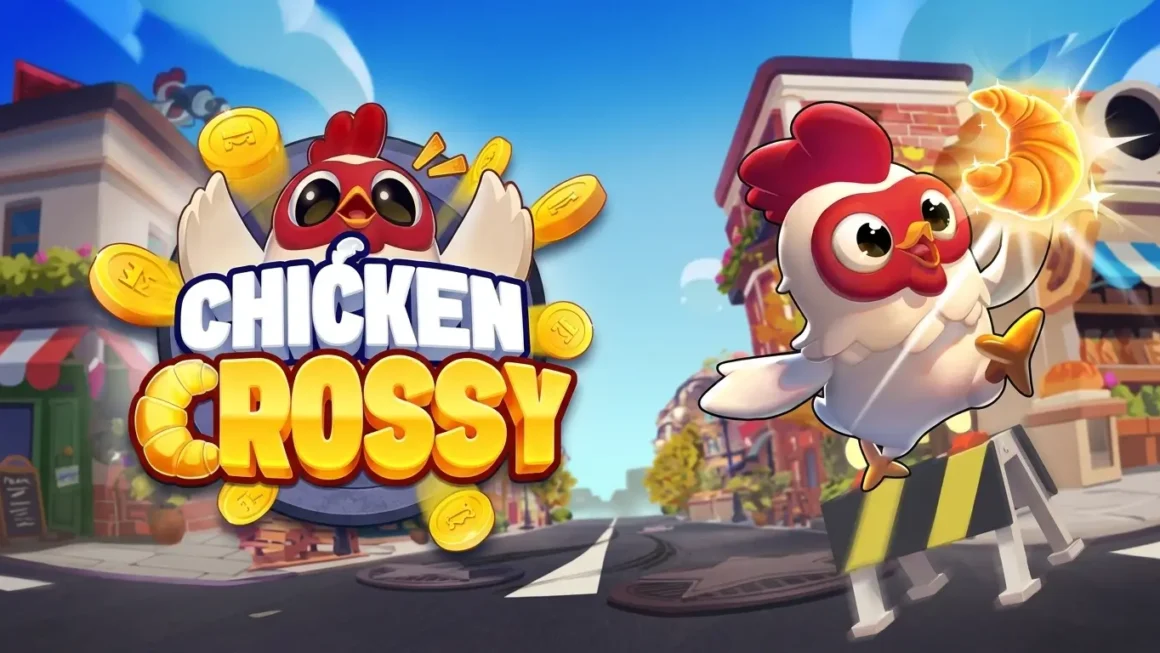
RTP: 95.99% | Volatility: High | Max Win: 3,138,009.6x | Developer: KingMidas Games | Certification: Gaming Labs International
There are crash games built on pure math. Cold, clinical, provably fair — you know the type. A multiplier climbs, you cash out, you forget about it by dinner. Then there are games built on something harder to quantify: a memory. A sound. The phantom muscle memory of tapping your phone on a bus years ago, hopping a blocky chicken across a pixelated road and thinking nothing of it except one more lane. Chicken Crossy by KingMidas Games is the second kind. And that, depending on who you are, makes it either the most compelling crash game of early 2026 or a cynical exercise in nostalgia monetization that you should walk away from immediately.
I’ve been covering casino games long enough to smell a gimmick from three jurisdictions away. Chicken Crossy is not a gimmick. It is a calculated, carefully executed gambling product that weaponizes one of mobile gaming’s most recognizable aesthetics — and it does so with enough mechanical substance to deserve a proper look, not just a nostalgic shrug.
What KingMidas Actually Built Here
Let’s be precise about what Chicken Crossy is, because the internet has generated a fair amount of confused content mixing it up with slot machines and other chicken-themed casino products. This is not a five-reel slot. It is a step-based multiplier game — a crash variant — where you guide a chicken across lanes of moving traffic, collecting a growing multiplier with each safe crossing, and cashing out before the inevitable collision ends your run.
The hook is the visual language. KingMidas didn’t just borrow the road-crossing concept; they reconstructed the specific aesthetic of Hipster Whale’s Crossy Road — the blocky voxel art style, the proportions of the character, the color palette, the animation rhythm. Screenshots of the game could genuinely confuse someone into thinking they’re looking at the original mobile title. And that’s not an accident. Someone studied the source material carefully and replicated it with precision. The car horn warnings, the hop sounds, the splashing water animation when you miscalculate a river crossing — every audio cue is calibrated to trigger recognition in anyone who spent time with the original.
This is significant because of how it affects the player’s psychological state before they’ve even placed a bet. You’re not approaching a cold, unfamiliar interface. You’re returning somewhere. That framing changes everything about how risk is perceived and how decisions get made.
KingMidas Games: Brief Context
Before diving into the game itself, it’s worth knowing who made it. KingMidas Games is an iGaming content provider operating in the B2B space — they develop and license casino game content to operators rather than running their own player-facing platform. By early 2026, the company was active enough to maintain a booth at ICE Barcelona 2026, one of the industry’s largest annual trade events, which indicates they’re operating at a legitimate mid-tier level in the supplier ecosystem. Their catalog includes multiple crash-format and next-gen titles beyond Chicken Crossy.
Their games carry Gaming Labs International (GLI) certification, which you can verify directly via the official KingMidas site footer. GLI is an independent testing laboratory that evaluates games for fairness, RTP accuracy, and regulatory compliance. It’s not the highest-profile certification in the industry — that distinction goes to labs with direct regulatory mandates in markets like Malta or the UK — but GLI certification is a meaningful and credible baseline. It tells you the RTP figure isn’t fabricated and the RNG has been independently validated.
The company brands itself around a “next-gen” positioning, which in practice means their game portfolio leans into crash-format and skill-adjacent games rather than traditional slots. Chicken Crossy sits squarely in that wheelhouse.
The Numbers, Stripped of Spin
RTP: 95.99%
The official figure from KingMidas Games, confirmed by SlotCatalog and other aggregators. That puts Chicken Crossy below the upper tier of the crash game genre — Stake’s original Chicken game runs at 98%, several Upgaming titles sit near 99%, and Roobet’s Mission Uncrossable isn’t far off. At 95.99%, the house takes roughly four cents of every dollar wagered over the long run. That’s not disqualifying, but it’s not exceptional either. If raw RTP is your primary criterion, there are better options in this genre.
Volatility: High
KingMidas classifies it as high volatility, which aligns with the step-multiplier format. The further you push your chicken across the road, the steeper the multiplier climbs — and the steeper the probability of losing that accumulated value in a single collision. High volatility here means sessions will swing hard. You’ll have stretches where you can’t survive two lanes, and you’ll have runs where you push deep and cash out at multipliers that feel absurd. The variance is real and you need to account for it when sizing bets.
Max Win: 3,138,009.6x
This is the figure that makes people do a double-take, and rightly so. Over three million times your bet — if the conditions align and you push far enough across the road without cashing out and without getting hit. KingMidas’s official page lists this as the ceiling. Whether reaching it in practice is statistically likely is another conversation entirely, but the theoretical ceiling is genuinely significant in this genre. Compare it to the 5,000x cap mentioned by some third-party reviewers and you start to see where the confusion comes from — those figures likely reflect earlier or misconfigured versions. The official KingMidas Games page puts it at 3,138,009.6x, and that’s the number that matters.
How the Game Actually Plays
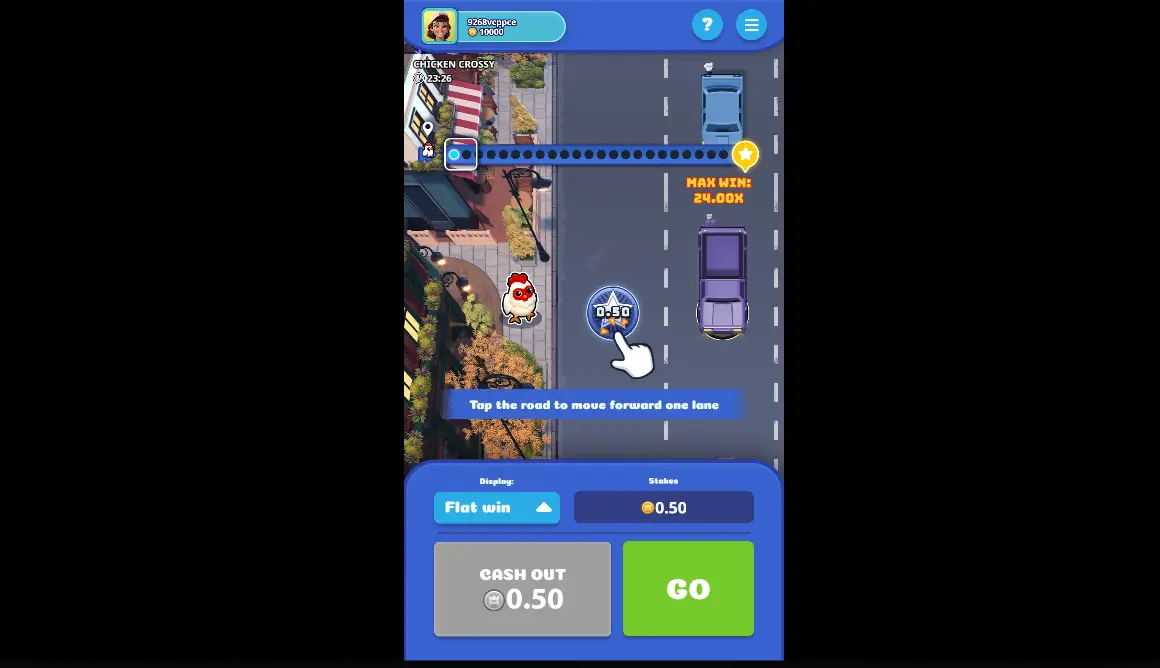
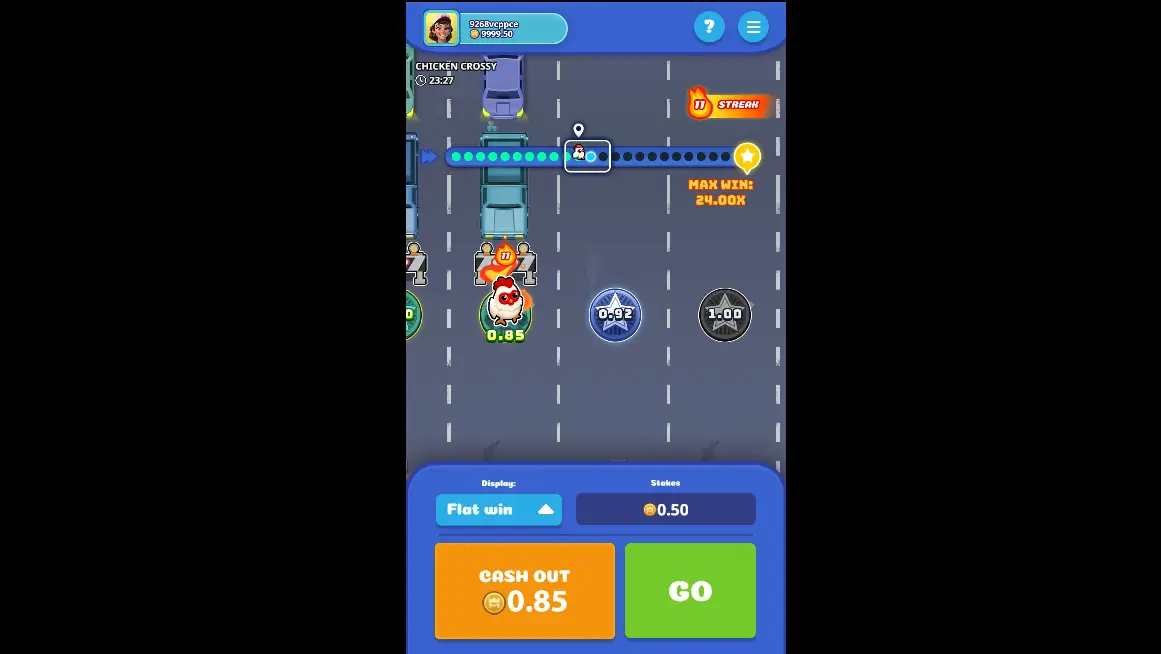
The mechanics are familiar if you’ve spent any time with crash-format games, with one important distinction: this is not a passive watch-the-multiplier-climb experience. You are actively making a discrete decision at each lane. Tap or click to hop one step forward. Survive and your multiplier increases. Get hit and you lose your stake. Cash out at any point to lock in your current multiplier. That’s it.
The “one step at a time” structure creates a different kind of tension than a traditional crash game. In a standard crash, the decision is singular: when do I bail out? In Chicken Crossy, you’re making a series of sequential binary choices, each one building on the last. The psychological effect is different — each successful hop feels like a small victory, which compounds the reluctance to stop. The sunk cost logic builds faster and more insidiously than it does when you’re just watching a line go up.
The voxel aesthetic reinforces this. You’re not watching an abstract number. You’re watching a character you recognize, hopping forward, surviving, hopping again. There’s a narrative — however thin — to each run. That narrative is what mobile gaming trained a generation of players to engage with, and it maps directly onto the push-your-luck tension that makes crash games functional as gambling products.
Character skins and unlocks are available in the game. These are cosmetic only — they don’t affect RTP, multipliers, or any mechanical element of the game. The collection system adds an optional completionist layer for players who want it, but the vast majority of real-money players won’t engage with it in any meaningful way.
Auto-cashout functionality is present, which matters more than it sounds. Setting a predetermined cashout target before a session is one of the more effective risk management behaviors in crash-format games, and having that feature built in removes the friction of manual decision-making under pressure. Use it.
The Nostalgia Mechanics: Honest Assessment
I want to spend some time on this because it’s the central design decision in Chicken Crossy and it deserves more than a surface-level nod.
The original Crossy Road was downloaded over 200 million times by 2018. The people who played it extensively are now, in many cases, in their late twenties and thirties — the core demographic for online casino gaming. KingMidas identified this overlap and built a product that exploits it directly.
Here’s what that exploitation actually means in practice: players with genuine Crossy Road history approach this game with pre-existing timing instincts. The hop rhythm feels familiar. The traffic patterns are recognizable. You’re not learning a new game — you’re applying skills from a decade of mobile gaming, in a context where those skills have monetary stakes attached. There’s something genuinely clever about that design choice.
But I’d be doing you a disservice if I didn’t flag the other side of this. The psychological associations that make the game feel familiar are also the associations that make it harder to apply cold, analytical decision-making. When a sound effect triggers a positive memory, your guard goes down. The “this is just a game I used to play” feeling and the “this is real money on the line” reality are in tension, and the nostalgia design deliberately blurs that line.
The game itself does not do anything underhanded. The RTP is what it is, the mechanics are transparent, and the volatility is disclosed. But the emotional framing deserves acknowledgment. If you load Chicken Crossy and immediately feel comfortable, at home, like you already know how this works — that comfort is by design, and it’s worth being aware of.
Distribution and Availability
This is where things get restrictive. At time of writing, Wild.io holds exclusive distribution rights for Chicken Crossy. That means one platform, one option. Wild.io is the only place you can access authentic KingMidas Chicken Crossy gameplay.
SlotCatalog lists the game as available across 33 countries, with the strongest casino presence in Canada, Austria, Finland, and Norway. If you’re outside those markets, availability will be limited or nonexistent through conventional licensed casino channels.
The exclusivity arrangement makes commercial sense — Wild.io gets unique content that differentiates it from competitors, KingMidas gets guaranteed distribution and revenue. But from a player perspective, it’s a meaningful limitation. You can’t shop for better bonus terms or compare withdrawal speeds across platforms. You’re locked into one operator. That’s worth factoring into your decision, particularly if you prefer to have options.
Demo mode is available through the platform, which is genuinely valuable here. If your Crossy Road muscle memory is five years old and rusty, the demo lets you recalibrate timing before real money enters the picture. Given the game’s reliance on player familiarity as a selling point, this is the right way to start.
The game holds Gaming Labs (GLI) certification, visible on KingMidas’s official site. That’s a credible independent testing credential and provides some baseline assurance on the RNG and RTP accuracy.
Where Chicken Crossy Sits in the Crash Game Landscape
The chicken-crossing genre has become genuinely crowded by early 2026. Stake’s original Chicken game, Mission Uncrossable from Roobet, Chicken Road 2, Upgaming’s Chicken Cross, EvoPlay’s Uncrossable Rush, Turbo Games’ entries — the market is producing new variants at a rate that would have been unthinkable twelve months ago. Understanding where Chicken Crossy fits requires being honest about what it does and doesn’t offer relative to this field.
On raw mechanics, it’s competitive but not leading. The step-by-step format is standard for the genre. High volatility with a meaningful theoretical max win puts it in the right conversation, but 95.99% RTP trails the top performers. Several competitors offer 98-99% RTP, provably fair systems with full seed verification, and comparable or superior max win potential.
Where Chicken Crossy genuinely differentiates itself is the fidelity of its aesthetic execution. This is not a generic chicken sprite on a generic road graphic. The recreation of the Crossy Road visual and audio language is detailed enough that it functions as a distinct product experience rather than another interchangeable crash game skin. For the specific audience it’s built for — players with genuine emotional connection to the original mobile game — that differentiation is real.
For players without that connection, the value proposition weakens significantly. If Crossy Road means nothing to you, the 95.99% RTP and single-platform availability are harder to justify against alternatives with better returns and broader access.
The Weaknesses, Named Directly
RTP sits below genre leaders. 95.99% is functional and within normal range for online casino games broadly, but the crash game genre specifically has been pushing toward 97-99% RTP from multiple providers. If you’re making a purely numbers-based decision, there are better-returning options.
Single-platform exclusivity is a real constraint. One casino means no comparison shopping for bonuses, no flexibility on withdrawal terms, and dependency on one operator’s service quality. If Wild.io has an outage, a policy change, or a dispute with your payment method, your options are limited.
No provably fair verification. Multiple leading crash games in this genre offer cryptographic seed verification — a system where you can independently confirm the fairness of every round after it concludes. Chicken Crossy doesn’t appear to offer this. For players who prioritize mathematical transparency over trust-in-operator, that’s a gap worth noting.
The nostalgia hook cuts both ways. As discussed — the emotional framing is a design feature, and it affects decision-making. Players who recognize this and account for it can engage with the game on their own terms. Players who don’t may find themselves making decisions based on comfort rather than calculation.
Availability limitations. 33 countries is not global reach. Players outside the supported markets simply can’t access the game through legitimate channels, which limits the audience regardless of interest.
Who This Game Is Actually For
I’ll be blunt: Chicken Crossy is a strong product for a specific audience and a mediocre product for everyone else.
If you played Crossy Road extensively and you’re curious what the experience feels like with real stakes attached — this is exactly what it is. The timing will feel right. The sounds will register. The visual language will click. The learning curve that normally exists with crash games is compressed significantly because you’re not starting from zero. Your existing instincts are a real asset in this game, and that’s an unusual and genuinely interesting feature for a gambling product to offer.
If you have no history with the original mobile game, you’re looking at a high-volatility crash variant with a below-average RTP, single-platform distribution, and no provably fair verification, competing against a field that includes products with meaningfully better numbers on all those dimensions. The voxel aesthetic is charming, but charm alone doesn’t make a game the right choice.
The high max win ceiling — over 3 million times your bet — will attract players who chase peak theoretical outcomes. That’s legitimate, though those players should understand that high volatility and a 95.99% RTP mean session bankroll management is non-negotiable. Set a cashout target before each run. Use the auto-cashout feature. Decide in advance what “enough” looks like, because the game’s design — and specifically its nostalgic emotional warmth — will apply pressure to keep you going.
How to Play This Game Without Getting Flattened
This section isn’t about finding a secret edge. There isn’t one. Chicken Crossy is a house-edge game with a certified RTP and a random number generator that doesn’t care about your feelings or your history with the source material. What follows is practical thinking about how to engage with a high-volatility crash game in a way that doesn’t end your session in twenty minutes.
Set a cashout target before each run, not during it. This is the single most useful behavioral habit for any crash-format game, and it matters more in Chicken Crossy because the nostalgic framing actively works against cold-headed decision-making. Decide before you click “play” that you’ll cash out at 3x, or 5x, or 10x — whatever aligns with your risk tolerance and session goals. Then do it. The impulse to push one more lane when you’re already at a comfortable multiplier is exactly what the game’s design feeds on.
Use the auto-cashout feature. The feature exists specifically to remove in-the-moment decision-making from the equation. If you’ve decided 4x is your target, set it and let the game execute for you. Manual cashout requires you to win a reaction-speed battle against your own emotional state. Auto-cashout removes that variable.
The high volatility is not theoretical. A high-volatility game at 95.99% RTP can absolutely produce long losing streaks at the beginning of a session before any meaningful multipliers appear. Size your bets with that reality in mind. If you’re running ten to fifteen consecutive low-lane exits, that’s variance behaving normally — not a sign that the game is broken or that you need to increase your bet to “catch up.” Chasing losses in a high-volatility environment is how sessions end badly.
Demo mode is genuinely useful here, not just a formality. The game’s design premise is that your existing Crossy Road timing and rhythm transfer to the gambling context. That might be true if you played the original game last year. If your last session was five years ago, that muscle memory has degraded. The demo lets you recalibrate at zero cost. Specifically, test whether the traffic timing feels intuitive before committing real money to that intuition.
Track your sessions. High-volatility games with nostalgia-driven design are particularly prone to encouraging “just a bit longer” thinking. Write down what you deposited, what you’ve won or lost, and when you started playing. Having that data in front of you creates an external reference point that’s harder to rationalize away than a feeling.
The character skins cost real money and affect nothing mechanical. I’ll say it plainly: unless collecting cosmetics gives you genuine personal satisfaction, skip them entirely. They don’t change RTP, they don’t change your odds on any individual lane, and they don’t improve your session outcomes. The collectible system is a secondary monetization layer designed to appeal to players with completionist tendencies. If that’s not you, treat it as invisible.
The Crash Genre in Early 2026: Why This Game Exists Now
Understanding why Chicken Crossy was built when it was built requires a brief look at where the crash game category has gone. The genre exploded in 2023-2024, driven initially by Aviator from Spribe and then accelerated by a wave of imitators and variations. By mid-2025, the chicken-crossing subgenre specifically had caught fire — Stake’s original Chicken game launched in September 2025 and became one of the most-played titles on that platform almost immediately, and a cascade of competing versions followed from every direction.
This is the market Chicken Crossy launched into: already crowded with chicken-themed crash games, with player attention fragmented across Stake Originals, Roobet’s Mission Uncrossable, Upgaming’s Chicken Cross, EvoPlay’s Uncrossable Rush, and several others. Differentiating in that context requires something that most of those games don’t have.
KingMidas’s answer was the Crossy Road visual license — or rather, a Crossy Road aesthetic executed with enough fidelity to function as a de facto nostalgic product even if the relationship to the original IP is complicated. The genre was mature by the time Chicken Crossy arrived. The innovation wasn’t mechanical; it was emotional. That’s either a smart read on what the market needed next, or a sign that the game has a limited shelf life once the novelty fades. Probably some of both.
The exclusivity deal with Wild.io suggests KingMidas understood this product wasn’t going to win on broad distribution and comparison-shopping. It wins by being the only place you can get this specific experience. That’s a different business logic than most crash game launches, and it’s worth understanding as context for why the game is positioned the way it is.
Final Assessment
Chicken Crossy is a well-made, mechanically coherent crash game built around a clear creative thesis: take a game that millions of people already know and love, add real money betting, execute the recreation with enough fidelity that the nostalgia is genuine rather than superficial. KingMidas achieved that goal. The voxel graphics, the audio design, the movement feel — it’s all there.
What they didn’t do is lead the field on the metrics that matter most for pure gambling value. The RTP is competitive but not exceptional. The max win is genuinely significant. The high volatility will produce memorable sessions in both directions. The single-platform distribution is a meaningful constraint.
Whether those tradeoffs are worth it depends on one thing: does the game mean something to you before you load it? If yes, Chicken Crossy offers a combination of familiarity and financial stakes that doesn’t exist anywhere else in the market right now. That’s a real and rare thing.
If no — play something else. The market has better options on the numbers, and nostalgia you don’t feel isn’t a feature at all