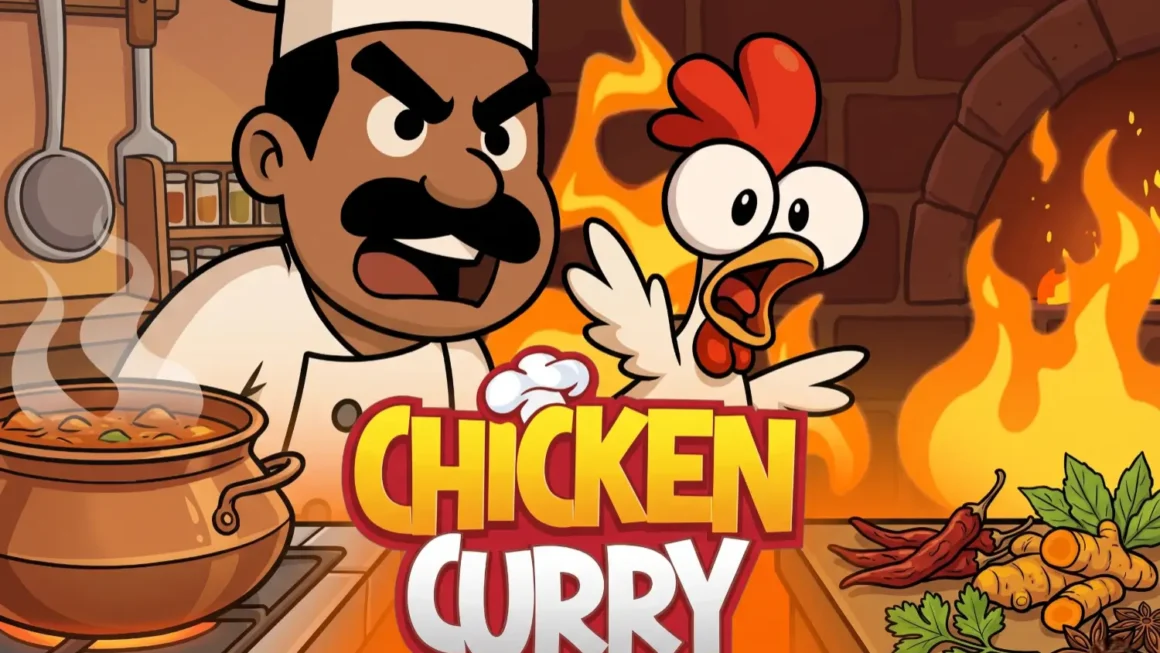
Chicken Curry landed in December 2025 — less than six months ago as of this writing — which makes it one of PoggiPlay’s freshest releases and, arguably, their most polarising. The premise is morbid in the best possible way: you are guiding a terrified chicken across a kitchen counter while boiling pots lurk in every column, waiting to end your run. If you survive long enough, you collect a multiplier. If you don’t, you lose your stake and the chicken becomes dinner.
That much is charming. The question worth asking in mid-2026 is whether the math behind the cartoon is competitive, or whether PoggiPlay’s name recognition in the crash/instant-win space is doing more work than the numbers deserve. The RTP sits at 95% — three points below Chicken Road from InOut Games, which runs at 98% on the same genre format. That gap is not trivial. The max win is 5,000×, but only in Hardcore mode — standard play caps at 2,000×. The step-controlled volatility model is genuinely interesting. Whether it is interesting enough to justify the house edge is the honest question this review tries to answer.
What Chicken Curry actually is: genre classification matters
Before getting into the numbers, the genre label needs to be correct. Chicken Curry is not a slot. It has no reels, no paylines, no scatter symbols, no free spins round. It is a turn-based instant-win game — in the same category as Mines, Plinko, and crash games like Aviator — where your decisions determine when the round ends, not a random outcome after a spin. The mechanic is a column-by-column progression: each step your chicken takes onto the next tile increases a multiplier. You choose when to cash out. If a boiling pot appears on the tile your chicken steps on, the round is over and the stake is gone.
This distinction matters because the analytical framework for evaluating these games is different from traditional slots. There is no hit frequency metric in the traditional sense. There is no base game versus bonus structure to assess. The relevant questions are: how often do you bust at different difficulty levels, what does the multiplier curve look like, and does the RTP hold up at the difficulty tier you actually want to play?
PoggiPlay categorises Chicken Curry under “instant win / crash” across its distribution partners. One aggregator site — chicken-game-gambling.com — tags it as medium volatility. Respinix.com classifies it as high volatility. The truth is that neither label is wrong: Chicken Curry’s volatility is not fixed. It is a variable the player sets by choosing a difficulty mode. Easy mode produces low-volatility outcomes. Hardcore mode is genuinely brutal. The 95% RTP is the same across all four modes; what changes is the distribution of wins.
Math model and mechanics
RTP: 95%, and that’s the number that starts every honest conversation
The return to player is 95%. This figure is consistent across SlotCatalog’s listing and all major aggregator pages covering the game. There is no evidence of operator-configurable RTP variants for Chicken Curry — unlike Aviator, where Spribe explicitly allows operators to set the RTP between 94% and 97%.
What does 95% mean in practice? On a £1 bet, the theoretical long-run return is £0.95. Over a 100-round session at £1 per round, the expected loss is £5. Over 1,000 rounds, that’s £50 — meaningful if you are a high-frequency player, trivial if you are testing the game for an hour. The issue is not the absolute number but the competitive context. Chicken Road from InOut Games — the closest direct competitor in the step-multiplier / chicken crash format — runs at 98% RTP. The 3-point difference means your expected loss per 100 rounds at the same stake is roughly three times higher on Chicken Curry. If you are playing both games at the same volume, that adds up fast.
One nuance worth flagging: several third-party review sites describe Chicken Curry’s 95% RTP as “industry standard for arcade and instant-win games.” That framing is outdated. The better crash and step-multiplier titles in 2026 — InOut’s Chicken Road, BGaming’s Crash, Spribe’s Aviator — run at 97–98%+. Calling 95% typical for the category is accurate for the lower tier of the genre; it is not accurate as a benchmark for what the best titles deliver.
It is also worth being clear about what RTP does not tell you in a game like this. The 95% figure is a long-run average calculated across all difficulty modes and all possible outcomes, including rare full-board completions in Hardcore. Your short-term experience is dictated entirely by the difficulty you select and the multiplier you target before cashing out. A player who consistently targets 1.5× in Easy mode experiences a very different variance profile than someone gunning for 500× in Hardcore — but both are contributing to the same 95% long-run average. The RTP is not a session-by-session guarantee; it is a mathematical property of the game engine over millions of rounds. Understanding that distinction is not optional. It is what separates someone who plays Chicken Curry intelligently from someone who gets frustrated at the game for “not paying out,” when in reality they set themselves an unrealistic multiplier target and let compound probability do the rest.
Volatility: player-controlled, which is the game’s main design claim
Chicken Curry’s four difficulty modes function as a manual volatility toggle. The multiplier ceilings per mode are:
- Easy: up to 250×
- Medium: up to 1,000×
- Hard: up to 2,000×
- Hardcore: up to 5,000×
The RTP of 95% applies across all four modes. The bust frequency increases with difficulty — more columns with traps, higher risk of incineration — and the multiplier growth curve steepens. In Easy mode, surviving to the end of the board is achievable in a meaningful portion of rounds. In Hardcore, the compound probability of consecutive safe steps collapses quickly. Respinix’s analysis makes the maths explicit: if each step carries a 90% survival probability, surviving 10 consecutive steps gives only a 34.8% total success rate. In Hardcore, the survival probability per step is lower than 90%, and the path is longer.
The bet range confirmed across PoggiPlay’s crash family runs from £0.10 to £100 per round. Exact Chicken Curry-specific limits should be verified in the game’s information panel, as operators can adjust these.
Max win: 5,000× in Hardcore only
This is where Chicken Curry’s ceiling looks impressive on paper and less impressive in context. The 5,000× max win is only achievable in Hardcore mode by reaching the final column of the board — a statistically rare event. In standard play (Easy, Medium, and Hard combined), the ceiling is 2,000×.
Compare this to Chicken Road (InOut Games): the max win there is capped at £20,000 in absolute terms, with theoretically enormous multipliers across difficulty levels in Hardcore before the cap kicks in. On a £150 maximum bet, that’s a 133× effective ceiling due to the £20,000 cap. On a £1 bet, 5,000× on Chicken Curry pays £5,000; on a £0.10 bet, it pays £500. The 5,000× multiplier is meaningfully large at higher stakes but requires Hardcore mode, which most players cannot sustain for long sessions given the bust frequency.
There is no progressive jackpot. There is no bonus buy. These absences are typical for games in this format and do not represent a flaw specific to Chicken Curry — they are structural features of the instant-win genre.
Feature breakdown
Difficulty mode system — the core mechanic
The four difficulty levels are the central design element of Chicken Curry. Each mode changes three things simultaneously: the number of columns on the board (the path length), the starting multiplier value when you first step onto a tile, and the maximum multiplier achievable by completing the board.
Respinix documents that Hardcore mode specifically reduces the grid to 10 columns and increases the starting multiplier to 1.6×. This is the mode where 5,000× becomes theoretically accessible. The catch: with 10 columns and elevated risk per column, the probability of completing the board without hitting a boiling pot is, as Respinix estimates, under 0.02%. That means running this mode to its ceiling will cost you hundreds of failed rounds before a single complete run.
The honest limitation of this feature: the difficulty modes create an illusion of meaningful strategy, but they are fundamentally a risk tolerance selector, not a strategic advantage. The RTP is fixed at 95% regardless of which mode you pick. Choosing Hardcore does not make the game better value — it shifts the win distribution toward rarer, larger outcomes while keeping the same expected return. Players who believe they can “read” when to stop are subject to the same compound probability rules as anyone else.
Cash out mechanic
After each successful step, Chicken Curry offers a cash out button to collect the current multiplier. This is standard for the genre. The psychology here runs deep. Each individual step feels survivable — the probability of surviving any single column in Easy mode is high. The aggregate probability of surviving 15 or 20 consecutive steps drops sharply. The game exploits this mismatch effectively.
There is no auto-cashout feature in Chicken Curry. This is a genuine weakness versus InOut’s Chicken Road, which allows players to set a target multiplier for automatic collection. Without auto-cashout, discipline requires manual intervention every round. Over extended sessions, this creates consistency problems — players who would rationally exit at 3× regularly push for one more step when clicking manually.
There is also no autoplay functionality confirmed for this title.
No bonus buy, no free spins, no progressive jackpot
These absences are as documented. Chicken Curry has no bonus buy because there is no bonus round to buy into. The game’s structure — step by step, cash out or bust — is the entirety of the mechanic. For players who prefer instant-win titles specifically because they find free spins rounds in traditional slots tedious, this is not a drawback. For players hoping for a bonus-style jackpot event, this game does not offer one.
PoggiPlay as a studio: context for the review
Chicken Curry comes from an Armenian micro-studio founded around 2019–2020, operating out of Yerevan. PoggiPlay holds no gambling licence of its own. Their games carry BMM Testlabs certification, which covers RNG integrity and math model verification — a legitimate third-party audit process — but no regulatory authority oversees the studio directly. They operate as a B2B supplier through aggregators including SoftSwiss and Slotegrator, relying on the licences held by the operators who carry their games. For a studio of this size, that model is standard rather than unusual. It does mean there is no PoggiPlay-specific regulatory complaint path if a dispute arises; any issue goes through the operator, not the game developer.
The studio’s distribution skews toward CIS-market operators — MostBet, BetBoom, 1Win are cited as primary partners. English-language player communities carry minimal discussion of PoggiPlay titles. This is relevant for players at European regulated casinos: Chicken Curry’s availability at MGA or UKGC-licensed operators is limited compared to titles from Pragmatic Play, Spribe, or InOut Games. If you are at a CIS-facing platform, you will likely find it. If you are at a regulated Western European casino, availability is less certain.
PoggiPlay’s catalogue split matters more than it might appear. The studio makes two distinct kinds of product: traditional video slots (5×3 grids, free spins, standard mechanics) and crash/instant-win games with player-controlled risk. The crash titles — Chicken Curry, Chicken Run, Labu Run, Zeus X Machina — represent the more original work. The slot titles are described by independent analysts as “standard mid-tier output.” Chicken Curry belongs to the stronger half of PoggiPlay’s catalogue. That does not make it the strongest title in its category market-wide, but it is where the studio’s genuine design identity sits.
2026 competitive context
The sibling game: Chicken Run (PoggiPlay, July 2025)
Chicken Curry’s closest relative in PoggiPlay’s own catalogue is Chicken Run, released five months earlier in July 2025. Chicken Run uses the same turn-based mechanic, the same four difficulty modes, and — critically — the same 5,000× maximum win and 95% RTP. The setting differs: Chicken Run puts a chicken with a backpack through a jungle swamp, dodging crocodiles. Chicken Curry puts a sweating chicken through a kitchen, dodging boiling pots.
The mechanical difference that several aggregators note: Chicken Run’s grid features a broader column range and crocodile-themed traps versus kitchen hazards. The statistical structure appears identical. If you have played Chicken Run and enjoyed it, Chicken Curry offers the same risk model in a different aesthetic. If you have played Chicken Run and found the 95% RTP unsatisfying, Chicken Curry will produce the same result — because the math is the same.
PoggiPlay also lists Labu Run and Zeus X Machina in the same crash/instant-win family, both using the step-multiplier format. Zeus X Machina reportedly offers four branching paths at each decision point rather than a single binary — which adds genuine complexity beyond what Chicken Curry or Chicken Run provide.
The direct competitor: Chicken Road (InOut Games, April 2024)
Chicken Road from InOut Games is the title most players will encounter first when searching for chicken-themed crash games. The comparison is direct and the numbers are not favourable to Chicken Curry:
- Chicken Road RTP: 98% | Chicken Curry RTP: 95%
- Chicken Road max win: £20,000 absolute cap | Chicken Curry max win: 5,000× (in Hardcore only)
- Chicken Road auto-cashout: available | Chicken Curry: not available
- Chicken Road provably fair: yes | Chicken Curry: BMM Testlabs certified RNG, not provably fair
- Chicken Road bet range: £0.01–£150 | Chicken Curry bet range: £0.10–£100 (indicative, operator-variable)
The 3-point RTP gap is the headline. InOut built Chicken Road specifically to undercut the industry’s typical 95–96% house edge in this format, and that decision made the game the dominant title in the chicken crash sub-genre. Over 1,000 rounds at £1 per round, you expect to lose £20 more on Chicken Curry than on Chicken Road. At higher stakes, the difference compounds.
The one area where Chicken Curry’s mechanic has an argument: the kitchen theme and cartoon presentation are genuinely distinct. Chicken Road is a dungeon manhole cover format; Chicken Curry is a kitchen counter with boiling pots. The aesthetics serve different preferences. If theme matters to you more than math, Chicken Curry has its own identity. If math matters more — and for regular players it should — Chicken Road has the better model.
The market leader: Aviator (Spribe)
Aviator is not a step-multiplier game, but any crash format article that ignores it is incomplete. Spribe’s Aviator runs at 97% RTP, is available at over 1,000 casino operators, offers a dual-bet system, live social features, and provably fair transparency. The max multiplier is theoretically unlimited, though capped by operator payout limits in practice. For players attracted to the crash format generally, Aviator’s distribution, community features, and math model make it the default entry point for a reason.
Chicken Curry addresses a different player profile: someone who wants character-driven design, a kitchen theme, and a format that feels closer to arcade gaming than multiplayer gambling. That is a real segment. The question is whether 95% RTP is acceptable to that segment once they understand what it means over volume.
Buy bonus and advanced features: absent industry-wide for this format
The crash/step-multiplier genre does not have a buy-bonus convention in the way high-variance slots do. No title in this category offers a direct bonus purchase. Chicken Curry is therefore not disadvantaged by this absence — it is structurally consistent with the format. What it does lack versus InOut’s titles is provably fair transparency and auto-cashout, both of which have become baseline expectations in the better-regarded crash games of 2026.
Session strategy and the compound probability problem
Most content covering Chicken Curry and its siblings treats the four difficulty levels as interchangeable options — pick your vibe, accept the risk, enjoy the cartoon. That framing does players a disservice, because the mathematics of compound probability make Hardcore mode genuinely hostile to all but the most disciplined bankroll management.
Here is how compound probability works in a step-multiplier game. Suppose each column in a given mode has a 75% survival probability — the chicken lands safely 3 times out of 4. After one step, your survival rate is 75%. After two steps, it is 56.25% (0.75 × 0.75). After four steps, it is 31.6%. After eight steps, it is 10%. You are playing a game where each step feels survivable, but the cumulative probability of surviving a long run is far lower than intuition suggests. This is not a design flaw in PoggiPlay’s title specifically — it is fundamental to how all step-multiplier games work, including InOut’s Chicken Road and Spribe’s Aviator in a related sense. But it means that players who repeatedly push for high multipliers in Hardcore will experience bust rates that feel disproportionate, because they are.
The practical guidance this points to:
In Easy mode, the bust frequency is lower, the multiplier ceiling is 250×, and the game can function as a consistent grind if you set modest targets — 1.5× to 2× per round — and cash out without deviation. The 95% RTP applies here, so over high volume you will still lose 5% of total stakes. But the session-level variance is more manageable than in higher modes.
In Medium mode, the 1,000× ceiling becomes relevant for players who can run long enough to encounter deep-board outcomes. The bust rate is higher than Easy. If you are targeting multipliers above 10×, expect to lose many rounds at a lower multiplier before a deep run materialises.
In Hard and Hardcore, the 5,000× max win is possible. It is also statistically remote. Respinix estimates the probability of completing a full Hardcore run at under 0.02%. At that frequency, you need to fund hundreds of failed rounds before a single complete run — and the stake on the completing round is just one round’s bet, not the accumulated loss from failed attempts. Players who treat 5,000× as their target return are planning for an outcome that will statistically require a bankroll capable of absorbing 499 or more consecutive losses at whatever stake they are playing.
None of this argues against playing Chicken Curry in Hardcore mode for entertainment. It argues against treating Hardcore mode as a reliable path to large returns. Set a session budget, decide on a difficulty level that fits the budget’s implied bust tolerance, pick a multiplier target, and treat reaching that target as a win regardless of what happens on the next column. The absent auto-cashout feature makes this discipline harder to maintain than it should be — see the feature breakdown above — but it is achievable with manual discipline.
The smartest session approach in Chicken Curry, given the 95% RTP and absent auto-cashout: Easy or Medium mode, multiplier target set before each round, manual cash out at target. This will not overcome the house edge over volume, but it keeps sessions from degenerating into Hardcore mode spirals where a run of busts triggers increasingly large bets in an attempt to recover.
Chicken Curry
This is a well-executed game with a personality PoggiPlay does well — cartoon characters, dark humour, mobile-first design, and a mechanic that takes about 30 seconds to understand. The difficulty mode system is genuinely useful for players who want to control their risk profile across sessions rather than accepting fixed volatility. The absence of a bonus buy or free spins is not a weakness; it is a genre characteristic.
The problem is the math. 95% RTP in a category where the category leader runs at 98% is a meaningful disadvantage for any player who intends to spend real time with this game. The 5,000× ceiling in Hardcore is real, but reaching it requires sustained play at a mode where bust frequency is extremely high and expected losses accumulate faster than in Easy or Medium. Without auto-cashout, consistent execution of any multiplier target is harder than it should be.
Play Chicken Curry if: you enjoy PoggiPlay’s visual style, you find Chicken Run’s jungle theme less appealing than a kitchen setting, and you are approaching this as an entertainment product for short sessions rather than volume play.
Do not play Chicken Curry as your primary crash title if: you care about long-term expected value, you play high volume, or you want the features — provably fair, auto-cashout, broader bet range — that the better-positioned competitors in this format already offer.
Chicken Run (PoggiPlay, July 2025)
The sibling title offers the same RTP, the same max win, and the same four-mode structure. If you are choosing between the two on math alone, there is no basis for a preference — the numbers are identical. Chicken Run has five more months of market exposure and may have broader operator distribution. Chicken Curry’s kitchen theme is more distinctive within PoggiPlay’s own catalogue.
For a player who wants a PoggiPlay crash title and has not played either: start with Chicken Run in demo mode. The mechanics are the same; the setting is a matter of taste. Do not start with Hardcore on either title. Get your bearings in Medium, understand the bust frequency, set a cash-out target, and stick to it. Then decide whether the 95% house edge is acceptable for what you want from the game.