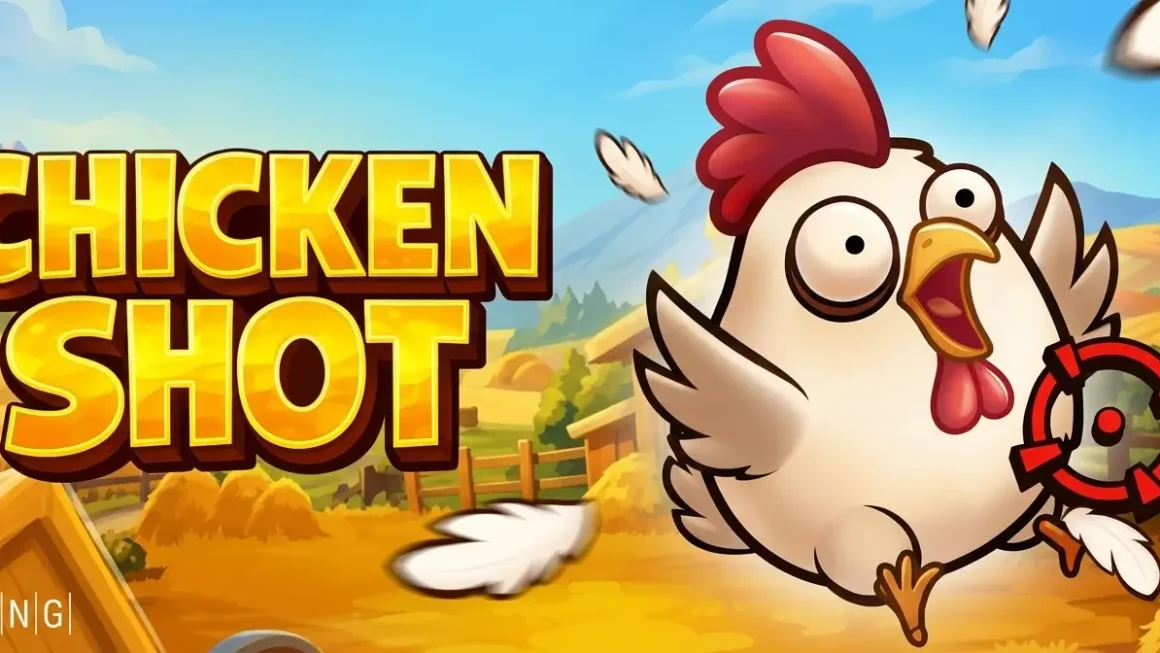
BGaming dropped Chicken Shot in late April 2026 — barely six weeks ago at time of writing. It’s a casual instant-win game, not a slot. No reels, no paylines, no free spins. You pick a chicken, you shoot, you either win the attached multiplier or you don’t. That’s the entire loop.
The format is not new. Crash-adjacent, click-driven titles have been expanding for two years, and BGaming already has form here with its Open It! gift-box casual game. What Chicken Shot does is apply that same tap-to-reveal logic to a moving-target mechanic with visible probability data shown before you commit. The RTP sits at a strong 97%. The max win is 64×. And that second number is the one worth examining before you start shooting.
BGaming has been building its casual games catalogue steadily since its founding in 2012 (officially relaunched as BGaming in 2018). The studio is best known for its traditional slots — Aztec Magic Megaways, Elvis Frog in Vegas, and Chicken Rush among them — but its casual category has expanded notably in recent years. The Provably Fair system that BGaming pioneered across its portfolio carries over into Chicken Shot, which is worth noting because it’s unusual for a game at this price point and this level of mechanical simplicity to carry independent outcome verification. Most casual instant-win titles just rely on standard RNG certification and call it done. BGaming goes further.
The commercial context also matters. Chicken Shot launched in the middle of BGaming’s Aviamasters™ 2 event cycle (running to June 2026), and it’s the kind of game that casino operators can feature alongside crash titles to capture players who find the full crash mechanic intimidating. Short-session, fixed-probability, mobile-optimised. That’s the brief Chicken Shot answers.
The math model: what 97% RTP actually means here
RTP of 97% is better than most of what you’ll find in a casino lobby. The industry average for video slots hovers around 96%, so Chicken Shot starts from a statistically sound position. What that 97% tells you, though, is not the same thing it tells you in a traditional slot.
In a slot, the RTP is distributed across millions of spin combinations. Some of it lives in base game hits, some of it lives in rare jackpot pulls. The figure gives you a long-run statistical expectation across a massive sample. In Chicken Shot, the RTP is delivered through a fixed probability table. Every outcome is governed by known odds displayed to you in real time. That is genuinely different — and more transparent — than anything a reels-based game offers. You are not waiting to discover your odds after the fact through experience. The odds are stated before each shot.
Here’s what that means in practice. If you stake £1 per round and play 1,000 rounds, your expected return is £970. Over 100 rounds — a realistic short session — variance will take over completely. Short-session outcomes in this format can swing hard in either direction regardless of RTP. Don’t treat 97% as a per-session guarantee. It isn’t.
Volatility is low. BGaming’s own description and multiple independent sources confirm this. Low volatility in the context of an instant-win game means something specific: the game is designed around frequent, small wins rather than long losing streaks punctuated by large payouts. The architecture here reflects that. The ×1.1 chicken hits 88.18% of the time. The ×1.5 lands at roughly 64% of the time. You can play this game for an extended session without going cold for ten rounds straight — which is more than you can say for high-volatility slots.
Hit frequency is inherently player-determined in Chicken Shot. Unlike a slot where the RNG decides your outcome before you even see the reels, here you are selecting which multiplier tier to attempt. If you always target ×1.1, your hit frequency will be nearly 9-in-10 rounds. If you exclusively target ×64, you’ll fail roughly 98.5 times out of 100. The “volatility” of your session is your own choice.
One note: bet range data is not confirmed on the official BGaming page or any primary source at time of writing. BGaming does not publish explicit min/max stake figures for Chicken Shot in the same format it does for traditional slots, and third-party sources list “N/A.” Assume limits are operator-configured and verify on your chosen casino before playing.
The low volatility classification deserves a moment’s attention because it’s counterintuitive. People associate low volatility with “safe” and “boring.” In a traditional slot, that’s often accurate — low-volatility slots produce many small hits and rarely produce anything dramatic. In Chicken Shot, the volatility label describes the aggregate mathematical behaviour of the game when played across all multiplier tiers in proportion. If you self-select toward the ×64 chicken every single round, your personal session will be extremely high-variance: you’ll fail roughly 98 times out of 100 and succeed roughly twice. That’s not what low volatility feels like to a player. The game’s official classification reflects its design intent for balanced play across the full multiplier range. Don’t treat “low volatility” as a guarantee of smooth sessions if you’re aiming exclusively at the top of the ladder.
Feature breakdown
The multiplier ladder
Each chicken on screen carries a fixed multiplier from the following range: ×1.1, ×1.5, ×2, ×4, ×8, ×16, ×32, ×64. Eight tiers. The multiplier is displayed on the chicken before you shoot, so there is no guesswork about what you’re targeting.
The Chance to Win figure appears when you hover over any chicken. This is the probability that your shot brings it down on the first attempt. ×1.1 shows 88.18%. ×64 shows 1.52%. The figures in between scale proportionally. This single UI element is the most interesting design choice in the game — BGaming is essentially showing you the implied odds of each bet before you make it. That’s closer to sports betting or table games than it is to a slot.
What the game doesn’t tell you is the expected value per tier. But you can calculate it yourself: a ×1.1 win at 88.18% success rate has an EV of 0.97× your stake (0.8818 × 1.1 = 0.97). A ×64 win at 1.52% success has an EV of 0.97× (0.0152 × 64 = 0.97). Every tier returns the same expected value. That’s how 97% RTP is maintained uniformly across the ladder — which is honest and clean, but it also means there is no “smart” multiplier to pick. The math is identical. The only thing that changes is your personal risk tolerance.
Let me break down what each tier feels like in practice.
The ×1.1 to ×2 range is the low-risk zone. At ×1.1 with an 88% success rate, you’ll hit a small profit most rounds. The problem is the return: a £1 stake wins you 10p. Run 100 rounds targeting exclusively ×1.1 and expect about 88 wins at £0.10 each (£8.80 returned) against 12 losses of £1 each (£12 lost). The 97% RTP in aggregate means you’re losing roughly £3 per £100 wagered over the long run, but the low stakes per round disguise how quickly you cycle through your session bankroll at pace. This tier is not a bankroll-building strategy — it’s a way to extend playtime with minimal variance.
The ×4 to ×8 range is where the game starts to feel more like a genuine risk/reward exchange. A ×4 win repays the stake four times over. A ×8 win returns eight times. These tiers sit in the middle of the probability distribution: frequently enough to land in a typical session, infrequently enough to create genuine variation. Most players who play Chicken Shot for more than a few minutes will naturally gravitate here because the tension-to-reward ratio feels right. The wins are meaningful without being lottery-level improbable.
The ×16 to ×32 range is where sessions start to bifurcate between good days and bad ones. At these odds, you might go 30 rounds without a hit. At a £1 stake, that’s £30 gone before you collect anything. When the hit does land, the return is significant relative to your per-round stake — but the gaps between wins are long enough to require genuine bankroll patience.
The ×64 tier is the ceiling. At 1.52% success probability, you expect to hit it approximately once every 66 attempts. At £1 per attempt, you’ve paid roughly £66 for one ×64 return of £64. The math always resolves to 97% RTP regardless of tier, but the psychology of repeatedly failing to hit the top multiplier across dozens of rounds is its own experience. High-volatility slot players are accustomed to this pattern. Players coming from low-stakes casual games may find it dispiriting.
One limitation worth stating plainly: there is no escalating reward for working up the ladder in sequence. Unlike crash games where a rising multiplier builds tension and rewards timing, each round in Chicken Shot is independent. You pick your target, you shoot, and the result is instant. There’s no momentum to chase.
Click counter
The click counter tracks how many shots you’ve fired at a specific chicken, even if you switch targets mid-round. This has limited practical value given that each shot is a fresh independent event — the chicken doesn’t get easier to hit after you’ve shot at it twice. The counter is more of an informational trail than a strategic tool. Some players may find it useful for tracking their own behaviour; others will ignore it entirely.
Manual and Spin modes
Manual mode is the default. You choose the target, you fire. Spin mode selects a random chicken for you, removing the targeting decision. Using Spin effectively surrenders the only discretionary element in the game. Unless you genuinely don’t care which multiplier tier you’re playing, there’s no real argument for Spin mode over Manual.
Autoplay
Autoplay lets you set a target multiplier, a number of rounds, and stop conditions. You can configure it to only shoot ×1.1 chickens for 200 rounds automatically, for example. For players who want to run the game at a steady low-risk pace without manual engagement each round, this is functional. The stop conditions add a basic level of session discipline — you can set it to halt on a balance drop below a specified threshold.
The Autoplay implementation in Chicken Shot is one of its more thoughtful inclusions. In many casual games, autoplay is an afterthought — a button you press and forget. Here, the ability to set multiplier preferences within Autoplay effectively turns the game into a configurable expected-value machine. Target low multipliers for sustained sessions, high multipliers for a fixed number of high-variance attempts. The design respects that different players have different session goals.
That said: Autoplay removes the only interactive element this game has. If you’re playing Chicken Shot in Spin mode with Autoplay running, you are essentially watching a game play itself. That’s a valid choice for some players. It’s worth being conscious of whether passive observation is why you opened the game in the first place.
No sequential unlocks. No bonus escalation. No free rounds that extend your session without additional stake. What you see in the paytable is the entire feature set.
2026 context: where does Chicken Shot actually sit?
BGaming’s Chicken Rush — released in May 2024 — is worth mentioning here because it’s the other “chicken” game in the BGaming portfolio and the most common comparison players make. They are not the same type of game. Chicken Rush is a 5×5 video slot with a 97% RTP, medium-high volatility, a 5,000× max win, a buy-bonus system with Bronze/Silver/Gold tiers, sticky symbol mechanics in the bonus round, and a hit rate of approximately 1 in 4.4 spins. It is a fully developed slot. Chicken Shot is a casual instant-win title with a 64× ceiling and no bonus structure at all. Comparing them directly is a category error — but the player asking “should I play the BGaming chicken game?” deserves to know both exist and how different they are.
BGaming’s own Open It! casual title is a closer structural comparison. Open It! runs 97% RTP, low volatility, and a ×64 max win ceiling — the same numbers as Chicken Shot. The mechanic is tap-to-reveal on gift boxes rather than shooting chickens. The math model is, from a player’s perspective, functionally identical. Open It! has been available longer and may have broader casino distribution. If you enjoy one, you’ll enjoy the other. If you’re deciding between them, the theme is the differentiator.
Looking outside BGaming: InOut Games released their own Chicken Shoot in March 2026 — effectively a direct competitor in the same tap-to-shoot chicken format. InOut’s version carries a 94% RTP, bet range from $0.01 to $200, and a maximum win expressed as $20,000 (not a fixed multiplier, but stake-dependent). The 94% RTP is meaningfully worse than Chicken Shot’s 97%. Over 1,000 rounds at a £1 stake, that’s a difference of approximately £30 in expected returns. In the casual instant-win format, that gap matters more than it does in a traditional slot because you’re cycling through rounds quickly.
Aviator by Spribe, the defining title in crash-adjacent casual casino gaming, is worth mentioning for context even though it’s a different mechanic. Aviator runs at 97% RTP with a theoretical maximum multiplier of ×10,000. That’s not a reasonable comparison point for Chicken Shot’s 64× ceiling, but it sets the player expectation floor for what casual, fast-round casino games can offer in 2026. Players who have used Aviator and are exploring Chicken Shot will immediately notice the max win limitation.
Buy-bonus availability: none. Chicken Shot has no mechanism to purchase a route to a high-variance outcome. This is a structural consequence of the game’s design — there are no bonus rounds to buy into. If bonus-buy is a feature you rely on in session planning, this game does not have it and cannot replicate it.
Progressive jackpot: absent. The 64× max win is a fixed ceiling, not a jackpot pool.
That 64× ceiling is the question mark the game can’t escape in 2026. A £1 stake hitting the maximum returns £64. A £5 stake hitting the maximum returns £320. These are real-money wins that would have a modest impact on a session. But in a year where Chicken Rush from the same provider offers 5,000×, and competitors across the broader casual category are pushing into four-figure multipliers, Chicken Shot’s ceiling is low. It’s not deceptive — BGaming advertises it plainly — but it is a genuine limitation for any player whose session goal involves chasing a meaningful return from a small stake.
One aspect of BGaming’s infrastructure that Chicken Shot inherits is the Provably Fair system. BGaming is the first major provider to implement provably fair verification across its casual catalogue — an algorithm based on cryptographic methods that allows players to independently verify the fairness of each outcome after the fact. This is a genuine differentiator from competitors who rely on standard RNG certification without player-side verification. Whether you use it in practice or not, it’s a meaningful trust signal.
The Provably Fair system also means Chicken Shot’s stated probability figures — 88.18% for ×1.1, 1.52% for ×64 — are verifiable, not marketing copy. That’s important context when you’re deciding whether to trust the Chance to Win display. You can check the outcome logic yourself.
A note on strategy in a fixed-EV game
Since every multiplier tier has identical expected value, there is genuinely no “optimal” multiplier to target from a pure math standpoint. What strategy actually means in Chicken Shot is bankroll management and session definition.
If you have a £20 session budget and want to play for 30 minutes without significant risk of busting early, targeting ×1.1 or ×1.5 is rational. Your loss rate will be slow, your hit frequency will be high, and you’ll get your time-on-device.
If you have the same £20 and your goal is to land one meaningful win before stopping, targeting ×8 or ×16 makes more sense. You’ll fail more often in individual rounds, but the wins will actually register as wins — not as breakeven micro-profits.
Targeting ×64 exclusively with a £20 budget means approximately 20 attempts at 1.52% success. Your statistical expectation is 0.3 hits in 20 rounds — meaning busting without a win is the probable outcome. That doesn’t mean it won’t hit on round three. It means you should budget for the realistic scenario of zero hits, not the optimistic one.
This is where Chicken Shot’s transparency becomes a genuine player benefit. Most slot games don’t tell you anything like this. The probability display, combined with verifiable math, gives you the information to set realistic session expectations. Use it.
Verdict
Chicken Shot (standard version)
This is a well-built casual game for a specific type of session: quick, low-stakes, transparent, and genuinely skill-adjacent in the sense that your multiplier choice determines your personal risk profile. The 97% RTP is good. The displayed probability system is one of the most honest UI decisions in the casual game category right now. For players who want to run 50–100 fast rounds as a side activity, or who are new to instant-win formats and want to understand the mechanic before committing to higher-variance titles, Chicken Shot is a solid starting point.
The player profile it suits: recreational players, mobile-first sessions, anyone who prefers transparent odds over elaborate bonus structures. Minimum viable budget is low — you don’t need a significant bankroll to cycle through the game meaningfully at low multiplier tiers. The game also works as a teaching tool. If you’ve never thought concretely about probability in casino gaming, seeing “1.52% chance of winning” displayed before you pull the trigger is clarifying in a way that a slot paytable never is.
There’s something else worth acknowledging: Chicken Shot is genuinely quick. Each round resolves in under ten seconds. There’s no spinning, no anticipation bar, no near-miss animation designed to slow your perception of time. That speed cuts both ways. It means you’ll cycle through a session budget faster than you might in a conventional slot — be aware of that, especially at medium and high multiplier tiers. But it also means you can play 30 meaningful rounds in five minutes on a commute. The format is honest about what it is.
The player profile it doesn’t suit: anyone chasing a session-changing win from a small stake. The 64× ceiling means a £0.50 round produces a maximum £32 payout. There’s no escalation path, no feature to unlock, no bonus round that breaks through that ceiling. High-roller behaviour is also poorly rewarded here — the risk/reward ratio doesn’t improve at higher stakes because the ceiling is fixed at the same multiplier regardless of bet size.
Against its nearest competition
Versus InOut Games’ Chicken Shoot (March 2026): BGaming wins on RTP — 97% against 94% — and on presentation polish. The probability display is better implemented in Chicken Shot. InOut’s version offers a higher maximum win expressed in dollar terms ($20,000) but that’s stake-dependent and at 94% RTP it carries a meaningfully worse long-run expectation. For the same casual tap-to-shoot format, Chicken Shot is the better-value product.
Versus BGaming’s own Open It! (casual, 97% RTP, 64× max): These are structurally identical games with different themes. If you’ve played Open It! and enjoyed it, Chicken Shot will feel familiar and the farm setting is arguably more dynamic than static gift boxes. If you haven’t tried either, start with whichever theme appeals. The math won’t be the differentiator.
Versus Aviator by Spribe (97% RTP): Not a fair direct comparison — Aviator is a crash game with a fundamentally different mechanic, social features, live multiplayer visibility, and a theoretical 10,000× ceiling. Crash games build tension through timing and community. Chicken Shot builds tension through probability selection. They attract different player types. If you’re already an Aviator player wondering whether to try Chicken Shot as a change of pace, the answer is probably yes — but go in knowing the max win ceiling is dramatically lower and the social component is absent.
The one number that limits this game is 64. That’s the ceiling, and it’s a low one. If you’re fine with it, this is a clean, honest game with good RTP and a better UI than most of its direct competitors. If you need the ceiling to be higher, BGaming’s own Chicken Rush at 5,000× gives you that — at the cost of medium-high volatility, more complex mechanics, and a buy-bonus price to access the high-variance territory directly.
Play Chicken Shot for short, low-stakes sessions with a clear budget in mind. Set your multiplier target before you start, not after you’ve already burned through a run of misses. The transparency the game offers is genuine and worth something — just don’t mistake that transparency for upside that isn’t there.