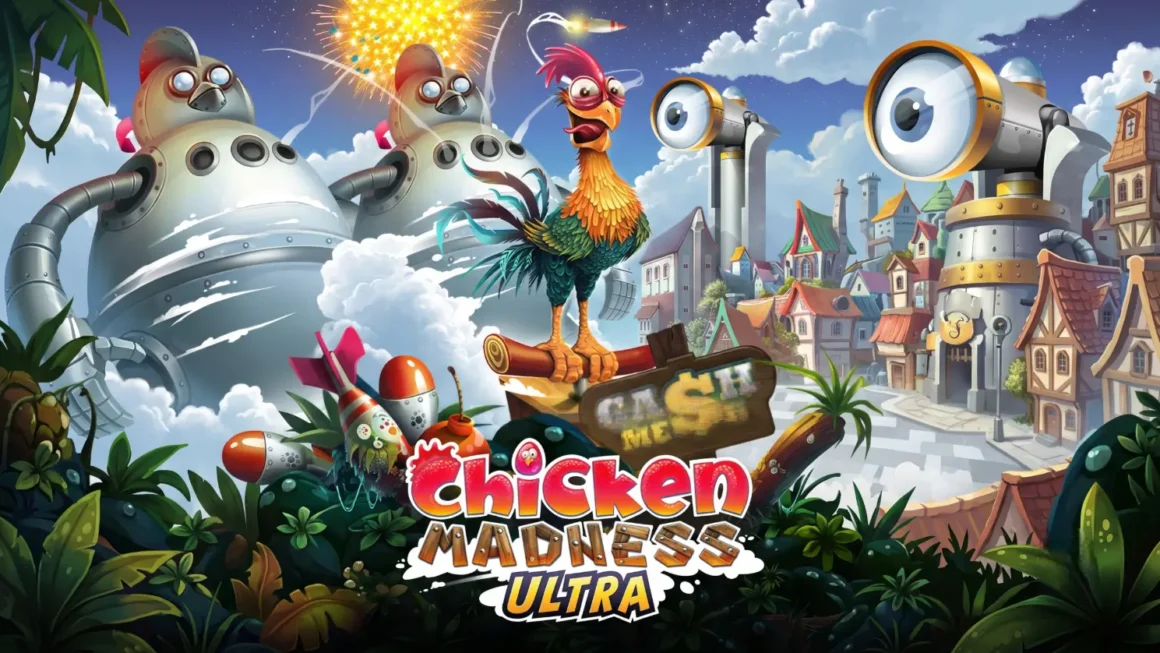
Chicken Madness Ultra landed in April 2023 as BF Games’ answer to a question nobody quite asked: what happens when you send farmyard chickens into a futuristic robot storyline and bolt on a Hold and Win round. Three years on, the game is still in circulation on BF Games-powered casinos, sitting quietly in a genre now dominated by titles with published five-figure win ceilings. Chicken Madness Ultra doesn’t have one of those. Its 96.01% top RTP and a Hold and Win mechanic built around fixed multiplier coins rather than cascading upgrades put it in a different bracket entirely — closer to a classic low-to-mid-stakes grinder than a max-win chaser. That distinction is the whole story of this review, and it’s worth understanding before you load the demo.
The math model: three RTP settings and a ceiling nobody publishes
BF Games’ own game card lists three RTP configurations for Chicken Madness Ultra: 92.05%, 94.06%, and 96.01%. This is standard practice for the studio and for most B2B slot suppliers — operators choose which build to deploy, and the number you get depends entirely on which casino you’re spinning at, not on anything you can control in the game itself. The 96.01% figure is the one worth checking for before you commit real money; the 92.05% build hands back roughly £4 less per £100 wagered over the long run than the top setting, which adds up fast at high volatility.
A couple of secondary sources, including SlotBeats and SlotsMate, cite the top RTP as 96.06% rather than 96.01%. That’s a small but real discrepancy — likely a rounding or database sync issue between aggregators rather than a genuinely different build, since the official BF Games game card is unambiguous about 96.01% as the top tier. Where the two disagree, the official source wins. Take the 0.05% gap as a reminder that aggregator data drifts out of sync with developer pages more often than players assume.
Volatility is rated high across every source that covers it, and the numbers back that up. Hit frequency sits at 25%, per the official game card — meaning roughly one spin in four returns something, though a meaningful share of those hits will be below your stake. That’s a tighter hit rate than the original Chicken Madness, which runs at 27%. Two points might not sound like much, but on a high-volatility game it translates to noticeably longer dry spells between the wins that matter.
Here’s what that means at the table: with a £1 spin and 25% hit frequency, you’re realistically looking at strings of three, four, sometimes five consecutive losing spins before the game throws you anything. High volatility isn’t a marketing label here — it’s a description of what your balance actually does over a 100-spin session. Bring a bankroll that can absorb that, or drop your stake size. A £20 deposit at £1 a spin gives you almost no room to survive a bad run before the multiplier or Cash Mesh ever has a chance to pay off.
The grid is a standard 5×3 layout with 10 fixed paylines, evaluated left to right, three-of-a-kind minimum. Nothing unconventional there — no cluster pays, no expanding reels, no Megaways mechanic. Bet range runs from €0.10 to €50 per spin, which is a wide enough band to cover casual and high-stake play alike, though the top end will burn through a modest bankroll in minutes at this volatility.
Run the numbers on a realistic session and the picture gets clearer. At €1 a spin with 96.01% RTP, a 200-spin session (€200 wagered) returns an average of roughly €192 over a very long run — but “average” is doing a lot of work on a high-volatility game. Individual 200-spin sessions will swing well outside that figure in both directions, and with a 25% hit frequency you should expect somewhere around 50 winning spins scattered through 150 losing ones, weighted toward the low end of the paytable. That’s the honest shape of the variance you’re signing up for, not a guarantee of anything close to break-even inside any single sitting.
Now the part that actually separates Chicken Madness Ultra from most of its 2026 competition: there is no published max-win multiplier. Symbol-level payouts top out at 50x total bet for a five-of-a-kind Wild combination, and the two mid-tier character symbols pay between 10x and 25x. Beyond that, the ceiling is theoretically open-ended, because the Major and Grand jackpots inside Cash Mesh are progressive — they grow with every spin across the network rather than sitting at a fixed cap. That’s a genuinely different design philosophy from the 5,000x-to-12,500x hard ceilings you’ll see quoted on newer chicken-themed slots from Pragmatic Play or Hacksaw Gaming, and it’s the single most important thing to understand before you compare this game to anything released after 2024.
Feature breakdown
Progressive win multiplier
The base game runs a streak multiplier that climbs with consecutive winning spins: x2 on your second straight win, x3 on the third, x4 on the fourth, capping at x5 on the fifth and staying there for as long as the streak continues. One non-winning spin and it resets straight back to x1.
Mechanically, this rewards exactly one thing — stringing together wins in a row — and does nothing for you on an isolated hit. In practice, on a 25% hit-frequency game, reaching x5 requires threading five consecutive hits in a row, which is a low-probability event even before you factor in that most individual hits will be small. Realistically, you’ll see the multiplier tick to x2 or x3 fairly often and rarely sustain it past that. One aggregator reviewer testing the near-identical Dice variant of this mechanic reported the highest multiplier they actually hit across a session was x4 — worth keeping your expectations grounded by that benchmark rather than the theoretical x5 ceiling.
Cash Mesh (Hold and Win)
Cash Mesh triggers when five or more Coin symbols land anywhere on the grid on a single spin. The triggering coins lock in place, and every other position on the 5×3 grid respins individually, hunting for more coins to fill the remaining slots. You keep respinning until the bonus spin allowance runs out or the entire grid fills.
Each coin carries either a fixed cash value or a jackpot label. This is where the research turned up a genuine data conflict worth flagging rather than papering over: BF Games’ own official game page states the Mini Bonus pays 2x your stake and the Minor Bonus pays 3x. Two independent aggregators — Clash of Slots’ syndicated content and a WorldCasinoDirectory launch article — describe the same two tiers as Mini worth 10x and Minor worth 20x, with the Major jackpot starting at a base of €500 and the Grand jackpot at a base of €1,000. That’s not a rounding gap; it’s a completely different pay table. Given that the official BF Games page is the primary source, treat 2x and 3x as the figures to trust, but be aware some third-party listings still quote the older, larger numbers — worth a demo spin at your specific casino to confirm which build you’ve actually been dealt before you calculate expected value.
If you manage to fill all 15 grid positions with coins during a Cash Mesh round, a Full House multiplier applies a 2x boost to the total value of every collected coin. That’s the single best outcome the feature can deliver short of hitting Major or Grand, and it’s rare — filling an entire 5×3 grid with coin symbols through random respins is a long-tail event, not something you should factor into a realistic session budget.
If the bonus round ends without every position filled, you’re not left empty-handed: the game randomly awards 1, 2, or 3 extra Cash Mesh Bonus Spins, giving the round a chance to extend itself even after the initial respin allowance runs dry. That’s a small mercy built into the math, and it’s the kind of detail that only shows up once you actually play the demo rather than skim a spec sheet.
One honest limitation: unlike modern Hold and Win designs from Pragmatic Play or BGaming, there’s no persistent upgrade mechanic carrying over between spins. Every Cash Mesh round starts from zero. What you land is what you get — no escalating multiplier, no growing grid, no compounding value the way Chicken Drop’s egg-upgrade system works. That keeps the feature simple, but it also caps its ceiling in a way competitors have deliberately engineered around.
Progressive jackpots — Major and Grand
The two headline jackpots are genuinely progressive, meaning their value climbs with every spin placed across the network of casinos running this build, not just your own session. Sourcing here splits the same way as the Mini/Minor confusion above: WorldCasinoDirectory’s launch coverage puts the Major jackpot’s starting value at €500 and the Grand at €1,000, while the official BF Games page doesn’t publish base values at all, only confirming the two tiers exist and reset upward from an unspecified floor.
The honest limitation: progressive jackpots that reset to an unpublished floor are hard to evaluate against a fixed-ceiling competitor. You can’t calculate “expected jackpot contribution to RTP” the way you can on a game with a stated max win, because the pool size at any given moment depends entirely on how long it’s been since the last hit and how much traffic the specific casino you’re playing at is feeding into it. Treat the jackpots as a genuine bonus on top of the base 96.01% RTP, not as a number you can plan a session around.
Wild symbol
The Rooster Wild substitutes for every standard symbol except the Cash Mesh Coin. On its own it pays 6x to 50x total bet depending on how many land in a winning combination, which makes it the single highest-value symbol combination available outside the jackpots. It doesn’t trigger anything beyond a standard payline win — no free spins attachment, no multiplier interaction beyond whatever the base-game streak multiplier happens to be active at the time.
The rest of the paytable
Below the Wild sits a small tier of character symbols — the chicken, the chef, the farmer, and a fourth farmyard face — paying 10x to 25x total bet for a maximum five-symbol combination. Card royals (J through A) sit at the bottom, paying 0.5x to 5x, standard low-tier filler that makes up the bulk of small wins on any given spin. That’s a fairly steep drop-off between the Wild’s 50x ceiling and the character tier’s 25x, which is one reason the streak multiplier matters as much as it does: stacking a x3 or x4 multiplier onto a character-symbol win closes some of that gap without needing a rare Wild combination to do it.
Worth noting for anyone doing their own math before depositing: the pay table is identical in structure across all three RTP builds. The RTP difference between the 92.05% and 96.01% versions comes from adjusted symbol weighting on the reel strips, not from different payout multipliers. You won’t see it in the paytable screen — it shows up only in the long-run numbers, which is exactly why it’s worth confirming which build a given casino is running before treating any of these figures as gospel.
The 2026 perspective
Chicken Madness Ultra doesn’t exist in isolation — it’s the middle entry in a four-title BF Games mini-series, and the comparison across that lineup tells you more about where the studio’s design thinking has gone than any single review of Chicken Madness Ultra alone would.
Chicken Madness (the 2022 original) runs the same 5×3, 10-payline frame with a slightly gentler pay table: RTP options of 92.13%, 94.13%, and 96.15%, and a 27% hit frequency — two points higher than Ultra’s 25%. That’s a real, measurable difference: the original hits more often and pays back marginally more at its top setting. Ultra tightened the hit rate and lowered the ceiling RTP by 0.14 percentage points in exchange for the futuristic reskin and the same Cash Mesh mechanic. If you’ve got a choice between the two on a given casino lobby, the original edges it slightly on pure math — the sequel’s value is almost entirely cosmetic and thematic, not mechanical.
Chicken Madness Dice, the dice-mechanic variant of the original, runs a reported 96.15% RTP with high volatility and, according to SlotsMate’s testing, no progressive jackpot at all — a meaningful trade-off for players who specifically want the Major/Grand chase that defines Ultra. One aggregator listing quotes a wildly inflated max win figure for this title that appears to be templated content mismatched from an unrelated game elsewhere on the same platform; that figure isn’t repeated anywhere else and shouldn’t be trusted.
Chicken Madness Ultra Dice, the newest release in the family, launched in February 2026 and adds cascading wins on top of the familiar Cash Mesh and streak-multiplier package. Independent RTP data for this title hadn’t been published by major aggregators at the time of writing — it’s simply too new for SlotCatalog or Casino Guru to have logged verified figures yet. Worth checking back on before assuming it inherits Ultra’s 96.01% ceiling; cascading mechanics frequently ship with different math models than their fixed-payline predecessors.
Now the competitive context that actually matters for a 2026 lobby decision. Three chicken-themed hold-and-win slots released after Chicken Madness Ultra make the gap in ambition obvious. Chicken Drop from Pragmatic Play runs a 96.50% RTP with a published 5,000x max win on a 7×7 cluster-pays grid with persistent egg-upgrade mechanics that carry value across spins — precisely the escalation system Chicken Madness Ultra’s Cash Mesh doesn’t have. Chicken Man from Hacksaw Gaming pushes further still: 96.31% RTP and a stated 12,500x max win across a 5×5, 19-payline frame. Even Chicken Fire from BGaming, a closer structural cousin at 3×3 with a straightforward Hold and Win round, publishes a 5,000x max win and fixed jackpot tiers capped at 1,000x — numbers you can actually plan a session around.
Chicken Madness Ultra publishes none of that. Its answer to “what’s my ceiling” is an open-ended progressive jackpot with an unconfirmed floor and a set of symbol payouts that top out at 50x. You might ask: does an uncapped progressive beat a stated 12,500x ceiling? On paper, sure — progressives have no theoretical limit. In practice, without transparent pool data, you have no way to size that opportunity against the guaranteed math of a competitor that tells you exactly what the best possible spin looks like. That opacity is Chicken Madness Ultra’s biggest disadvantage against 2026-era releases, full stop.
Lined up side by side, the gap looks like this:
| Game | Provider | RTP | Max win | Jackpot |
|---|---|---|---|---|
| Chicken Madness Ultra | BF Games | 96.01% (top setting) | Not published | 2 progressive, uncapped |
| Chicken Drop | Pragmatic Play | 96.50% | 5,000x | 1 progressive |
| Chicken Man | Hacksaw Gaming | 96.31% | 12,500x | None |
| Chicken Fire | BGaming | 95.90% | 5,000x | 4 fixed, capped 1,000x |
Chicken Fire is the one outlier worth a second look, because it actually sits below Chicken Madness Ultra on RTP — 95.90% against 96.01% — while still publishing both a max win and fixed jackpot ceilings. That tells you the transparency gap isn’t a function of RTP tier; BGaming manages a lower-paying game with a fully stated ceiling, while BF Games leaves its comparable Cash Mesh jackpots open-ended. It’s a design choice, not an inevitability of the genre.
There’s no buy-bonus option on Chicken Madness Ultra — you can’t pay to instantly trigger Cash Mesh, which every one of the three named competitors above offers as standard. For players who want to sample the bonus round without grinding base-game spins, that’s a real gap, and one BF Games hasn’t closed across any title in this family so far.
So who is this actually for? Chicken Madness Ultra reads as a recreational, low-stakes high-volatility game rather than a high-roller title or a max-win chase. The min bet of €0.10 keeps it accessible, the progressive jackpots add a lottery-ticket layer of appeal, and the theme is genuinely funny in a way most farmyard slots aren’t. What it isn’t is a competitive choice for anyone specifically hunting a published five-figure win multiplier — that player should be looking at Chicken Man or Chicken Drop instead.
Licensing and where you’ll find it
BF Games operates under a UK Gambling Commission account (issued 11 August 2017) through Bee-Fee Limited, with a separate Malta Gaming Authority Critical Gaming Supply licence held by its subsidiary Bitsurf Consulting Limited, issued 14 January 2019. The studio’s certificates also cover Croatia, Portugal, Bulgaria, Serbia, Italy, Greece, Estonia, the Netherlands, Belgium, Curaçao, Georgia, Latvia, Bosnia, and Hungary — a wide enough regulatory footprint that Chicken Madness Ultra shows up across a broad spread of European and Baltic-facing casino lobbies. That’s a supplier-level licence, not a per-game certification; individual casinos offering the title still hold their own separate operating licences, and it’s worth checking which one applies at the specific site you’re playing on.
Availability by GEO varies by operator rather than by the game itself — some markets simply won’t have a BF Games-powered casino live at all, and one aggregator noted the title wasn’t found live at any scanned casino in the US New Jersey market at the time of research. If you’re outside BF Games’ core European footprint, confirm the game is actually listed before building a session around it.
Verdict
Chicken Madness Ultra is worth a spin if you’re playing low stakes, enjoy the streak-multiplier tension, and don’t mind that the ceiling is a progressive jackpot rather than a number you can bank on. The 96.01% top RTP is average for 2026 standards and the 25% hit frequency demands patience, but at €0.10 a spin, the downside is manageable. The single number that most limits this game is the one it doesn’t publish: no stated max-win multiplier, against competitors sitting at 5,000x and 12,500x. If your bankroll can handle high volatility and you’re playing for the theme and the jackpot lottery rather than a specific win target, it delivers. If you’re comparing spec sheets before you commit, Chicken Man and Chicken Drop give you a number to plan around and Chicken Madness Ultra doesn’t.
For the original Chicken Madness, the verdict is a shade more favourable on pure math: the same core mechanics, a marginally better top RTP at 96.15%, and a friendlier 27% hit frequency. Anyone choosing between the two purely on the numbers should lean toward the original — the sequel’s futuristic reskin doesn’t buy you anything mechanically, and in one respect (hit frequency) it costs you something.
FAQ
What is the real RTP of Chicken Madness Ultra? BF Games’ official game card lists three configurable settings: 92.05%, 94.06%, and 96.01%. Which one you get depends on the casino, not the game itself — check the paytable or ask support before you deposit. A couple of aggregators list the top figure as 96.06% instead of 96.01%; the official source takes precedence.
Does Chicken Madness Ultra have a maximum win cap? No published figure exists. Fixed symbol payouts top out at 50x total bet for a five-Wild combination, but the Major and Grand jackpots are progressive and uncapped by design, which makes this game harder to compare directly against competitors with a stated ceiling.
How does the Mini and Minor Bonus actually pay out? Sources disagree. The official BF Games page states 2x and 3x your stake. Some third-party listings quote 10x and 20x instead. Trust the official figure, but confirm at your specific casino before relying on it for expected-value calculations.
Is there a demo version available? Yes. BF Games and multiple casino aggregators offer a free-play demo with no registration required — a sensible way to see the streak multiplier and Cash Mesh in action before risking real money on a game with this much volatility.
Should I play Chicken Madness Ultra or the original Chicken Madness? The original has a marginally higher top RTP (96.15% vs 96.01%) and a better hit frequency (27% vs 25%). Unless the futuristic theme specifically appeals to you, the original edges it on the math.