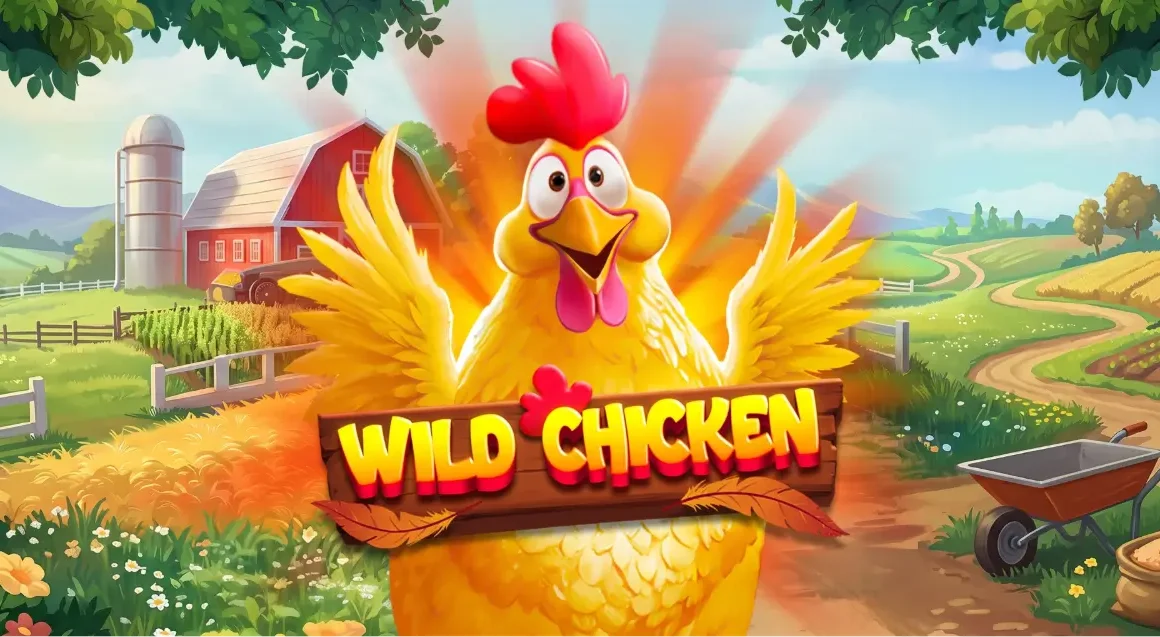
Swintt released Wild Chicken on 28 May 2026, dropping another farmyard title into a genre that Pragmatic Play has effectively owned since Chicken Drop launched back in 2021. Farmyard slots aren’t short on competition, and a newcomer arriving in mid-2026 has to answer one question immediately: does it bring a math model that justifies a seat at the table, or is it riding the theme’s recognisability?
The headline numbers are the interesting part. A 10,000x maximum win is double what Chicken Drop offers, yet Wild Chicken is rated medium volatility rather than high. That’s an unusual pairing — big theoretical ceilings normally come attached to punishing variance, not a 23.84% hit frequency that keeps the reels ticking over. Whether the mechanics underneath can actually reach that ceiling, or whether it’s a number that exists mostly for the marketing copy, is what the rest of this review is about.
There’s also a fair amount of noise around this release that’s worth clearing up before getting into the mechanics. Some coverage framed Wild Chicken as a high-roller title built around a five-figure maximum stake, which doesn’t match what’s actually confirmed about the betting range. That kind of confusion tends to happen with new releases in the first few weeks after launch, when press coverage outpaces verified specs, and it’s worth separating fact from headline before deciding whether this game is for you.
The math model and mechanics
Wild Chicken runs on a 96.07% RTP, and it’s worth being precise about that figure because Swintt ships the game with four separate RTP configurations: 96.07%, 92.13%, 90.17%, and 85.54%. The 96.07% figure is the one you’ll see quoted in most coverage, and it’s the highest of the four, but which version you actually get depends on which build your casino has deployed. Operator-configurable RTP isn’t unusual in 2026 — most major studios do it — but the spread here is wide. The gap between the top and bottom variant is nearly eleven percentage points, which is a meaningfully different game in terms of long-run return. On a £100 session, the difference between the 96.07% build and the 85.54% build works out to roughly £10.50 in expected return. That’s not a rounding error, and it’s the first thing worth checking in any casino’s game info panel before you commit real stakes.
Volatility is rated medium, and the 23.84% hit frequency backs that up in practice — roughly one spin in four lands some kind of win, which is a respectable rate for keeping momentum between bonus triggers. This isn’t a slot that grinds you down with long dead stretches before the bonus arrives; the base game pays often enough that a session doesn’t feel like waiting for permission to have fun. What medium volatility does mean here is that most of those wins will be modest. The bulk of the RTP gets returned through frequent smaller hits rather than occasional monster payouts, which is the trade-off that comes with the classification.
The 5×3 grid and 10 fixed paylines are as conventional as slot layouts get — five reels, three rows, left-to-right matching across ten lines. There’s no cluster mechanic, no cascading reels, no Megaways engine. This is the format Pragmatic Play used for the original Chicken Chase, and it’s a deliberate choice rather than a limitation: fixed paylines are easier for casual players to read at a glance than a 7×7 cluster grid, which matters if the target audience is players who want something they can understand within the first ten spins.
The symbol set follows the theme without much invention — cockerels, chicks, sunflowers, and corn baskets fill out the paytable, with the roaming chicken wild sitting above them as the clear standout icon. There’s nothing wrong with a conventional paytable structure on its own; the issue is that Wild Chicken doesn’t do anything with the low-tier symbols to differentiate the base game reading experience from any other farmyard slot on the market. Regular symbol wins land, they’re paid, the reels spin again — the paytable is doing its job without adding character to it, which is consistent with the wider critique that the visual presentation here is competent rather than distinctive.
Here’s where the 10,000x figure needs context. Chicken Drop caps at 5,000x with a high-volatility 7×7 cluster engine built specifically to reach big multipliers through stacked cascades. Wild Chicken claims double that ceiling from a much simpler fixed-payline structure with lower stated volatility. That’s not impossible — a well-designed multiplier mechanic in the bonus round can push a modest base game toward outsized peaks — but it does mean the 10,000x is doing more work as a marketing number than as a realistic session target. Treat it as the mathematical extreme of the simulation, not something to expect on a normal night’s play.
Put a number on it: at a £1 stake, that 10,000x ceiling is a £10,000 payout, and at the £100 max bet it’s a full £1,000,000. Those figures only mean something if the probability of reaching them is remotely reasonable, and Swintt hasn’t published a hit probability for the top prize the way some studios do for their headline multipliers. Given the medium volatility rating and the fact that the maximum requires stacking a fully upgraded 1×3 wild across multiple paylines simultaneously, this sits at the extreme tail of the outcome distribution — the kind of result that shows up in simulation data across millions of spins rather than something a typical session should be judged against. Compare that to the realistic session outcome: with a 23.84% hit frequency and a medium volatility profile, most sessions will consist of a steady trickle of 1x–5x wins on the base game, occasionally punctuated by a free spins trigger that pays somewhere in the low hundreds of times your stake if the Wild Upgrade system gets some cooperation from the scatter count.
It’s also worth being clear about what “medium volatility” means at the table rather than just as a label. It means the swings in your balance across a session should be moderate — not the flat, low-drama grind of a Chicken Chase session, but nothing like the extended dry spells that come with Chicken Drop’s 5-out-of-5 rating either. You’ll see wins often enough that boredom isn’t the main risk; the risk is closer to a mismatch between the modest, steady base game rhythm and a headline max-win figure that implies something far more dramatic than what a normal session will deliver.
One clarification worth making directly: some coverage of this release described Wild Chicken as offering a “$10,000 max bet,” framing it as a high-roller title built around a huge stake ceiling. That doesn’t match the betting range confirmed elsewhere — £0.10 to £100 per spin, standard territory for a mid-market release. The £10,000 figure appears to be a mix-up between the 10,000x maximum win multiplier and an actual maximum bet, and no other source corroborates a five-figure stake ceiling on this game. Worth flagging so you don’t go looking for a betting option that doesn’t exist.
Feature breakdown
Roaming Wild Chickens
The Roaming Wild Chicken is the base game’s defining mechanic. When a wild chicken symbol lands on the reels, it doesn’t disappear after the spin — it sticks in place and shifts one position to the left with every subsequent spin, substituting for all regular symbols except Scatters along the way. In principle, a wild that persists across multiple spins should extend its value each time it contributes to a new combination.
In practice, position matters enormously. A wild landing on reel 5 gets four spins of remaining life as it walks across the grid; a wild landing on reel 2 has one spin left before it walks off the left edge entirely. That asymmetry means the excitement of landing a roaming wild depends heavily on where it lands, and a chicken on the near side of the grid is close to spent the moment it appears. There’s no mechanic that compensates for this — no reset, no re-anchoring — so the base game’s most interesting symbol is also its most inconsistent one. Multiple wilds active on the grid at once produce the strongest moments the base game offers, but that alignment doesn’t come around often enough to define the session.
You might wonder why this matters more here than in other roaming-wild slots. Because the mechanic is the base game’s only real point of differentiation — take it away and Wild Chicken is a standard 5×3, 10-payline slot with a farmyard paytable and nothing else going on between bonus triggers. That puts a lot of weight on a mechanic whose value is essentially random based on landing position, and it means the base game’s pacing depends on a factor the player has zero control over. A session where wilds keep landing on reels 4 and 5 feels meaningfully different from one where they keep landing on reel 1 or 2, even though both are equally likely outcomes of the same RNG.
Free spins trigger
Landing 3 or more grain sack Scatter symbols during the base game triggers the Free Games round. The award scales with scatter count: three scatters gets you the minimum of 10 free spins, with higher counts pushing that up to 15 or 20 spins. Any roaming wild still active on the reels when the feature triggers adds one additional spin on top of the base award. Landing three or more grain sacks again during the bonus retriggers the feature, extending the round further.
Ten spins as a baseline is functional rather than generous — it’s the minimum viable allocation to make a bonus round feel worthwhile, not an amount that signals a big feature is coming. What actually elevates the Free Games round isn’t the spin count. It’s what happens to the wild symbol while you’re in it.
The retrigger mechanic deserves a second look, because it’s doing more structural work than the headline description suggests. Landing three or more grain sacks again mid-bonus doesn’t just add spins — it’s the same event that feeds the Wild Upgrade counter, so a retrigger and a wild upgrade often arrive together. That’s a reasonable piece of design: the moments that extend your session are also the moments that make your wild symbol more dangerous, which gives the bonus round a sense of building momentum rather than two disconnected systems running in parallel. The honest caveat is that retriggers, like the scatter landings that start the whole feature, aren’t guaranteed — a short, unlucky bonus round with no retrigger and a low scatter count means you leave with a 1×1 wild and the base allocation of spins, which is a fairly modest outcome given the 10,000x figure on the box.
Scatter Collection and Wild Upgrade
This is the mechanic that separates Wild Chicken from a generic scatter-trigger free spins round. Every grain sack Scatter that lands during the bonus is collected toward a progressive Wild Upgrade system, and the roaming wild grows in three stages as that count builds:
- A base 1×1 wild, identical to the base game version
- A 1×2 stacked wild once four additional grain sacks have been collected, covering two positions on the reel
- A 1×3 wild spanning the full reel height after 12 total grain sacks have been collected — effectively an expanding symbol that fills its column every time it lands
The logic is sound: sustained bonus play should reward you with a bigger wild, and reaching the full-column stage genuinely changes how much of the grid a single wild symbol can influence. The catch is pacing. Getting from stage to stage depends on scatter frequency during the bonus, which is outside your control, and the jump from stage one to stage two feels incremental rather than transformative. Stage three — the full-column wild — is where the mechanic finally delivers something worth the wait, but you need a genuinely productive bonus round to see it, and there’s no guarantee the round runs long enough to get there before the spins run out.
Twelve total grain sacks is a meaningful ask when the base allocation is only 10, 15, or 20 spins. Reaching Stage 3 without a retrigger extending the round means averaging more than one scatter symbol landing every couple of spins, which is a demanding rate for a symbol that isn’t guaranteed on every reel set. This is the mechanic’s honest limitation: it’s built to reward an above-average bonus round, and an average or below-average one will end with the wild stuck at Stage 1 or 2. That’s not a flaw exactly — every progressive system needs some scarcity to keep the top tier meaningful — but it does mean the marketing language around “progressive prize mechanics” implies more consistency than the underlying probability actually delivers. When Stage 3 does land, though, a full-column wild moving across a 5×3 grid one position at a time is genuinely the best few seconds Wild Chicken has to offer, and it’s the one moment where the roaming wild’s positional weakness in the base game stops mattering — a full column is valuable no matter which reel it’s currently sitting on.
Risk/Gamble feature
An optional Risk feature sits after any win, base game or bonus: guess the colour of a hidden playing card correctly and your payout doubles, guess wrong and you lose it. This is a straightforward 50/50 double-or-nothing mechanic, available up to the game’s maximum payout ceiling. It doesn’t interact with the roaming wild or the scatter collection system in any way — it’s a bolt-on for players who want to press their luck on a specific win, and entirely skippable for anyone who doesn’t. Treat it as an optional side bet rather than a core part of the game’s identity.
The 2026 perspective
There’s no Power Reels version, no Megaways variant, and no sequel to compare Wild Chicken against. That’s not a gap in the research — the game is barely two months old at the time of writing, and Swintt hasn’t announced any expanded edition. If one arrives later in 2026, the most obvious candidate for a fix would be the roaming wild’s positional inconsistency; a version that anchors the wild’s value regardless of starting reel would address the base game’s clearest weakness.
What Wild Chicken does have to answer for is the comparison to Pragmatic Play’s farmyard catalogue, and that comparison isn’t flattering. Chicken Drop runs a 7×7 cluster grid at a 96.5% RTP (also available at 95.51% and 94.53%), rated high volatility at 5 out of 5, with a 5,000x max win built through a progressive Golden Egg multiplier system that can reach 11x per drop. It’s a genuinely different design philosophy — tumbling cluster pays instead of fixed paylines — and multiple independent reviews rate its bonus mechanics as more consistently engaging than Wild Chicken’s scatter-collection system. At the other end of the volatility scale, Chicken Chase offers a 96.48% RTP (down to 94.55% on lower variants), low volatility at 2 out of 5, and a max win most trackers list at 210x — though a handful of sources cite 2,100x, a discrepancy that hasn’t been resolved across the aggregators checked for this review. Chicken Chase’s Spin and Hold feature gives it a distinct identity even at low stakes. Wild Chicken sits between these two in almost every respect without clearly beating either one at what it does.
There’s a third title worth naming here too: Motherclucker, released by Terminal Games earlier in 2026, takes the farmyard theme in a darker direction — a 5×5 grid with sticky wilds, walking symbols, expanding reels, and random multipliers layered into a horror-tinged farm setting rather than Wild Chicken’s cheerful cartoon presentation. It’s a different tonal approach to essentially the same shelf space, and its existence underlines just how saturated the farmyard-and-poultry niche has become by mid-2026. A player scanning a casino lobby for a chicken-themed slot in July 2026 isn’t choosing between one or two options — they’re choosing between at least four, and Wild Chicken’s roaming wild concept has to compete for attention against Chicken Drop’s cluster-pay chaos, Chicken Chase’s low-stress simplicity, and Motherclucker’s feature-dense horror spin on the same barnyard.
The absence of a bonus buy option is worth calling out directly in a 2026 release. Buy-a-bonus has become close to standard across mid-tier and premium slot releases this year, and its absence here means every player has to earn free spins through natural scatter landings — no shortcut for anyone who wants direct access to the Wild Upgrade system without grinding the base game first. Whether that’s a genuine drawback depends on what kind of player you are: purists who prefer earning their bonus the traditional way won’t mind, but the growing expectation of a buy-in option makes its absence noticeable rather than neutral.
There’s also no progressive jackpot attached to Wild Chicken. The 10,000x ceiling is a fixed multiplier cap, not a pooled or growing prize — so the maximum payout on any given spin is entirely determined by your stake at the time, with no jackpot meter building in the background.
Swintt’s positioning as a Malta-based, mobile-first studio is relevant context here too. The 5×3, 10-payline structure and the relatively contained feature set are the kind of design choices that render cleanly on a mid-range Android or iOS screen without the visual clutter a 7×7 cluster grid can create on a smaller display. That’s a reasonable trade-off for the studio to make, and it lines up with where a meaningful share of 2026 slot traffic actually happens — on a phone, in short sessions, rather than at a desktop. Where it costs Wild Chicken is in the feature-density department: mobile-first design doesn’t have to mean a thinner feature set, and studios like Hacksaw Gaming and Nolimit City have shown that complex, layered mechanics can still run well on a handset. Wild Chicken reads more like a studio playing it safe on mechanics while optimising for accessibility than one pushing the format forward.
Is this a high roller’s game, a recreational title, or dead weight in a crowded 2026 lobby? Given the £100 max bet, medium volatility, and the earlier clarification about the misreported $10,000 stake ceiling, Wild Chicken isn’t built for serious high-roller action — the betting range and math model both point toward a casual-to-mid-stakes audience. It’s not dead weight either; the 23.84% hit frequency and the three-stage wild upgrade give it enough going on to hold attention for a session. But “competent mid-tier release” is a different category from “essential 2026 slot,” and the farmyard theme’s existing benchmarks make that gap obvious the moment you put Wild Chicken next to them.
Verdict
Wild Chicken is a play for players who want a farmyard slot with straightforward mechanics, don’t need cluster pays or Megaways complexity, and are comfortable with a medium volatility session that pays reasonably often without chasing the headline 10,000x figure. The 23.84% hit frequency and the tiered wild upgrade system in the bonus give the game enough texture to justify a handful of sessions, and the £0.10–£100 betting range covers casual stakes through to moderately committed play.
The number that limits this game most is the absence of a bonus buy, paired with a base game where the roaming wild’s value depends almost entirely on where it happens to land. Combine those two factors and you get a title that asks for patience without offering a way to skip the wait, in a genre where Pragmatic Play’s Chicken Drop already delivers a more consistently engaging bonus round at a comparable RTP.
Play it if you want a low-stress, medium-volatility farmyard slot and don’t already have Chicken Drop or Chicken Chase in rotation. Skip it if you’ve already spent time with either of those two — Wild Chicken doesn’t do anything mechanically that improves on what Pragmatic Play built first, and the 10,000x ceiling is a simulation extreme rather than a realistic target for an ordinary session.
For the specific player profile this does suit: someone playing on mobile, at stakes in the £0.10–£20 range, who wants a fixed-payline slot they can pick up without reading a features guide first. The roaming wild is easy to understand on sight, the free spins trigger is a standard scatter count, and the Risk feature is there for anyone who wants an optional double-up without it being forced into the core loop. For the player this doesn’t suit: anyone chasing genuine high-volatility swings, anyone who wants a bonus buy to skip base-game grinding, and anyone who’s already found Chicken Drop’s cluster-pay chaos more rewarding — because nothing in Wild Chicken’s design gives them a reason to switch.