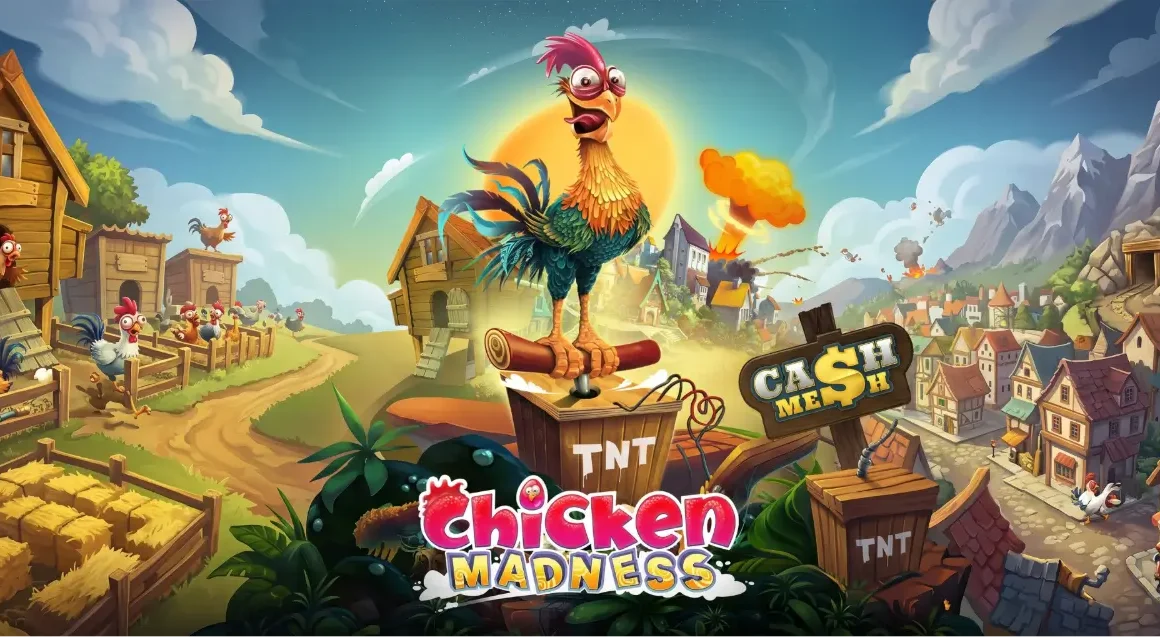
BF Games rolled Chicken Madness – Cash Mesh LINK out in the early summer of 2026, and it landed with barely a ripple of hard data behind it. The farmyard chaos, the coin-collecting Cash Mesh round, the creeping base-game multiplier — all of that is inherited straight from the original Chicken Madness, a game that’s been earning its 96.15% RTP since its launch. What’s new is the LINK part: BF Games has wired the Mini, Minor, Major, and Grand jackpots into a shared network pool instead of running them per-casino.
That’s a meaningful structural change. It’s also one BF Games hasn’t backed up with a published RTP, hit rate, or max-win figure on its operator-facing game card yet, at least not anywhere I could verify. So this review does something slightly unusual: it treats Cash Mesh LINK as what it actually is right now — a mechanical upgrade bolted onto a well-documented chassis — and holds the two apart wherever the numbers get fuzzy.
Math model and mechanics
Start with what’s confirmed. The base Chicken Madness game — the one Cash Mesh LINK is built from — runs on a 5×3 grid with 10 fixed paylines, wins forming left to right from reel one. BF Games lists three configurable RTP settings for it: 92.13%, 94.13%, and 96.15%, with the top figure independently confirmed by SlotCatalog. That spread matters more than it looks. A 96.15% game and a 92.13% game are not the same product wearing different labels — over a 1,000-spin session at a £1 stake, the gap between those two settings works out to roughly £40 in expected losses, purely down to which RTP tier your casino happens to have selected. Always check which version you’re on before you decide the math is working in your favour.
Volatility on the base game is rated high by BF Games’ own game card, with a 27% hit rate. That’s a genuinely useful number to sit with: just over one spin in four returns something, which is on the frequent side for a slot carrying a high-volatility label. What that tells you in practice is that Chicken Madness doesn’t ask you to survive long droughts to see any action — the wins just tend to be small until the Cash Mesh round or the multiplier stack does the heavy lifting. Betting range sits at €0.10 to €50 per spin, standard territory for BF Games’ catalogue and wide enough to suit a low-stakes tester or someone chasing the jackpot pool directly.
Now the part that needs stating plainly: I could not confirm an RTP, hit rate, or max-win figure specifically published for the Cash Mesh LINK version. BF Games’ own announcement of the release (via its official channels) confirms the game exists, confirms the LINK jackpot upgrade, and confirms the launch window — it does not carry a game-card RTP the way the base game, Ultra, and Dice all do. Until that figure surfaces on an operator’s game card or a specs aggregator, treat any RTP number you see quoted for Cash Mesh LINK specifically as unverified, regardless of how confidently a demo-aggregator site states it.
I checked several demo-aggregator pages hoping to fill that gap, and they’re worth flagging rather than quietly ignoring. A handful of sites list a max win around 323x for Cash Mesh LINK — a figure I’m not repeating as fact, because it sits wildly out of step with every other confirmed number in this game family (the original’s jackpot-fed ceiling, Dice’s 90,322x, even Ultra’s more modest structure), and the surrounding copy on those pages reads like templated filler rather than tested data — the same boilerplate phrasing shows up describing unrelated BF Games titles word for word. When a number that low shows up next to writing that generic, the safer assumption is that it’s a placeholder or a scrape error, not a verified spec. That’s exactly the kind of figure the no-fabrication discipline exists to keep out of a review like this one.
It’s also worth sitting with why a brand-new networked-jackpot release might launch without a settled RTP in the first place. Linked progressive systems pool contributions across multiple operators, and the pool’s growth curve — and therefore the game’s realistic long-run return — depends partly on how many casinos actually plug into the network and how quickly they do it. It’s plausible BF Games is waiting on a broader rollout before publishing a stabilised figure. That’s a reasonable operational reason, but it doesn’t change the practical guidance here: don’t stake meaningfully on Cash Mesh LINK while treating a rumoured RTP as confirmed.
What’s changed mechanically is the jackpot architecture, and BF Games has been explicit about this on its own site for the sibling Cash Mesh LINK titles: instead of Mini, Minor, Major, and Grand jackpots running as isolated pots tied to a single casino’s Chicken Madness install, the LINK versions connect those four tiers to a shared pool across the wider network. Every spin on every linked casino feeds the same Major and Grand values, rather than each operator seeding and growing its own. That’s a real change to the win distribution, not cosmetic — it means the top two jackpot tiers should, in theory, grow faster and hit bigger than a standalone Chicken Madness install could support on its own. Whether that shows up as a materially different overall RTP is the exact figure nobody’s published yet.
The base-game multiplier is unchanged from the original: consecutive wins build a global multiplier from 1x up through 2x, 3x, 4x, and 5x, and — this is the detail worth underlining — it doesn’t reset the moment you hit a non-winning spin the way most consecutive-win systems do. It holds at whatever value it reached until a spin actually breaks the streak. If you’re riding a 4x multiplier and land three quiet spins in a row followed by a small win, that win still gets multiplied at 4x. That’s a genuinely player-friendly quirk, and it’s one of the more distinctive things about this family of games compared to the flood of generic consecutive-multiplier slots that reset on the first blank spin.
Special features
Cash Mesh
The signature mechanic, and the one that survives untouched across every version of this game including LINK. Land five or more Coin symbols on a single base-game spin and Cash Mesh triggers. Each coin carries a predefined cash value or one of the four jackpot labels, and the number of triggering coins sets your starting respin count. During the feature, landed coins lock in place while the remaining grid positions respin, and — in the standalone Cash Mesh version — every new coin that lands resets your respins back to three.
The realistic payout picture here is modest most of the time. In player testing logged against the Dice variant, one tester triggered Cash Mesh once across an extended session and walked away with a £35 win on a small stake — a long way from the theoretical ceiling, and a fair example of what the feature actually delivers on a typical run rather than the marketing version of events. The catch worth flagging honestly: with a 27% hit rate on the base game but a coin-based trigger requiring five simultaneous landings, Cash Mesh itself fires much less often than that headline hit rate implies. Most of your 27% of winning spins are ordinary line hits, not bonus triggers.
Full House multiplier
If you manage to fill all 15 grid positions with coin symbols during a Cash Mesh round, a Full House multiplier kicks in and doubles the total collected coin value. This is the mechanism that turns a decent Cash Mesh round into a genuinely large one — going from a partial fill to a completely locked 5×3 grid isn’t a small ask, but it’s the single biggest lever in the base feature. The catch: this requires filling every position, which on a coin-based respin system with only three or five starting spins is a low-probability outcome even when Cash Mesh has already triggered. Treat it as the ceiling, not the expectation.
Consecutive win multiplier
Already covered above in mechanical terms, but worth isolating as a feature in its own right because of how it interacts with everything else on the reels. Every consecutive winning spin escalates the multiplier by one step, topping out at 5x, and it sustains at that peak until the streak actually breaks rather than decaying gradually. In practical terms, this means a hot base-game run compounds nicely with a Cash Mesh trigger that happens to land while the multiplier is already elevated — though BF Games hasn’t confirmed whether the consecutive multiplier applies to Cash Mesh collections or only to standard line wins, and I couldn’t verify that interaction from official documentation. Worth checking the in-game paytable before assuming it stacks.
Compare this to the more common industry pattern, where a consecutive-win multiplier resets to 1x the instant a single spin fails to pay — Chicken Madness’s sustain-until-broken design is the more forgiving version of that idea, and it’s one of the few genuinely distinctive mechanical choices in a game that otherwise plays like a fairly standard Hold and Win title. You might ask why that distinction matters at low stakes. It matters because it changes how you should read a quiet patch mid-session: three blank spins after a 5x streak in most competing slots means you’re back to square one, but here it means your next win, whenever it lands, still gets the full multiplier. That’s a small psychological difference with a real mathematical basis behind it.
Jackpots — Mini, Minor, Major, Grand
The original Chicken Madness runs four jackpot tiers: two fixed (Mini and Minor) and two progressive (Major and Grand), with the progressive pair seeded at roughly €5,000 and €10,000 respectively according to third-party aggregator data. Cash Mesh LINK’s contribution is connecting all four tiers to a shared network pool rather than running them per-install. The mechanical trigger is unchanged — landing a jackpot-labelled coin during Cash Mesh gives you access to that tier — but the pool feeding Major and Grand should, structurally, be larger and faster-growing under LINK than under a standalone casino install. One honest limitation: BF Games hasn’t published the network’s current jackpot values or seed amounts specific to the LINK version, so there’s no way to state with confidence how much bigger those jackpots run in practice versus the original’s per-casino pots.
Free spins via coin count
Landing the triggering coins for Cash Mesh also determines your starting spin allocation, typically 5 to 10 spins depending on how many coins landed on the triggering spin, capped by aggregator sources at around 10. If your respins run out before the grid fills completely, the game has been documented (across the Ultra variant, at minimum) to randomly award 1 to 3 extra spins as a consolation mechanic rather than ending the feature cold. That’s a small but real piece of player-friendliness worth knowing about going in — it softens the disappointment of a near-miss Cash Mesh round that doesn’t complete the grid.
The 2026 perspective
Chicken Madness now exists in at least four forms: the original, Ultra (the futuristic-themed sequel), Dice (a card-and-dice reskin), and Cash Mesh LINK. That’s a lot of iteration on one theme in a fairly short window, and it’s worth being honest about what each version actually changed versus what it just relabelled.
Ultra swapped the farmyard setting for a futuristic one — spy cameras, robots, the works — while keeping the 5×3, 10-payline structure and the Cash Mesh trigger completely intact. Its confirmed RTP settings run 92.05% / 94.06% / 96.01%, marginally lower across the board than the original’s top tier, with the same high volatility rating and a slightly tighter 25% hit rate. BF Games’ own game card lists the Mini and Minor bonuses at 2x and 3x stake respectively, though the launch press release for Ultra separately quoted Mini and Minor jackpots at 10x and 20x stake — those two figures don’t reconcile cleanly, and I’d treat the game-card numbers as the more current reference point since press releases tend to lag post-launch balancing changes. Either way, Ultra reads as a reskin exercise rather than a mechanical overhaul, and the marginal RTP dip means it’s not the better version of this game on paper.
Dice went further with an actual structural addition — a dice-driven multiplier mechanic layered onto the same base — and its numbers diverge more sharply. BF Games’ own listing shows RTP settings of 94.08% and 96.06%, while SlotCatalog independently lists the top tier at 96.15%. That’s a real discrepancy between two sources that should agree, and I’m not going to silently pick one; if you’re chasing the highest configurable RTP on Dice specifically, verify the figure in-game before assuming either source is current. What’s not in dispute is the max win: both SlotCatalog and independent slot-review aggregators converge on 90,322x stake for Dice, a genuinely enormous ceiling that dwarfs anything documented for the original Chicken Madness or Ultra. If raw win-multiplier headroom is what you’re after within this specific game family, Dice is the version that delivers it — assuming you can find a casino running the top RTP configuration.
Which brings the comparison back to Cash Mesh LINK, sitting in an odd spot: mechanically the most ambitious version of the four thanks to the networked jackpot pool, but the only one without a confirmed RTP, hit rate, or max win on record. That’s not necessarily a red flag — new releases routinely launch before every aggregator has indexed them — but it does mean anyone recommending Cash Mesh LINK today is recommending it on the strength of its jackpot architecture and its inherited base-game feel, not on a verified return figure.
Buy-bonus availability: none of the four versions in this family offer a direct feature-buy option based on everything documented across official and third-party sources. That’s worth noting plainly in 2026, when feature-buy has become close to standard on high-volatility releases from providers like Hacksaw Gaming and Nolimit City. Its absence here means the only route into Cash Mesh is organic — five coins landing naturally — which keeps the game closer to a classic-style Hold and Win slot than to the buy-your-way-in titles that now dominate a lot of high-roller lobbies.
Set against the wider Hold and Win category, Chicken Madness’s whole family sits in reasonable but unremarkable company. Pragmatic Play’s Wolf Gold, the title most credited with popularising this respin-jackpot format at scale, runs a confirmed 96.01% RTP, medium volatility, and a 2,500x max win off a 5×3, 25-payline grid with its Money Respin feature. That’s a lower ceiling than Chicken Madness Dice offers, but a materially higher hit frequency and a gentler volatility profile — different audience, essentially. Pragmatic Play’s own farmyard-themed Chicken Chase, meanwhile, is a far softer game by design: 96.48% RTP at its top configurable tier, low volatility, and a 210x max win capped hard by the developer. If Cash Mesh LINK’s unpublished numbers land anywhere near the rest of its family, it’ll sit well above both of those in ceiling terms and well below Chicken Chase in accessibility — a high-variance, coin-collection game for players who already know they want that shape of session, not a casual pick-up-and-play title.
Progressive jackpot presence, at least, is a genuine point in this family’s favour against Chicken Chase, which has none. Whether the LINK network’s shared pool actually outgrows the original’s standalone Major and Grand pots meaningfully is the one question this review can’t answer with confidence yet — nobody’s published the comparison.
It’s also worth putting Cash Mesh LINK alongside its own siblings in the LINK family rather than only against outside competitors, because that comparison is actually answerable. Stunning Crown – Cash Mesh LINK, which shares the exact same networked-jackpot upgrade and launched through the same official BF Games channel, does carry a published game card: 92.04% / 94.10% / 96.07% RTP, high volatility, and a 15% hit rate on a 5×3, 10-payline grid. That’s a materially tighter hit rate than the original Chicken Madness’s 27%, which tells you something useful even without a Chicken Madness-specific LINK figure in hand — if the LINK upgrade behaves consistently across BF Games’ portfolio, a lower hit rate paired with the networked jackpot pool looks like the likely trade-off pattern: fewer, but potentially larger, meaningful hits. That’s an inference, not a confirmed spec for this exact title, and I’d rather say that plainly than dress a sibling game’s numbers up as this one’s.
The broader Hold and Win category has also shifted toward exactly this kind of networked structure over the past couple of years, and BF Games is a relatively late entrant rather than a pioneer here. Studios like Foxium and 1spin4win have run multi-tier linked jackpot systems for a while, typically pairing them with high or extreme volatility ratings and accepting the trade-off of a lower hit frequency in exchange for a bigger headline pool. Chicken Madness Cash Mesh LINK fits that pattern structurally, even without its own confirmed numbers to prove it delivers the same trade-off in practice.
Verdict
Original Chicken Madness and Ultra: play them if you want a documented, high-volatility, coin-collection slot with a genuinely player-friendly sustaining multiplier and don’t need the biggest ceiling in the category. The confirmed 96.15% top-tier RTP on the original and the 27% hit rate make it a reasonably approachable high-volatility game rather than a punishing one, and the four-tier jackpot structure gives it more texture than a straight line-pay slot. The number that limits it most is the RTP spread itself — a 4-point gap between the lowest and highest configurable settings is wide enough that checking which version your casino runs isn’t optional, it’s the single most important thing to do before you deposit. Skip it if you specifically want feature-buy access; it doesn’t exist here.
Cash Mesh LINK: this is the version for a player who wants the biggest possible jackpot pool this theme can offer and is comfortable playing a brand-new release before the RTP, hit rate, and max win have been independently confirmed anywhere. The networked Mini-to-Grand jackpot structure is a real and reasonably rare upgrade — most operators don’t bother wiring standalone slot jackpots into shared pools — but until BF Games or a major aggregator publishes hard numbers for this specific build, you’re taking the mechanics on faith and the math on trust. Play it for the jackpot architecture and the inherited Cash Mesh feature you already know works from the rest of the family. Hold off if you only play games with a fully documented return-to-player figure in hand before you stake real money — that’s a reasonable line to draw, and this game doesn’t clear it yet.
FAQ
Is Chicken Madness – Cash Mesh LINK the same game as the original Chicken Madness? No, though it’s built on the same 5×3, 10-payline chassis and Cash Mesh trigger. The LINK version’s distinguishing feature is connecting the Mini, Minor, Major, and Grand jackpots to a shared network pool rather than running them per-casino, which the original does not do.
What’s the RTP of Chicken Madness – Cash Mesh LINK? Not confirmed at the time of writing. The original Chicken Madness runs configurable RTP settings of 92.13%, 94.13%, and 96.15%; Cash Mesh LINK inherits the base structure but hasn’t had a matching figure published on an operator game card or major aggregator yet.
How do I trigger the Cash Mesh feature? Land five or more Coin symbols on a single base-game spin. Each coin carries a cash value or a jackpot label, and the number of triggering coins sets your starting respin allocation, typically five to ten spins.
Does Chicken Madness – Cash Mesh LINK have a buy-bonus option? No version in the Chicken Madness family — original, Ultra, Dice, or Cash Mesh LINK — has a documented feature-buy option based on available sourcing.
How does the LINK jackpot system differ from the standard version’s jackpots? The standard Chicken Madness jackpots (Mini, Minor fixed; Major, Grand progressive) grow per individual casino install. The LINK network connects those same four tiers across multiple operators, pooling contributions into a shared jackpot rather than isolated ones.
Is there a version of this game with a bigger max win? Chicken Madness Dice carries the highest confirmed max win in the family at 90,322x stake, independently verified across two sources. Cash Mesh LINK’s max win hasn’t been published yet, so no direct comparison is currently possible.