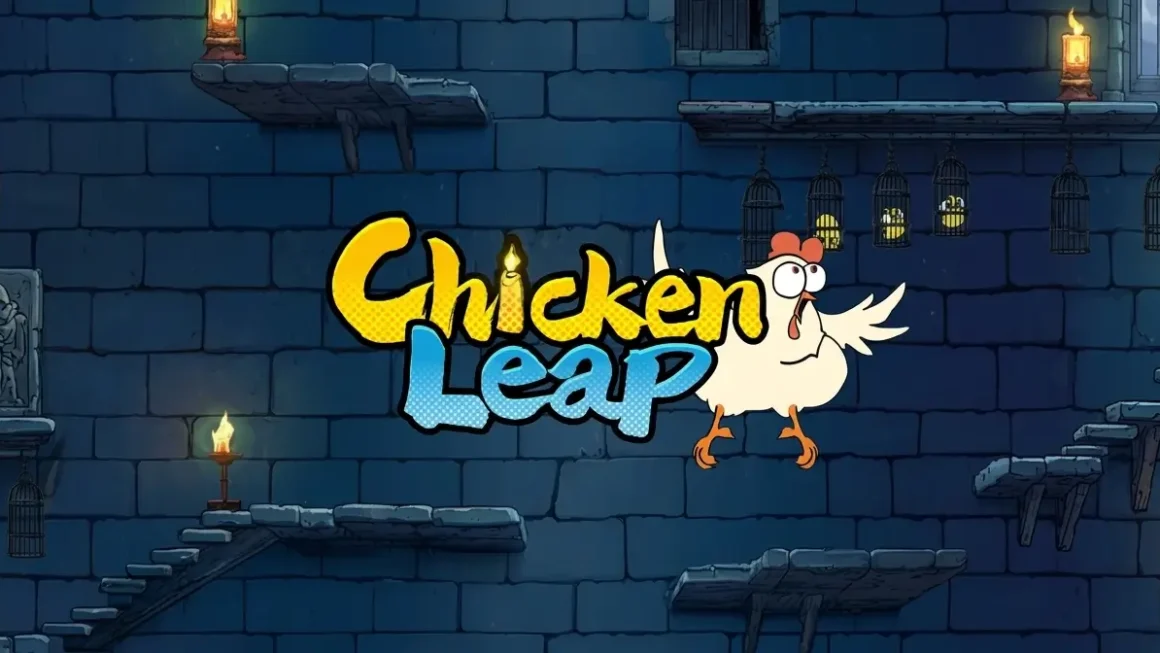
KA Gaming launched Chicken Leap on 10 December 2025, which makes this a genuinely fresh release — under six months old at time of writing. That matters, because the chicken-game genre has been through something of a gold rush. Chicken Road. Chick vs Croc. Landing Chicken. Mission Uncrossable. The mechanic of guiding a fowl across increasing danger while a multiplier climbs has gone from niche novelty to crowded market in the space of eighteen months. Into that crowded market, KA Gaming dropped something slightly different: not a crash-style cash-out game, but an arcade-progression slot where the chicken simply charges forward, round by round, through up to 19 steps, building toward a 50,000x ceiling. The question worth asking — and answering honestly — is whether that ceiling means anything, or whether Chicken Leap is a charming title propped up by a headline number it rarely approaches.
The confirmed RTP is 96%. The volatility is officially unlisted, though the 50,000x max win makes high volatility the only mathematically coherent conclusion. This review works with what’s confirmed and flags what isn’t. That’s the only honest approach with a game this new.
Math model and mechanics
RTP: 96% — solid, but the genre benchmarks higher
At 96%, Chicken Leap sits comfortably inside the acceptable range for arcade-style slots. The genre average is meaningfully higher: Chicken Road (InOut Games) runs 98%, Landing Chicken (Funky Games) runs 98%, and Chick vs Croc (Dragon Gaming) tops out at 97% on its most generous operator setting. In other words, Chicken Leap gives the house an extra 2 percentage points compared to the best-RTP competition in its category. Over a £100 session at £1 stakes, that’s the difference between an expected return of £96 and an expected return of £98. Doesn’t sound like much until you’re running extended sessions and that edge compounds.
This is worth flagging directly: if RTP matters to you — and it should — Chicken Leap is not the most player-favourable title in the chicken-game space. It’s fine. It’s not the leader.
I have not found evidence of operator-configurable RTP variants for Chicken Leap. If your casino is running a stripped-down version, the 96% figure I’ve cited is the baseline from the game’s published spec; actual in-session RTP will depend on operator configuration at the platform where you’re playing.
Volatility: high, almost certainly
KA Gaming has not published a volatility classification for Chicken Leap. That’s frustrating, but the 50,000x max win is diagnostic. Games with that kind of ceiling do not run at medium volatility — the math simply doesn’t work. Medium-volatility games with ceilings in the 5,000x–10,000x range can sustain decent hit frequencies because the distance between floor and ceiling is manageable. At 50,000x, the distribution has to stretch far further. You’re looking at a game that pays frequently at small amounts or pays rarely at large amounts, with the latter concentration being how the 50,000x stays theoretically reachable.
The practical implication: session variance will be aggressive. A £20 deposit will not give you a comfortable afternoon of gradual climbing. You’ll exhaust it faster than you’d expect, or you’ll catch a run and walk away up. The in-between sustained grind that medium-volatility games offer is not what Chicken Leap is built for.
Mechanic: arcade progression, not crash
This is the most important mechanical distinction to understand before loading the game. Chicken Leap is not a crash game. In crash games — Chicken Road, Landing Chicken, Mission Uncrossable — you place a bet, a multiplier climbs, and you choose when to cash out before the round ends. The skill element, such as it is, is the timing of that cash-out decision.
Chicken Leap works differently. The chicken advances through a fixed progression of up to 19 steps. Each step corresponds to a multiplier tier, and the game’s payout model is built around completing those steps or falling at some point along the path. You’re not watching a multiplier climb in real time and deciding when to pull out. The structure is more discrete — more like a slot with a clearly mapped path than a crash game with a continuous curve.
This distinction matters for two types of players. If you’re drawn to the strategic tension of timing a cash-out, Chicken Leap won’t scratch that itch in the same way. If you find that tension exhausting — the pure lottery question of “do I bail now or push one more step?” — Chicken Leap’s more structured progression may actually suit you better. It feels less like white-knuckle improvisation and more like watching a story unfold.
Max win: 50,000x — genuinely impressive for the category
The 50,000x ceiling is real. Let’s put it in pound terms: at a £1 stake, the maximum theoretical win is £50,000. At a £0.10 stake, it’s £5,000. That’s on the stronger end of the chicken-game category — Chick vs Croc caps at 3,134x, Landing Chicken’s ceiling isn’t in the same tier, and Chicken Road (InOut) tops out around a €20,000 absolute amount depending on stake. Chicken Leap’s per-stake ceiling beats the market.
The caveat is the one that applies to every high-ceiling game: 50,000x is theoretically accessible, statistically rare, and functionally irrelevant to how most sessions play out. What matters more for day-to-day play is where the mid-tier pays cluster — and KA Gaming hasn’t published that distribution data publicly. What I can say is that if you’re playing for the 50,000x, you’ll need patience, session discipline, and a bankroll that can weather the variance without imploding.
Feature breakdown
The core progression mechanic
The 19-step path is the primary feature and the entire game. The chicken advances through up to 19 stages, with each successful stage increasing the multiplier available. The exact multiplier values per step are not published in the public spec — KA Gaming keeps its paytable data close — but the progression architecture is confirmed: 19 possible steps, sequential advancement, with the win ceiling of 50,000x reachable at or near the final stage.
The trigger condition is simple: each round begins with a bet, and the chicken starts moving. There is no separate bonus round trigger, no scatter-activated free spins, no buy-feature. The game is the feature.
The honest limitation here is transparency. Without confirmed step-by-step multiplier values, I can’t tell you what a mid-path exit looks like in pound terms, or at which step the risk/reward ratio becomes interesting for conservative play. That’s information KA Gaming has chosen not to make easily available, which is mildly annoying from a player-decision perspective.
What I can reason through is the general shape of the distribution. If 50,000x sits at step 19, and the mechanic is a progressive multiplier path, then the mid-path values — around steps 9 through 13 — are likely in the range that most sessions will touch on successful runs. Think of it this way: a game with a 50,000x ceiling and roughly logarithmic step growth would have mid-path values somewhere in the 100x–500x range, depending on the curve’s steepness. Whether KA Gaming uses a linear, exponential, or custom multiplier curve per step is not publicly documented. That opacity is a design choice, but it makes advanced planning impossible. You go in, you see what steps pay what, and you play accordingly. Some players will find that liberating. Others will find it frustrating.
The SlotCatalog listing notes “up to 19 chances to boost the multiplier” — which confirms the 19-step cap but gives no per-step breakdowns. Until KA Gaming or a player-run database documents the paytable granularly, mid-path values remain an unknown. I’d rather flag that clearly than construct a false precision from incomplete data.
Hand-drawn visual presentation
The artwork is worth discussing because it’s a genuine differentiator. Most chicken-game competitors use a clean, functional, slightly generic cartoon style. KA Gaming went with hand-drawn visuals for Chicken Leap — softer outlines, a warmer palette, a chicken character that has genuine personality rather than being a clip-art placeholder.
This matters mechanically only in the sense that it affects session length. I’ve spent more time with games that look good because they don’t fatigue my eyes the same way polished-but-sterile 3D renders do. The hand-drawn approach makes Chicken Leap considerably more comfortable to run for extended periods than some of its technically glossier competitors.
It does not affect outcomes. The RNG is the RNG. But comfort during play is underrated.
No buy-bonus feature
Chicken Leap does not offer a bonus-buy mechanic. This is 2026, and in 2026, the absence of a buy-bonus is worth flagging for every game that lacks one. It’s not a dealbreaker — it’s a category note. Players who like controlling when they access high-variance rounds (and who are willing to pay 50x–100x their stake for the privilege) have no option here. Every round is a base-game round. The path to 50,000x is the base game itself.
Whether that’s a problem depends entirely on what you want from the session. For recreational players, the absence of a buy-feature means a more democratic game: you can’t fast-track to maximum volatility. For advantage-adjacent players who use bonus buys to target features with known math, there’s nothing to buy.
No progressive jackpot
Confirmed: Chicken Leap has no progressive jackpot component. The 50,000x is the ceiling, and it’s fixed. This is standard for the category — most chicken games don’t run progressives — but it closes off one angle of play for jackpot chasers.
The 2026 perspective: where does Chicken Leap sit in the market?
Against the cash-out chicken games
The natural comparators are the games that own this category in 2026. Chicken Road by InOut Games set the template: a chicken crossing a road through increasing stages, player cash-out decision, 98% RTP, proven popularity. That game has been running since 2024 and has a player base that Chicken Leap is now competing against. Chicken Road’s RTP advantage is real — 98% vs 96% is two points of house edge that matters across extended play.
Landing Chicken by Funky Games (released November 2025, one month before Chicken Leap) takes the progression concept airborne — a flying chicken with altitude-based multipliers and real-time stats on each flight. Its 98% RTP and medium volatility make it one of the more accessible entries in the space. The comparison to Chicken Leap is direct: Landing Chicken is built for players who want lower variance and maximum RTP efficiency; Chicken Leap is for players who want the ceiling.
Chick vs Croc by Dragon Gaming (3,134x max, 92–97% RTP depending on operator setting, four difficulty modes) represents the direct-tension end of the spectrum. Its cash-out pressure model is entirely different from Chicken Leap’s structured progression, but both target the same demographic of players who’ve moved past standard video slots.
The KA Gaming context
KA Gaming has been in this market since 2016. The studio’s strengths are volume and variety — over 750 titles, licensed across 27+ jurisdictions, genuinely strong penetration in Asian markets and growing European and Latin American reach. Their best-known titles tend to be traditional video slots with Asian cultural themes: Luck88, Fortune Ganesha, Dragon-themed series.
The studio holds licenses from the Malta Gaming Authority, UK Gambling Commission, and Curaçao eGaming, and is certified by Gaming Labs International for RNG integrity. That’s a stronger regulatory footprint than many providers of comparable size. It means Chicken Leap isn’t a grey-market product dropped into lobbies through obscure aggregators — it’s a properly audited title from a studio with documented compliance.
Chicken Leap is something of a departure from KA Gaming’s usual output. The studio’s reputation is built on volume: they release 10 to 18 new games per month, covering traditional Asian slots, fish-shooting games, table games, and arcade titles. Most of that output leans toward familiar, culturally-specific templates. Chicken Leap is their attempt at the arcade-progression format that has been eating player time across competitor catalogues. The result is technically competent, visually stronger than you’d expect, and mathematically reasonable. What it doesn’t do is win on RTP or hit frequency against the best competition in its specific niche. What it might win on is presentation and the 50,000x ceiling.
There’s a broader point worth making about KA Gaming’s arcade pivot. The studio started as a land-based slot developer in Asia and converted much of its catalogue for online play. That lineage shows in how their games are structured — discrete, contained, with clear visual feedback rather than the feature-layering that Western developers favour. Chicken Leap fits that design sensibility. It’s a clean game with a clear proposition: follow the chicken, collect the multiplier when you’re done. No three-layer bonus trigger. No clustered wilds cascading into a respin into a hold-and-spin. Just the path.
For operators, KA Gaming’s distribution network is an advantage. Their games are available through SoftGamings, Hub88, and QTech Games aggregators, which means Chicken Leap will turn up in a lot of lobbies. Availability isn’t quality, but it’s reach. A game that’s accessible on 200 platforms has a different commercial reality than one locked to 10 exclusive operators.
Is buy-bonus absence a 2026 problem?
Yes and no. The cash-out chicken-game format is inherently round-by-round — every round is essentially its own “feature” because the multiplier climbs differently each time. In that sense, the buy-bonus mechanic doesn’t translate cleanly to this format the way it does to traditional free-spins slots. What would a bonus buy even mean here — you pay to skip to step 10? That would change the game’s mathematical architecture entirely.
So the absence of a buy-bonus in Chicken Leap isn’t a sign of laziness; it’s a reflection of the format. Chicken-style progression games with cash-out mechanics don’t typically offer buy-features. The game is the feature.
Who is Chicken Leap actually for?
The player who gets the most from Chicken Leap is someone who has played and enjoyed the chicken-road genre but finds the real-time cash-out tension of games like Chicken Road or Chick vs Croc more stressful than enjoyable. The discrete-step structure of Chicken Leap — where each round plays through its progression rather than asking you to bail at the right millisecond — is genuinely less taxing. It’s the same thematic territory, made more playable for people who want to enjoy the chicken story without the white-knuckle timing element.
There’s also a player profile that Chicken Leap serves well in terms of markets: KA Gaming has deep penetration in Asian markets where arcade-style gameplay with clear visual progression has a long cultural history. Fish-shooting games. Pachinko derivatives. Step-based multiplier mechanics. Chicken Leap fits naturally into that aesthetic tradition — hand-drawn, progression-forward, legible at a glance. For players coming to it from a Western casino lobbies context, it will feel slightly different from what they’re used to; that difference is a feature for some and a friction for others.
The player who won’t get much from it is someone chasing maximum RTP efficiency. You’re giving up two percentage points to the house compared to Chicken Road. Over 1,000 rounds at £1 per round, that’s roughly £20 of expected value lost relative to the 98% alternatives. It doesn’t feel like much per round; it adds up. If the math is your primary criterion, Chicken Leap is not your best option in this category.
High rollers running meaningful stakes should also note that the published bet range data isn’t prominent in the confirmed spec. If your game plan involves £50+ stakes per round, verify the maximum bet limit at your specific operator before committing. With KA Gaming titles, bet ceilings vary by market and platform configuration.
Verdict
Chicken Leap by KA Gaming: play or skip?
Chicken Leap is a more interesting game than its quiet December 2025 launch suggested. The hand-drawn visuals are a genuine differentiator in a category dominated by competent-but-forgettable graphics. The 50,000x ceiling is one of the highest in the chicken-game space. The structured 19-step progression makes it more accessible than crash-style alternatives for players who don’t want timing pressure running every round.
The number that limits this game is 96% RTP. In a category where 98% is achievable — and where the two market leaders (Chicken Road and Landing Chicken) both hit that mark — choosing Chicken Leap means accepting a 2% house-edge penalty. At casual stakes, that penalty is tolerable. At serious volume, it accumulates.
For recreational players: Chicken Leap is worth your time. Load it, run a few rounds, enjoy the artwork, and appreciate the fact that you’re not timing a cash-out button while traffic rushes past. The 50,000x gives you a number worth chasing. Stake accordingly — this is high-volatility territory, so treat your session budget as fully expendable rather than expecting a steady return curve. If you’re comfortable with that, the game delivers what it promises.
For volume players and RTP-focused grinders: This is not your game. The 96% RTP is the deciding factor. Chicken Road at 98% is the same category, proven market traction, and two percentage points of house edge you don’t have to give away. That’s the honest conclusion.
For players new to the chicken-game format: Chicken Leap is actually a solid entry point precisely because it removes the cash-out anxiety that can make crash-style games feel overwhelming in the early sessions. You’ll learn the progression format — what step counts feel like, how quickly rounds resolve, what variance in this mechanic actually means — without also managing a real-time decision clock. Play Chicken Leap first, then graduate to cash-out formats once the genre’s rhythm makes sense.
My recommendation: Chicken Leap is worth playing at stakes you’d spend on any recreational slot. It is not the game to grind for RTP optimisation. If you’re running volume and measuring session math, load Chicken Road or Landing Chicken instead. If you want something that looks different, plays differently from standard crash games, and gives you a genuine shot at five-figure returns from a small stake, Chicken Leap has earned its place in that conversation.
The 96% RTP is the reason not to make it your primary game. The 50,000x ceiling and hand-drawn style are the reasons to keep it open in a second tab.
A note on high-volatility play and responsible gambling
High-volatility games with large ceilings carry a specific risk pattern that’s worth naming directly. The 50,000x ceiling is real. The path to it is rare. Sessions will frequently end without a meaningful return — that’s what high volatility means in practice. If you load Chicken Leap expecting the variance to average out within a single session, you’re misreading how the math works.
Set a session budget before you start. Treat it as a ticket price, not a deposit you expect to recoup. The game’s round speed means bankrolls deplete faster than they do in slower-paced video slots, and the escalating multiplier path creates a pull to keep going that is structurally the same as in any crash-format game.
If gambling is causing problems — financial, personal, or otherwise — GamCare (gamcare.org.uk) and BeGambleAware (begambleaware.org) both offer free support. Neither Chicken Leap nor any casino game is a financial strategy.
What is Chicken Leap’s RTP? The confirmed RTP is 96%. This sits below the genre’s best competitors — both Chicken Road (InOut) and Landing Chicken (Funky Games) run at 98%. If you play both, you’ll feel the RTP difference across longer sessions even if individual rounds are indistinguishable.
Is Chicken Leap high volatility? KA Gaming hasn’t published an official volatility rating. Given the 50,000x max win, high volatility is the only reasonable inference — the math requires it. Treat it as high-volatility and bankroll accordingly: short-session swings will be meaningful, and dry runs are part of the territory.
How does Chicken Leap differ from crash games like Chicken Road? The core difference is the cash-out decision. In Chicken Road and similar crash games, you watch a multiplier climb in real time and choose when to exit before the round ends. In Chicken Leap, the progression through 19 steps is more structured — you’re not making a split-second timing call on a continuous curve. The thematic territory is identical; the mechanical experience is notably different.
Can I buy the bonus in Chicken Leap? No. There is no buy-bonus feature. Every round starts from the base game. The 19-step progression is the entire game experience.
What is the maximum win in Chicken Leap? 50,000x your stake. At £1 per round, that’s a £50,000 maximum. That ceiling is among the highest in the chicken-game category and meaningfully above competitors like Chick vs Croc (3,134x) and Chicken Road (absolute cap around €20,000 depending on bet). The 50,000x is theoretical — approaching it requires the full 19-step run to land perfectly.
Where can I play Chicken Leap? KA Gaming distributes through major aggregators including SoftGamings, Hub88, and QTech Games, which means availability is broad. The game appeared in operator lobbies from December 2025. Check your casino’s KA Gaming section — if they carry the provider’s portfolio, Chicken Leap should be findable.
Is there a demo version of Chicken Leap? Demo versions of KA Gaming titles are available through SlotCatalog and the Casino Guru platform. Playing a few rounds in demo mode before committing real stakes is always worth the time with a high-volatility game — the session rhythm will tell you whether the pacing suits your style.